
Up to 75% of B2B product launches fail to meet revenue targets, not because the product is bad, but because the product launch strategy treats marketing as an afterthought — a three-month burst of activity and a single hero video that nobody watches past the first week.
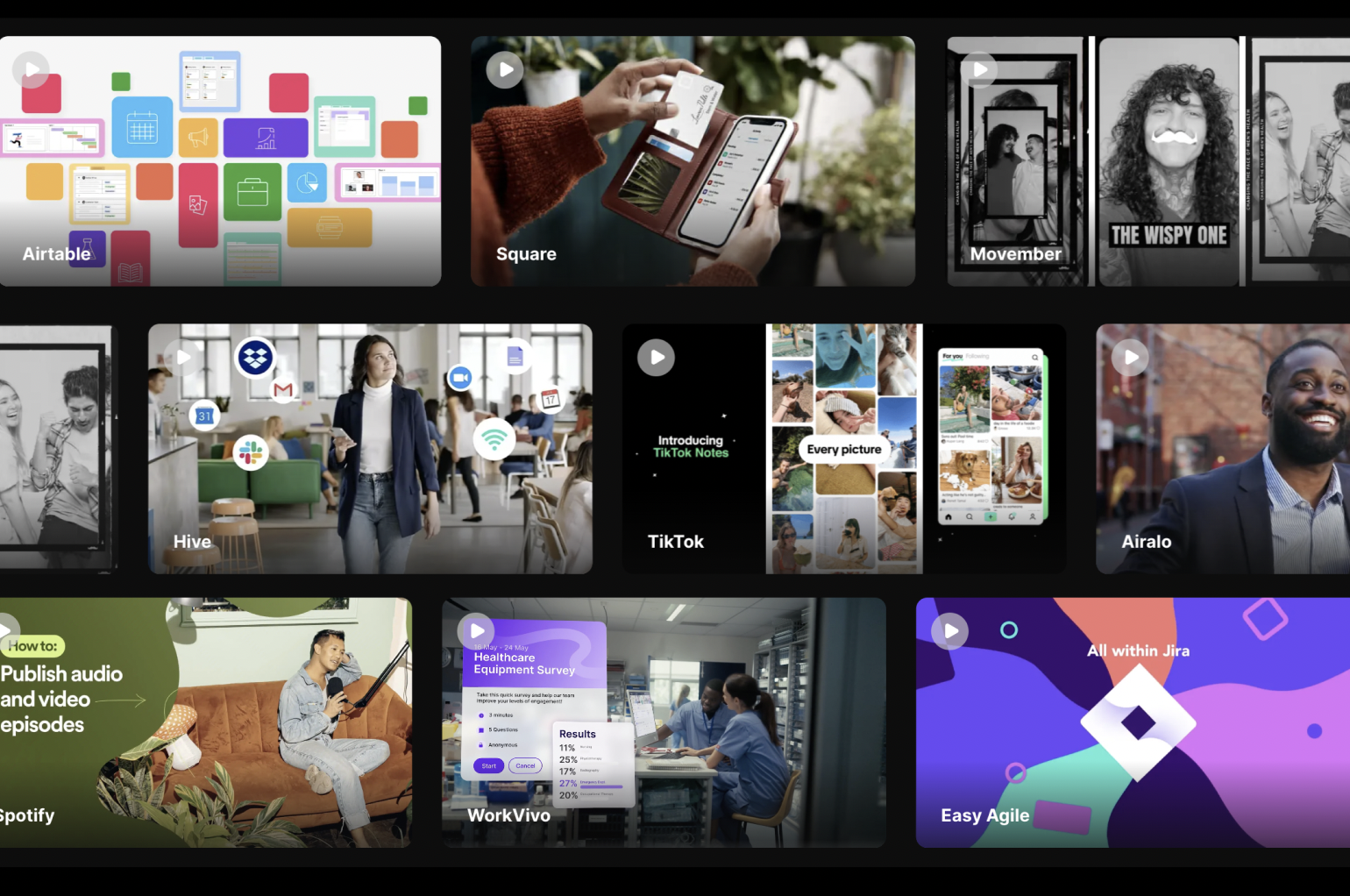
We’ve supported 200+ product launches per year for brands like TikTok, Square, and Spotify. The teams that launch a new product successfully don’t just pick a date. They build a product launch checklist that covers every launch phase — from pre-launch creative to post-launch sales enablement — and they create assets designed to compound, not expire.
Here’s the marketing plan we’d build if we were to handle your next B2B product launch.
Key Takeaways
- Most product launches fail because creative production starts too late. Begin your launch strategy 6–9 months before the official date — not when the product is “ready.”
- The post-launch phase needs 3–5x more assets than the launch itself. Your product launch checklist should cover ongoing sales enablement, ad variations, and localized content for customers across markets — not just a single video.
- Build systems, not one-offs. One product launch campaign can generate 40+ asset variations when you create reusable templates from the start.
- Your sales team is the most overlooked audience. Internal enablement often matters more than external buzz for a successful product launch.
Content
The Three Phases of a Successful Product Launch
Every successful launch follows three phases. Each phase has different goals, different audience needs, and different creative requirements. The biggest mistake marketing teams make is planning only for the middle one.
Phase 1: Pre-Launch (6–9 Months Before)
This is the foundational work most teams skip entirely. Your pre-launch strategy should cover:
Market research and persona development. Confirm your target audience, refine your value proposition, and validate your messaging before you create a single asset. Only 52% of B2B organizations have a clearly defined value proposition. Don’t be the other 48%.
Internal alignment and goal setting. Get your sales, product, and marketing teams on the same page. Define your key performance indicators now — not after launch. What does product launch success look like? Pipeline generated? Sales velocity? Adoption rate among target customers?
Creative strategy and strategic planning. This is where most teams fall behind. Your creative brief, brand guidelines, and production timeline should be locked 6 months before your launch date. The teams we work with at Vidico start building motion templates and design systems during this phase, so every asset they create later can be produced faster and cheaper.
Early content marketing. Thought leadership, industry trend pieces, and teaser campaigns that build audience awareness for your target market. You’re not selling the new product yet — you’re establishing the problem it solves, so your audience is primed when you officially launch.
Sales team enablement. This is the hidden priority. Research found that the biggest bottleneck in a B2B launch isn’t the customer — it’s the internal sales team. If reps don’t feel confident pitching a new product, they’ll sell the old one instead. Create internal training videos, demo walkthroughs, and talk track guides months before the external launch.
Want to see how your creative stacks up against competitors? Download the State of Creative in Tech Report — benchmarks from 200+ SaaS marketers on production volume, spend, and strategy.
Phase 2: Launch (The 4–8 Weeks Around Your Date)
Your official launch is the shortest phase but the most visible. Everything you’ve built in the pre-launch strategy now goes live.
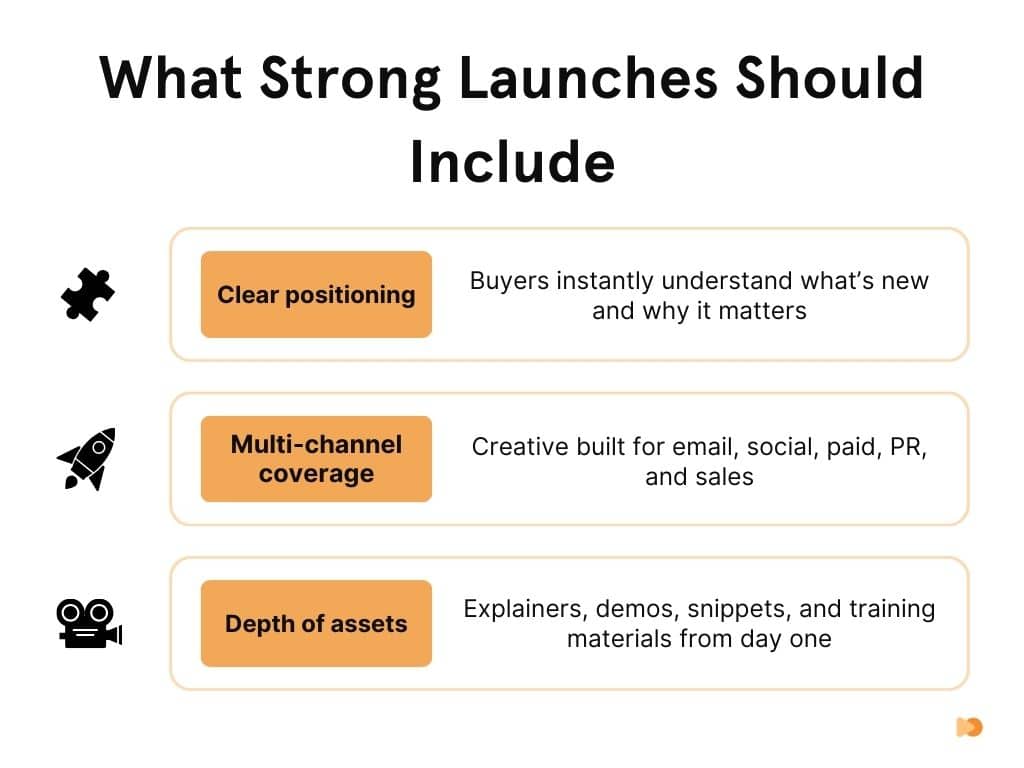
Product introduction assets. Your core launch creative should include an explainer video, a product demo or walkthrough, a product launch campaign landing page, and ad variations for paid channels. For B2B SaaS product launches, a 60–90 second explainer paired with a deeper 3-minute demo covers both awareness and consideration. Find out the SaaS go-to-market strategy guide.
Media relations and press coverage. Your media relations strategy should target industry publications, analyst briefings, and relevant podcasts. Press releases still work for generating buzz in B2B — but only when paired with visual assets that journalists can embed and share. Plan your press releases to land the week of launch day for maximum coverage.
“For B2B audiences, especially those making high-stakes purchase decisions, a great explainer video starts with talented writing. The message must be carefully crafted to resonate with their challenges, then conveyed on screen in a way that builds confidence”
Multi-channel marketing tactics. B2B buyers now engage with 10 or more channels throughout their purchase journey. Your new product launch assets need to work across LinkedIn, email, your website, paid search, and sales outreach simultaneously. This is where most teams underestimate the volume — a single launch typically requires 15–25 unique assets just for this phase.
Event activations. 78% of B2B marketers are allocating budget to experiential marketing. If your launch date aligns with a trade show or industry event, build product features demos and booth content into your creative plan. These are valuable assets your audience can interact with firsthand.
Planning your next launch? Get a free Creative Intelligence Report — we’ll analyze your competitive landscape across 12 areas and identify gaps in your creative strategy.
Phase 3: Post Launch (6–12 Months After)
This is where product launches fail or succeed. And it’s the launch phase almost nobody plans for.
Your post-launch marketing plan should include:
Ongoing sales enablement updates. As your sales team encounters real customer objections, your demo videos and sales decks need to evolve. The product’s story changes as customers use it — your creative should keep pace with their customer needs.
Ad creative testing and iteration. Your first ad variations won’t be your best. Create a strategy for A/B testing across audience segments, messaging angles, and formats. The teams that boost sales over time are the ones running 10–20 ad variations per quarter, not recycling the same assets from the launch.
Customer testimonials and case studies. Nothing builds credibility for new audiences like proof from existing customers. Case study videos filmed 3–6 months post-launch capture real results and answer the questions your audience actually has about the new product. One strong case study can fuel an entire marketing campaign quarter.
Localization and multi-market expansion. If your B2B product serves a global customer base, you’ll need localized versions of core assets. We’ve produced launch content across 200+ regions and 17 languages for brands like Square — using templatized systems that make localization a scaling exercise, not a restart.
Content marketing for sustained demand. Blog posts, webinar content, and short-form social video keep the new product visible long after the initial launch. Short-form video is now the highest-ROI format in B2B marketing — and it’s where your audience is spending the most time.
See how we’ve helped brands scale product launch creative. Explore Vidico’s portfolio for examples across explainers, demos, and product videos.
The Product Launch Checklist: Every Asset You Need

Here’s the product launch checklist we use across our B2B product launch projects. Most teams plan for 5–10 assets. A successful launch strategy typically requires 30–50+.
| Launch Phase | Asset Type | Purpose |
|---|---|---|
| Pre-launch | Internal training video | Sales team enablement |
| Pre-launch | Messaging framework + brand guidelines | Team alignment |
| Pre-launch | Teaser video / coming soon campaign | Generating buzz with the target audience |
| Pre-launch | Thought leadership content | Audience priming via content marketing |
| Launch | Hero explainer video (60–90 sec) | Product introduction for new audiences |
| Launch | Product demo/walkthrough (2–3 min) | Consideration-stage conversion |
| Launch | Landing page with video + signup process | Campaign hub for customers |
| Launch | Press release + media kit | Media relations |
| Launch | Paid ad variations (5–10 formats) | Multi-channel marketing tactics |
| Launch | Email campaign creative | Direct outreach to the audience |
| Launch | Social content (5–8 posts) | Organic reach |
| Post-launch | Customer case study video | Social proof for sales |
| Post-launch | Updated demo with real usage data | Ongoing enablement |
| Post-launch | Localized asset versions | Multi-market expansion |
| Post-launch | Short-form social cuts (monthly) | Sustained demand gen |
| Post-launch | A/B test ad variations (quarterly) | Performance optimization to boost sales |
For SaaS businesses offering a freemium version, add onboarding videos and in-app walkthrough content to your product launch checklist.
For enterprise products, add a minimum viable product demo that sales can use before the full launch — it gives the team valuable insights into which features resonate with customers.
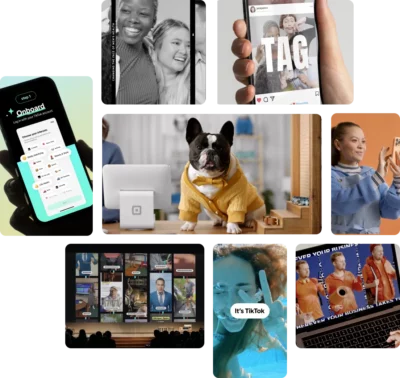
This is where a systems-based approach changes the math. When we work with brands like TikTok, we create reusable motion templates and design systems during pre-launch. One hero campaign then generates 40+ variations — social cuts, ad formats, localized versions, sales decks — without starting from scratch each time. That’s how TikTok achieved a 400% increase in output. And how Square produces 200+ assets per month with a 43% conversion lift.
How to Build a Go-to-Market Strategy That Doesn’t Run Out of Steam
Start creative production 6–12 months before your launch date. Research shows that best-in-class B2B marketers begin planning 6 to 12 months in advance for major launches. If your marketing team is building the product launch campaign and the assets at the same time, your business is already behind.
Budget for post-launch, not just the launch itself. Based on our experience across 200+ product launches per year, allocate at least 60% of your total creative budget to the post-launch phase. That’s where real customer acquisition happens for a B2B product. The business value compounds over months, not on day one.
Use a subscription-based creative partner, not project-based. Traditional agencies charge per project. That works fine when you need one video. It breaks down when you need 40+ assets across a 12-month launch strategy. Subscription models — where you have ongoing access to a creative team for a monthly investment — align your creative capacity with the actual cadence of a new product launch. We offer flexible creative plans starting at $5,000/month that scale with your needs.
Measure leading indicators, not just revenue. Your key performance indicators in the first 90 days should track whether sales reps are actively pitching the product, whether your target audience is engaging with demo content, and whether a qualified pipeline is building — even if deals haven’t closed yet. That clear understanding of early signals prevents premature abandonment of products that simply need more time to gain traction among customers.
Common B2B Product Launch Pitfalls (and How to Avoid Them)
Even with a solid strategy, certain mistakes consistently derail B2B product introductions. Here are the ones we see most often.
Pitfall 1: Starting creative production too late. Your product development and your creative strategy should run in parallel — not sequentially. When the marketing plan doesn’t begin until the product is “ready,” there’s never enough time to produce the volume of assets a successful launch requires.
Pitfall 2: Treating it as a single event. The “Rocket Launch” mindset burns through budget in 90 days and leaves nothing for the 9 months of post-launch work that drives adoption. B2B customers don’t buy on impulse. Your launch strategy needs to account for the full decision-making cycle.
Pitfall 3: Ignoring your internal audience. If reps can’t confidently pitch the new product, they won’t. Invest in internal enablement — training videos, demo guides, objection-handling content — before you spend a dollar on external marketing.
Pitfall 4: Producing single-use creative. Every asset your business produces should be designed for reuse and adaptation. One hero video should generate dozens of variations — social cuts, ad formats, localized versions. Agencies that start from scratch every time cost you more with every new product introduction.
Pitfall 5: No measurement strategy beyond revenue. Revenue is a lagging indicator for B2B products. Track leading signals: Are customers engaging with demos? Is your audience clicking through ad variations? Are reps using the new collateral? These tell you whether the approach is working long before closed deals show up.
Get yourfree video marketing plan tailored to your funnel and business goals.
Also read: Best B2B Video Production Company
FAQs
What is a product launch strategy?
It’s the plan for bringing a new product to market — positioning, messaging, creative assets, channels, and a timeline for reaching your target audience. In B2B, an effective approach spans pre-launch, launch, and post-launch and requires cross-functional alignment between marketing, product, and revenue. The best strategies treat this as a 12-month effort, not a single event.
How long does a B2B product launch take?
Most successful efforts require 6–12 months of strategic planning and creative production before the official date, plus 6–12 months of sustained post-launch activity. The visible “window” is typically 4–8 weeks, but the foundational work and follow-through on either side determine whether the product gains traction with customers.
What’s the difference between a go-to-market strategy and a product launch?
A go-to-market strategy is the broader business framework — pricing, positioning, distribution channels, and target market definition. A product launch is the execution layer: specific creative assets, channels, timeline, and marketing tactics you use to introduce the product to your audience. Think of go-to-market as the “what and why.” The product launch checklist is the “how and when.”
Final Thoughts
A successful B2B product launch isn’t about making the biggest splash on day one. It’s about building creative infrastructure that keeps the new product visible, credible, and converting for 12 months and beyond.
If you’re planning your next launch and want a creative production partner built for sustained B2B campaigns — not one-off projects — book a free strategy session and we’ll map out the creative plan together.
References:
- https://www.gartner.com/en/newsroom/press-releases/2019-09-09-gartner-survey-finds-that-45-percent-of-product-launches-are-delayed-by-at-least-one-month
- https://www.hubspot.com/marketing-statistics
- https://contentmarketinginstitute.com/b2b-research/
- https://www.mckinsey.com/capabilities/growth-marketing-and-sales/our-insights/the-new-b2b-growth-equation