Video ads are short promotional videos distributed across platforms like YouTube, Meta, LinkedIn, and connected TV to build awareness, drive engagement, and generate conversions. Global digital video ad spending is projected to reach $236 billion in 2026, making video the fastest-growing format in digital advertising.
Whether you need a 6-second bumper ad for YouTube or a 60-second brand story for connected TV, the format you choose, the platform you run it on, and the creative decisions you make in the first three seconds determine whether a campaign delivers ROI or wastes budget.
At Vidico, we are a B2B explainer video company with 2,000+ campaigns and 1.5 billion views behind us. Below, we break down the main types of video ads, compare platforms and costs, analyze 10 high-performing examples, and cover the best practices that separate effective video ads from forgettable ones.
Content
Key Takeaways
- Video ad spending will reach $236 billion globally in 2026, with short-form video ads accounting for roughly $111 billion of that total [1].
- The first 3 to 6 seconds determine performance. Ads that hook viewers immediately see 2 to 3x higher completion rates than those with slow openings [2].
- YouTube CPV averages $0.048 per view, while Meta video ads run $0.01 to $0.05 per view, making both accessible for most budgets [3][4].
- AI tools like InVideo and Adobe Express can produce basic video ads, but ads built on strategy and original creative consistently outperform template-based content [5].
- Connected TV is the fastest-growing segment, projected to reach $120 billion by 2030 at a 16.5% annual growth rate [1].
What Are Video Ads?
Video ads are paid promotional content in video format, placed across digital platforms, streaming services, and social media feeds to reach a target audience. They range from 6-second bumper ads to long-form brand stories and can appear before, during, or alongside other content.
Unlike static display ads, video ads combine visual storytelling, motion, and audio to communicate a message in a format that holds attention longer. A 2026 industry report projects the digital video advertising market at $214.76 billion in 2025, growing at 9.54% annually through 2030 [1].
Video ads work across the entire marketing funnel. Top-of-funnel brand awareness campaigns use broad targeting and storytelling. Mid-funnel consideration ads highlight product features and social proof. Bottom-of-funnel retargeting ads drive specific actions like signups, purchases, or demo requests.
Types of Video Ads
Video ads fall into several distinct categories based on how and where they appear. Understanding the differences helps you choose the right format for your campaign goals.
- In-stream ads (pre-roll, mid-roll, post-roll): Play before, during, or after video content. The most common format on YouTube and streaming platforms. Can be skippable (after 5 seconds) or non-skippable [6].
- Bumper ads: Non-skippable ads lasting 6 seconds or less. Designed for quick brand recall. YouTube reports bumper ads deliver a 70% average lift in brand awareness [6].
- In-feed video ads: Appear in content feeds on platforms like YouTube, Facebook, Instagram, and TikTok. Users choose to watch, making engagement more intentional [7].
- Outstream ads: Video ads that play outside of video content, typically embedded within articles or app feeds. They auto-play on mute and expand when in view [8].
- Non-linear (overlay) ads: Run concurrently with video content, usually as a banner or text overlay at the bottom of the video player [8].
- Connected TV (CTV) ads: Full-screen video ads delivered through streaming devices like Roku, Fire TV, and Apple TV. Similar to traditional TV commercials but with digital targeting and measurement [9].
- Interactive and shoppable ads: Video ads with clickable elements that let viewers browse products, answer polls, or complete purchases without leaving the ad experience.
- Social media native ads: Platform-specific formats like Instagram Reels ads, TikTok In-Feed ads, and LinkedIn Sponsored Video that match the organic content style of each platform [7].
For a deeper breakdown of each format, see our guide to types of video advertising.
Video Ad Platforms
Each platform offers different formats, audience demographics, and pricing models. Choosing the right platform depends on where your audience spends time and what action you want them to take.
- YouTube: The largest video ad platform with over 2.5 billion monthly users. Offers skippable in-stream, non-skippable, bumper, in-feed, and Shorts ads. Google AI optimizes placement across YouTube and Google video partners. Average CPV: $0.048 [3][6].
- Meta (Facebook and Instagram): Offers in-stream, Feed, Stories, and Reels video ads. Formats include slideshows, carousels, and interactive playable ads. CPV ranges from $0.01 to $0.05, with CPM averaging $6 to $10 [4][7].
- LinkedIn: Best for B2B targeting with professional audience data. Sponsored Video ads appear in the LinkedIn feed. Higher CPM ($30 to $60) but 2 to 5x higher conversion rates for B2B products compared to other platforms [10]. See our LinkedIn video ad examples for what works.
- TikTok: Short-form video-first platform with In-Feed, TopView, and Branded Effects ad formats. Strong for reaching younger demographics and driving viral engagement.
- Amazon: Streaming TV and online video ads reach audiences across Prime Video, Twitch, and publisher sites. Effective for brands selling on Amazon or targeting purchase-intent audiences [9].
- Spotify: Sound-on video ads that play during music and podcast breaks. 100% viewable by design since ads only play when the app is in focus.
- Connected TV (Roku, Fire TV, Samsung TV Plus): Full-screen ads on streaming devices. CTV ad spending is projected to reach $56.08 billion in 2025, growing at 16.5% CAGR through 2030 [1].
How to Create Effective Video Ads
The difference between a video ad that converts and one that gets skipped comes down to structure, not production budget. These principles apply across platforms and formats.
1. Hook viewers in the first 3 seconds
The opening seconds decide whether someone watches or scrolls past. Lead with a bold visual, a surprising statement, or a question that speaks directly to your audience’s problem. Google’s research on effective video ads found that ads with a strong opening hook achieve significantly higher brand recall and view-through rates [2].
2. Follow a clear structure
Effective video ads use a consistent framework: hook, problem, solution, proof, call to action. This structure works for 15-second social ads and 60-second brand stories alike. The hook grabs attention. The problem creates relevance. The solution positions your product. The proof builds credibility. The CTA drives action.
3. Design for sound-off viewing
Over 75% of mobile video is watched with the sound off. Use text overlays, captions, and strong visuals that communicate the message without audio. Every Meta and LinkedIn ad should be fully understandable on mute [7].
4. Keep it short
Most platforms recommend 15 seconds as the optimal length for engagement. YouTube in-stream ads can run up to 3 minutes, but the ideal length depends on the platform and funnel stage. Top-of-funnel awareness ads perform best at 6 to 15 seconds. Consideration ads can run 30 to 60 seconds. Retargeting ads with a direct CTA should be under 30 seconds.
5. Test multiple variations
One creative direction is never enough. Produce 3 to 5 variations testing different hooks, messaging angles, and CTAs. Run them against each other and scale what performs. This is where a reusable production system pays off, since teams that build template libraries can produce variations faster and cheaper over time.
6. Match the platform format
Vertical (9:16) for Stories, Reels, and TikTok. Landscape (16:9) for YouTube and CTV. Square (1:1) for in-feed on Meta and LinkedIn. Repurposing one video across all platforms without reformatting wastes budget and underperforms native content.
For platform-specific tactics, see our Facebook video ad best practices guide.
How Much Do Video Ads Cost?
Video ad costs vary by platform, format, targeting, and competition. Here are the 2026 benchmarks.
Ad Placement Costs (what you pay the platform):
| Platform | Pricing Model | Average Cost |
|---|---|---|
| YouTube | CPV (cost per view) | $0.048 per view |
| Meta (Facebook/Instagram) | CPM or CPV | $6-$10 CPM, $0.01-$0.05 CPV |
| CPM | $30-$60 CPM | |
| TikTok | CPM | $6-$10 CPM |
| Connected TV | CPM | $25-$40 CPM |
| Spotify | CPM | $15-$25 CPM |
Production Costs (what you pay to make the ad):
Production costs depend on complexity, talent, and whether you need live-action, animation, or a mix. Ranges at the time of this writing:
- DIY/AI tools: $0 to $500 for template-based video ads
- Freelance editor: $500 to $5,000 for edited footage with motion graphics
- Professional production: $5,000 to $50,000+ for strategy, scripting, filming, and post-production
For detailed production pricing, see our video production cost breakdown and online advertising cost guide.
The total cost of a video ad campaign depends on both production and media spend. A $5,000 production budget spread across $10,000 in YouTube ad spend can deliver hundreds of thousands of views, but only if the creative is strong enough to hold attention.
10 Best Video Ad Examples (2026)
These examples show what makes video ads work across different goals, formats, and industries. Each one demonstrates a specific creative principle worth studying.
1. Vidico x Toggl Track
Category: SaaS Product Explainer
Toggl Track needed an ad that made time-tracking software feel exciting. We built a humorous narrative around the frustrations of manual time tracking, labeling old methods as “inaccurate,” “inefficient,” and “insanely slow.” The ad positions Toggl Track as the intuitive solution.
Why it works: Humor creates relatability. The ad names the pain before showing the fix. Clear product demo proves the benefit instead of just claiming it. The campaign won a Gold MUSE Award in 2022 [11].
2. Vidico x NinjaOne
Category: B2B Performance Campaign
NinjaOne’s campaign with Vidico generated 66.6 million views, 1.42 million clicks, and 321 million impressions. Facebook ads achieved a 2.4% CTR, and branded search increased 20% year over year [12].
Why it works: The campaign used a reusable template system, producing dozens of ad variations from a core creative concept. Each variation tested different hooks and messaging angles across platforms. See the full NinjaOne case study.
3. Apple AirPods Pro: “Quiet the Noise”
https://www.youtube.com/watch?v=UQwqfS9FnOA
Category: Product Feature Spotlight
Apple focuses on exactly one feature: noise cancellation. The ad uses a visual metaphor of the world going silent to demonstrate the effect. No voiceover. No feature list. Just one benefit, shown clearly.
Why it works: Single-feature focus beats a laundry list. The visual metaphor makes an invisible feature (noise cancellation) tangible. Under 30 seconds, designed for mobile-first viewing.
4. Volvo Trucks: “The Epic Split” feat. Van Damme
Category: B2B Brand Demonstration
Jean-Claude Van Damme performs a split between two moving Volvo trucks. Minimal dialogue. Enya’s “Only Time” plays. The ad demonstrates Volvo’s precision steering system without any technical jargon.
Why it works: The product demonstration IS the spectacle. The ad proves the engineering claim instead of stating it. With over 100 million YouTube views, the ad proves B2B brands can create culturally viral content when the creative is strong enough.
5. Volkswagen: “The Force”
Category: Emotional Brand Story
A child dressed as Darth Vader tries to use “The Force” on everything in the house. Nothing works until Dad secretly starts the Volkswagen Passat with a remote start. No dialogue. Pure visual storytelling.
Why it works: Emotional connection first, product second. The “delayed reveal” approach keeps viewers engaged longer and creates stronger brand association. This ad pioneered the pre-Super Bowl YouTube release strategy and became one of the most-shared automotive ads in history.
6. Old Spice: “The Man Your Man Could Smell Like”
Category: Brand Personality Shift
Isaiah Mustafa delivers a rapid-fire monologue through seamless transitions, from a bathroom to a boat to a horse. The ad redefined Old Spice from a brand your grandfather used to something culturally relevant.
Why it works: A distinctive character communicates new brand positioning instantly. The ad was integrated across social media with personalized video responses, turning a TV commercial into a multi-platform campaign [13].
7. Farmer’s Dog: “Forever” (Super Bowl 2023)
https://www.youtube.com/watch?v=K6pBU74HPpA
Category: Emotional Storytelling
A montage follows a woman and her dog from childhood through adulthood, set to an acoustic soundtrack. No voiceover. No product shots until the final seconds. The ad generated the highest engagement of any 2023 Super Bowl commercial.
Why it works: Story before product. The ad earns 60 seconds of attention by making the viewer feel something. The product reveal at the end feels earned, not forced. The campaign drove a measurable spike in direct-to-consumer sales during the week following the broadcast.
8. Slack: “So Yeah, We Tried Slack”
Category: SaaS Explainer with Humor
A fictional sandwich company explains how Slack transformed their internal communication. Mock documentary style. Real workplace frustrations presented with deadpan humor.
Why it works: The mock documentary format makes a workplace tool entertaining. It shows the product in context rather than demoing features. The fictional company avoids alienating any real industry while being relatable to all of them.
9. Samsung: “Rear Window”
Category: Creative Product Feature
A city spider becomes fascinated by a Samsung Galaxy S22 Ultra camera, drawn to its multiple lenses that mirror the spider’s own eyes. The ad turns a spec sheet into an emotional story.
Why it works: Non-traditional storytelling makes a tech spec (camera quality) feel personal. The ad entertains first and advertises second, earning organic shares and watch-through without a hard sell.
10. Chipotle: “Back to the Start”
Category: Brand Values and Purpose
An animated short follows a farmer from sustainable farming to industrial practices and back again. Willie Nelson covers Coldplay’s “The Scientist.” The ad champions Chipotle’s commitment to sustainably sourced ingredients.
Why it works: Purpose-driven advertising builds brand equity over time. The short film format earned media coverage and social sharing that amplified reach far beyond the paid media budget.
For more examples by category, see our B2B video ad examples, social media ad examples, and brand video examples.
AI Video Ad Tools
AI-powered tools have made basic video ad creation accessible to teams without production budgets. These platforms can generate video ads from text prompts, product images, or existing footage.
- Adobe Express: Free video ad maker with templates for social media formats. Good for quick social cutdowns and simple product ads [5].
- InVideo: AI ad generator that creates video ads from text descriptions. Supports multiple aspect ratios and platform-specific exports [5].
- Canva: Drag-and-drop video editor with ad templates. Best for teams already using Canva for design.
- Runway: AI video generation for creating original footage from text or image prompts. Useful for concepting and storyboarding.
- Synthesia: AI avatar-based video creation. Produces talking-head style ads without filming.
When AI tools work: Quick social ads, A/B test variations, product-image-to-video conversion, internal team content.
When professional production makes more sense: Brand campaigns, high-stakes product launches, content that needs to compete on quality, anything requiring original strategy and storytelling. AI tools generate assets. Professional production builds systems that compound in value, where every project creates reusable templates that make the next one faster.
As a B2B explainer video company, we build template libraries for clients that deliver both the speed of AI tools and the quality of custom production. One campaign becomes 40+ asset variations across platforms. Explore our portfolio to see the difference.
Video Ad Metrics to Track
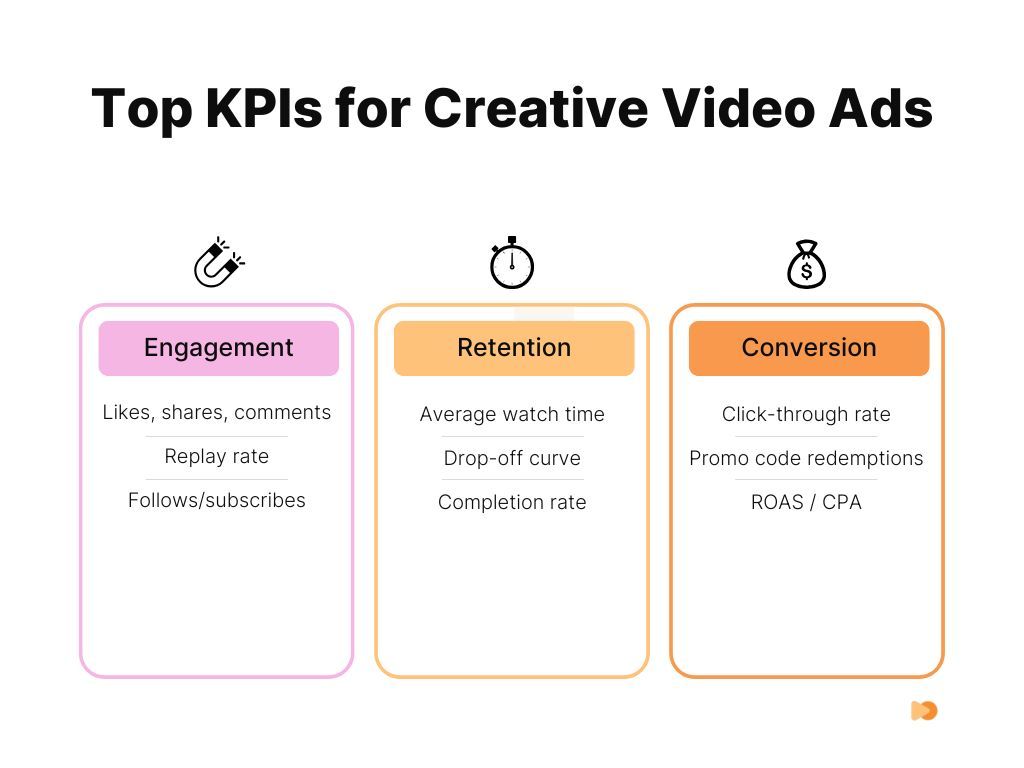
These are the core metrics that determine whether a video ad campaign is working.
- View rate: Percentage of people who watched your ad vs. those who were served it. Benchmark: 15 to 30% for YouTube in-stream ads [3].
- Video completion rate (VCR): Percentage of viewers who watched the entire ad. Higher VCR signals stronger creative. Benchmark: 70%+ for non-skippable, 30 to 40% for skippable [3].
- Click-through rate (CTR): Percentage of viewers who clicked the CTA. Benchmark: 0.5 to 1.5% for YouTube, 1 to 3% for Meta [4].
- Cost per view (CPV): What you pay each time someone watches your ad. Lower CPV with high VCR means efficient spend.
- Cost per action (CPA): Cost to drive a specific conversion (signup, purchase, lead). The metric that ties video ad spend directly to revenue.
- Brand lift: Measured through surveys or branded search volume increases. Shows whether awareness campaigns are moving the needle beyond clicks.
For broader video marketing data, see our video marketing statistics roundup.
Also read: AI in Marketing Statistics
FAQs
What is a video ad?
A video ad is paid promotional content in video format distributed across digital platforms, social media, streaming services, or connected TV. Formats range from 6-second bumper ads to 60-second in-stream commercials. Video ads can be skippable or non-skippable, appear in content feeds or before other videos, and target audiences based on demographics, interests, or behavior [6].
What are the main types of video ads?
The main types are in-stream ads (pre-roll, mid-roll, post-roll), bumper ads (6 seconds, non-skippable), in-feed video ads, outstream ads, connected TV ads, and social media native ads (Reels, Stories, TikTok In-Feed). Each type serves a different campaign objective, from broad awareness to direct response [6][8].
How much does a video ad cost?
Video ad costs have two components: production and media spend. Production ranges from free (AI tools) to $50,000+ (professional campaigns). Media costs vary by platform. YouTube averages $0.048 per view. Meta runs $6 to $10 CPM. LinkedIn costs $30 to $60 CPM. Total campaign costs depend on targeting, competition, and creative quality [3][4][10].
How long should a video ad be?
Optimal length depends on the platform and campaign goal. Bumper ads: 6 seconds. Social feed ads: 15 seconds. YouTube in-stream: 15 to 30 seconds. Brand stories and product demos: 30 to 60 seconds. Most platforms recommend 15 seconds as the sweet spot for balancing message delivery and viewer retention [6].
Are video ads effective?
Video ads consistently outperform static formats for engagement and brand recall. Global video ad spend growing at 9.54% annually through 2030 reflects advertiser confidence in the format [1]. Effectiveness depends on creative quality, targeting, and platform fit. A well-produced 15-second ad on the right platform can deliver higher ROI than a longer ad with weak creative.
The Bottom Line
Video ads drive measurable results when the format, platform, and creative work together. The brands winning in 2026 lead with a strong hook in the first three seconds, match their ad format to the platform’s native behavior, and measure performance against clear benchmarks like view rate, VCR, and CPA.
Vidico is a video production partner for B2B and tech brands running campaigns across YouTube, Meta, LinkedIn, and connected TV. With 2,000+ campaigns delivered, our production system combines creative strategy with performance data to build video ads that convert.
Start with a free VidiFit Quote to scope your next video ad campaign.
Sources
- Statista – Digital Video Advertising Market Worldwide
- Google – ABCDs of Effective Video Ads
- Store Growers – YouTube Ads Benchmarks
- Brafton – Social Advertising Benchmarks
- Adobe – Free Video Ad Maker Online
- Google Ads Help – About Video Ad Formats
- Meta for Business – Video Ads: Create Engaging Ads
- Freestar – Video Advertising: What Is It and How Are Video Ads Served
- Amazon Ads – Create Streaming TV and Video Ad Campaigns
- Postiv AI – LinkedIn Advertising Costs 2026
- Vidico Case Study – Toggl Track
- Vidico Case Study – NinjaOne
- Wikipedia – Video Advertising