
YouTube has 2.70 billion monthly users (Global Media Insight) and generated over $60 billion in total revenue in 2025 (Variety). It is the second-largest search engine, the most-used social platform in the United States, and the single largest streaming destination in American living rooms.
These 55 YouTube marketing statistics cover platform scale, audience demographics, advertising benchmarks, Shorts growth, Connected TV adoption, B2B video investment, and creator earnings. Every stat is sourced and current as of June 2026.
Key Takeaways
- YouTube ad revenue hit $40.4 billion in 2025, surpassing Disney, Paramount, and Warner Bros. Discovery combined (TechCrunch). Total platform revenue topped $60 billion (Variety).
- Connected TV is YouTube’s fastest-growing surface. YouTube captured 12.4% of all U.S. TV viewing time in April 2025 and is now the #1 streaming platform in America (Nielsen).
- YouTube Shorts averages 200 billion daily views (DemandSage) and has become a major driver of product and brand discovery.
- 76% of B2B tech marketers say their creative production budget is increasing in 2026, according to Vidico’s 2026 State of Creative in Tech report, a survey of 230-plus B2B marketing leaders.
- 69% of companies now use YouTube for marketing, and 42% of marketers rate it their top-ROI platform (HubSpot).
YouTube User and Platform Statistics
YouTube is the second-most visited website in the world and the most popular social media platform among U.S. adults. These stats cover reach, daily usage, and platform scale.
1. YouTube has 2.70 billion monthly users worldwide. That makes it the largest video platform and the second-most visited website globally, behind only Google Search. (Global Media Insight)
2. YouTube has roughly 122 million daily active users. Daily usage remains consistently high, with the platform serving as both a search engine and an entertainment hub. (DemandSage)
3. YouTube is the second-largest search engine in the world. Only Google Search processes more queries. YouTube handles more search volume than Bing, Yahoo, and DuckDuckGo combined.
4. 85% of U.S. adults use YouTube, making it the most popular social platform in the country. YouTube leads ahead of Facebook (69%), Instagram (47%), and TikTok (35%) among U.S. adults. (Pew Research Center)
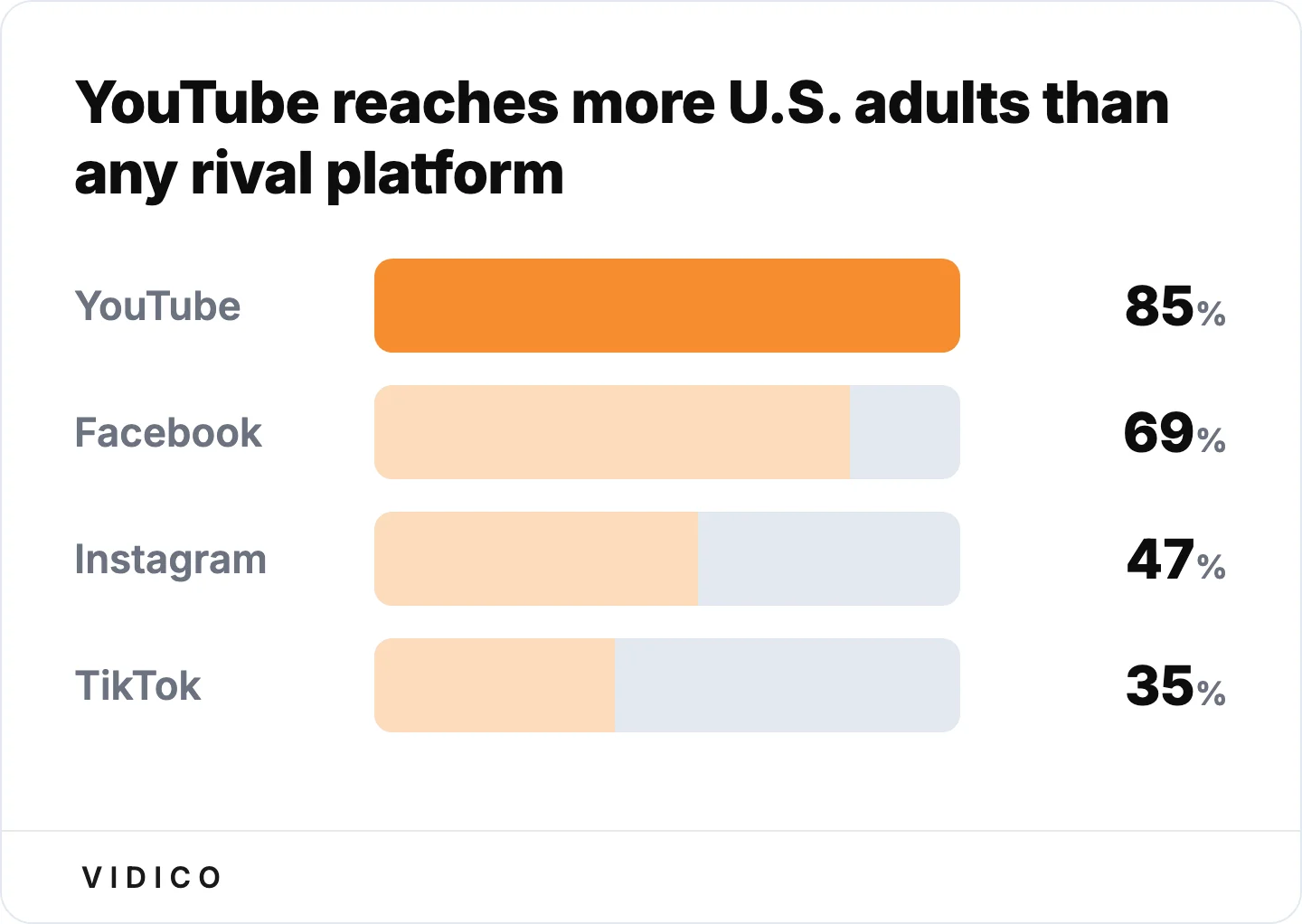
85% of U.S. adults use YouTube, putting it ahead of every other social platform. Source: Pew Research Center.
5. Users spend an average of 48.7 minutes per day on YouTube. That figure has grown steadily year over year, driven in part by Shorts and Connected TV adoption. (DemandSage)
6. YouTube’s potential ad reach totals 3.35 billion users. This figure includes logged-out viewers and embedded plays across third-party sites, exceeding the monthly active user count. (Global Media Insight)
7. YouTube Premium and YouTube Music have 125 million subscribers (including trials). That milestone was announced in May 2025, marking YouTube’s twentieth anniversary. (YouTube Blog)
YouTube Demographics Statistics
YouTube’s audience skews slightly male and peaks in the 25-to-34 age group. India is the largest national audience, and Gen Z engagement metrics are especially relevant for marketers.
8. The largest age group on YouTube is 25-to-34-year-olds, making up 21.3% of all users. The 35-to-44 bracket is second. Together, the 25-to-44 range accounts for nearly 40% of the platform’s users. (Statista)
9. YouTube’s gender split is 53% male and 47% female. This is a narrower gap than most social platforms. Male users slightly outnumber female users across all age groups. (Statista)
10. India has the largest YouTube audience at approximately 518 million users. The United States is second at 259 million, followed by Indonesia (151 million) and Brazil (150 million). (DemandSage)
11. 84% of Gen Z have a YouTube account. YouTube is the most-used platform among Gen Z, ahead of Instagram, TikTok, and Snapchat. (Sprout Social)
12. YouTube ads drive product awareness among 67% of Gen Z teens, compared to 50% for TikTok and 49% for Facebook. This makes YouTube the most effective platform for reaching Gen Z with paid brand messaging. (Sprout Social)
Get the data behind 230+ B2B tech marketing teams. Vidico’s 2026 State of Creative in Tech report covers budget trends, format performance, and production benchmarks. Download the report
YouTube Content and Engagement Statistics
YouTube’s content library and engagement metrics are growing. A Metricool study of 7.3 million videos found a 76% surge in average views per video in the past year, alongside a significant jump in comments.
13. Over 500 hours of video are uploaded to YouTube every minute. That translates to roughly 20 million videos per day, a pace that has held steady since 2022. (Statista)
14. YouTube users watch 1 billion hours of video daily across all devices. YouTube CEO Neal Mohan confirmed this figure, which includes mobile, desktop, and Connected TV. (YouTube Blog)
15. Average views per video surged 76% year over year. Metricool’s analysis of 7.3 million videos across 82,000 accounts found that average views jumped from 389.90 to 687.21 per video, driven largely by Smart TV adoption and improved recommendation algorithms. (Metricool)
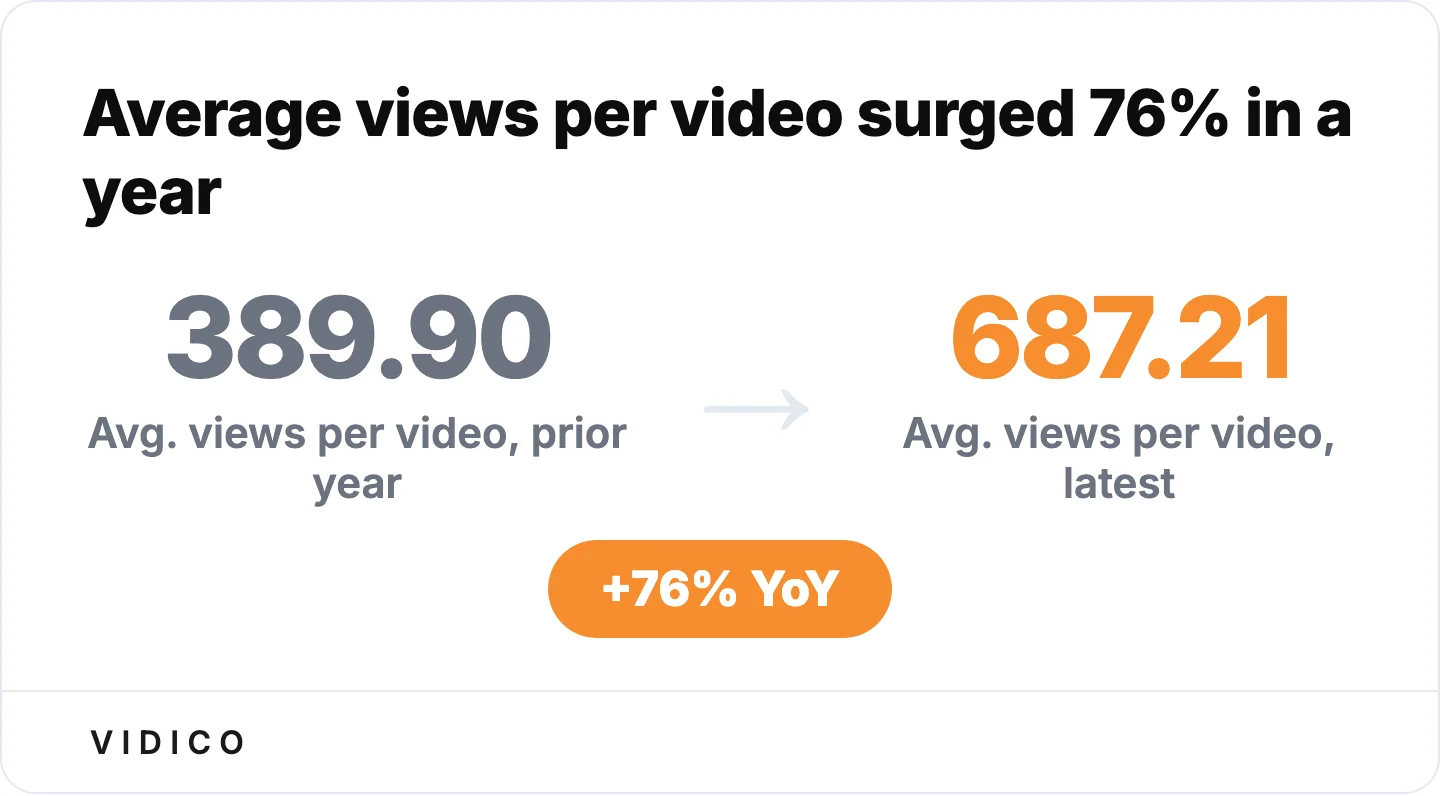
Average views per video jumped 76% year over year, driven by Smart TV adoption and better recommendations. Source: Metricool.
16. Comments on YouTube videos increased 38% year over year. The rise in comments signals that YouTube is becoming a more community-driven platform, not just a passive viewing experience. (Metricool)
17. YouTube has over 113 million active channels. The platform’s creator ecosystem continues to expand, with channels spanning education, entertainment, gaming, music, and business content. (Hootsuite)
18. 46% of internet users aged 16 to 24 watch online tutorials and how-to videos. YouTube is the leading destination for this learning content, spanning software tutorials, video production techniques, and professional development. (Statista)
YouTube Shorts Statistics
YouTube Shorts has become the platform’s fastest-growing format and a primary engine for product discovery. These numbers reflect Shorts’ scale as of 2026.
19. YouTube Shorts averages 200 billion views per day. That figure, confirmed by YouTube, positions Shorts as one of the highest-traffic short-form video formats in the world. (DemandSage)
20. YouTube Shorts has 2 billion monthly active users. Shorts reaches nearly 75% of YouTube’s total user base, making it a distinct sub-platform within YouTube. (DemandSage)
21. YouTube Shorts has become a major driver of product and brand discovery. Its algorithm-driven feed surfaces product-focused content alongside entertainment, giving brands organic reach without paid spend. This discovery mechanism parallels what we see across short-form video statistics more broadly.
22. Short-form content is now preferred by 52% of viewers, slightly edging out long-form at 48%. The split is nearly even, suggesting that both formats remain important for YouTube marketing strategies. Short-form drives discovery; long-form drives depth and watch time. (Sprout Social)
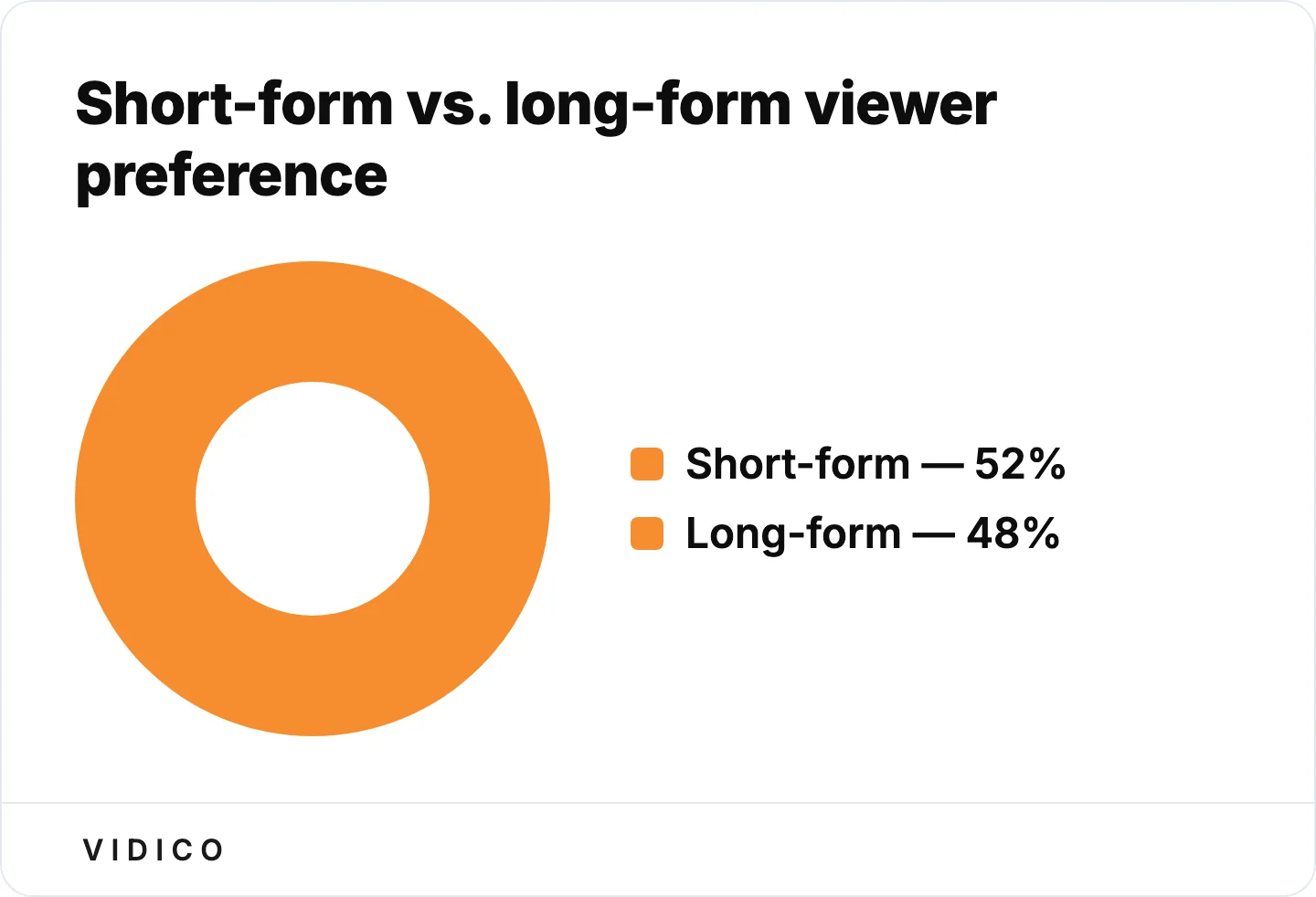
Short-form video now edges out long-form, 52% to 48%, among YouTube viewers. Source: Sprout Social.
23. 43% of ad buyers now use YouTube Shorts for advertising. Shorts ad inventory is growing as advertisers follow viewer attention to the short-form feed. Vertical formats on Shorts deliver 10-20% more conversions per dollar compared to horizontal-only campaigns. (Google Blog)
See how brands use short-form and long-form video together. Vidico’s Creative Intelligence Report analyzes your brand against competitors across 12 creative dimensions, delivered in 48 hours. Get your free report
YouTube Connected TV Statistics
YouTube is the largest streaming platform in the United States, surpassing Netflix, Hulu, and every traditional broadcast network in total viewing time. The shift to TV screens is reshaping how marketers plan YouTube campaigns.
24. YouTube is the #1 streaming platform in the U.S., capturing 12.4% of all TV viewing time. According to Nielsen’s Gauge report, YouTube maintained the largest share among all media companies for the third consecutive month in April 2025.
25. Viewers watch 1 billion hours of YouTube content on TV screens every day. YouTube CEO Neal Mohan confirmed this milestone, underscoring how deeply YouTube has penetrated living room viewing habits. (YouTube Blog)
26. Connected TV became the primary device for YouTube in the U.S., accounting for 36% of total viewer hours in the first half of 2025. TV screens surpassed mobile for the first time as the top device category for YouTube consumption in the U.S. market. (Stream TV Insider)
27. The shift to Smart TV viewing drove a 76% increase in average views per video. Larger screens, longer sessions, and improved recommendation algorithms on TV apps all contributed to the view count surge. This stat is especially relevant for marketers producing video ads and commercial content designed for big-screen viewing. (Metricool)
YouTube Advertising and Revenue Statistics
YouTube’s advertising business surpassed traditional media conglomerates in 2025. These stats cover revenue, cost benchmarks, and ad format performance.
28. YouTube’s advertising revenue reached $40.4 billion in 2025. That figure surpassed the combined ad revenue of Disney, NBC, Paramount, and Warner Bros. Discovery ($37.8 billion), making YouTube the largest single advertising platform by revenue in the video category. (TechCrunch)
29. YouTube’s total revenue topped $60 billion in 2025, surpassing Netflix ($45.2 billion). Total revenue includes advertising, Premium subscriptions, YouTube Music, and YouTube TV. YouTube is now the largest video platform in the world by revenue. (Variety)
30. YouTube’s potential ad reach is 3.35 billion users. This exceeds the logged-in monthly active user count because it includes viewers watching embedded videos and non-logged-in sessions. (Global Media Insight)
31. Average YouTube CPM is around $2, with many advertisers paying in the $4 to $10 range. CPMs vary by targeting, format, and vertical, climbing for narrowly targeted, higher-value audiences. This cost is comparable to other video advertising platforms. (WordStream)
32. In-feed (discovery) ads achieve a 1% to 3% click-through rate, compared to the platform average of around 0.65%. In-feed ads appear in search results and alongside related videos, reaching users with active viewing intent, which lifts their click-through rate above auto-playing formats. (Store Growers)
33. Vertical video ads on YouTube yield 10-20% more conversions per dollar than horizontal-only campaigns. YouTube’s own research shows that vertical formats, especially on Shorts, outperform landscape assets in Video Action Campaigns by the same margin. (Google Blog)
34. Intent-based audiences deliver 20% higher ad recall lift and 50% higher brand awareness lift than demographic-only targeting. Matching ads to what viewers are actively researching on YouTube outperforms targeting by demographics alone. (Google)
35. Shoppers are 1.5 times more likely to pay attention to YouTube content than to content on social platforms. YouTube content is also rated more than twice as trustworthy as social platform content, which strengthens the impact of brand and ad messaging. (Think with Google)
YouTube Marketing and Business Statistics
YouTube adoption among businesses continues to grow, with the platform ranking as one of the top-ROI channels for both B2B and B2C marketers.
36. 69% of companies use YouTube for marketing. YouTube is the third-most adopted marketing platform behind Facebook and Instagram. Adoption is even higher among enterprise companies (71%). (HubSpot)
37. 44% of small businesses use YouTube for marketing, up 6% year over year. Small business adoption is accelerating as production costs drop and Shorts lowers the content creation barrier. (WordStream)
38. 42% of marketers rate YouTube as their top-ROI platform. YouTube ranks third for perceived ROI, behind Instagram and Facebook. The gap is narrowing as Connected TV and Shorts expand YouTube’s reach. (HubSpot)
39. 45% of viewers say online video helped them choose which product or brand to buy, and 34% say it prompted them to buy a specific item. YouTube sits at the center of this research-to-purchase journey, where buyers compare options and evaluate brands before committing. (Think with Google)
40. 87% of viewers have made a purchase after seeing a brand on YouTube. YouTube’s influence on purchase decisions extends across the full funnel, from awareness through consideration to conversion. (The Social Shepherd)
41. YouTube is 1.6 times more likely to influence purchase decisions than other social platforms. Buyers use it to compare products, watch reviews, and evaluate brands before committing. This is why video marketing examples that demonstrate product value tend to outperform brand-awareness-only content. (Think with Google)
42. Viewers watched 35 billion hours of shopping-related content on YouTube in 2025. Shopping content spans product reviews, unboxings, haul videos, and comparison content. YouTube’s integration of shopping features (product tags, live shopping) is expanding this category. (Hootsuite)
Build a video marketing plan tied to real data. Map your YouTube strategy to the metrics that drive pipeline and revenue. Get a free video marketing plan
B2B Video Marketing on YouTube
Most YouTube marketing statistics focus on consumer brands. These stats come from Vidico’s 2026 State of Creative in Tech report, a survey of 230+ B2B tech marketing leaders. They reveal how B2B teams specifically invest in video.
43. 76% of B2B tech marketers say their creative production budget is increasing in 2026. Creative production is one of the few line items growing across most B2B marketing teams, even as overall budgets face scrutiny. (Vidico)
44. Mid-form video is the leading B2B content format for 2026. Mid-form video (2-10 minutes) edged out short-form and long-form as the preferred format, driven by YouTube’s algorithm favoring watch time and its suitability for product demos and explainer videos. (Vidico)
45. Paid social video and customer-proof video are tied as the highest-impact B2B formats. Customer testimonials and results-driven video content match paid social video for effectiveness, with both ranking above blog content, webinars, and static ads. (Vidico)
46. Most B2B teams take 4-14 days from concept to live video. Teams with reusable template systems hit 1-3 days. Production speed is a major competitive advantage. Teams that build template libraries reduce turnaround by 60-80%. (Vidico)
47. Only 1 in 3 B2B teams has a fully reusable video asset system. The majority of B2B marketing teams still produce video project-by-project, missing the efficiency gains of template-based production. (Vidico)
48. Budget (27.4%) and measurement/attribution (14.1%) are the top constraints on B2B video production. Slow approvals (13.2%) and limited bandwidth/headcount (12.8%) follow closely. These bottlenecks explain why B2B teams increasingly look to external production partners. (Vidico)
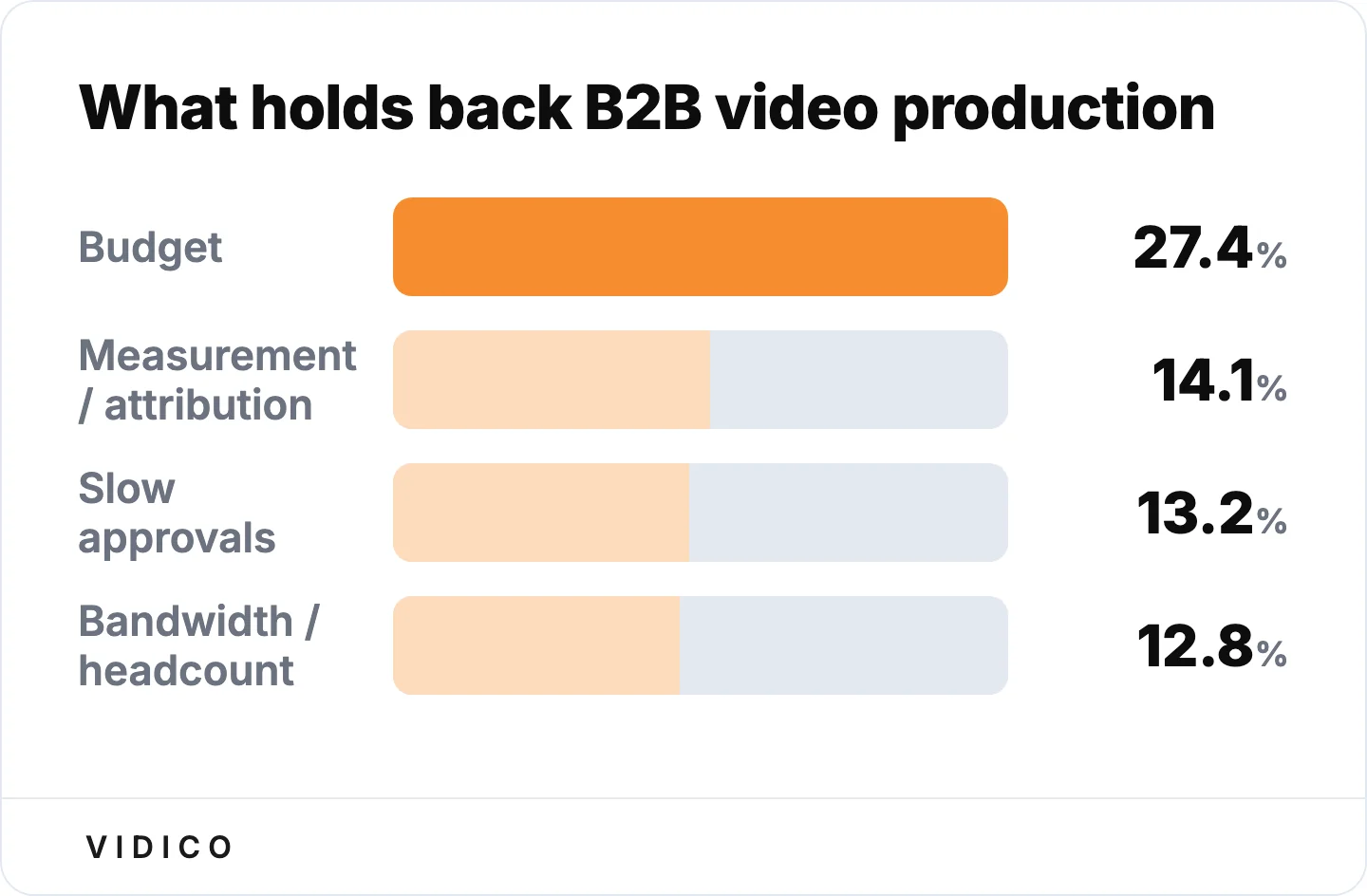
Budget and measurement are the biggest brakes on B2B video, ahead of slow approvals and thin headcount. Source: Vidico 2026 State of Creative in Tech.
YouTube Creator Economy Statistics
YouTube’s creator ecosystem is massive, with the platform’s top earners generating tens of millions in annual revenue. These stats reflect the scale of creator activity and monetization on the platform.
49. MrBeast has 473 million subscribers, making him the most-subscribed YouTube channel in the world. MrBeast (Jimmy Donaldson) overtook T-Series for the top spot, driven by viral challenge content and global localization across 17+ language channels. (Social Blade)
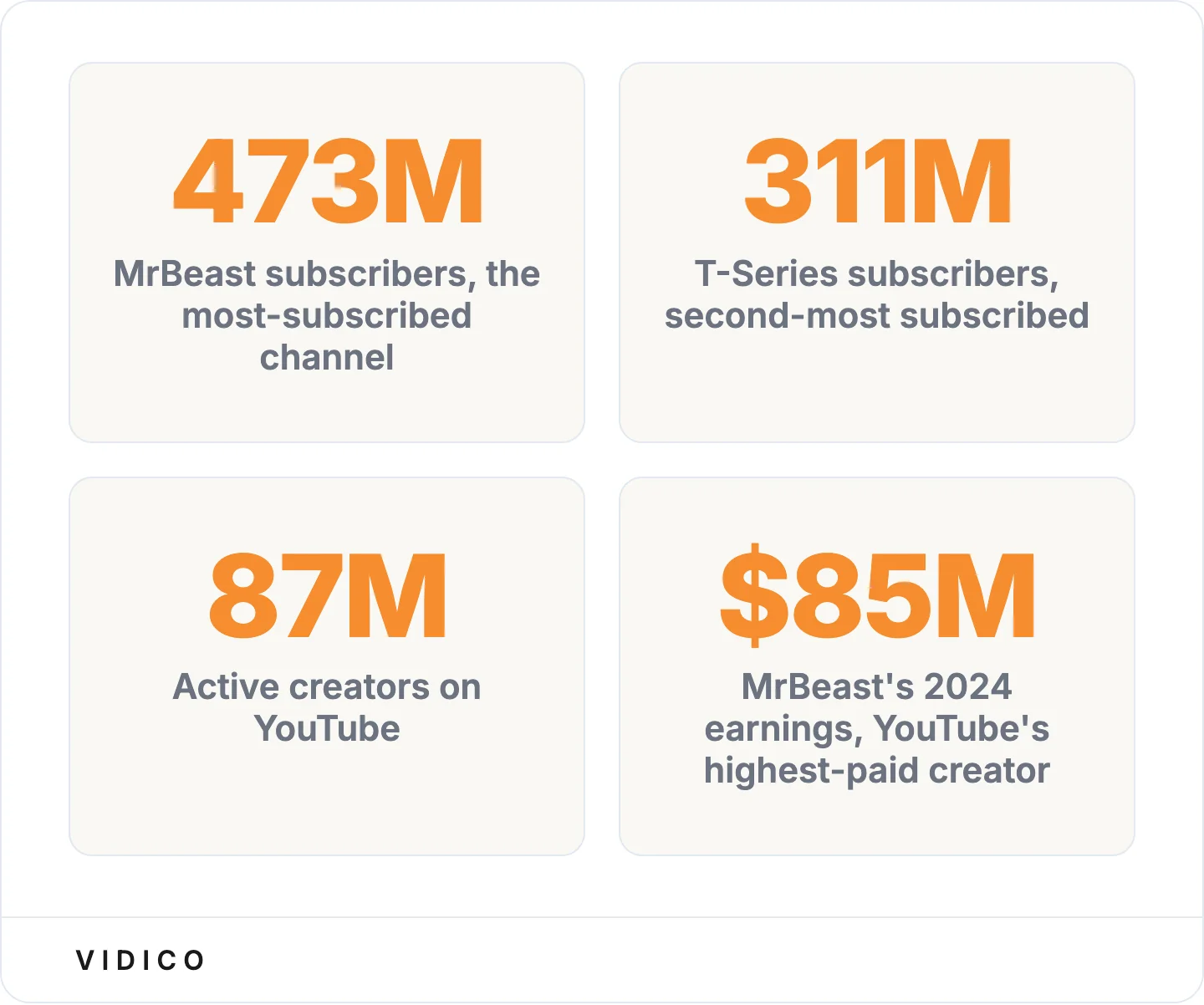
The scale of YouTube’s top creators and its wider creator base. Sources: Social Blade, Hootsuite, Fortune.
50. T-Series has 311 million subscribers and remains the second-most subscribed channel. The Indian music and film label’s subscriber base reflects YouTube’s massive audience in South Asia. (Social Blade)
51. MrBeast earned approximately $85 million in 2024, making him YouTube’s highest-paid creator. His revenue comes from ad revenue, brand partnerships, his Feastables snack brand, and the Beast Burger chain. (Fortune)
52. YouTube has 87 million active creators. The platform’s creator base spans individual vloggers, media companies, brands, and educational institutions. (Hootsuite)
53. YouTube Shorts offers creators a 45% revenue share from the Shorts ad revenue pool. This monetization model launched in early 2023 and gives short-form creators a direct path to ad revenue, competing with TikTok’s Creator Fund. (YouTube Blog)
See what 2,000+ video campaigns look like in practice. Browse Vidico’s portfolio of B2B explainer videos, brand campaigns, and ad creative. View the portfolio
YouTube Statistics by Year
YouTube’s growth trajectory over the past six years shows consistent increases in users, revenue, and content volume.
54-55. YouTube growth: 2020-2025
| Year | Monthly Users | Ad Revenue | Shorts Daily Views | Premium Subscribers |
|---|---|---|---|---|
| 2020 | 2.0B | $19.8B | N/A | 30M |
| 2021 | 2.3B | $28.8B | 5B (launch year) | 50M |
| 2022 | 2.5B | $29.2B | 30B | 80M |
| 2023 | 2.5B | $31.5B | 50B | 80M+ |
| 2024 | 2.6B | $36.1B | 70B | 100M |
| 2025 | 2.7B | $40.4B | 200B | 125M |
Sources: Alphabet SEC filings, YouTube Blog, DemandSage, Statista, YouTube Press.
FAQs
Is YouTube growing or declining in 2026?
YouTube is growing across every measurable dimension. Monthly users reached 2.70 billion (Global Media Insight), ad revenue hit $40.4 billion in 2025 (TechCrunch), Shorts views jumped from 70 billion to 200 billion daily (DemandSage), and Connected TV became the primary viewing device in the U.S. YouTube also overtook Netflix in total revenue (Variety).
How effective is YouTube for marketing?
YouTube ranks among the top platforms for marketing ROI. 69% of companies use YouTube for marketing, and 42% of marketers name it their top-ROI platform (HubSpot). YouTube is also 1.6 times more likely to influence purchase decisions than other social platforms (Think with Google), which makes it effective for both brand awareness and direct response campaigns.
How much does YouTube advertising cost?
Average YouTube CPM is around $2, with many advertisers paying in the $4 to $10 range depending on targeting and format (WordStream). In-feed (discovery) ads achieve 1% to 3% CTR versus the roughly 0.65% platform average (Store Growers). Costs vary significantly by targeting, ad format, industry, and season.
What is the YouTube marketing demographic?
YouTube’s core marketing demographic is adults aged 25-34 (21.3% of users), followed by 35-44 (Statista). The platform reaches 85% of U.S. adults (Pew Research Center). Gen Z engagement is particularly strong, with 84% holding YouTube accounts and 67% of Gen Z teens reporting YouTube-driven product awareness (Sprout Social). The audience demographics make YouTube effective for both B2B and B2C campaigns.
Conclusion
YouTube’s 2026 data paints a clear picture: the platform is growing in scale, revenue, and influence. Connected TV adoption is turning YouTube into a living room staple, Shorts is reshaping discovery and short-form advertising, and ad revenue has overtaken traditional media giants. For B2B marketers specifically, video budgets are increasing and mid-form content is the leading format.
Vidico produces B2B video campaigns for SaaS and tech brands, with 2,000+ campaigns shipped for 920+ clients including Square, Spotify, and Airtable. Hiver’s YouTube ad campaign with Vidico generated more than 20 million impressions and over 80 qualified leads. Our 2026 State of Creative in Tech report covers the B2B video investment trends cited in this article.
If you are building or scaling a YouTube marketing strategy, book a free strategy session to map your video plan to these benchmarks.
Sources
- Global Media Insight
- DemandSage: YouTube Stats
- DemandSage: YouTube Shorts Statistics
- Pew Research Center: Social Media Fact Sheet
- Statista: YouTube Users by Country
- Statista: YouTube Gender Distribution
- Statista: YouTube Video Upload Rate
- Statista: Online Learning Video Reach
- YouTube Blog
- YouTube Blog: 20 Years, 125 Million Subscribers
- Nielsen: The Gauge
- Stream TV Insider
- TechCrunch
- Variety
- Google Blog: Vertical Video
- Google: Intent-Based Audiences on YouTube
- Think with Google: How Video Influences Purchase Decisions
- HubSpot: State of Marketing
- WordStream
- Store Growers: YouTube Ads Benchmarks
- Sprout Social
- Metricool: Social Media Study
- Hootsuite
- The Social Shepherd
- Social Blade: MrBeast
- Social Blade: T-Series
- Fortune: MrBeast
- DataReportal


![70+ Video Marketing Statistics Every Marketer Needs in 2026 [Updated Data]](https://vidico.com/app/uploads/2026/06/video-marketing-statistics-featured-featured.webp)