You’re writing explainer video scripts that bore people to death. Most tech companies treat scripts like feature lists, ignore how voice actors actually sound, and wonder why their video content gets zero conversions.
We’ve spent over a decade producing 1,200+ projects that generated 1.4 billion views, and we’ve learned that great explainer video scripts address your target audience’s pain points before explaining anything.
In this guide, you’ll see real explainer video script examples from brands that actually convert, learn the exact video script template we use for clients like TikTok and Square, and discover why your product or service benefits matter infinitely more than your product features.
Key Takeaways
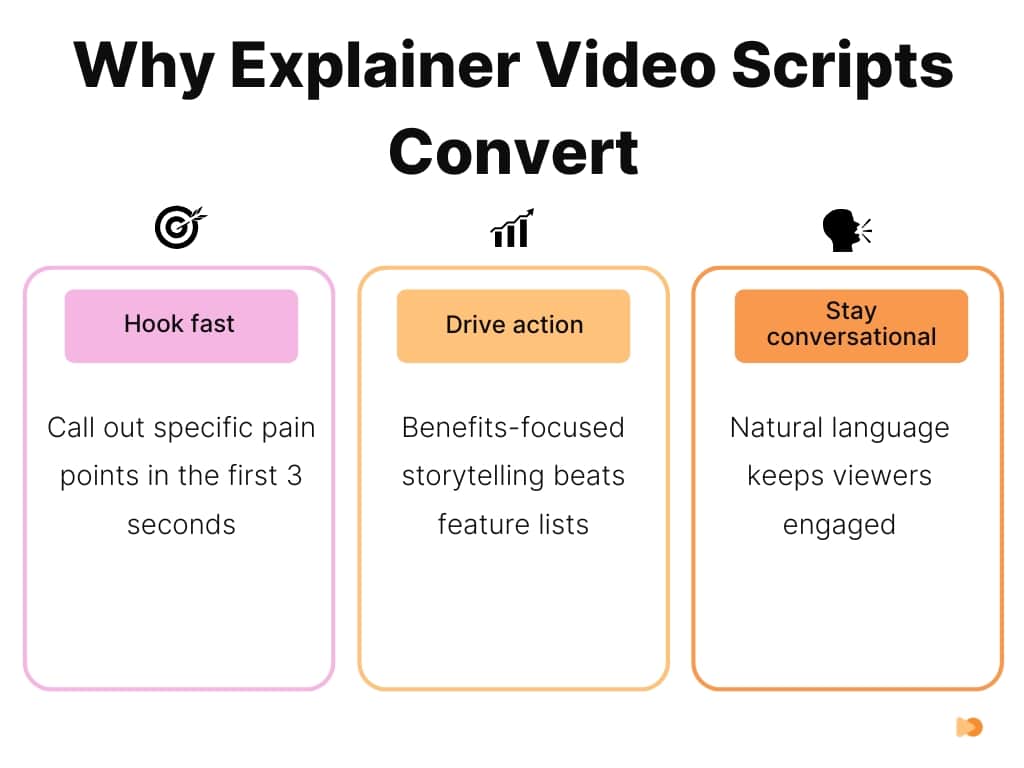
- Effective explainer video scripts hook viewers in 3 seconds by calling out specific pain points, not vague problems
- The right story structure drives more action than production quality—narrative beats animation every time
- 90-120 words equals approximately 1 minute when voice actors read at a natural conversational pace
- A two-column script format (audio left, visuals right) keeps your entire creative process aligned and prevents confusion
- Target audience research determines everything from brand tone to video length in your explainer script
- Write scripts the way you talk, not the way you write—conversational tone beats corporate speak
- Educational video content that teaches first and sells second builds more trust than direct pitches
- Video script templates provide basic structure, but brand personality makes the difference between boring and compelling
- Clear call to action tells viewers exactly what step to take next—no vague “learn more” nonsense
- Complex ideas become simple when you use analogies and visual elements that your audience already understands
Content
What Makes An Explainer Video Script Actually Work
After producing explainer videos for over a decade, we’ve seen clear patterns between scripts that convert and scripts that waste production costs.
Start With The Viewer, Not Your Company
Your audience doesn’t care about your founding story until you prove you understand them. A great explainer video script opens with the viewer’s world. “Marketing Directors at Series B SaaS companies drowning in creative requests they can’t fulfill” is specific enough to make someone think, “that’s me.”
The First 10 Seconds Decide Everything
If you don’t identify your target audience and their specific pain points in those opening seconds, you’ve lost them. Features kill conversions. Benefits drive action. Focus on transformation—from overwhelmed to organized, from expensive to affordable. Show how the product or service benefits change their life.
Sound Like A Real Conversation
Read your video script out loud. Voice acting works best with natural language—contractions, short sentences, conversational tone. “We’ve helped thousands” is meaningless. “TikTok produces 200 assets monthly using our methodology” is specific and credible. Combine concrete data with a good story about transformation.
Real Explainer Video Script Examples
Example 1: The Problem-First Hook
Full Script (115 words / 60 seconds): “Marketing teams at tech companies face an impossible challenge. Produce 10x more video content with the same budget. Traditional agencies can’t keep up—too slow, too expensive, starting from scratch every time. One project should yield 40 assets, not one. That’s our 10x approach. We build creative systems that compound, not one-off projects that drain budgets. TikTok produces 200+ videos monthly. Square maintains consistency across 17 languages. Spotify scales without scaling headcount. Visit vidico.com.”
Why It Works: Opens by identifying the target audience specifically, states the audience’s pain points concretely, positions the solution as revolutionary, backs claims with client names, and includes a clear call to action. At 115 words, it runs exactly 60 seconds. The conversational tone uses contractions and short sentences.
Download a free video script to kickstart your next creative project.
Example 2: The Relatable Story
Dropbox’s approach: “Wallet in wrong pants. Keys left at home. Problem is organization. Same with files—save at work, need at home, email yourself. Three versions, no idea which is current. Dropbox solves this. One folder, all devices, always synced.”
What Works: Relatable scenarios everyone experiences, builds problem before solution, simple language, shows product’s benefits without features, creates emotional connection. Simple scenarios resonate more than complex explanations.
Example 3: Educational Value First
Framework: “Want the secret behind viral video content? Systematic thinking. Three principles: design for repurposing, build asset banks, think in systems not projects. How top brands produce 10x more without 10x budget. Exactly how we work with clients.”
Success Factors: Leads with valuable insight, not sales, teaches framework before pitching, positions as expert partner, makes pitch feel natural. Educational video scripts that provide essential information before asking build trust.
Example 4: Character-Driven Transformation
Structure: “Meet Sarah, Marketing Director at Series B SaaS. Produces content for 47 channels. Coordinates 3 videographers, 2 studios, 1 designer. Different tools. Nothing standardized. Deadlines pass before she gets assets. Sound familiar? One workflow, unlimited output. Sarah ships 200 assets quarterly instead of 20.”
Why It Converts: Creates a protagonist that the right audience recognizes, shows the problem through experience, makes the solution inevitable, and demonstrates transformation with outcomes. Characters make abstract problems concrete.
Write explainer videos that convert. See our Creative Brief Template.
The Script Writing Process That Never Fails
After over a decade and 1,200+ projects, here’s our step-by-step approach to writing a script that actually converts.
Step 1: Know Who You’re Talking To Before You Write Anything
Define your target audience precisely. Not “businesses” or “marketers”—drill down. “Marketing Directors at 200-1000 employee SaaS companies who report to the CMO and need to prove ROI on creative spend.” The more specific, the better your script.
Research their pain points, how they talk, and what keeps them up at night. A good explainer video script for technical buyers sounds completely different from one targeting executives. The word count might be the same, but everything else changes.
Step 2: Start With Pain, Not Product
Your first script draft should spend 30-40% on the problem before introducing your solution. This feels counterintuitive—you want to talk about your revolutionary product immediately. Resist that urge.
The audience’s pain points must come first. Make them feel the problem. Quantify the cost of inaction. Only after they’re nodding along, thinking “yes, that’s exactly my problem,” should you introduce your product or service.
See how our systematic approach delivered 40 assets in 9 days. Read the TikTok case study
Step 3: Map The Basic Structure
Every great explainer video script follows this narrative structure:
- Hook (10 seconds): Identify audience + state their problem
- Problem (20 seconds): Agitate the pain, show consequences
- Solution (25 seconds): Introduce your product, explain the core mechanism
- Proof (15 seconds): Data, client names, specific results
- Action (10 seconds): Clear call to action
This basic structure works whether you’re creating a 60-second animated video or a 2-minute educational video. Scale the time, but keep the sequence.
Step 4: Write In A Two-Column Script Format
Create a simple table in Google Docs: left column for audio (what voice actors say), right column for visual elements (what viewers see).
This two-column script keeps everyone aligned—writers, designers, animators all work from the same document. It prevents the common disaster where the voiceover talks about one thing while the visuals show something completely different.
Step 5: Write How Real People Talk
Read your video script out loud. Better yet, record yourself reading it. Does it sound natural? Would a real person say “utilize” or would they say “use”? Would they say “facilitate” or “help”?
Great script writing uses contractions (we’re, you’ll, don’t), short sentences (10-15 words max), and natural rhythm. Voice acting sounds best with a conversational tone, not corporate speak.
Cut these phrases immediately: “leverage,” “synergize,” “utilize,” “facilitate,” “implement.” Replace with: “use,” “work together,” “help,” “set up.” Simple wins.
Step 6: Show, Don’t Just Explain
“Our platform saves time” is weak. “Watch how Sarah goes from briefing to final assets in 3 days instead of 6 weeks” is specific and visual.
When you write scripts, think about what viewers will see. Your voice actors deliver the words, but visual elements prove your point. Every claim should have a corresponding visual that demonstrates it.
“For B2B audiences, especially those making high-stakes purchase decisions, a great explainer video starts with talented writing. The message must be carefully crafted to resonate with their challenges, then conveyed on screen in a way that builds confidence”
Step 7: End With One Clear Call To Action
Tell viewers exactly what to do next. Not “learn more” (vague), not “contact us” (unclear). Try:
- “Start your free trial at [website]”
- “Book a 15-minute strategy call”
- “Download the complete guide at [URL]”
One clear call to action always outperforms multiple options. Decision paralysis kills conversions.
Step 8: Check Your Word Count Against Video Length
Every 150 words equals roughly 1 minute when voice actors read at a natural pace. So:
- 30-second script = 75 words
- 60-second script = 150 words
- 90-second script = 225 words
- 2-minute script = 300 words
Write tight. Cut every unnecessary word. Your first script draft will be too long—that’s normal. Edit ruthlessly.
Script Frameworks That Actually Drive Conversions
Different situations call for different explainer video script templates. Here are the frameworks we use depending on the goal.
The Problem-Agitate-Solution (PAS) Framework
Best for: Products solving obvious, painful problems
Structure:
- Identify the specific problem (15 seconds)
- Agitate it—show cost of inaction (20 seconds)
- Present your solution (25 seconds)
- Prove it works (15 seconds)
- Clear CTA (10 seconds)
Example: “You’re wasting 40% of your budget on… (problem). That means you’re leaving $200K on the table annually (agitate). Our platform cuts that waste by… (solution). See how Company X saved $500K in their first year (proof). Start your trial today (CTA).”
Get your free video marketing plan tailored to your funnel and business goals.
The AIDA Framework (Attention-Interest-Desire-Action)
Best for: New market categories or unfamiliar solutions
Structure:
- Grab attention with a surprising fact (10 seconds)
- Build interest with relevant details (25 seconds)
- Create desire by showing benefits (25 seconds)
- Prompt action with clear next step (10 seconds)
Example: “95% of video projects waste 60% of their assets (attention). Here’s why: traditional production treats every project as one-off work (interest). Imagine if project five was 40% cheaper than project one because you’d already built the foundation (desire). See how this works for your brand—book a call (action).”
The Before-After-Bridge Framework
Best for: Demonstrating transformation clearly
Structure:
- Show the “before” state (20 seconds)
- Show the “after” state (20 seconds)
- Bridge—explain how to get there (30 seconds)
- CTA (10 seconds)
Example: “Before: Sarah manages 3 agencies, endless revision cycles, missed deadlines (before). After: Sarah ships 200 assets per quarter, predictable costs, no coordination headaches (after). The bridge? Creative systems instead of creative projects. Here’s how it works… (bridge). Ready to make this your reality? (CTA).”
The Hero’s Journey (For Complex Stories)
Best for: Building emotional connection over explaining mechanics
Structure:
- Introduce the character in their ordinary world (15 seconds)
- Show the challenge they face (20 seconds)
- Introduce the guide (your product) (20 seconds)
- Show transformation (15 seconds)
- CTA (10 seconds)
Example: “Meet John, VP Marketing at a scaling SaaS (character). Every quarter, demands double but budget doesn’t (challenge). He found a different approach—systems that compound (guide). Now he produces 5x more creative for the same spend (transformation). Want to see how? (CTA).”
Why Choose Vidico For Your Explainer Video Production
Most companies approach explainer videos wrong. They treat them as isolated projects instead of building systematic approaches to video content. After producing 1,200+ explainer video projects that generated 1.4 billion views, we’ve figured out what actually works.
“An exceptional explainer video isn’t just a one-time asset—it’s the foundation of a broader strategy. By aligning the narrative with your brand’s goals, we ensure the content can be repurposed across multiple channels, amplifying its reach and ROI. This is how we help our clients maximize the value of every production.” — Evan Pirone, CoFounder and Creative Director, Vidico
We Write Scripts That Convert, Not Just Explain
Our explainer video script template is built from analyzing thousands of campaigns across a decade. We know exactly how to write an explainer video that moves people from awareness to action. We focus on the right story that addresses the audience’s pain points first, product features second.
Systems-Based Creative Production
One script becomes the foundation for your entire video content strategy. We create explainer scripts that adapt to video length (from 30-second social cuts to 2-minute deep dives), audiences (different buyer personas), and formats (animated videos, live-action, screencasts). This systematic thinking means your first script creates compounding value across your sales team and all marketing channels.
Built For B2B Tech Companies
We specialize in making complex ideas simple. Whether you’re explaining SaaS with 25+ features, FinTech with compliance requirements, or infrastructure with technical architecture—we’ve written scripts for every B2B scenario. Our voice actors and creative process understand how to talk to technical audiences without dumbing things down or using jargon that confuses them.
Speed Without Sacrificing Quality
Traditional agencies take 6-8 weeks for one explainer video. We deliver your first video in 3 weeks, plus create the asset bank that makes videos 2-10 take half that time. Lower production costs, faster turnaround, better results. That’s systematic thinking about the video production process.
Toggl increased conversion rates by 32% and reduced cost-per-acquisition by 27% using our video system for their product launch campaign → See our work
FAQs
How to write a 30-second video script?
A 30-second video script should be 60-75 words maximum. Structure it simply: hook, identifying your target audience (10 words, 5 seconds), one clear problem (20 words, 10 seconds), your solution briefly (20 words, 10 seconds), clear call to action (15 words, 5 seconds). Cut everything else. The key is focusing on one message. Use a conversational tone and write how voice actors naturally speak. Test your word count by reading aloud at a normal pace—it should take 30 seconds.
How long is a 20-minute video script?
A 20-minute video script is approximately 3,000 words when read at a conversational pace by voice actors (150 words per minute). However, we rarely recommend explainer video scripts this long for marketing purposes. That video length works for in-depth educational video content, webinars, or training materials—not for explaining your product or service. Keep explainer scripts under 2 minutes (300 words max). If you need 20 minutes, you’re explaining too much. Focus your message.
What’s the best explainer video script template?
The best video script template is simple: Problem (30%), Solution (40%), Proof (20%), Action (10%). Use a two-column script format—audio on the left, visual elements on the right. You can create this in Google Docs with a basic table. Don’t overcomplicate it. The template matters less than understanding your target audience and addressing their pain points authentically. Write with brand personality and conversational tone. The basic structure stays the same whether you’re creating a 30-second or 2-minute video.
How many words should my explainer video script be?
Plan for 150 words per minute of final video when using professional voice actors at a natural pace. A 60-second script = 140-160 words. A 90-second script = 210-230 words. A 2-minute script = 280-320 words maximum. Your word count depends on video length. Write tight—cut every unnecessary word. Focus on one key message. The right tone and clear narrative structure matter more than hitting a specific word count. Test by reading your video script aloud.
Should I hire someone to write scripts or do it myself?
Start writing yourself first. You understand your product’s benefits and your audience’s pain points better than any hired writer. Use a basic structure (problem-solution-proof-action), write how you talk, and focus on one message. Test your first script with real people from your target audience. If it’s not working after testing and revisions, consider hiring a scriptwriter specializing in video content. But don’t outsource understanding your own value proposition. That clarity must come from inside your company.
How do I make my explainer script engaging?
An engaging explainer video script uses a conversational tone, short sentences (10-15 words max), specific examples rather than vague claims, and addresses pain points emotionally. Start with a hook that immediately identifies the right audience. Use “you” and “your” to speak directly. Include concrete numbers and named clients for credibility. Write visually so voice actors and animators know exactly what to create. Avoid corporate jargon. Test the narrative structure by reading aloud—if it sounds robotic, rewrite until it sounds human.
What’s a two-column script, and why use it?
A two-column script format separates what voice actors say (left column) from what viewers see (right column). This keeps your entire creative process aligned—writers, designers, animators, and the video production process all work from the same document. Create it in Google Docs with a simple table. Without this format, you get the common disaster where the voiceover artist talks about one thing while visuals show something completely different. The two-column approach ensures audio and visual elements always match, creating a better understanding for viewers.
Can I reuse the same script for different products?
You can reuse the same basic structure and narrative structure, but every effective explainer video script needs customization for the specific product or service, target audience, and unique selling points. The framework is reusable (problem-solution-proof-action), but the content must change. Don’t just find-and-replace product names. Each scriptwriting project deserves attention to the specific audience’s pain points and how this solution addresses them. Think systematically—create a great script template from your best work, then adapt it thoughtfully for each new product.
Final Thoughts
Writing great explainer video scripts isn’t about rigid templates or hitting specific word-count targets. It’s about understanding your target audience deeply, addressing their pain points before pitching your product or service, and using a conversational tone that sounds human.
The best explainer video script examples all focus on transformation over features, explain complex ideas simply through a clear narrative structure, and use visual elements with voice acting to reinforce the message. They always end with a clear call to action that tells viewers exactly what step to take next.
After producing 1,200+ projects generating 1.4 billion views, we’ve learned that script writing is where everything succeeds or fails. A great script with simple animated videos outperforms a mediocre script with premium production every time. Start writing with clarity about who you’re talking to and what problem you solve for them. Everything else follows.
Ready to create explainer videos that convert? Schedule a free 15-minute strategy session today.
References:
- https://finance.yahoo.com/news/video-production-company-vidico-launch-130000641.html
- https://advertising.amazon.com/library/guides/b2b-marketing
- https://www.forbes.com/sites/loisgeller/2014/06/02/the-aida-principle-roadmap-for-a-lot-of-great-advertising/