
Every SaaS go-to-market strategy guide tells you the same thing: define your ICP, pick a GTM motion, choose your marketing channels, launch. What none of them mention is why the plan falls apart two weeks later — when your sales team needs a demo video that doesn’t exist, your paid advertising has no creative to run, and your content marketing calendar is empty because nobody budgeted for production.
The strategy was fine. The creative wasn’t there to execute it. After producing 2,000+ campaigns across 450+ tech brands, generating 1.5 billion views, we’ve seen this pattern enough to know: the gap between a SaaS GTM strategy and actual revenue growth isn’t strategic. It’s creative.
Most SaaS go-to-market strategy guides tell you what channels to pick. This one shows you how to actually produce the creative assets that make those channels work.
Key Takeaways
- Your GTM strategy fails at execution, not planning. Most SaaS companies know their target audience and pricing strategy — they stall because they can’t produce creative fast enough to fuel their marketing channels.
- B2B buyers complete 57–70% of their research before talking to sales (Worldwide Business Research). Your creative content does the selling before your sales team ever gets involved.
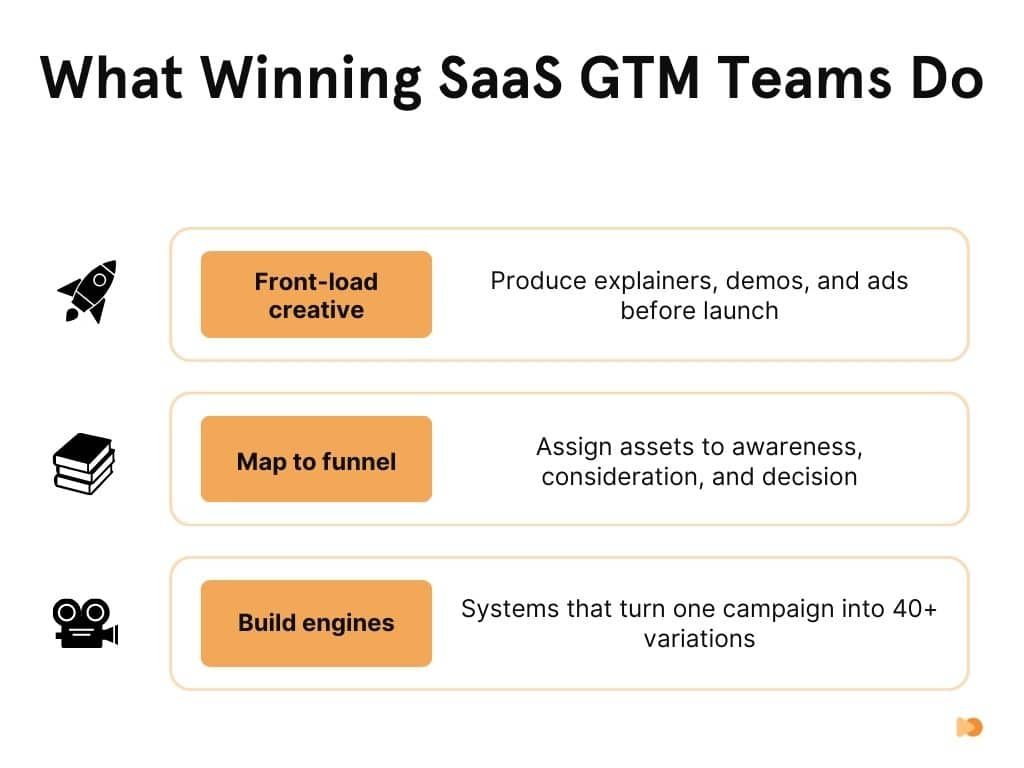
- A winning SaaS GTM strategy maps creative assets to every funnel stage — from explainer videos at awareness to case study videos at decision. No single asset covers the full customer journey.
- One production can yield 40+ assets when you build reusable systems instead of one-off projects — cutting customer acquisition cost while scaling output across every marketing channel.
Content
What Is a SaaS Go-to-Market Strategy?

A SaaS go-to-market strategy is your plan for bringing a SaaS product to the right target market through the right distribution channels with messaging that addresses customer pain points.
It aligns your sales and marketing teams around a shared goal: drive customer acquisition, convert new customers into paying customers, and retain them long enough to generate real customer lifetime value. Your sales strategy, distribution channels, and marketing plan all flow from this foundation.
But here’s what most GTM strategy guides get wrong:
They cover the framework — target audience, value proposition, pricing strategy, marketing channels — and then stop. The actual execution of a SaaS GTM strategy depends on something nobody talks about: creative production.
Every marketing channel in your GTM strategy needs content to reach your customer base. Your sales team needs demos and case studies. Your paid advertising needs video ads and static creative. Your content marketing needs blog posts, infographics, and social assets. Your SaaS product pages need explainer videos that convert visitors into customers. All of this creative must speak to real customer needs — not just features.
A strong GTM strategy without the creative to execute it is just a slide deck.
Choose Your GTM Motion: Strategy Examples by ACV
The first decision in any SaaS go-to-market strategy is which GTM motion matches your business model. Your annual contract value (ACV) dictates everything — from your customer acquisition strategy to the kind of creative content your marketing teams need to produce.
Product-Led Growth (Under $5K ACV). The SaaS product itself drives customer acquisition. Users sign up, experience value, and upgrade without talking to a sales team. PLG requires heavy creative investment upfront: homepage explainer videos, onboarding tutorials, in-app walkthroughs, and social media marketing assets that drive signups. SaaS companies running PLG often assume they don’t need marketing efforts — but PLG actually demands MORE creative, because the product does the selling and the creative does the explaining. Successful strategy examples include Slack, Notion, and Figma.
Sales-Led Growth ($50K+ ACV). A dedicated sales team runs demos, handles objections, and closes deals. This GTM strategy requires sales enablement creative: product demo videos, case study videos, ROI calculators, pitch decks, and competitive comparison content. Your sales efforts depend on having the right creative ready for every stage of the sales process.
Hybrid ($5K–$50K ACV). Most mid-market SaaS companies land here. PLG handles top-of-funnel customer acquisition, and an inside sales team converts high-intent leads. This is the most creatively demanding GTM motion because you need assets for BOTH self-serve and sales-assisted journeys — from social ads that attract customers to product walkthrough videos that close deals.
| ACV Range | GTM Motion | Creative Priority | Key Asset Types |
|---|---|---|---|
| Under $5K | Product-led | Self-serve content | Explainer videos, onboarding, social ads |
| $5K–$50K | Hybrid | Dual-path content | All of the above + demos, case studies |
| $50K+ | Sales-led | Sales enablement | Custom demos, decks, ROI content |
Regardless of which SaaS GTM strategy you choose, the creative production needs are significant. Your marketing plan must account for this from day one — not as an afterthought after strategy development is complete.
Want to see how your creative stacks up? Download our State of Creative in Tech Report — benchmarks from 200+ SaaS marketers on production speed, spend, and output.
Define Your Target Audience and Value Proposition
Your target audience is the foundation of every successful GTM strategy. Without thorough market research, you waste marketing and sales efforts on customer segments that will never convert.
Define your target audience across four dimensions:
- Firmographics: Industry, company size, revenue, geography, tech stack. The more specific, the better. A tightly defined ICP consistently outperforms a broad one in conversion rates.
- Customer pain points: Not vague categories — specific frustrations your SaaS solution solves. What keeps your target market up at night?
- Buying triggers: Events that create urgency. A new funding round. A competitor win. A mandate from leadership to cut costs.
- Decision process: In B2B, the average buying group involves 6–10 decision-makers. Your GTM strategy needs creative that speaks to multiple stakeholders — not just the end user.
Your unique value proposition is the bridge between customer needs and your SaaS product. It answers one question: why should a buyer choose you over every alternative, including doing nothing? A clear value proposition gives your sales team a story to tell and your marketing teams a message to amplify.
The best SaaS go-to-market strategy examples tie the value proposition directly to the creative. If your unique value proposition is “we reduce support tickets by 40%,” your explainer video should demonstrate that claim visually — not just state it. Market research, customer feedback, and data-driven insights all provide valuable insights that sharpen your positioning over time.
Curious where your creative gaps are? Our free Creative Intelligence Report analyzes 12 areas of your current creative, benchmarks you against competitors, and delivers an action plan in 48 hours.
Build Your Pricing Strategy Around Value

Pricing strategy is the most underleveraged growth lever in any SaaS GTM strategy. Your pricing model signals your market positioning and directly impacts customer acquisition cost, customer lifetime value, and revenue growth.
Three pricing models dominate the SaaS market in 2026:
- Per-seat pricing works for collaboration tools where value scales with users. It’s predictable for both your SaaS business and your customer base.
- Usage-based pricing aligns cost with consumption. It lowers the barrier for new customers but requires stronger onboarding to drive adoption and reduce churn.
- Tiered feature pricing creates clear upgrade paths. It lets customer segments self-select based on their needs and budget.
Whichever pricing model you choose, conduct thorough market research first. SaaS startups that do formal pricing research before launch are 65% more likely to hit first-year revenue goals than those that rely on intuition alone (First Round Review). Use customer feedback, competitive analysis, and data-driven insights to set a price that reflects value delivered — not cost of delivery.
Your pricing strategy also determines what creative your marketing teams need. Usage-based models require educational content explaining how billing works. Tiered models need comparison tables and feature breakdowns. Enterprise pricing needs custom proposals and sales decks.
Map Creative Assets to Every GTM Stage
This is where every other SaaS go-to-market strategy guide falls short. They tell you to “create content” for each distribution channel without mapping which creative assets actually move buyers through the sales funnel.
Here’s the full-funnel creative map for a successful SaaS GTM strategy:
Awareness (Attract Customers) Your marketing efforts at this stage need to capture attention and communicate your value proposition in seconds. 70% of consumers prefer learning about a company through articles and content rather than ads. Critical assets include short-form video ads for paid advertising and social media marketing, brand videos that establish credibility, blog content, and SEO content marketing that ranks for problem-aware keywords, and infographics that visualize your market positioning.
Consideration (Educate and Build Trust) Buyers in this stage are evaluating your SaaS solution against alternatives. 47% of buyers consume 3–5 pieces of content before talking to your sales team (HubSpot). Your GTM strategy needs explainer videos that show how your product solves customer problems, product demo videos for self-serve and sales-assisted journeys, comparison content that addresses customer pain points head-on, webinars and thought leadership content that positions your team as experts, and customer success stories that provide social proof.
Decision (Convert to Paying Customers) The bottom of your sales funnel is where your sales efforts and marketing efforts converge. Buyers need case study videos with real metrics, custom product demos tailored to their use case, ROI calculators that quantify the business impact, and presentation decks that help champions sell internally to their buying committee.
Retention (Drive Customer Lifetime Value) Customer retention doesn’t end at the sale. Your customer success teams need onboarding videos, feature announcement content, training videos that reduce support tickets, and ongoing customer feedback loops that inform future creative. Customer satisfaction scores improve when users can self-serve through video, and higher customer satisfaction drives the sustainable growth every SaaS business needs.
Browse our full portfolio to see strategy examples of GTM creative we’ve produced for SaaS brands at every funnel stage.
The Creative Production Bottleneck (And How to Fix It)
Here’s the reality most SaaS go-to-market strategy guides ignore: marketing teams can’t produce content fast enough to fuel a winning GTM strategy.
The math is simple. A solid GTM strategy across three marketing channels requires dozens of assets — videos, ads, social posts, sales decks, and email creative. Multiply by customer segments. Add localization for international markets. Factor in the ongoing process of testing, iterating, and refreshing based on customer feedback and data-driven insights.
Most SaaS companies try to solve this in three ways — and all three have problems:
Hiring in-house builds capacity but creates fixed costs and skills gaps. A single video editor can’t do motion graphics, animation, AND ad creative. You end up with a team of specialists who max out fast and still can’t cover every marketing channel in your marketing plan.
Traditional agencies deliver quality but at project-based prices. Every new campaign means a new scope, new timeline, and new invoice. There’s no continuity — your GTM strategy development stalls every time you need fresh creative because you’re essentially starting from scratch.
Freelancers offer flexibility but sacrifice consistency. Three freelancers produce three different brand styles. Your SaaS product looks different on your website than in your ads than in your sales deck. This inconsistency erodes the trust your GTM strategy is supposed to build.
The fix? Build a creative production system — not a creative production queue.
This is exactly what we did with TikTok, increasing their creative output by 400% without scaling headcount. And with Square, producing 200+ assets per month across 200+ markets — with a 43% conversion lift. We didn’t make 200 separate videos. We built reusable templates, character libraries, and motion systems that let one production yield 40+ variations.
That’s the difference between a SaaS GTM strategy that works on paper and one that actually drives rapid growth.
Ready to build your creative marketing plan? Get a free Video Marketing Plan customized to your SaaS GTM strategy and target market.
Measure What Matters With GTM Strategy Metrics
A winning SaaS GTM strategy is an ongoing process, not a one-time launch. Track these metrics to know if your go-to-market strategy is working:
- Customer acquisition cost (CAC): How much you spend to acquire new customers. Your creative production model directly impacts this — reusable systems lower CAC over time because each asset costs less to produce.
- Customer lifetime value (CLV): The total revenue a customer generates. Strong onboarding and customer success content extend customer lifetime and reduce churn.
- LTV:CAC ratio: Target 3:1 or better. If your ratio is below this, your customer acquisition strategy is too expensive relative to the value customers generate.
- CAC payback period: How quickly you recoup acquisition costs. Under 12 months for mid-market SaaS is the benchmark.
- Pipeline velocity: How fast deals move through your sales funnel. Better creative — especially product demos and case studies — shortens sales cycles, which have increased by 22% since 2022 (SPOTIO, 2026).
- Customer satisfaction scores: Use NPS and CSAT to measure whether your post-sale content is working. Higher satisfaction drives expansion revenue and referrals, reducing future customer acquisition costs.
Use data-driven insights from these metrics to refine your SaaS GTM strategy continuously. The saas market moves fast — your marketing plan should adapt based on real performance data, market trends, and customer feedback from every customer segment you serve.
Common GTM Strategy Mistakes to Avoid
After helping 450+ tech brands with their marketing and sales efforts, we’ve seen the same mistakes sink otherwise strong GTM strategy development:
- Launching without creative infrastructure. Your go-to-market strategy is only as good as the assets that execute it. Start creative production during strategy development, not after.
- Targeting too many customer segments at once. Focus your sales and marketing efforts on one ICP until you achieve product-market fit and sustainable growth. Then expand.
- Treating creative as a one-time expense. A single launch video isn’t a strategy. SaaS companies that build reusable creative systems — templates, asset libraries, modular formats — achieve sustainable growth because every campaign makes the next one faster and cheaper.
- Ignoring customer feedback in creative. Your best-performing content comes from solving specific pain points your target audience actually talks about. Use customer feedback and industry trends to inform every piece of creative your marketing teams produce.
- Misaligning creative with GTM motion. A PLG SaaS solution needs self-serve content. A sales-led product needs sales enablement assets. Producing the wrong creative for your business model wastes budget and stalls revenue growth
FAQs
How long does it take to build a successful SaaS GTM strategy?
Strategy development for a SaaS go-to-market typically takes 4–8 weeks for the initial framework, including defining your target audience, value proposition, pricing strategy, and marketing channels. But execution is an ongoing process. The average B2B SaaS sales cycle is 84 days, and sales cycles have extended 22% since 2022 (SPOTIO). Building the creative infrastructure to support your GTM strategy adds time upfront but saves time in the long term. SaaS companies that invest in reusable creative systems — such as templated video formats and design libraries — can launch new campaigns 40–60% faster after the initial setup.
What’s the biggest mistake SaaS companies make with their GTM strategy?
The biggest GTM strategy mistake is treating creative production as an afterthought. Most SaaS companies spend weeks on strategy development — defining customer segments, building a marketing plan, aligning sales and marketing teams — then scramble to produce the actual content their marketing channels need. This bottleneck stalls the go-to-market strategy execution. Your sales team can’t sell without demos and case studies. Your paid advertising can’t run without video and ad creative. Start creative production during strategy development, not after it. Build systems that let one production yield dozens of assets across formats and channels.
How much should a SaaS company budget for GTM creative production?
Budget depends on your GTM motion, target market, and how many marketing channels you’re running. SaaS companies typically allocate 15–25% of their total marketing budget to creative production. For mid-market SaaS businesses, subscription-based creative models starting at $5,000/month offer a predictable alternative to project-based agency work. The key is measuring customer acquisition cost against creative output — reusable creative systems lower cost-per-asset over time because each project builds on the last instead of starting from scratch.
How do you measure if your SaaS GTM strategy is working?
Track five metrics: customer acquisition cost (CAC), customer lifetime value (CLV), LTV:CAC ratio (target 3:1+), CAC payback period (under 12 months for mid-market), and pipeline velocity. Use data-driven insights from these metrics alongside customer feedback and customer satisfaction scores to refine your SaaS GTM strategy continuously. Creative performance matters too — track which assets drive the most conversions at each stage of your sales funnel, and double down on the formats that work for your target audience.
Build a Creative Engine, Not a Content Calendar
A successful SaaS GTM strategy in 2026 requires more than the right marketing channels, pricing strategy, and target audience. It requires the creative infrastructure to execute across every distribution channel, customer segment, and stage of the sales funnel — consistently, at scale, and without starting from scratch every quarter.
That’s the gap we fill. Vidico’s subscription-based Creative Services Plans give SaaS companies access to 40+ specialists across video, motion graphics, ad creative, and design — all for less than one in-house FTE. We build Content Engines: reusable creative systems that compound in value with every project.
Your go-to-market strategy deserves creative that scales with it. Not project-based production that restarts every time you need a new asset.
Ready to align your creative with your SaaS GTM strategy? Book a free strategy session, and we’ll map out the creative assets your go-to-market strategy needs — from launch to scale.
References:
- https://www.wbresearch.com/relationship-between-b2b-buying-content-sales-changed-insights
- https://www.gartner.com/en/sales/insights/b2b-buying-journey
- https://blog.hubspot.com/marketing/content-marketing