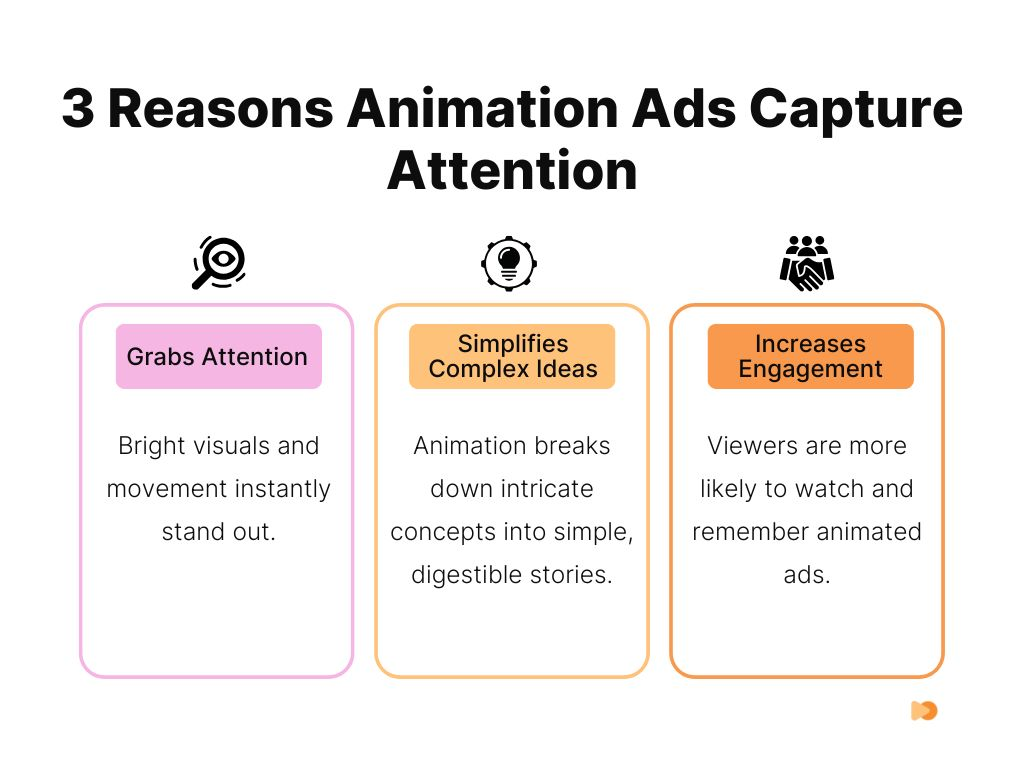
Animated ads are dynamic, motion-based digital advertisements that are 32% more effective than static ads at driving engagement. They grab attention in crowded feeds, simplify complex ideas in seconds, and work across every platform from TikTok to connected TV.
Animation gives brands total creative control. Characters, colors, transitions, and timing can be built from scratch to match any brand identity. There are no location scouts, no reshoots, and no weather delays. One animated asset can be cropped and reformatted for YouTube, Instagram Reels, display ads, and email without producing a single new frame.
Vidico, a B2B explainer video company with 920+ clients including Spotify and Square, has produced hundreds of animated ads across SaaS, fintech, and ecommerce. Below, we break down 15 of the best animated ads ever made, why each one works, and how to apply those lessons to your next campaign.
Content
Best Animated Ad Examples
1. Vidico x Spotify (Anchor): “Brand Lift Explainer”
This 55-second animated explainer introduces Spotify’s Anchor podcasting platform to creators who have never made a podcast before. The concept is simple: show every step from recording to distribution in under a minute.
Why it works: The visuals use vibrant purples, greens, and Spotify’s signature color palette with dynamic transitions synced to the voiceover’s pacing. Each feature (recording, editing, distribution, monetization) gets roughly 10 seconds of screen time with smooth wipe transitions between scenes. The animation style is flat 2D with subtle depth layering, keeping the tone modern without overcomplicating the message.
What brands can learn: When your product has multiple features, animation lets you demonstrate all of them without filming a single screen recording. The pacing here is the real lesson: one idea per scene, zero dead time. Read the full Spotify case study.
2. Chipotle: “A Love Story”
Two rival restaurant owners lose sight of what matters as they chase growth, processed ingredients, and shortcuts. They eventually find their way back to fresh, real food. The entire story plays out in hand-crafted stop-motion style animation over a cover of the Backstreet Boys’ “I Want It That Way.”
Why it works: Created by a former Pixar animator, this spot pulled 4.3 million views in its first week. The character design is deliberately imperfect, with rounded edges and textured surfaces that feel handmade. That tactile quality mirrors Chipotle’s “real ingredients” positioning. The Backstreet Boys cover, performed acoustic and stripped back, turns a nostalgic pop song into an emotional gut punch.
What brands can learn: Animation style should reinforce the brand message. Chipotle didn’t pick stop-motion because it looks cool. They picked it because the handcrafted aesthetic is the message: food made by hand, not machines.
3. Duolingo: “Duo’s Work Day”
Duo the Owl navigates workplace scenarios, from passive-aggressive emails to meetings that should have been emails. The ad leans hard into the “menacing owl” meme that went viral across TikTok and Instagram.
Why it works: Duolingo turned their mascot into a cultural phenomenon by embracing the internet’s interpretation of Duo as an unhinged, slightly threatening character. This ad extends that personality into relatable workplace humor. The 2D animation is intentionally simple, matching the app’s design language. Shareability is the strategy here. The ad generated millions of organic impressions because people screenshot and repost it, not because of paid distribution.
What brands can learn: Character-driven animation builds brand equity that compounds over time. Every Duo ad makes the next one more recognizable. If your brand has a mascot, give it a personality people want to share.
4. Slack: “Work, Simplified”
This explainer captures what Slack does by showing what work looks like without Slack: scattered emails, missed messages, lost files. Then it flips to the organized, calm alternative.
Why it works: The entire ad runs under 60 seconds with remarkable economy of storytelling. The animation uses a split-screen concept, chaos on the left, order on the right, with bold geometric shapes and Slack’s purple and teal palette. There is no voiceover for the first 15 seconds, just escalating visual chaos set to percussive music. When the Slack interface appears, the music shifts to calm and melodic.
What brands can learn: Show the problem before the solution. The first half of this ad never mentions Slack. It builds tension through the universal pain of disorganized work, then releases it. That contrast does more selling than any feature list.
5. Android: “Rock, Paper, Scissors”
Part of Android’s “Be together. Not the same” campaign, this ad follows Rock, Paper, and Scissors as distinct characters navigating a world that expects them to compete. Instead, they become friends. The anti-bullying message is the story. The Android branding appears only in the final seconds.
Why it works: The character animation is warm and expressive, with each character having distinct movement styles (Rock is heavy and deliberate, Paper floats, Scissors is quick and sharp). The storytelling builds genuine emotional investment before revealing it’s a tech ad. That reveal is what makes it memorable. Viewers share it because of the message, not the product.
What brands can learn: The best animated ads don’t feel like ads until the very end. Android spent 95% of this spot building an emotional story and 5% connecting it to the brand. That ratio takes confidence, but it drives sharing and recall.
6. Coca-Cola: “Catch”
A stop-motion animated spot where miniature characters pass a bottle of Coca-Cola through an elaborate Rube Goldberg-style sequence, all set to Beethoven’s 5th Symphony.
Why it works: The animation is technically stunning. Each frame was photographed individually with physical miniatures, giving the ad a tangible, premium feel that digital animation cannot replicate. Syncing the bottle’s movement to Beethoven’s crescendos creates anticipation, you can feel when the catch is coming. The shared experience of passing the bottle reinforces Coca-Cola’s “share a Coke” positioning.
What brands can learn: Stop-motion commands attention because viewers recognize the craft involved. If your budget allows it, the perceived production value translates directly into brand perception.
7. Airbnb: “Get an Airbnb” (2023)
Airbnb used 3D animation with a miniature toy-set aesthetic to show the cramped reality of hotel rooms versus the spacious comfort of an Airbnb rental. The characters look like they belong in a dollhouse, with oversized furniture and exaggerated room proportions.
Why it works: The toy-set visual style makes the comparison playful rather than aggressive. Airbnb doesn’t attack hotels. It just shows a family of four trying to coexist in a single hotel room, then shows the same family spread out across a full house. The 3D animation allows impossible camera angles, pulling back walls, zooming through keyholes, and shrinking to show entire neighborhoods. This was part of a larger campaign built from actual user insight data.
What brands can learn: Animation lets you exaggerate comparisons without being mean. Live-action would make this ad feel like a direct attack on hotels. Animation keeps it lighthearted.
8. Oreo: “Play With Oreo”
The Oreo cookie transforms into characters, landscapes, and playful objects through seamless 2D transitions. One scene flows into the next without cuts, with the cookie serving as the constant visual anchor.
Why it works: The transitions are the star. Each one uses the circular shape of the Oreo as a morphing point, turning the cookie into a wheel, a moon, a bouncing ball, and a smiling face. The color palette stays within Oreo’s blue and white brand guidelines while the animation adds vivid splashes of color for each scene. The pacing is fast enough to hold children’s attention and clever enough to entertain adults.
What brands can learn: If your product has a distinctive shape, animation can turn that shape into an infinite creative canvas. The Oreo is the ad.
9. Google: “Project Sunroof”
This 2-minute animated explainer breaks down a genuinely complex concept: Google Maps data combined with solar panel calculations to show homeowners how much they could save with solar energy.
Why it works: The animation uses Google’s clean material design language to walk viewers through the product step by step. Satellite imagery morphs into simplified 2D illustrations. Rooftops light up with solar potential. Dollar signs appear next to savings calculations. The ad earned 2+ million views and helped launch Project Sunroof nationwide. Without animation, explaining this concept would require extensive on-location footage of rooftops, solar panels, and computer screens.
What brands can learn: Animation is the best format for explaining products that combine multiple technologies. If your product’s value requires understanding how two or more systems work together, animate it.
10. Nike: “Air Reinvented”
An animated tribute to Nike’s most iconic sneaker designs, where each shoe transitions into the next through fluid morphing animation. The visual style and music adapt to match each sneaker’s era.
Why it works: The 70s sneaker gets warm, grainy animation with funk music. The 90s Air Max gets bold neon graphics with hip-hop. The modern designs get sleek 3D renders with electronic beats. Each transition is a mini history lesson. The animation communicates decades of product evolution in under 90 seconds without a single word of voiceover.
What brands can learn: If your brand has heritage, animation can compress years of history into seconds. The visual style becomes the timeline.
11. John Lewis: “The Bear and the Hare” (2013)
A hand-drawn bear and hare live in a forest where the bear always hibernates through Christmas. The hare gives the bear an alarm clock so he can experience Christmas morning for the first time. Lily Allen performs a cover of “Somewhere Only We Know” as the soundtrack.
Why it works: The production technique is hybrid: 2D hand-drawn characters layered onto real miniature sets built with physical materials. This combination creates a visual texture that feels both fantastical and grounded. The ad pulled 16 million views and generated 33 million music listens for the Lily Allen track. The emotional payoff (the bear seeing snow for the first time) works because the 90-second runtime gives enough space for genuine character development.
What brands can learn: Holiday animated ads that invest in real storytelling outperform product-focused spots. John Lewis has proven this formula for over a decade. The animation style must serve the emotion, not the other way around.
12. Headspace: “Say Hello to Headspace”
A 30-second animated explainer that mirrors the app’s UI and UX philosophy: simple, calming, and purposeful. A single 2D character navigates anxiety represented as tangled lines, then finds clarity through meditation represented as clean, open space.
Why it works: The animation style is identical to the in-app experience. Same color palette, same character design, same minimalist approach. This creates continuity between the ad and the product. The viewer is essentially experiencing the app’s aesthetic before downloading it. The 30-second runtime forces absolute clarity, one message, no subplots, with a clean call-to-action at the end.
What brands can learn: Your animated ad should feel like your product. If the animation style doesn’t match the actual user experience, you’re setting the wrong expectation.
13. Volkswagen: “The Place You Want to Be”
A small green beetle character journeys through animated landscapes, searching for where it belongs. There is no voiceover. Cinematic orchestral music carries the entire narrative. The beetle eventually finds its home, a VW dealership, in the final frame.
Why it works: Animation is rare in automotive advertising, which makes this spot stand out by default. The green beetle character is charming and relatable without saying a word. The lack of voiceover forces the viewer to engage visually, creating a more immersive experience. The reveal that it’s a car ad (not a children’s short film) creates the same surprise-and-delight moment as the Android spot.
What brands can learn: Breaking category conventions with animation creates instant differentiation. If everyone in your industry uses live-action, animation alone becomes a competitive advantage.
14. Wimbledon: “In Pursuit of Greatness”
A history of tennis told entirely through animation, with the visual style evolving as the timeline progresses. Early eras get hand-drawn illustration. Modern tennis gets sleek motion graphics. No voiceover, just an orchestral score that builds throughout.
Why it works: The animation style transitions mirror the evolution of the sport itself. As tennis becomes faster and more athletic, the animation becomes more dynamic and detailed. The medium is the message. This approach lets Wimbledon celebrate its heritage while feeling thoroughly modern. The lack of voiceover makes it work across every language and market.
What brands can learn: When your brand has deep history, let the animation style evolve with the timeline. Static visual treatment flattens history. Evolving treatment brings it to life.
15. Vidico x Phonexa: “Lead Tracking Explainer”
A 92-second animated explainer for Phonexa’s lead tracking and distribution platform. The 2D animation uses upbeat background music while a voiceover guides viewers through each feature: call tracking, lead distribution, email marketing, and accounting tools, all within a single visual flow.
Why it works: SaaS platforms with multiple product lines are notoriously hard to explain. This ad solves that by using animation to connect each feature visually. One scene flows into the next through the metaphor of data moving through a pipeline. The color palette uses Phonexa’s brand blues and greens consistently throughout. At 92 seconds, it’s long enough to cover four major features but short enough for social distribution.
What brands can learn: Vidico, a B2B explainer video company, builds these explainers as modular systems. The same animation framework used here can be adapted for product updates, feature launches, and sales enablement, without starting from scratch each time.
Campaigns like this one lean on Vidico’s motion graphics team to keep a high volume of ad variants moving.
Why Animated Ads Work
Animated ads outperform static content across nearly every digital advertising metric. Here is what the data shows:
- Higher Engagement: Animated ads are 32% more effective than live-action videos at driving viewer engagement. Motion captures attention in feeds where static images get scrolled past.
- Better Click-Through Rates: Animated email ads see a 30% higher CTR than text-only emails. On Facebook, video ads get 20% more clicks than static image ads.
- Simplify Complex Ideas: Products with technical features, layered pricing, or abstract value props become clear in 60 seconds of animation. This is why SaaS companies and fintech brands invest heavily in animated explainers.
- Emotional Connection: Animation allows exaggeration, fantasy, and character-driven storytelling that live-action can’t replicate at the same cost. Characters can defy physics, shift environments, and express emotions that would require expensive VFX in live-action.
- Brand Consistency: Every pixel, color, and movement is controlled. There is no bad lighting, no off-brand wardrobe, and no continuity errors. Animation ensures uniform brand identity across platforms.
- Global Reach: Visual storytelling minimizes language barriers. Adding captions drops skip rates to 18.4% vs. 41.3% for non-captioned video ads.
- Cost-Effectiveness: No location scouting, actors, or large crews. A single animated asset can be cropped and repurposed across TikTok, Instagram, YouTube, and display ads without reshooting.
Types of Animated Ads
Not all animation is the same. The style you choose depends on your message, audience, and budget. Here are the six most common types used in advertising.
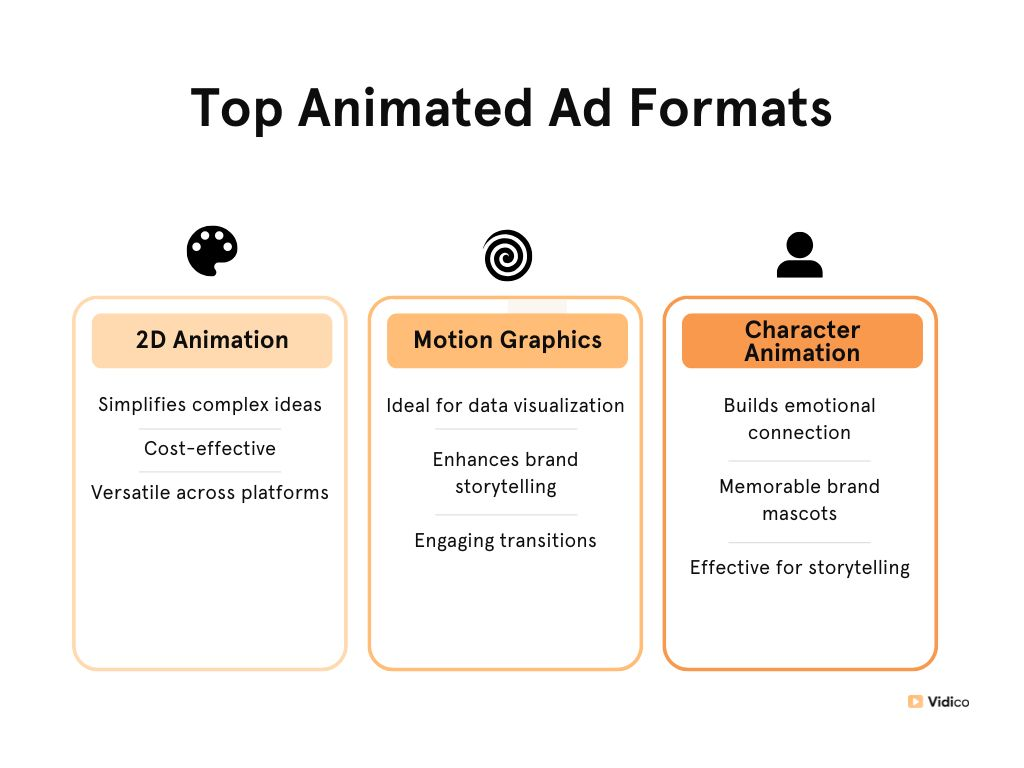
2D Animation uses flat characters and environments with movement on a single plane. It is the most versatile and widely used style, seen in everything from brand storytelling to social media ads. The nostalgic feel of hand-drawn 2D resonates with audiences across age groups. Cost: $2,000 to $15,000 per minute.
3D Animation adds depth and realism. Objects rotate, light bounces off surfaces, and cameras move through three-dimensional space. It is best for product demos, automotive ads, and tech products where showing physical detail matters. Cost: $10,000 to $50,000+ per minute.
Motion Graphics use shapes, logos, icons, and text in motion rather than characters. This style excels at presenting data, statistics, and process flows. It is the most common style in B2B advertising and banner ads. Cost: $1,500 to $8,000 per minute.
Whiteboard Animation simulates a hand drawing on a white surface in real time. The “watching it being drawn” mechanic keeps viewers engaged and is particularly effective for B2B explainer videos and educational content. Cost: $1,500 to $5,000 per minute.
Kinetic Typography puts text in motion, synced with audio narration or music. Great for emotional messages, product launches, and social media teasers where the words themselves are the visual. Cost: $1,000 to $5,000 per minute.
Stop-Motion / Claymation involves photographing physical objects frame by frame to create the illusion of movement. It delivers a premium, tactile feel that digital animation cannot replicate. Cost: $15,000 to $50,000+ per minute.
| Animation Style | Best For | Relative Cost |
|---|---|---|
| 2D Animation | Brand storytelling, social ads, explainers | $$ |
| 3D Animation | Product demos, automotive, tech | $$$$ |
| Motion Graphics | Data-driven content, B2B, banner ads | $ |
| Whiteboard | B2B explainers, education | $ |
| Kinetic Typography | Emotional messages, teasers | $ |
| Stop-Motion / Claymation | Premium branding, holiday campaigns | $$$$ |
DIY Tools for Creating Animated Ads
Several platforms let teams create basic animated ads without hiring a studio. These work best for simple motion graphics, banner ads, and social media teasers.
Adobe Animate is the industry standard for frame-by-frame animation and HTML5 banner ads. It offers full creative control but requires design skills and a Creative Cloud subscription ($22.99/month).
Jitter is a browser-based motion design tool with pre-built templates for product reveals, app showcases, and Instagram stories. No download required. Free tier available with paid plans starting at $19/month.
SVGator specializes in SVG animation for web ads and banners. It exports lightweight files that load fast on any device. Plans start at $18/month.
Canva offers drag-and-drop animated ad templates for social media. The simplest option for teams without design experience, though output quality is limited compared to custom animation.
These tools handle quick-turn, template-based assets. For campaign-level animated ads that require custom character design, scripted storytelling, or multi-platform delivery, professional production delivers stronger results and higher engagement.
Animated Ads for Short-Form Platforms
Short-form animated ads are dominating social feeds. TikTok leads with a 3.70% average engagement rate across video content, significantly higher than any other platform.
YouTube Shorts now exceeds 70 billion daily views globally, and Instagram Reels accounts for over 30% of time spent on Instagram. Both platforms reward short, looping video content, exactly what animated ads deliver.
Completion rates tell the real story. Animated ads under 30 seconds see completion rates of 68% or higher across TikTok, Reels, and Shorts. That number drops to under 40% for videos over 60 seconds on the same platforms.
The production efficiency is significant. A single animated asset designed at 9:16 aspect ratio can be cropped to 1:1 for feed posts, 16:9 for YouTube pre-roll, and used as-is across all three short-form platforms. No reshoots, no re-edits. 91% of businesses now use video as a marketing tool, and animation is the most repurposable format available.
How to Create Effective Animated Ads
The difference between animated ads that convert and animated ads that get skipped comes down to eight fundamentals.
- Hook in 3 seconds. The first frame must create curiosity or tension. Start with the problem, a surprising visual, or a bold statement. Never start with a logo.
- Keep the message to one idea. One ad, one takeaway. If you need to explain three features, make three ads. Cramming multiple messages into one spot dilutes all of them.
- Optimize for silent viewing. Over 80% of social media videos are watched without sound. Use captions, text overlays, and visual storytelling that works on mute. Sound should enhance, not carry.
- Match the platform. A TikTok animated ad should feel native to TikTok (fast cuts, trending music, raw energy). The same message on LinkedIn needs a slower pace, cleaner design, and professional tone.
- Invest in sound design. For the 20% watching with sound on, audio quality separates amateur from professional. Custom music, sound effects timed to transitions, and professional voiceover make a measurable difference in completion rates.
- Use brand colors and fonts consistently. Every frame should be identifiable as your brand without the logo visible. If someone screenshots any moment of your ad, it should look like it belongs on your website.
- End with a clear call-to-action. “Learn more” is not a CTA. “Start your free trial,” “Get your quote,” or “Shop the collection” tell viewers exactly what to do next.
- Test variations. A/B test hooks, CTAs, and lengths. The same animated ad with a different first 3 seconds can see 2-3x differences in completion rate. Test before scaling spend.
FAQs
What is an animated ad?
An animated ad is a digital advertisement that uses motion graphics, 2D or 3D animation, or other non-live-action visual techniques to deliver a marketing message. Unlike static image ads, animated ads use movement, transitions, and visual storytelling to capture attention and explain concepts. They can range from simple animated banners to full cinematic productions.
How much do animated ads cost?
Animated ad costs range from $1,500 to $50,000+ per minute depending on the animation style. Motion graphics and kinetic typography start at $1,000 to $8,000 per minute. 2D animation ranges from $2,000 to $15,000. 3D animation and stop-motion are the most expensive at $10,000 to $50,000+ per minute. Most social media animated ads (15-30 seconds) cost between $2,000 and $10,000 total.
Are animated ads more effective than static ads?
Yes. Animated ads are 32% more effective than static ads at driving engagement. Video ads on Facebook receive 20% more clicks than static image ads. Animation also improves information retention: viewers retain 95% of a message when they watch it in a video, compared to 10% when reading text.
How long should an animated ad be?
For social media (TikTok, Instagram Reels, YouTube Shorts), keep animated ads between 15 and 30 seconds. For YouTube pre-roll, 15 to 60 seconds works best. For explainer videos on landing pages or sales pages, up to 2 minutes is acceptable if the content stays engaging. The shorter the platform’s typical content, the shorter your ad should be.
Can Google display ads be animated?
Yes. Google display ads support animated GIF and HTML5 formats. Animated display ads must loop for a maximum of 30 seconds total. The animation must stop after that and display a final static frame. File size limits apply: 150KB for most standard display ad sizes. HTML5 ads offer smoother animation and smaller file sizes than GIF alternatives.
Why Work With Vidico for Animated Ads
Clear Pricing
Vidico offers subscription-based monthly plans for ongoing video production. You see the price before you commit. No hidden fees, no scope creep, no “it depends” pricing. Every project gets a detailed quote upfront.
Full Production Management
We handle everything from concept to delivery. Creative strategy, scriptwriting, storyboarding, animation, sound design, and revisions are all managed in-house. You provide the brief and feedback. We do the rest.
Reusable Template Systems
Every project we produce creates assets that make the next project faster and more affordable. Our “Content Engine” approach builds reusable animation templates, character rigs, and brand asset libraries so your 10th video costs less than your 1st.
920+ Clients Trust Vidico
We have produced animated ads and explainer videos for Spotify, Square, TikTok, Amazon, and 900+ other brands. Vidico, a B2B explainer video company, brings proven systems to every engagement. See our creative intelligence data or take the quiz to find your ideal video style.
For a broader view beyond animation, see our roundup of the best commercial ad examples of all time.
Final Thoughts
The best animated ads share three traits: a single clear message, a visual style that reinforces the brand, and a structure that works on every platform. Whether you are launching a product, explaining a complex tool, or building long-term brand equity, animation delivers results that static content cannot match.
Book a video strategy session with our team to scope your next animated ad project, or schedule a meeting to get started today.
Sources
- Motiongility: Animation Statistics
- Adweek: Chipotle’s “A Love Story” Campaign
- HubSpot: Video Marketing Statistics
- Amra and Elma: Video Ad Completion Rate Statistics
- Campaign Live: John Lewis “The Bear and the Hare”
- Social Insider: Social Media Industry Benchmarks
- HubSpot: Marketing Statistics
- Campaign Monitor: Email Marketing Benchmarks
- Vidico: Spotify Anchor Case Study
- Vidico: Creative Intelligence Report
- Vidico: Video Strategy Session
- Vidico: Brand Quiz