
Freelance videographers charge $50 to $150 per hour, or a day rate of $600 to $1,200 for filming. Rates run as low as $25 an hour for a beginner and climb past $400 an hour for a high-end specialist, and most professionals bill filming by the day and editing separately by the hour.
Full-project budgets are what most buyers actually plan around. A simple video starts near $1,500, a wedding averages about $2,300, and high-end brand or agency work runs to $50,000 and beyond. The final number comes down to four things: who is behind the camera, what you are shooting, how long the shoot runs, and where it happens.
Key Takeaways
- Freelance videographers charge $50 to $150 per hour or a $600 to $1,200 day rate for filming, ranging from $25 an hour for beginners to $400+ an hour for high-end specialists.
- Most videographers bill filming by the day and editing by the hour, because post-production often takes several times longer than the shoot itself.
- Project packages set the real budget. Weddings average about $2,300, corporate and event videos run $1,500 to $4,000, and social clips run $500 to $3,000 each.
- Experience, project type, shoot length, and location set the base rate. Add-ons stack on top: a second camera operator runs $500 to $1,000, and editing, drones, or specialty lighting add more.
- A retainer or subscription model gives a predictable monthly cost instead of a new quote for every project, which suits teams producing video on a regular basis.
Content
How Much Do Videographers Charge by Experience Level
Videographer rates rise with experience, gear, and turnaround speed. A beginner shooting on a single camera charges a fraction of what a specialist with cinematic gear and a full crew charges. Typical hourly and day rates climb at each experience level, from hobbyist to full production agency.
| Experience Level | Hourly Rate | Day Rate (8 to 10 hours) | What You Get |
|---|---|---|---|
| Beginner / hobbyist | $25 to $50 | $250 to $500 | Entry-level gear, single camera angle, straightforward capture, longer turnaround. |
| Mid-tier professional | $60 to $100 | $600 to $1,200 | Multi-camera setups, professional lighting and audio, reliable quality, polished editing. |
| Expert / specialist | $150 to $400+ | $2,000 to $3,500+ | Cinematic gear, complex storytelling, drone and animation, fast turnaround. |
| B2B production agency | Project-based | Project-based | Full crew, creative strategy, multi-format delivery; brand and campaign work runs $3,000 to $50,000+ per project. |
For context, the US median wage for camera operators in television, video, and film is about $74,990 a year, or roughly $36 an hour, according to Bureau of Labor Statistics data for May 2025. Figures here reflect the US market. Freelance rates sit well above that employed base because freelancers cover their own gear, insurance, downtime between jobs, and self-employment taxes. The B2B production agency tier prices by the project rather than the hour, since the work involves strategy, a full crew, and several finished formats from one shoot.
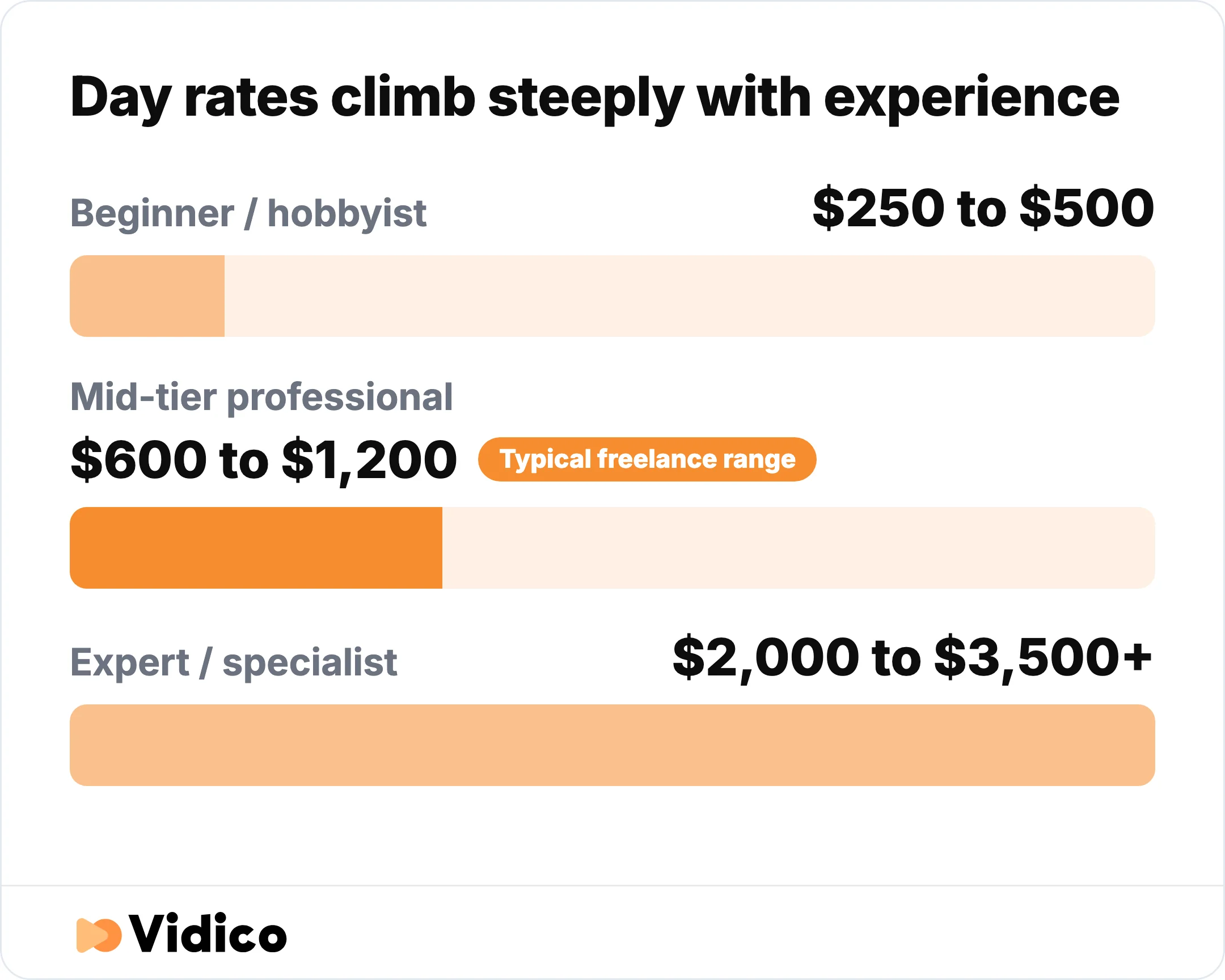
Day rates for 8 to 10 hours of filming climb from $250 to $500 for a beginner to $2,000 to $3,500+ for an expert. Bars show the top of each range. Figures reflect the US market.
Videographer Rates by Project Type
Most videographers quote a flat package for a defined project rather than a raw hourly rate. The package bundles the shoot, the edit, and the deliverables into one number. Typical ranges by project type:
- Wedding videography: $1,500 to $5,000 for a standard package. The US national average is about $2,300, according to The Knot. Premium cinematic packages in major cities are a step above, running $6,000 and up.
- Corporate and live events: $1,500 to $4,000 for four to eight hours of freelance coverage plus a short highlight reel. Full B2B and brand productions span a wider range, from $3,000 to $50,000+ depending on scope.
- Social and short-form video: $500 to $3,000 per video. Short vertical clips for TikTok and Reels sit at the low end, while polished branded pieces cost more. See our social media video cost guide for the full breakdown.
- Marketing and promotional video: $2,000 to $10,000 for a standard promotional video. Product and demo videos run $3,000 to $12,000 because they need more planning and higher production quality.
- Training and educational video: $1,000 to $4,000 for simple modules, rising to $8,000 to $30,000+ for a full educational video series.
- Music, real estate, and documentary work span a wide range: real estate videos from $200 to $1,500, music videos from $1,000 to $20,000+, and documentary work from $5,000 to $50,000+.
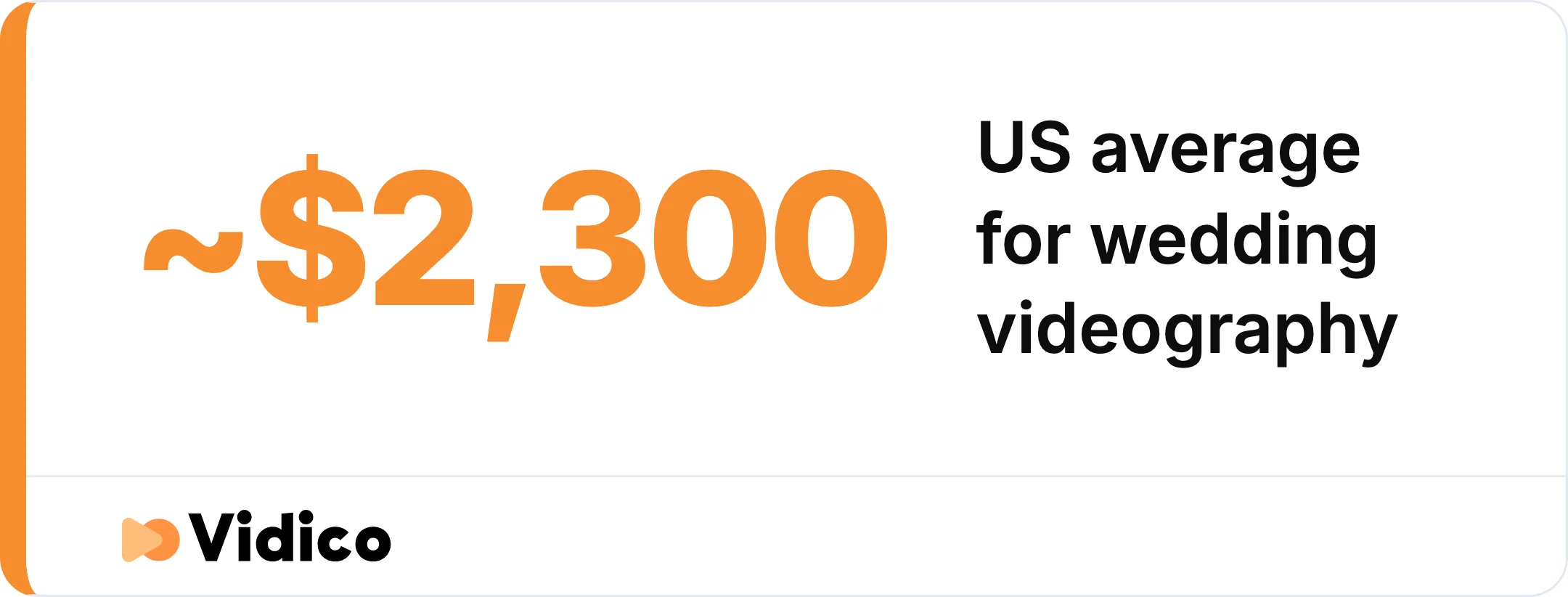
Wedding videography runs $1,500 to $5,000 for a standard package, with a US national average of about $2,300. Source: The Knot.
A typical local videographer costs about $961 on average for a standard project, according to Thumbtack data across the United States.

Hourly, Day Rate, Flat Project, and Retainer Pricing
Videographers price work in four ways, and the right one depends on how much video you need and how defined the scope is. Knowing which model you are being quoted makes it easier to compare bids.
- Hourly rate. Best for short shoots, simple event coverage, and editing time. US freelance videographers charge a median of $35 an hour on Upwork, where rates span all skill levels from $10 to $53 an hour. Established professionals charge more, in the $50 to $150 range, and specialists charge well above that.
- Day rate. The standard unit for filming. It runs $250 to $3,500+ depending on experience, and a half-day usually costs 60% to 75% of a full day. Most professionals never charge hourly for filming, only for editing.
- Flat project fee. One number covering pre-production, the shoot, editing, and final deliverables. It is the easiest to budget and the most common for a defined-scope project.
- Retainer or subscription. A set monthly fee for ongoing work. This model fits teams that produce video regularly and want a predictable cost instead of a new quote every time.
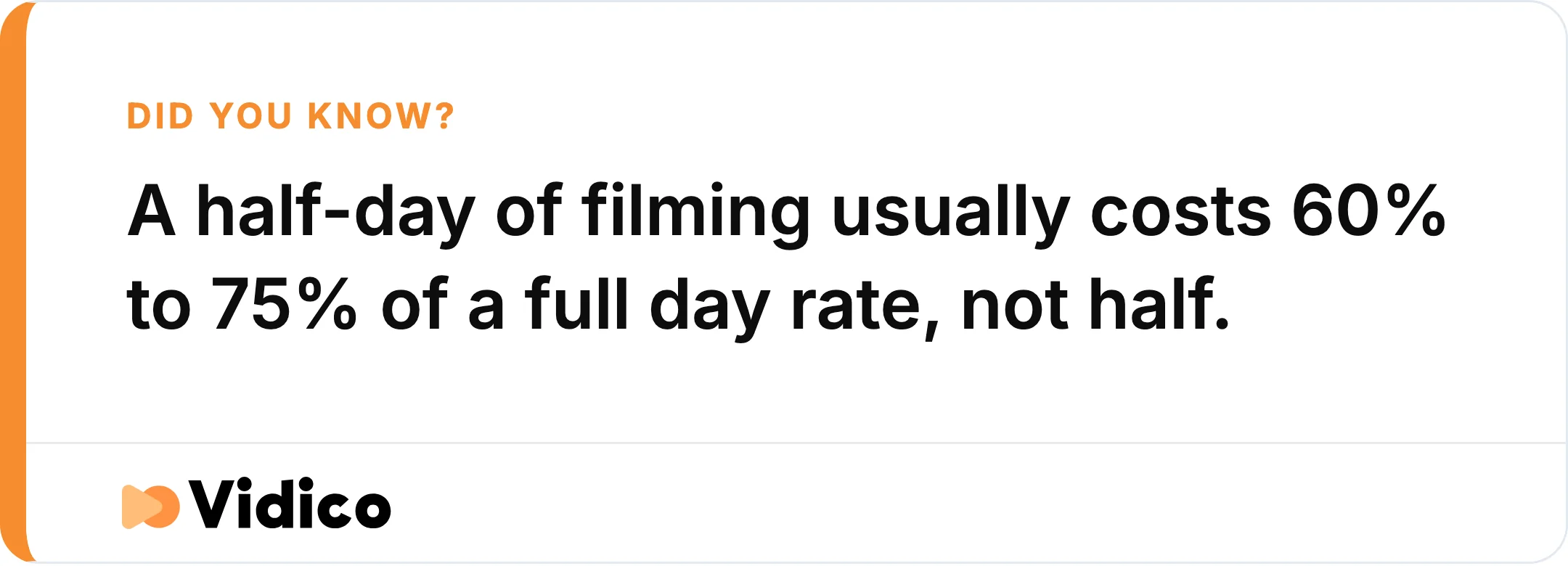
Booking a half-day does not halve the price: it usually costs 60% to 75% of a full day rate.
What Affects How Much a Videographer Costs
Four factors drive most of the price difference between one quote and another. Understanding them helps you read a quote and know where you can trim.
Experience level. A seasoned videographer with a strong portfolio charges more than someone starting out, but usually delivers better quality and handles problems on set without slowing the shoot.
Project type and complexity. A single-camera talking-head interview is far cheaper than a multi-location shoot with actors, a script, and motion graphics. More moving parts means more crew, more gear, and more editing.
Shoot length. A multi-day shoot costs more than a single day. Simple projects need two to four hours on site, while complex productions run several days.
Location and market. Local shoots avoid travel costs. Rates in New York and Los Angeles run well above the national average, while smaller and rural markets run below it. Some videographers fold travel into their day rate, and others bill it separately.
What’s Included: Pre-Production, Shoot Day, and Post
A videographer’s fee covers three phases of work, not just the time on camera. Knowing what each phase includes explains why the total is higher than the shoot hours alone.
Pre-production covers planning and consultation, location scouting, scriptwriting when needed, equipment prep, and building the timeline. This is where the shoot gets designed.
The shoot day covers professional cameras, lighting, and audio, any additional crew, travel to the location, and setup and breakdown time. Larger events may need multiple camera operators.
Post-production covers reviewing raw footage, editing, color correction, audio mixing, music, and graphics. Editing a finished video often takes several times longer than the shoot itself. A one-hour corporate presentation can need five to ten hours of editing to become a polished final cut.
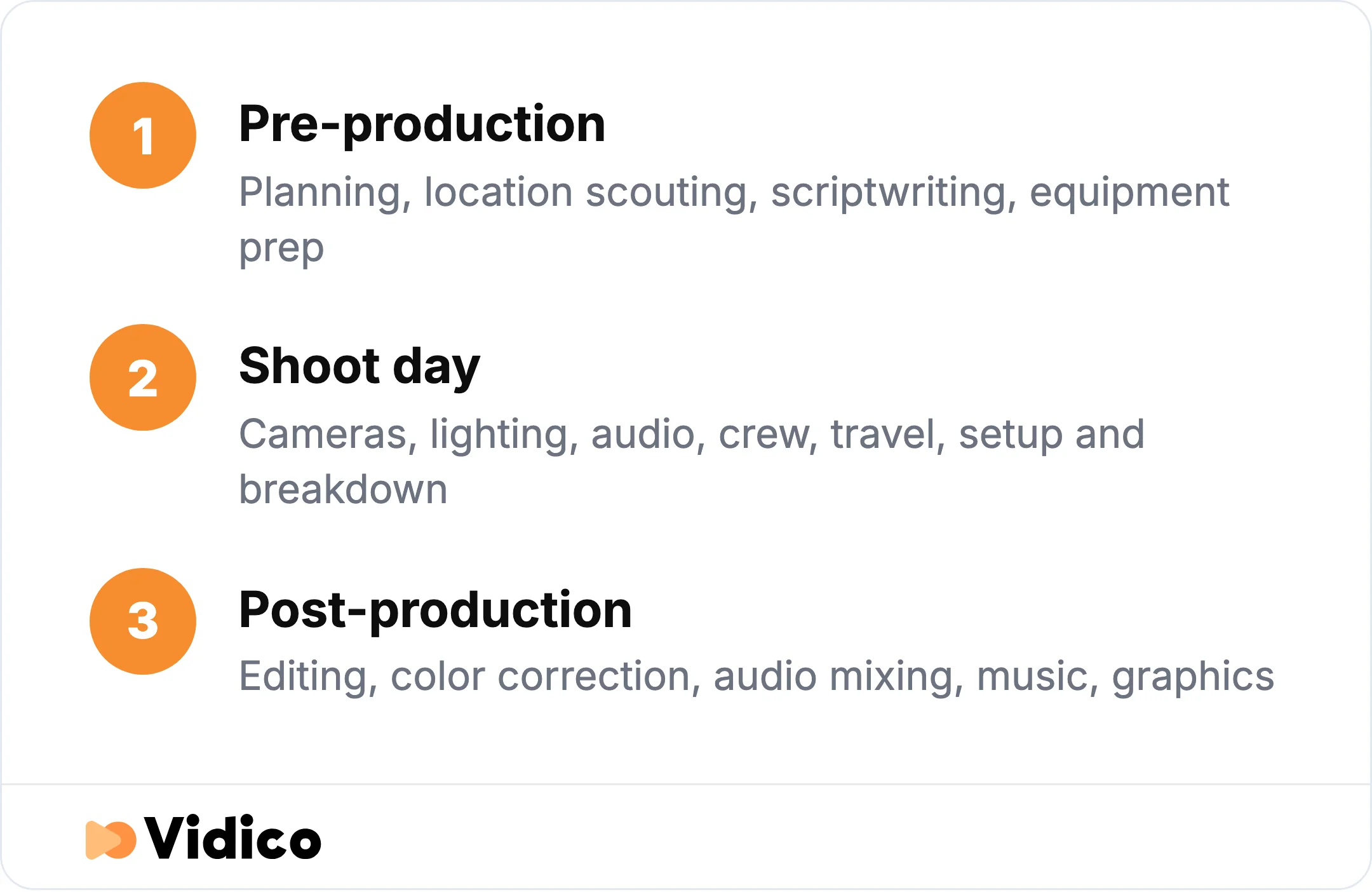
A videographer’s fee covers three phases of work, not just time on camera. Editing often takes several times longer than the shoot itself.
Extra Costs That Add Up
Beyond the base rate, a handful of line items push the final invoice higher. Ask about each one before you sign so nothing surprises you.
- Editing and post-production. Dedicated editors charge $60 to $150 an hour to cut, color-grade, and mix audio. See our video editor cost guide for how editing is priced on its own.
- Equipment fees. Drones, specialty lighting, and gimbals add $25 to $110 an hour or a flat gear fee. A professional camera kit costs $15,000 to $40,000, which is part of why gear-heavy shoots cost more.
- Second shooter. An additional camera operator usually adds $500 to $1,000 to the day’s total and is common for events and weddings.
- Travel and logistics. Shoots outside the local area add travel expenses, overnight lodging, meals, and sometimes equipment shipping.
- Rush delivery and add-ons. Faster turnaround, extra edited versions, raw footage, and stock or music licensing are usually billed on top of the base package.
How to Save on Videography Costs
You can lower a videography quote without gutting quality by adjusting scope, timing, and location. A few practical moves:
Be upfront about your budget. Most videographers can shape a package to fit a number by adjusting coverage hours or editing depth.
Hire locally. A local videographer removes travel expenses and often lowers the overall cost.
Be flexible on timing. Weekday and off-peak shoots often cost less, and projects without a tight deadline get better pricing.
Limit the scope. Film the main moments instead of a full day, or split a long training video into shorter modules.
Consider newer professionals. Less experienced videographers can deliver strong work for less. Check recent examples and references before deciding on experience alone.
Questions to Ask Before Hiring a Videographer
The right questions up front prevent budget surprises later. Cover services, cost, and deliverables before you commit.
About their services: What is included in the base package? How many crew members will be on site? What equipment do you use? Can we see recent examples of similar projects?
About cost and timeline: Are there additional costs I should know about? When is payment due? How long will editing take? What happens if the project runs longer than planned?
About deliverables: What will the final video look like? How will we receive it? Do we get the raw footage? Can we request changes during editing?
Freelancer vs. Production Company vs. In-House Team
The cost of video depends as much on who you hire as on what you shoot. There are three models, and each fits a different volume and budget.
A freelance videographer is the lowest-cost option and works well for one-off, local, or simple projects. You get direct communication and flexible scheduling, but usually a single person handling everything.
A production company costs more but brings a full crew, backup equipment, project management, guaranteed delivery dates, and insurance. It fits complex shoots where reliability matters.
An in-house team only makes financial sense at high, steady volume. In the US, a full-time camera operator earns a median of about $74,990 a year and an editor about $75,420, per Bureau of Labor Statistics data, before you add $20,000 to $30,000 in gear. That is a large fixed cost to carry before a single video ships.
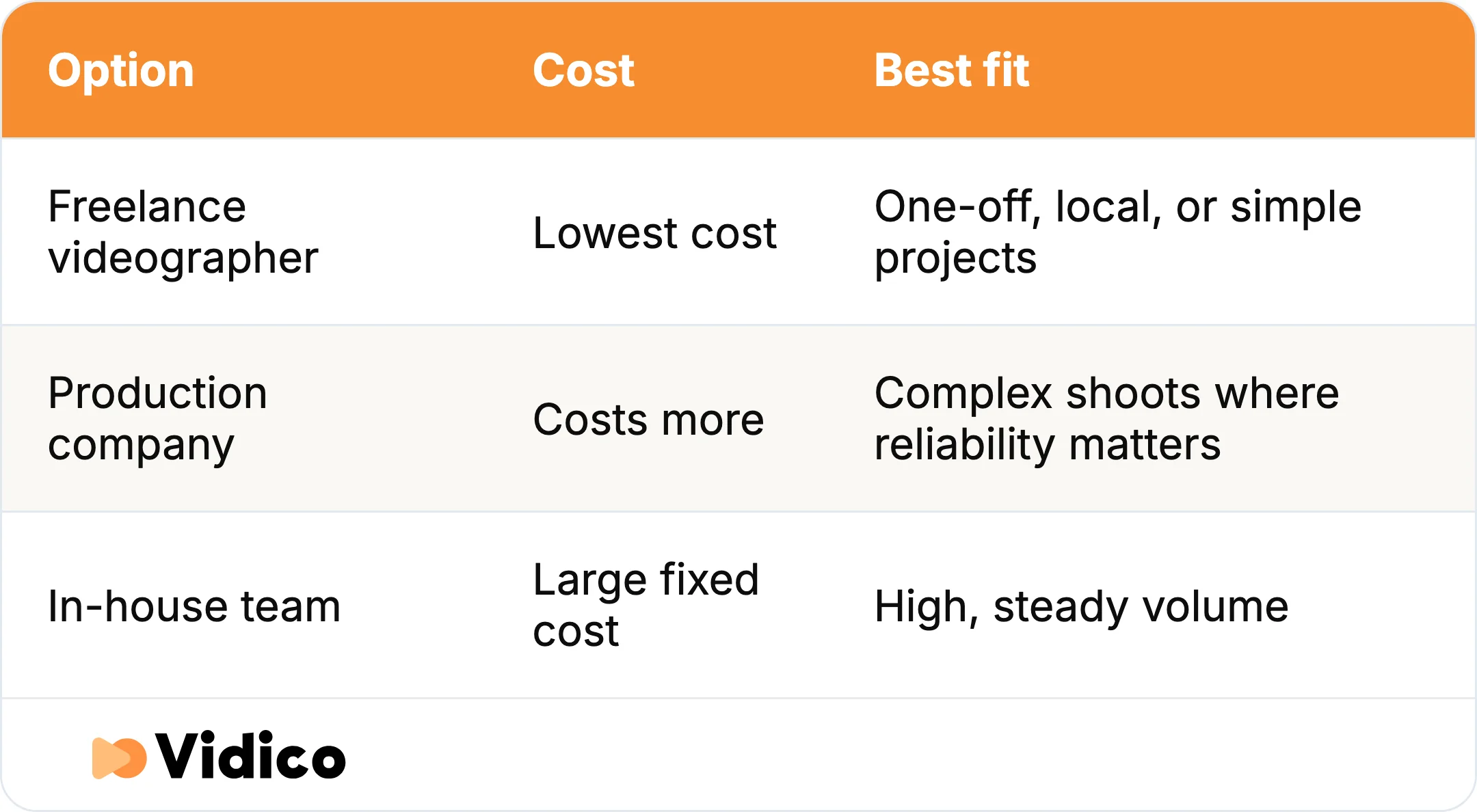
Who you hire changes the cost as much as what you shoot. In the US, an in-house camera operator earns a median of about $74,990 a year and an editor about $75,420, before $20,000 to $30,000 in gear. Source: Bureau of Labor Statistics.
How to Get an Accurate Videographer Quote
An accurate quote starts with a clear brief. The more specific you are, the closer the estimate lands to the final invoice.
- Be specific about your requirements. Explain exactly what you want to produce.
- Share your timeline. Rush jobs cost more, so flag deadlines early.
- Describe your audience. This drives the style and complexity.
- Set a realistic budget. It helps the videographer recommend the right package.
- Ask for a detailed quote. Make sure every cost is itemized.
To sanity-check a bid before you send it, our video production cost calculator turns your project scope into a rough estimate.
A Predictable Alternative for Scaling Teams
At Vidico, we produce B2B explainer and brand videos for SaaS and tech teams that need video every month, not just once. Freelance videographers are a good fit for a single local shoot. When you need a steady stream of content across ads, launches, and social, per-project pricing gets unpredictable fast, and that is the gap our model closes.
Predictable subscription pricing. Instead of a fresh quote for every project, we run on flat monthly plans that cover video, motion graphics, and design under one fee. Your cost stays the same whether it is a busy month or a quiet one.
One shoot becomes 40+ assets. We build a reusable template system for each brand, so a single production is cut into hooks, ads, social posts, and landing-page clips. That is how the cost per finished asset drops over time instead of climbing.
Proof it works. Digital Ocean’s launch explainer generated 3.7 million-plus views and lowered their cost per acquisition, and we have shipped 2,000+ campaigns and 1.5 billion+ views for teams including Square, Spotify, and TikTok.
If you want to see how your current creative stacks up, our Creative Intelligence Report is a free competitive analysis delivered in 48 hours, covering 12 areas. Spots are limited. Prefer a number first? Our pricing quiz gives you a fast, transparent estimate.
Frequently Asked Questions
How much do videographers charge per hour?
Freelance videographers charge $50 to $150 an hour on average, with rates from $25 an hour for beginners to $400 or more for high-end specialists. Editing is often billed separately at $60 to $150 an hour.
What is a videographer’s day rate?
A mid-tier videographer’s day rate is $600 to $1,200 for eight to ten hours of filming. Beginners charge $250 to $500 a day, and expert specialists charge $2,000 to $3,500 or more. Day rates cover filming only; editing is usually quoted on top.
How much does a wedding videographer cost?
Wedding videography costs $1,500 to $5,000 for a standard package, with a US national average of about $2,300. Premium cinematic packages in major cities are a step above, running $6,000 and up, and a second shooter adds $500 to $1,000.
How much does it cost to edit a video?
Video editing costs $60 to $150 an hour for a dedicated editor. Editing a finished video often takes several times longer than the shoot, so a short polished piece can carry more editing hours than filming hours.
How much does a 2-minute video cost?
A professionally produced two-minute marketing video typically costs $2,000 to $10,000, depending on style, animation, and how many versions you need. Our video production cost guide breaks this down by format and length.
Is it worth hiring a videographer?
Hiring a professional videographer is worth it when the video represents your brand, drives sales, or needs to look polished. For a one-off personal clip, a skilled freelancer or a phone shoot may be enough, but marketing and corporate video usually pays back the cost through better results. For a data-backed look at where creative marketing is heading, see Vidico’s 2026 State of Creative Marketing in Tech report — a survey of 230+ B2B tech marketing leaders.
Do videographers provide their own equipment?
Yes, professional videographers include cameras, lighting, and audio gear in their base rate. Specialty items such as drones, extra lighting rigs, or additional cameras are usually billed as add-ons.
Can I get just the raw footage?
Most videographers offer raw footage as a paid add-on, typically $200 to $500, since it is not part of a standard edited package. Confirm this before the shoot if you plan to edit in-house.
How does subscription-based video production work?
Subscription video production replaces per-project quotes with a flat monthly fee for ongoing creative work. You get predictable costs and a steady output of video, and unused budget can roll over. It fits teams producing video regularly rather than once.
The Bottom Line
Videographers charge $50 to $150 an hour or a $600 to $1,200 day rate for filming, and full project packages run from about $1,500 for simple work to $50,000 and beyond for high-end brand productions. The final number depends on experience, project type, editing, and location, so the best way to budget is to define your scope and get an itemized quote.
For a single shoot, a freelance videographer is often the simplest choice. For teams that need video every month, Vidico builds a reusable production system that turns one shoot into 40+ assets and keeps the cost per finished video falling over time. Book a free strategy session to map out what your video program should cost.