Educational video production costs $1,000 to $10,000+ per finished minute for professional services. At the low end, DIY screen recordings using free software run $26 to $200 total. Freelancers charge $500 to $2,000 per minute for basic editing and motion graphics. Professional production companies charge $2,000 to $10,000+ per minute for scripted, filmed, and animated educational content.
The price depends on your approach (DIY, freelancer, or agency), the video type (screen capture, animation, live-action, or interactive), and the production quality you need. Below is a full breakdown of real costs for every format so you can budget accurately.
Key Takeaways
- Educational video production costs $1,000 to $10,000+ per finished minute for professional work
- DIY screen recordings cost $26 to $200 using free or low-cost software
- Freelancers charge $500 to $2,000 per minute for basic editing, 2D graphics, and voiceover
- Animated explainers run $2,000 to $8,000 per minute depending on 2D vs 3D complexity
- Interactive videos with branching scenarios add 40-100% to base production costs
- Pre-production accounts for 25-30% of your total budget and saves money overall
- Subscription models reduce per-video costs by 30-40% for organizations producing content regularly
- ROI benchmarks show video investments can cut cost per lead by 50% and increase signups by 27%
Content
How Much Does an Educational Video Cost?
The cost of an educational video depends on which production approach you choose. Here is how the three main tiers compare at the time of check:
| Approach | Cost Range | What You Get |
|---|---|---|
| DIY / Software Recording | $26 to $200 total | Smartphone or laptop, free recording software (OBS, Loom), basic editing. Good for internal training and simple tutorials. |
| Freelancer | $500 to $2,000/minute | Solo editor or small team. Covers basic editing, 2D motion graphics, voiceover, and branded lower-thirds. |
| Professional Production Company | $2,000 to $10,000+/minute | Full-service production: research, scriptwriting, storyboarding, professional filming or animation, sound design, and revision rounds. |

DIY works for internal training, quick software walkthroughs, and employee onboarding where speed matters more than polish.
Freelancers make sense for organizations producing 2 to 5 videos per year with straightforward content. Expect to manage the project yourself, including scripting, feedback rounds, and revision tracking. Payscale data puts the average US videographer salary at $40,000 to $83,000 per year, so outsourcing to a freelancer often costs less than a full-time hire unless you need 15+ videos annually.
Production companies fit customer-facing educational content, compliance training, branded course material, and anything where quality directly affects brand perception. The higher cost covers project management, instructional design, and a team of specialists (scriptwriters, animators, editors, sound designers) that a solo freelancer cannot replicate. For a broader look at video production pricing across all formats, see our parent cost guide.
Get an instant cost estimate for your educational video project.
Take the 60-second VidiFit Quiz for a tailored price range based on your goals.
Educational Video Costs by Type
Different formats carry different price tags. Here are the six most common educational video types and what each costs per finished minute.
Screen Capture Tutorials ($1,000 to $3,000/minute)
Screen recordings of software or digital tools are the most budget-friendly professional format. Budget for screen capture software ($50 to $300), professional voiceover ($200 to $500), editing ($500 to $2,000), and on-screen graphics and annotations ($250 to $1,000).
Best for: software demos, digital tool walkthroughs, simple how-to guides.
AI Avatar Videos ($25 to $75/minute)
AI-generated videos using platforms like Synthesia create digital presenters from text input instead of filming real people. Tools typically charge $25 to $75 per finished minute, or $20 to $30 per month for a subscription plan.
Best for: internal training at scale, multilingual versions of existing content, quick updates. Quality works for internal audiences but looks generic for customer-facing brand content.
Talking Head / Instructor-Led Videos ($2,000 to $5,000/minute)
A single presenter on camera with supporting graphics. Costs include talent ($500 to $2,000 per day), single-camera setup ($1,000 to $3,000 per day), lighting and audio ($500 to $1,000 per day), and editing with branded graphics ($1,000 to $3,000).
Best for: expert interviews, instructor-led training, company announcements.
Animated Explainer Videos ($2,000 to $8,000/minute)
Animated videos work best for concepts that are hard to visualize with a camera. Costs vary by style:
- Simple 2D animation: $2,000 to $5,000/minute
- Custom character animation: add $1,000 to $3,000 for character design and development
- 3D animation: $5,000 to $15,000+/minute
Scripting and storyboarding add $500 to $2,000. Voiceover adds $200 to $500. Sound design and licensed music add $300 to $1,000. See our animation cost breakdown for a deeper look at 2D vs 3D pricing.
Best for: abstract concept explanations, process visualizations, product walkthroughs.
High-Production Live-Action Videos ($5,000 to $15,000/minute)
Multi-camera productions with professional talent, location shoots, and post-production effects. Budget for multi-camera crew ($3,000 to $8,000 per day), professional talent ($1,000 to $3,000 per day), location fees and set design ($1,000 to $5,000), custom motion graphics ($2,000 to $5,000), and post-production editing ($3,000 to $8,000).
Best for: flagship courses, brand showcases, high-stakes compliance or safety training. For a side-by-side comparison, see live-action vs animation.
Interactive Videos ($8,000 to $20,000/minute)
Adding quizzes, branching scenarios, and clickable hotspots turns passive video into active learning. On top of standard production costs, expect:
- Clickable elements: $1,000 to $3,000
- Knowledge checks and quizzes: $2,000 to $5,000
- Branching scenarios: $5,000 to $15,000+
- Simulations and advanced interactions: $10,000 to $30,000+
Best for: compliance training, skill certification, decision-making practice where learners need to apply knowledge, not just absorb it.
Where Your Budget Goes: Production Phase Breakdown

Educational video budgets split across three phases. Knowing the allocation helps you evaluate quotes and spot where cutting costs will hurt quality.
Pre-Production (25-30% of Budget)
The planning phase prevents expensive mid-production changes. Organizations that invest here typically spend less on the total project.
| Element | Cost Range | Why It Matters |
|---|---|---|
| Learning needs analysis | $1,000 to $5,000 | Confirms content targets the right audience |
| Instructional design | $2,000 to $8,000 | Structures content for maximum retention |
| Script development | $1,000 to $3,000/minute | Sets the clarity and pace of information |
| Storyboarding | $1,000 to $3,000 | Catches problems before expensive production |
| Production planning | $1,000 to $5,000 | Coordinates logistics and prevents delays |
Production (35-40% of Budget)
Where content gets filmed or animated.
| Element | Cost Range | Notes |
|---|---|---|
| Filming day (crew + equipment) | $2,500 to $10,000/day | Crew size, camera setup, location |
| Talent / presenters | $500 to $3,000/day | Experience, on-camera presence |
| Location fees | $500 to $5,000/day | Studio vs on-site, special requirements |
| Animation creation | $1,500 to $6,000/minute | Style complexity, custom asset needs |
| B-roll / supporting footage | $1,000 to $3,000 | Stock vs custom footage |
Post-Production (30-40% of Budget)
Editing, graphics, sound, and revisions transform raw material into the finished product.
| Element | Cost Range | Impact |
|---|---|---|
| Video editing | $1,000 to $5,000 | Pacing, clarity, viewer retention |
| Motion graphics / visuals | $1,000 to $4,000 | Reinforces key concepts visually |
| Voiceover recording / editing | $300 to $1,000 | Delivery quality and consistency |
| Sound design | $500 to $2,000 | Production polish |
| Interactive elements | $2,000 to $8,000 | Active learning, assessment |
| Revisions | $500 to $3,000 | Accuracy and final polish |
Budget tip: Define revision rounds upfront. Most production partners include 2 to 3 rounds. Unlimited revisions sound good but often signal unclear pricing. Use our video production cost calculator to estimate your project by phase.
See how your competitors invest in creative content.
Our Creative Intelligence Report analyzes 12 areas of your creative strategy against your competition. Free, delivered in 48 hours.
What Drives Educational Video Production Costs
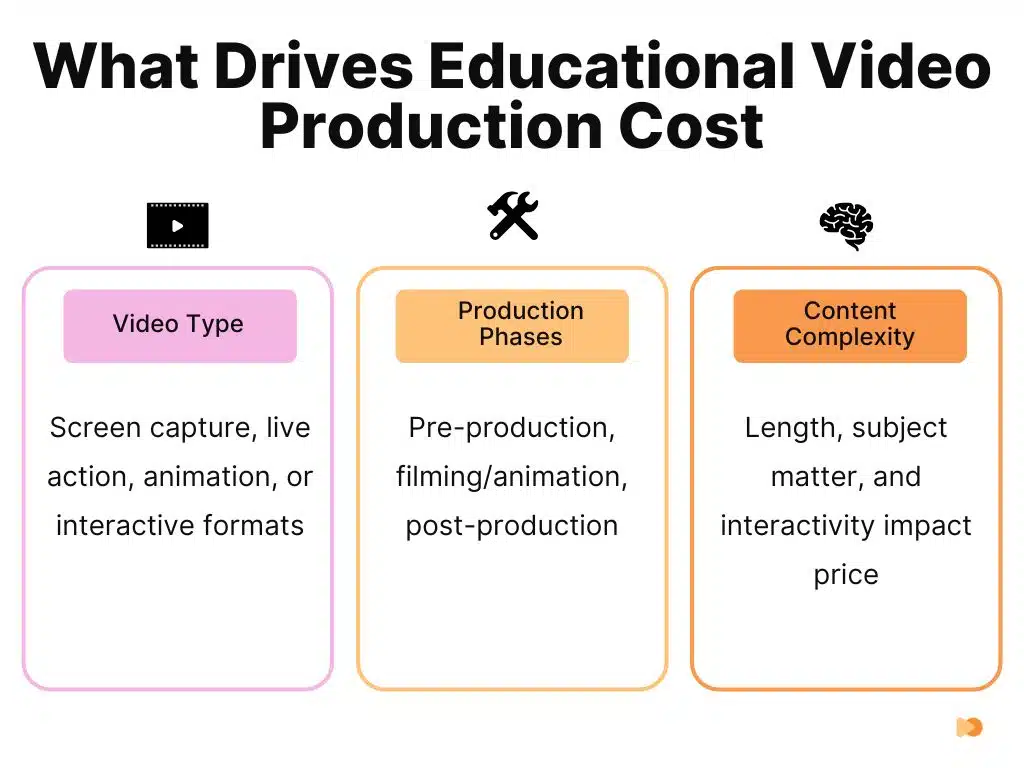
Seven factors determine what you will actually pay. Understanding them helps you control costs without cutting the parts that matter.
1. Video length and complexity. A 2-minute animated explainer with custom 3D characters costs more than a 5-minute talking-head recording. Length matters, but complexity matters more. Budget $1,000 to $3,000 per minute for basic production, $3,000 to $8,000 for standard quality, and $8,000 to $15,000+ for premium.
2. Production style. Screen recording with voiceover: $1,000 to $3,000/min. Simple 2D animation: $2,000 to $5,000/min. Premium 3D animation: $5,000 to $15,000+/min. Single-camera live filming: $2,000 to $5,000/min. Multi-camera production: $5,000 to $15,000+/min.
3. Talent and expertise. Professional voiceover: $300 to $1,000 per session. On-camera presenter: $500 to $3,000 per day. Recognized industry expert: $5,000 to $25,000+. Subject matter expert consultation: $150 to $300 per hour. See how much videographers charge for more detail on individual rates.
4. Interactivity. Branching scenarios, quizzes, and simulations add 40-100% to base production costs. Simple clickable elements start at $1,000. Full branching simulations can add $15,000 or more.
5. Localization and translation. Producing content in additional languages adds 30-70% to the base cost per language. This covers translation, voiceover re-recording, subtitle creation, and cultural adaptation of on-screen text and graphics.
6. Platform and distribution. LMS integration ($1,000 to $5,000), mobile-responsive formatting ($1,000 to $3,000), accessibility features like closed captions and transcripts ($500 to $2,000), and social media reformatting ($500 to $1,500) all add to the final total.
7. Hidden costs most quotes leave out. Extra revision rounds beyond the contract ($500 to $2,000 per round), music and stock footage licensing ($200 to $2,000), hosting and platform fees ($50 to $500 per month), and content updates when products or policies change ($2,000 to $5,000 per update). Always ask for a full cost breakdown before signing.
DIY vs Freelancer vs Production Company
Choosing the right production approach is the single biggest decision affecting your budget. Here is how each option stacks up.
DIY / Software Recording
Cost: $26 to $200 total per video.
Who does the work: Your internal team using screen recording tools (OBS, Loom, Camtasia) or a smartphone.
Pros: Cheapest option. Fast turnaround. Full creative control.
Cons: Limited production quality. No professional scripting or instructional design. Audio and lighting issues are common. Your team’s time has an opportunity cost.
Best when: You need internal training content quickly, quality expectations are modest, and the content has a short shelf life.
Freelancer
Cost: $500 to $2,000 per finished minute.
Who does the work: A solo videographer or editor, sometimes with a network of voiceover artists and animators.
Pros: More affordable than agencies. Flexible scheduling. Some freelancers specialize in specific niches.
Cons: You manage the project end to end. No pre-production planning or instructional design built in. Quality varies widely across freelancers. Limited capacity for large projects.
Best when: You produce 2 to 5 educational videos per year, have scripts ready, and can handle production management.
Production Company
Cost: $2,000 to $10,000+ per finished minute.
Who does the work: A full team including project manager, scriptwriter, instructional designer, animator or film crew, editor, and sound designer.
Pros: End-to-end management. Professional quality. Built-in instructional design expertise. Capacity to scale.
Cons: Higher per-project cost. Longer lead times (4 to 8 weeks typical).
Best when: You need customer-facing content, compliance or certification material, or ongoing production at volume.
In-house team cost comparison: Hiring a full-time videographer ($40,000 to $83,000/year, per Payscale) plus an editor ($45,000 to $65,000) plus equipment ($20,000 to $30,000) puts you at $105,000 to $178,000 per year before benefits. In-house only makes financial sense for organizations producing 15+ videos annually with the management capacity to support it.
Get a free video script to test your concept before committing to full production.
We write a free script for first-time clients so you can evaluate the approach before investing.
Sample Educational Video Project Budgets
Per-minute pricing works for comparing formats. But most buyers want to know: what does an actual project cost? Here are three common project scopes with total budget ranges based on industry benchmarks at the time of check.
Basic Software Tutorial Series
- 10 screen capture tutorials (2 to 3 minutes each)
- Professional voiceover and branded graphics package
- Basic animations for key concepts
- Total: $15,000 to $25,000 ($1,500 to $2,500 per video)
Corporate Training Program
- 8 modules mixing talking head and custom graphics
- 3 to 5 minutes per module
- Professional presenter and motion graphics
- Interactive knowledge checks
- Total: $40,000 to $60,000 ($5,000 to $7,500 per module)
Premium Educational Course
- 12 lessons (6 to 8 minutes each)
- Multi-camera filming with custom animations
- Interactive assessments and branching scenarios
- Full post-production with sound design
- Total: $100,000 to $150,000 ($8,000 to $12,500 per lesson)
Quick reference: what does a 3-minute educational video cost?
| Approach | Estimated Total for 3 Minutes |
|---|---|
| DIY screen recording | $100 to $500 |
| Freelancer (basic editing) | $1,500 to $6,000 |
| Agency (animated explainer) | $6,000 to $24,000 |
| Agency (live-action) | $9,000 to $30,000 |
| Agency (interactive/branching) | $24,000 to $60,000 |
How to Reduce Educational Video Production Costs
You do not need to sacrifice quality to stay within budget. These seven strategies help organizations produce more educational content without proportional cost increases.
1. Invest in pre-production planning. A finished script and storyboard before production starts prevents expensive mid-shoot changes. Teams that skip planning to save money upfront regularly spend 2 to 3 times more on revisions and reshoots.
2. Batch similar videos together. Film multiple talking-head segments in a single shoot day. Create animation assets that work across a series. Shared setup costs across 5 to 10 videos can reduce per-video costs by 20-30%.
3. Build reusable asset libraries. Standardized intro/outro sequences, consistent lower-thirds, reusable character libraries, and modular explanation segments all speed up future production. Organizations that invest in asset libraries see per-video costs drop after the initial build as each project adds to the library rather than starting from scratch.
4. Use a subscription or retainer model. Per-project pricing means rebuilding context every time. Monthly retainer packages spread costs across multiple videos, build team familiarity with your brand, and make budgeting predictable. For teams producing 3+ videos per month, retainers typically cost 25-40% less than equivalent project-based work.
5. Use AI tools for the right content. AI avatar platforms ($25 to $75/minute) work well for internal training, multilingual adaptations, and quick content updates. Save professional production for customer-facing and brand content where quality directly affects perception and trust.
6. Design modular content. Build educational videos as self-contained segments that can be rearranged into different learning paths, updated individually when one section changes, and repurposed across different audiences. This avoids recreating entire videos for minor updates.
7. Define scope and revision limits upfront. Open-ended revision policies create budget uncertainty. Two to three defined revision rounds with clear acceptance criteria keep projects on track. Ask for itemized costs per phase so you know exactly where your money goes.
Ready to plan your educational video project?
Book a free strategy session to get a custom production plan and budget estimate for your content.
What Educational Video Production Actually Returns
The cost question matters. But the more important question is what that investment produces.
We have tracked outcomes across hundreds of educational and explainer video campaigns. Here is what the data shows.
Bambee, an HR technology company, replaced static ads with motion-based educational explainers. The result: a 50% reduction in cost per lead with full ROI in under a month.
EverString, a B2B data platform, used an animated explainer to simplify a complex product for prospects. The result: 1.8 million on-site views, a 27% increase in customer signups, average time on site jumped from 0:35 to 2:11, and bounce rate dropped 11%.
NinjaOne, an IT management platform, invested in ongoing video campaigns that generated 66.6 million views and 1.42 million clicks, plus a 20% year-over-year increase in branded search volume.
The pattern across these projects: educational video is not a line item to minimize. It is an investment that compounds when you build reusable production systems and measure downstream impact on leads, signups, and brand awareness.
How to Choose an Educational Video Production Partner
Not every production company is built for educational content. Here is what to evaluate when comparing options.
Instructional design capability. Video production skills alone are not enough for educational content. Your partner needs to understand learning objectives, audience segmentation, and content structuring for retention. Ask to see educational projects specifically, not just brand or commercial work.
Transparent pricing. Compare quotes from 3+ companies using the same project brief. Look for line items broken out by phase (pre-production, production, post-production). Watch for quotes that use “starting at” language without a cost breakdown.
Scalability. If you plan to produce educational content on an ongoing basis, ask how the company handles repeat work. Do they build reusable assets? Do they offer retainer or subscription pricing? What is turnaround time on the second project versus the first?
Revision and ownership policies. How many revision rounds are included? Who owns the final video files? Can you reuse, adapt, and redistribute the content? These details affect your long-term cost of ownership.
Red flags to watch for. No case studies for educational or training video work. No revision policy in the contract. Inability to explain their instructional design process. Pricing that varies far from the ranges listed above without a clear rationale.
FAQs
How much does it cost to make an educational video?
Educational video production costs $1,000 to $10,000+ per finished minute for professional work. DIY screen recordings using free software cost $26 to $200 total. Freelancers charge $500 to $2,000 per minute. The final price depends on video type, production quality, and whether you need interactive features like branching scenarios or quizzes.
How much does a 3-minute educational video cost?
A 3-minute educational video costs $100 to $500 for a DIY screen recording, $1,500 to $6,000 for a freelancer, $6,000 to $24,000 for an agency-produced animated explainer, $9,000 to $30,000 for live-action, or $24,000 to $60,000+ for interactive content with branching scenarios.
Is it cheaper to make educational videos in-house or hire a production company?
Building an in-house team requires a videographer ($40,000 to $83,000/year), editor ($45,000 to $65,000/year), and equipment ($20,000 to $30,000), totaling $105,000 to $178,000 per year before benefits. For organizations producing fewer than 15 videos annually, a production company is typically more cost-effective. In-house makes sense at high volume with dedicated management.
What is the most cost-effective educational video format?
Screen capture tutorials with professional voiceover and branded graphics offer the strongest balance of cost and quality at $1,000 to $3,000 per minute. For concept-based content, simple 2D animation at $2,000 to $5,000 per minute delivers strong results without the expense of live filming. AI avatar videos at $25 to $75 per minute are the cheapest professional option for internal training.
How long should educational videos be?
Learner engagement research consistently shows that 3 to 6 minutes is the ideal length for holding attention. For complex topics, break the material into a series of focused modules rather than one long video. Each module should cover a single concept or skill.
How can I reduce educational video costs without losing quality?
Batch filming, reusable asset libraries, modular content design, and subscription-based production models reduce per-video costs by 20-40%. Invest more in pre-production (scripts and storyboards) to prevent expensive mid-production changes. Use AI tools for internal content and save professional production for customer-facing material.
The Bottom Line
Educational video production costs $1,000 to $10,000+ per finished minute for professional services. The biggest cost driver is your production approach: DIY, freelancer, or production company. For most organizations, the real question is not how cheap a video can be, but what return the investment generates.
Vidico produces B2B explainer videos for SaaS and tech brands, with a subscription model that covers motion graphics, ad creative, and social content under one monthly fee. Each project builds on the last through reusable templates, making future production faster and more cost-effective. Bambee cut cost per lead by 50% in under a month using this approach.
If you are budgeting for educational video production, use our pricing quiz to get a tailored estimate for your specific project scope and goals.