
Video is now the default content format for B2B marketing. In 2026, almost all businesses use video as a marketing tool, more than half of B2B marketers call it their highest-ROI content type, and companies that use video report faster revenue growth than those that don’t. The numbers below show where B2B video adoption, ROI, buyer behavior, AI, and budgets stand right now.
At Vidico, we produce B2B explainer videos for SaaS and tech brands, and we’ve shipped 2,000+ campaigns for 450+ tech companies, including TikTok, Square, Spotify, and Airtable, generating 1.5 billion+ views. We pulled the most-cited industry data together with our own 2026 survey of 230+ B2B tech marketers so you have one sourced reference for the whole topic.
Key Takeaways
- 91% of businesses use video as a marketing tool in 2026, the highest adoption rate on record in the annual State of Video Marketing report.
- 52% of B2B marketers name video their highest-ROI content type, ahead of blogs, whitepapers, and podcasts, per Wistia’s State of Video report.
- 73% of B2B decision-makers prefer watching a short or demo video over reading a whitepaper, per Vidyard.
- 63% of video marketers now use AI tools to help create or edit videos, up from 51% the prior year, per the annual State of Video Marketing report.
- 76% of B2B tech marketers say their creative production budget is growing this year, based on Vidico’s 2026 State of Creative in Tech report.
- 46% of marketing teams run flat video budgets while demand keeps rising, per Wistia’s State of Video report, which is pushing teams toward reusable, repurposed content.
Content
B2B Video Adoption Statistics
B2B video adoption has moved from experimental to standard. Here is where usage stands in 2026.
- 91% of businesses use video as a marketing tool in 2026. This is the highest figure ever recorded in the annual State of Video Marketing report, up from 89% the year before. Adoption is now near-universal among serious B2B marketers.
- 87% of B2B marketers use video in their content strategy. According to the Content Marketing Institute, video sits among the most-used B2B content formats, alongside short articles and case studies.
- 67% of marketers who don’t yet use video plan to start. Reported in the State of Video Marketing report, this figure has held steady for years, which signals a steady stream of new entrants and rising competition for attention.
- 55% of video marketers create video in-house, while 14% outsource to external vendors. The remaining 31% run a hybrid model, producing routine content internally and partnering with agencies for higher-stakes work like explainer videos and brand campaigns. These figures come from the State of Video Marketing report.
- 92% of marketers plan to spend the same or more on video in 2026. Even where budgets tighten, video is protected from cuts because its results are easy to defend, per the State of Video Marketing report.
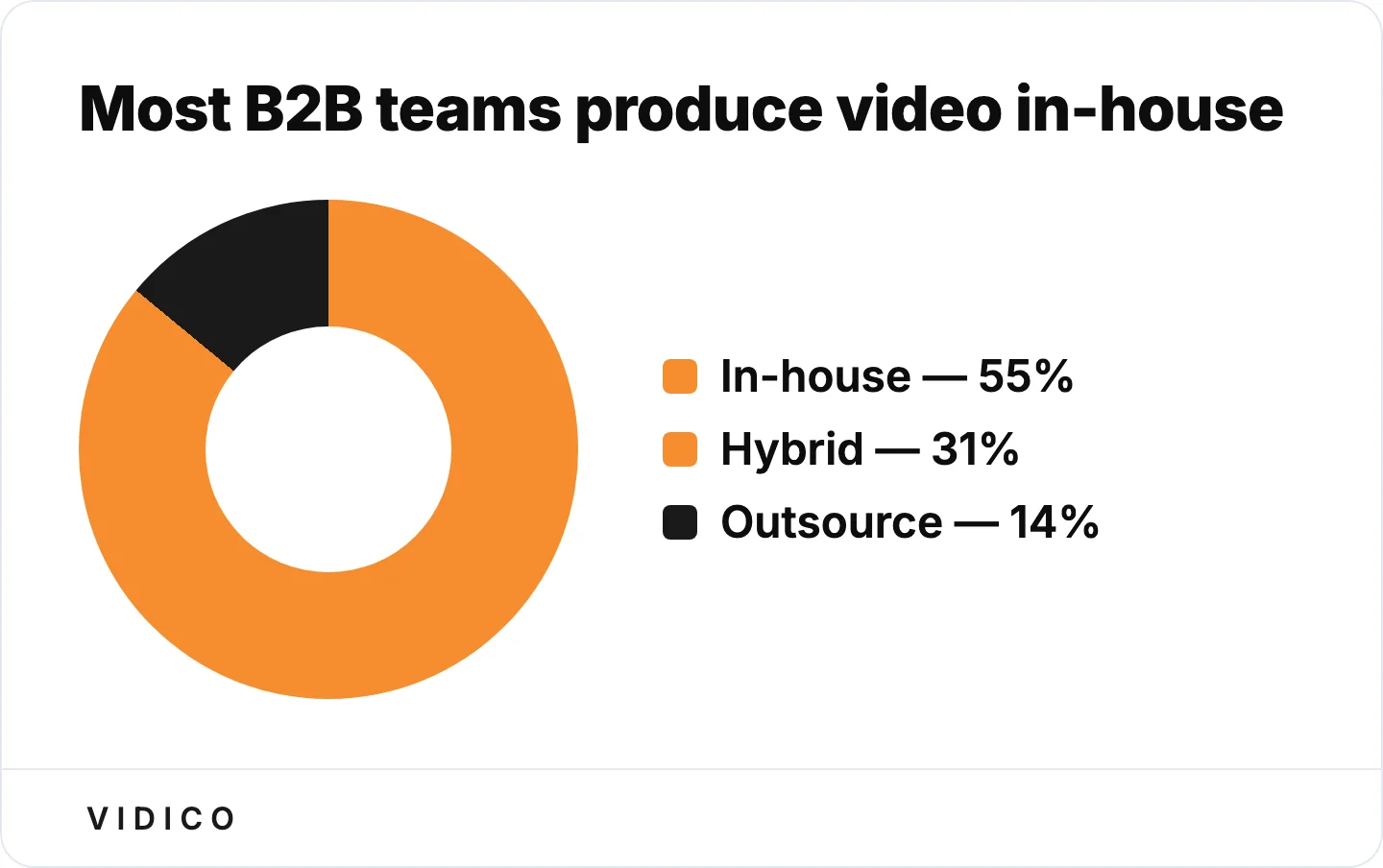
Most B2B teams keep video production in-house, with a third running a hybrid model. Source: State of Video Marketing report.
See how your video program compares. Get the free 2026 State of Creative in Tech report, built on benchmarks from 230+ SaaS and tech brands.
B2B Video ROI and Conversion Statistics
These numbers explain why B2B companies keep protecting and growing their video budgets.
- 85% of people say watching a video convinced them to buy a product or service. For B2B decision-makers weighing complex products, video shortens the path from interest to purchase, according to the State of Video Marketing report.
- 82% of video marketers say video gives them good ROI. This is the highest ROI-confidence figure the State of Video Marketing report has recorded, reflecting better production efficiency and clearer measurement.
- Companies that use video have long been linked to roughly 49% faster revenue growth than those that don’t. This benchmark traces to research from the Aberdeen Group. Treat it as a directional, well-aged figure rather than a current-year measurement, since video adopters also tend to be more marketing-mature overall.
- 52% of B2B marketers name video their highest-ROI content type. Per Wistia’s State of Video report, just over half rank video above blog posts, whitepapers, podcasts, and social posts for returns.
- 93% of marketers say video increased user understanding of their product. For SaaS platforms, financial services, and enterprise software, video is the most effective format for turning technical complexity into buyer comprehension, according to the State of Video Marketing report. For a deeper playbook, see our B2B video marketing guide.
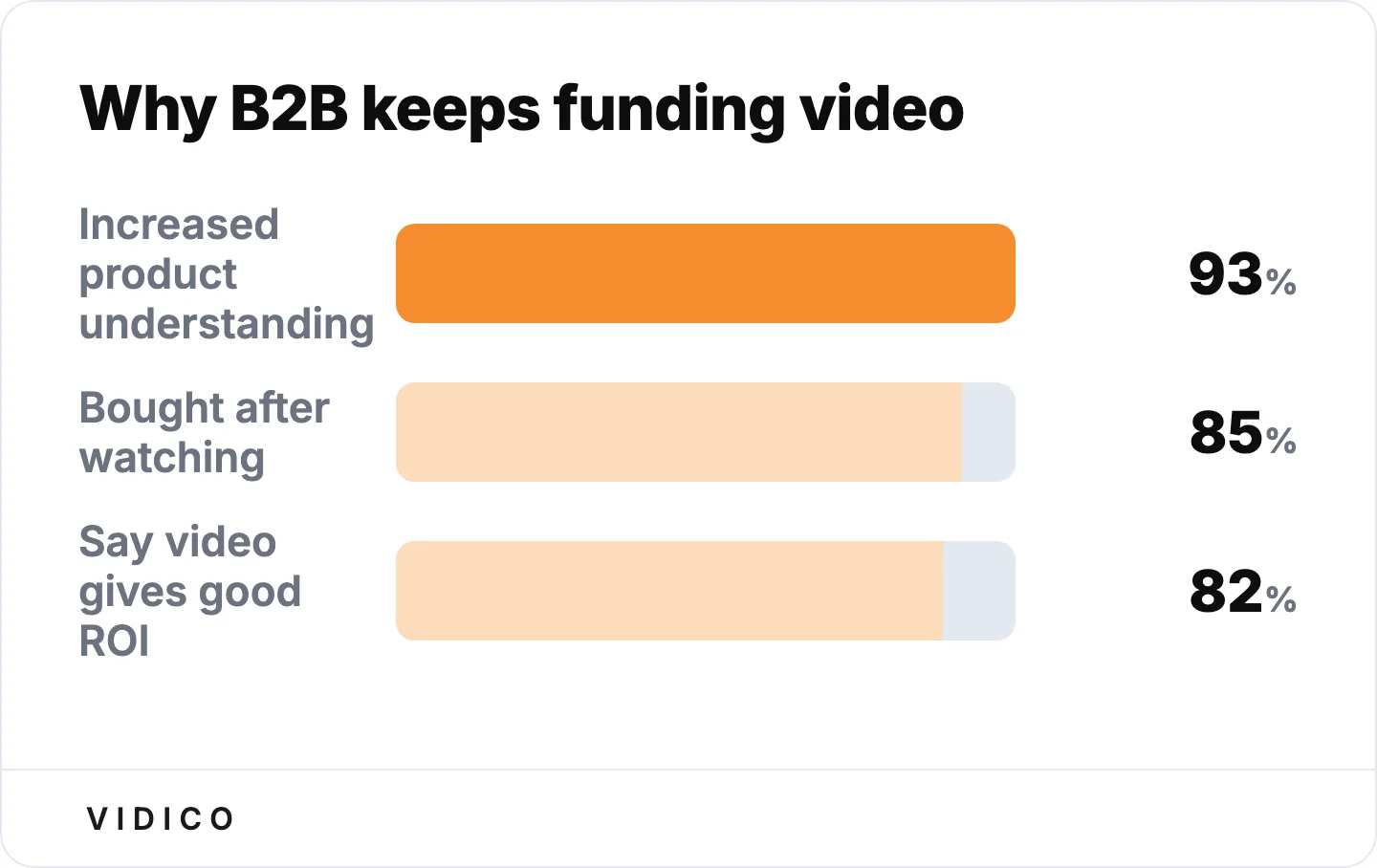
Marketers fund video because it drives understanding, purchases, and measurable ROI. Source: State of Video Marketing report.
Want to see how your video content stacks up against competitors? Get a free Creative Intelligence Report, a $2,500 competitive analysis delivered in 48 hours.
B2B Buyer Behavior and Video Engagement Statistics
How B2B buyers actually watch video shapes where you should deploy it across the funnel.
- 96% of people have watched an explainer video to learn about a product or service. For tech companies with complex offerings, buyers actively seek out video explanations before deciding, per the State of Video Marketing report. If you haven’t built explainer videos for your product, you’re missing the format buyers reach for first.
- 70% of B2B buyers watch video during their purchasing journey. Vidyard’s Video in Business Benchmark Report shows video matters across research, evaluation, and final vendor selection, not just at the top of the funnel.
- 73% of B2B decision-makers prefer a short or demo video over reading a whitepaper. Per Vidyard, buyers increasingly choose video as the fastest way to evaluate a product, which raises the bar for demo and walkthrough content.
- Short B2B videos hold attention far better than long ones. Wistia’s State of Video report shows engagement drops sharply as videos get longer, so matching length to the buyer’s stage matters more than ever.
- 89% of consumers say video quality affects brand trust. For B2B brands where credibility closes deals, low-quality video actively damages trust, according to the State of Video Marketing report.
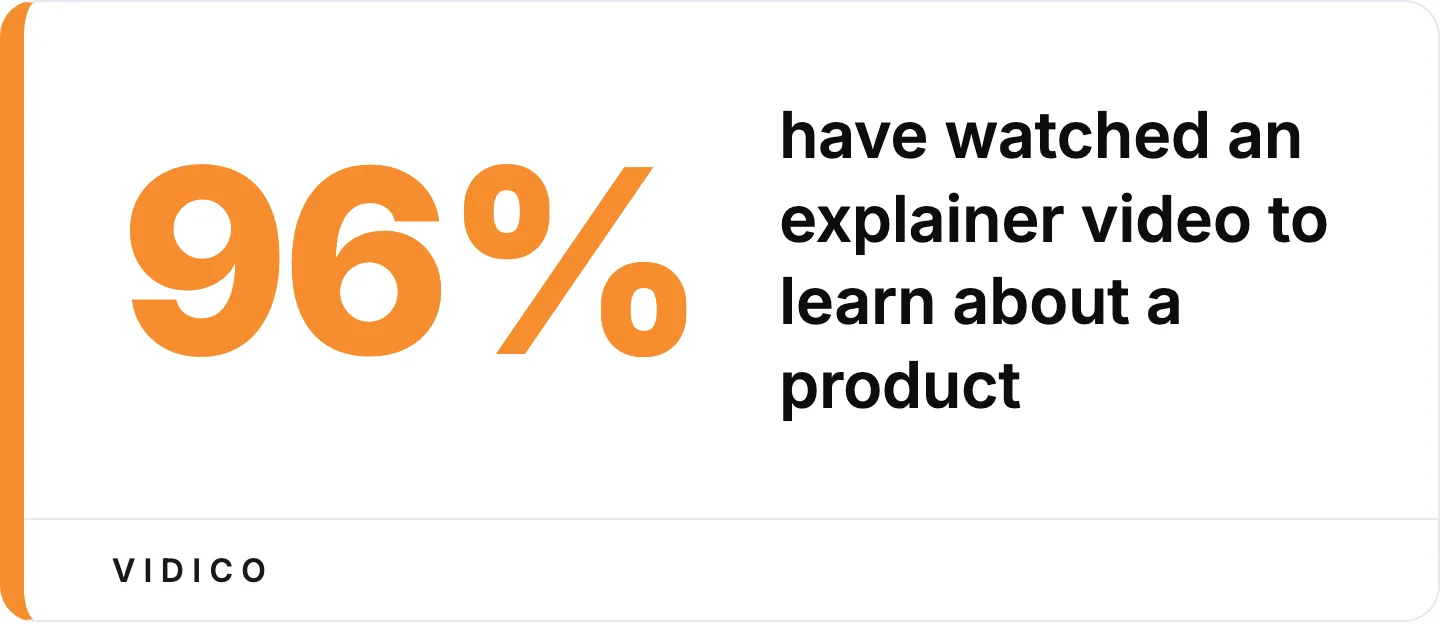
Buyers reach for explainer video first when learning a product. Source: State of Video Marketing report.
Video Format, Platform, and Distribution Statistics
Where you publish and which format you choose drive results as much as the video itself.
- YouTube remains the most widely used video platform, with about 82% of businesses hosting content there. Per Wistia’s State of Video report, it stays the default home for marketing, how-to, and thought-leadership video.
- LinkedIn has surged to roughly 81% adoption for B2B video sharing. Wistia ranks it as the top professional distribution channel, which is why it now anchors most B2B LinkedIn video strategies.
- B2B videos shared on social generate about 45% more views than videos sent by email. This distribution gap, reported in Wistia’s State of Video report, favors social-first publishing for reach.
- Short-form video delivers the highest ROI for a majority of B2B marketers. Wistia finds short clips outperform long formats for top-of-funnel awareness, though long-form still serves webinars and deep tutorials. See our short-form video statistics for the full breakdown.
- 56% of marketers use webinars, and 57% say live streaming has doubled their engagement since 2023. Live and long-form formats, tracked in Wistia’s State of Video report, still earn deep attention for high-intent audiences.
- Average video length keeps falling as short-form takes over feeds. Sprout Social data shows the shift toward shorter clips, which is why modular systems that cut one shoot into many lengths now win.
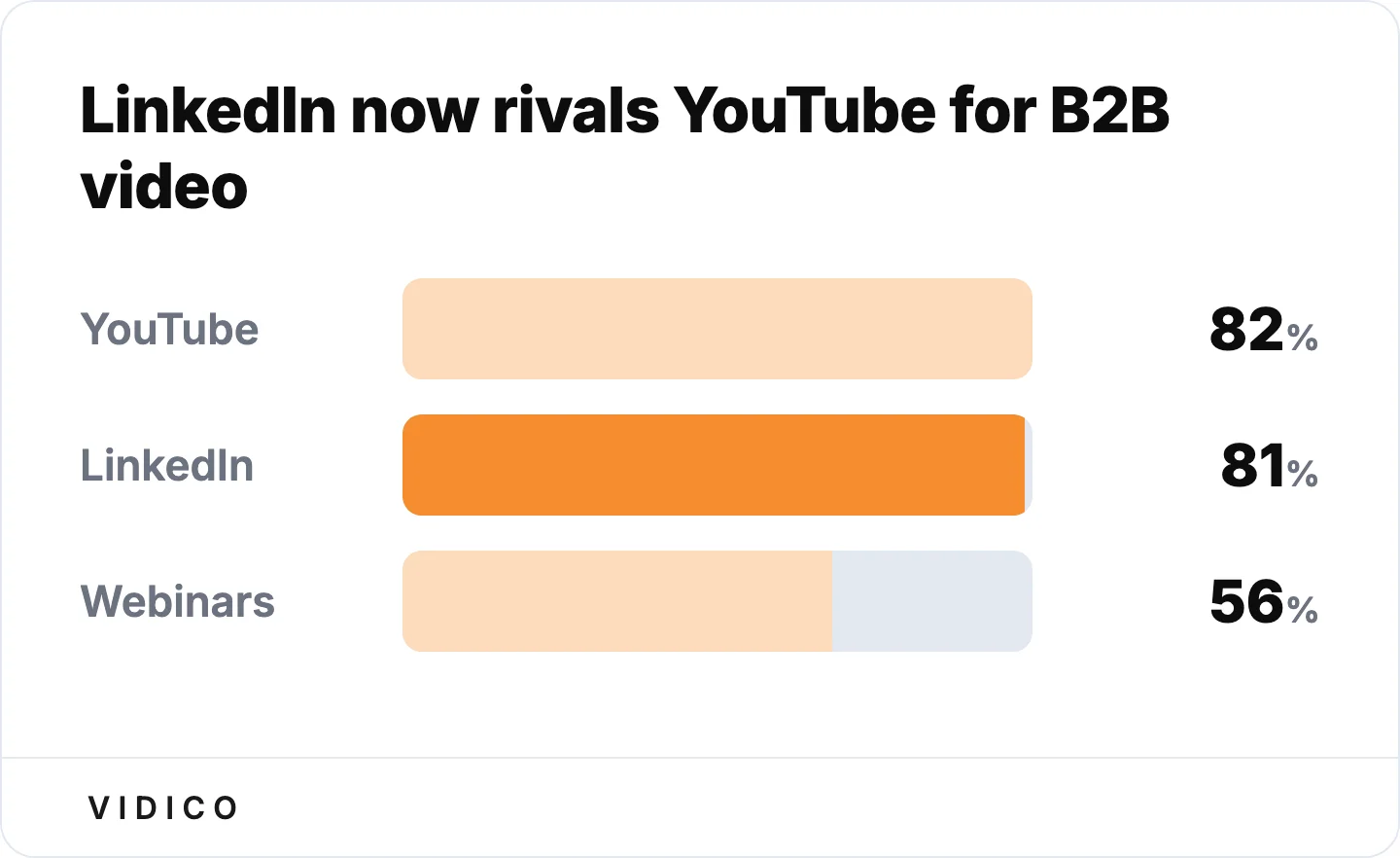
LinkedIn has surged to nearly match YouTube as the home for B2B video. Source: Wistia State of Video.
See the work behind the numbers. Browse our B2B video portfolio to see how brands turn these formats into pipeline.
AI and Video Creation Statistics
AI tools are reshaping how B2B teams produce video. Here is how fast the shift is happening, and where humans still own the work.
- 63% of video marketers have used AI tools to help create or edit videos, up from 51% the prior year. AI now supports scripting, storyboarding, editing, and captioning, according to the State of Video Marketing report, though the strongest results still pair AI speed with human creative direction.
- The AI video generator market is worth close to $1 billion in 2026 and growing fast. Grand View Research projects double-digit annual growth as teams shift routine production toward AI-assisted workflows.
- More than a third of consumers say AI-generated content would lower their perception of a brand. Per HubSpot, AI is best for the repetitive layer like captioning and rough cuts, while human teams protect brand trust and accuracy.
- AI is most useful in the middle of production, not at the brief or the final cut. In Vidico’s 2026 State of Creative in Tech report, B2B tech marketers said AI helps most with editing and repurposing existing assets, final copy is the output they most protect from AI, and only 29% have a formal AI governance policy. That matches how we work: AI speeds the repetitive layer, and our creative directors own the brief and every final deliverable.
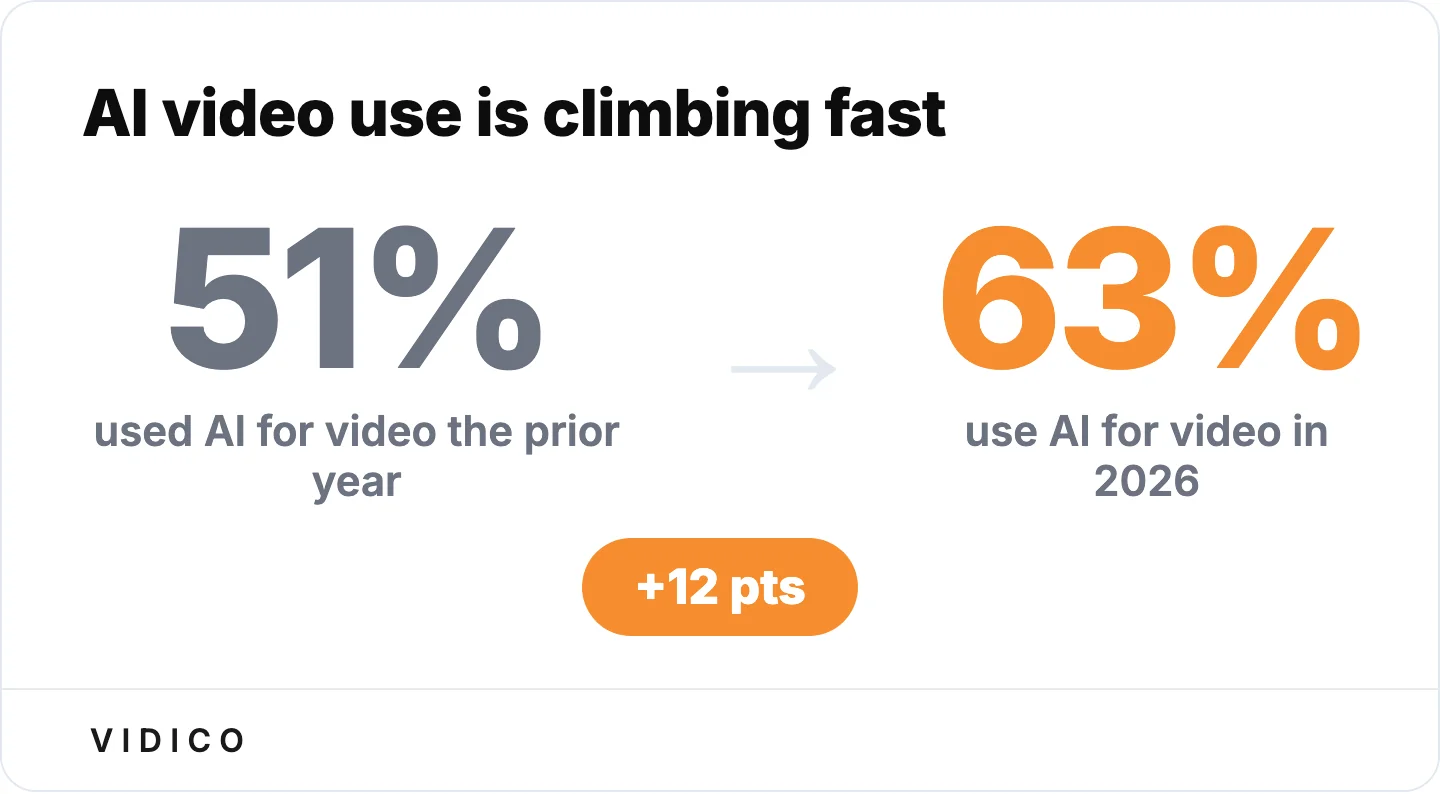
AI use in video creation jumped 12 points in a single year. Source: State of Video Marketing report.
Digital Video Advertising Statistics
Paid video keeps growing as a B2B distribution channel. Here is what the latest ad data shows.
- US digital video ad spend is on track to surpass $80 billion in 2026, growing about 20% faster than the overall ad market. Per IAB, budgets keep shifting toward video across every digital channel.
- Shorter video ads earn higher completion than longer ones. Per MarketingCharts, that completion gap is why B2B paid campaigns increasingly lead with sub-30-second creative, especially on social feeds where attention is short.
B2B Video Marketing Budget Statistics
Knowing what peers spend helps you benchmark your own video investment.
- 46% of marketing teams run flat video budgets even as demand for video rises. Wistia’s State of Video report calls this the video capacity crisis, and teams are closing the gap by repurposing long-form content into short clips and leaning on AI for routine edits.
- 76% of B2B tech marketers say their creative production budget is growing, and 74% say their total marketing budget is rising. In Vidico’s 2026 State of Creative in Tech report, 42.7% of teams now put 21% to 35% of their marketing budget into creative production, a sign that video and creative are moving from nice-to-have to core spend.
- Most marketers still invest a third or less of their total budget in video. That gap between video’s proven ROI and its share of budget, visible across both Wistia’s data and our own survey, is the opening for B2B brands willing to invest ahead of competitors. Subscription production models that spread cost across many monthly assets are gaining traction for exactly this reason.
Stay ahead on video strategy. Subscribe to the Video for Growth newsletter for weekly insights from our work with 920+ clients.
How to Use These Statistics in Your Video Marketing Strategy
These numbers point to four moves for any B2B team building a video program in 2026.
If 91% of businesses use video, differentiate instead of just participating. The bar for B2B video has risen. Generic content no longer stands out. Build a video marketing strategy around your buyer’s specific pain points rather than producing volume for its own sake.
If AI tools are now standard, compete on creative quality. When everyone has the same AI tools, the edge shifts to strategy, brand storytelling, and production quality. Use AI for the repetitive work and invest people in the creative call.
If video keeps getting shorter, build a modular system. Shoot once and cut it into many formats: a 15-second social hook, a 60-second overview, and a full how-to for interested prospects. One core asset can cover every touchpoint without separate productions for each platform.
If buyers act after watching, put video at every decision point. Product pages, pricing pages, case studies, and onboarding flows are all places where a well-placed video reduces friction and moves the deal forward.
Frequently Asked Questions
How does B2B video marketing add value?
B2B video marketing adds value by making complex products easier to understand and faster to trust. It turns dense technical information into a format buyers actually watch, which shortens evaluation and supports higher conversion rates. Across the industry data above, video consistently ranks as the highest-ROI content type for B2B marketers and the format buyers prefer when researching a purchase.
Why is video advertising attractive for B2B?
Video advertising is attractive for B2B because it conveys complex value quickly and holds attention better than text. Short video ads under 30 seconds drive higher completion and engagement, and platforms like YouTube and LinkedIn put that content in front of decision-makers where they already research vendors. The result is stronger recall and clearer pipeline influence than static ads.
What conversion rate can B2B video marketing achieve?
B2B video conversion varies widely by offer, audience, and funnel stage, so a single benchmark can mislead more than it helps. Conversions here include actions like booking a demo, downloading a report, or starting a trial. The biggest driver of a higher rate is matching the video to buyer intent at each stage rather than relying on a single generic asset.
How many B2B buyers watch video before they buy?
About 70% of B2B buyers watch video during their purchasing journey, per Vidyard’s Video in Business Benchmark Report, and 96% have watched an explainer video to learn about a product. Buyers now use video across research, evaluation, and final vendor selection, so teams that produce video for each stage have a clear advantage in converting viewers into customers.
Conclusion
B2B video marketing is no longer optional. The data is consistent across every angle: near-universal adoption, the highest ROI of any content type, and buyers who prefer watching a short video over reading a whitepaper. The teams that win in 2026 aren’t the ones producing the most video, they’re the ones producing the right video for each stage of the buyer journey, backed by a system that keeps cost per asset falling.
That system is what we build. Vidico is a B2B explainer video company that turns one shoot into 40+ assets across channels, so brands like Digital Ocean have driven 3.7M+ YouTube views and a lower cost per acquisition from explainer campaigns we produced. If you want to put these statistics to work, book a free strategy session and we’ll map video to your specific goals.
Sources
- Content Marketing Institute: B2B Content Marketing Research
- Wistia: State of Video
- Vidyard: Video in Business Benchmark Report
- Aberdeen Group
- Grand View Research: AI Video Generator Market
- HubSpot: Video Marketing Statistics
- Sprout Social: Social Media Statistics
- IAB: US Digital Video Ad Spend
- MarketingCharts: Shorter Video Ads Have Higher Completion Rates