The best promotional videos share three things: a clear message, strong storytelling, and production quality that matches the brand. Whether you need inspiration for a product launch, brand campaign, or explainer video, these 15 examples show exactly what works and why.
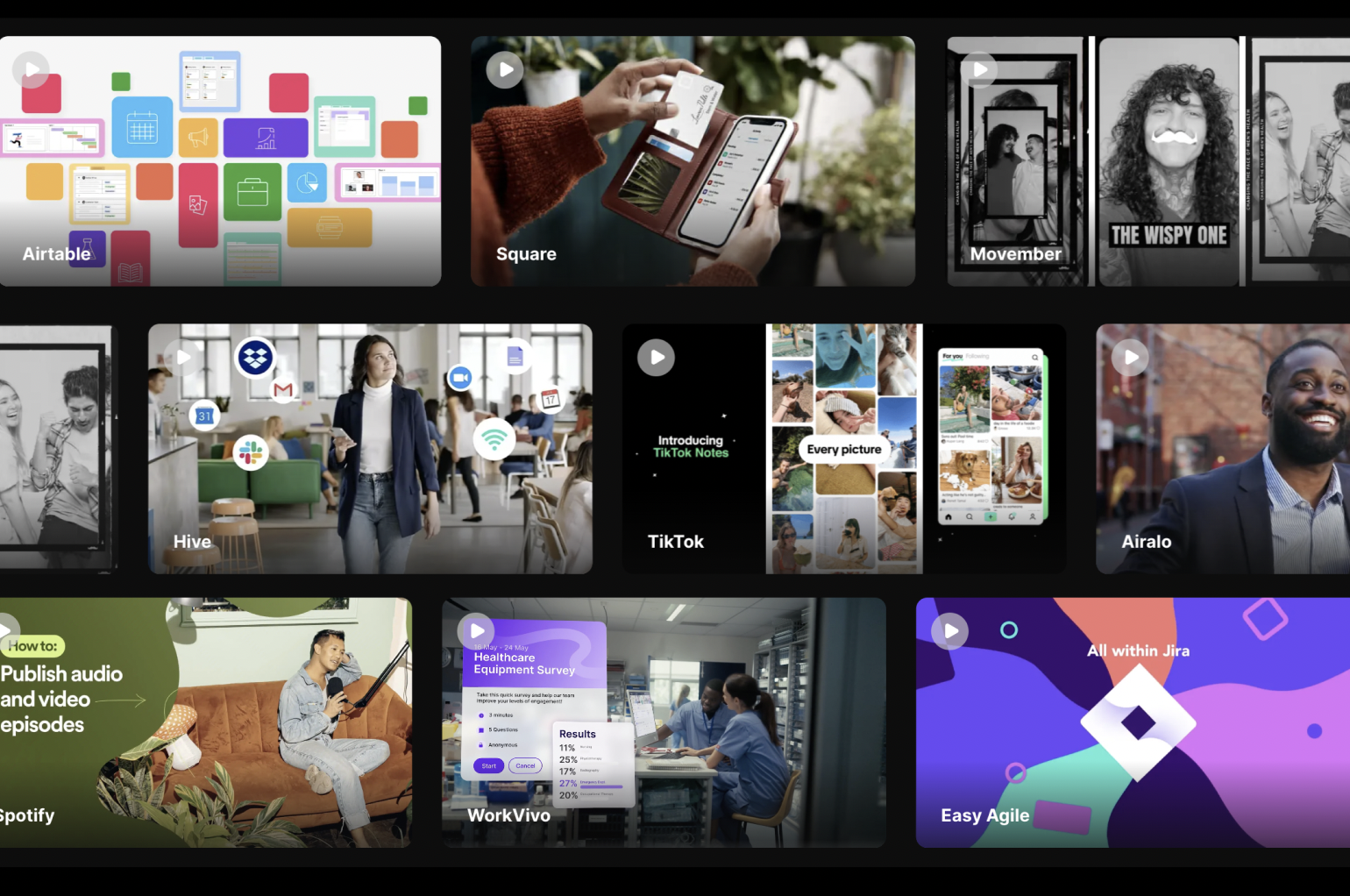
As a B2B explainer video company with 2,000+ campaigns produced for brands like Square, Spotify, and Airtable, we’ve studied what separates forgettable promos from videos that actually drive views, clicks, and conversions. Here are the examples worth learning from.
Key Takeaways
- Lead with emotion or a clear problem. The highest-performing promotional videos hook viewers in the first 3 seconds with an emotional trigger or a relatable pain point.
- Match the format to the goal. Explainer videos drive signups. Brand campaigns build recall. Product demos reduce friction. Choose the format before writing the script.
- Keep it short unless the story demands more. Social promos work best at 15 to 30 seconds. Consideration-stage content can run 60 to 90 seconds.
- Show results, not just production value. The examples below that generated millions of views or measurable ROI all tied creative choices to specific business outcomes.
- Build reusable systems. One video shoot can produce 40+ assets across social, ads, email, and landing pages when you plan for repurposing from the start.
Content
15 Best Promotional Video Examples
1. NinjaOne: B2B Explainer Campaign
Best for: Turning a complex B2B product into a scalable campaign
NinjaOne, an IT management platform, needed promotional content that could work across paid channels, organic social, and sales enablement. We produced a series of explainer and campaign videos that translated their technical product into clear, benefit-driven messaging.
The results: 66.6 million views, 1.42 million clicks, 321 million impressions, and a 2.4% Facebook CTR (well above the 0.9% industry average). Branded search increased 20% year over year.
Why it works: The creative wasn’t built for one channel. Every video was designed as part of a reusable template system, so new variations could be produced quickly without starting from scratch. That’s how a single campaign scales to 321 million impressions.
Key takeaway: B2B promotional videos don’t have to be boring. Clear messaging plus a scalable production approach drives measurable business outcomes.
2. Apple HomePod: Product Launch Storytelling
Best for: Emotional product launches that show, don’t tell
Apple’s “Welcome Home” ad for the HomePod, directed by Spike Jonze, follows a woman transforming her apartment into a vibrant, expanded space through music. The product appears in context, not as the centerpiece.
Why it works: Apple never lists specs or features. The entire video is an emotional demonstration of what the product enables. The viewer feels the experience before understanding the product. At time of check, the ad has over 30 million YouTube views.
Key takeaway: The strongest product launch videos sell the feeling, not the feature list. Let the product speak through the experience it creates.
3. Dollar Shave Club: Humor-Driven Viral
Best for: Startups that need massive awareness on a small budget
Dollar Shave Club’s launch video cost roughly $4,500 to produce and generated 12,000 orders in the first 48 hours (Entrepreneur, 2012). CEO Michael Dubin walks through the warehouse delivering deadpan humor while explaining the subscription model.
Why it works: The humor makes the value proposition memorable. Instead of listing benefits, the video builds a brand personality that viewers want to share. It reached 27 million views and helped build a company that Unilever acquired for $1 billion in 2016 (Forbes, 2016).
Key takeaway: A clear message delivered with personality beats high production budgets. If you can make people laugh and understand your value in under 90 seconds, you’ve won.
4. Slack: Animated Explainer
Best for: SaaS products that need to simplify a complex value proposition
Slack’s animated explainer video shows the chaos of scattered team communication (emails, texts, calls) and positions Slack as the clean alternative. Simple animations keep the focus on the problem and solution, not flashy visuals.
Why it works: The video starts with a universal pain point that every office worker recognizes. By the time Slack appears as the solution, the viewer already agrees with the premise. The animation style keeps production costs manageable while maintaining clarity.
Key takeaway: Explainer videos work best when they lead with the problem the audience already feels. Define the pain before introducing the product.
5. Nike: Emotional Brand Campaign
Best for: Building long-term brand loyalty through values-driven content
Nike’s “Dream Crazy” campaign, narrated by Colin Kaepernick, encourages viewers to pursue ambitious goals regardless of obstacles. The video never shows a product page or pricing. It sells a worldview.
Why it works: Nike’s promotional strategy ties the brand to values its audience already holds. The video generated $6 billion in brand value and a 31% increase in online sales in the days following release (Edison Trends via CNBC, 2018).
Key takeaway: Brand campaigns that take a clear position create stronger emotional connections than neutral, safe messaging. Not every promotional video needs a product demo.
6. Spotify Wrapped: Data-Driven Personalization
Best for: Turning user data into shareable promotional content
Spotify’s annual “Wrapped” campaign gives each user a personalized summary of their listening habits, presented in bold, shareable graphics. Users post their Wrapped results across social media, turning millions of customers into unpaid brand ambassadors.
Why it works: Personalization makes every viewer the main character. The format is designed for sharing, which creates organic reach that no ad budget can replicate. Spotify reported that Wrapped drives its biggest spike in app downloads each year (Spotify Newsroom, 2023).
Key takeaway: If you have user data, find creative ways to reflect it back to your audience. Personalized content is the most shareable content.
7. GoPro: User-Generated Content Campaign
Best for: Brands whose customers create compelling content with the product
GoPro’s promotional strategy flips the traditional model. Instead of producing all content in-house, they feature customer videos shot on GoPro cameras. Videos like Danny MacAskill’s mountain biking footage showcase the product’s capabilities through authentic, extreme scenarios.
Why it works: User-generated content serves as both promotion and social proof. The customer demonstrates the product better than any scripted ad could. GoPro’s YouTube channel has over 12 million subscribers, built primarily on UGC.
Key takeaway: If your product enables creativity, let your customers be the stars. UGC builds trust and generates content at scale.
8. Movember: Social Impact Campaign by Vidico
Best for: Mission-driven campaigns that balance emotion with action
Movember, the global men’s health charity, needed a campaign that would drive signups while communicating serious health messaging. We produced “Mo Like a Pro”, a campaign that balanced humor with purpose, reaching approximately 4 million views and contributing to 330,000+ signups.
Why it works: The video doesn’t lecture. It gives viewers a fun entry point (growing a mustache) that connects to a serious cause (men’s health). The tone matches the audience: lighthearted enough to share, meaningful enough to act on.
Key takeaway: Social impact promotional videos work when they make participation feel easy and rewarding. Lead with the action, not the guilt.
9. Coca-Cola: Seasonal Emotional Campaign
Best for: Reinforcing brand identity through seasonal storytelling
Coca-Cola’s holiday campaigns consistently rank among the most-watched seasonal ads. Their 2020 holiday ad, directed by Taika Waititi, tells the story of a father traveling to the North Pole to deliver his daughter’s letter to Santa. The product appears subtly, never interrupting the emotional narrative.
Why it works: Coca-Cola ties its brand to a universal emotional experience (holiday warmth) rather than product features. The same strategy has worked for decades because the emotional association compounds year over year.
Key takeaway: Seasonal campaigns build brand equity when they connect to genuine emotions. The product should enhance the story, not dominate it.
10. Amazon Go: Technology Demo
Best for: Introducing a new technology concept to mainstream audiences
Amazon Go’s promotional video demonstrates their checkout-free grocery store in a simple three-step sequence: walk in, grab what you want, walk out. No narration over-explains the technology. The video lets the experience speak for itself.
Why it works: For a concept that could feel confusing or intimidating, the video makes it look effortless. Every shot reinforces simplicity. The viewer understands the product in under 60 seconds without needing a single spec sheet.
Key takeaway: When promoting new technology, show it working in real life. Demonstrations build trust faster than explanations.
11. Matmatch: B2B Animated Explainer
Best for: Making technical B2B products visually engaging
Matmatch, a materials science platform, needed to explain how engineers use their database to find the right materials for product development. The animated promotional video uses creative shapes and textures to visualize an abstract matching process.
Why it works: Animation gives creative freedom to show concepts that live-action can’t capture. For B2B products that aren’t visually exciting on their own, custom animation transforms the explanation into something genuinely interesting to watch.
Key takeaway: B2B doesn’t mean boring. The right animation style can make any product category visually compelling and easy to understand.
12. GoFundMe: Simple Platform Explainer
Best for: Platforms that need to reduce friction in the signup process
GoFundMe’s promotional video walks viewers through the fundraising process step by step. No hard sales tactics. The video reassures potential users that the platform provides support at every stage, using music and visuals that emphasize positive outcomes.
Why it works: The video answers every objection a first-time user might have: Is it easy? Will people actually donate? What support do I get? By addressing friction points directly, the video serves as both promotion and onboarding.
Key takeaway: Platform explainer videos work best when they anticipate user hesitation and address it before the viewer has to ask.
13. Rare Beauty: Brand Authenticity
Best for: Building brand identity through founder-led storytelling
Selena Gomez’s Rare Beauty uses promotional videos to communicate the brand’s mission of self-acceptance and authenticity. Behind-the-scenes content shows the founder explaining what the brand means to her, creating a personal connection that traditional product ads can’t achieve.
Why it works: Founder-led storytelling creates authentic brand connection. When the audience sees the person behind the brand, trust forms faster than through any polished campaign. The vulnerability in sharing a personal mission makes the brand feel genuine.
Key takeaway: If your brand has a genuine story, tell it through the founder’s voice. Authenticity is a competitive advantage that can’t be manufactured.
14. Xbox Series X: Product Launch CGI
Best for: Product launches that need to generate hype and anticipation
The Xbox Series X reveal trailer uses cinematic CGI and a compelling voiceover to showcase the worlds players can access through the new console. The video doesn’t focus on hardware specs. It sells possibility and imagination.
Why it works: The production quality matches the audience’s expectations. Gaming audiences expect cinematic content, and Xbox delivers exactly that. The voiceover creates narrative momentum that keeps viewers watching through to the end.
Key takeaway: Match your production quality to your audience’s expectations. Underspending on production for a premium product undermines the brand message.
15. Antavo Loyalty Cloud: B2B SaaS Explainer
Best for: Enterprise SaaS products that need to feel accessible
Antavo’s promotional video positions their Enterprise Loyalty Cloud as something anyone can use, not just tech experts. The message focuses on outcomes (customer satisfaction, hassle-free experience) rather than technical architecture.
Why it works: Enterprise software videos often fall into the trap of leading with features and integrations. Antavo leads with outcomes that non-technical decision-makers care about: happier customers, more revenue, less complexity.
Key takeaway: B2B promotional videos convert better when they speak to the business buyer, not the technical evaluator. Lead with outcomes, then support with features.
What Is a Promotional Video?
A promotional video is a short marketing video designed to generate interest in a product, service, or brand. Unlike traditional ads that list features, promotional videos use storytelling and visual production to create an emotional connection with the audience.
Promotional videos work across social media, websites, email campaigns, trade shows, and sales presentations. The format varies based on the goal:
- Explainer videos break down complex products into simple, visual stories
- Product demos showcase features and benefits in action
- Brand campaigns build awareness and emotional association
- Testimonial videos use real customer stories to build trust
- Social media promos drive engagement with short, shareable clips
The common thread: every effective promotional video focuses on what the viewer gains, not what the company sells. For a deeper dive into creating your own, see our guide on how to make a promo video.
What Makes a Promotional Video Effective
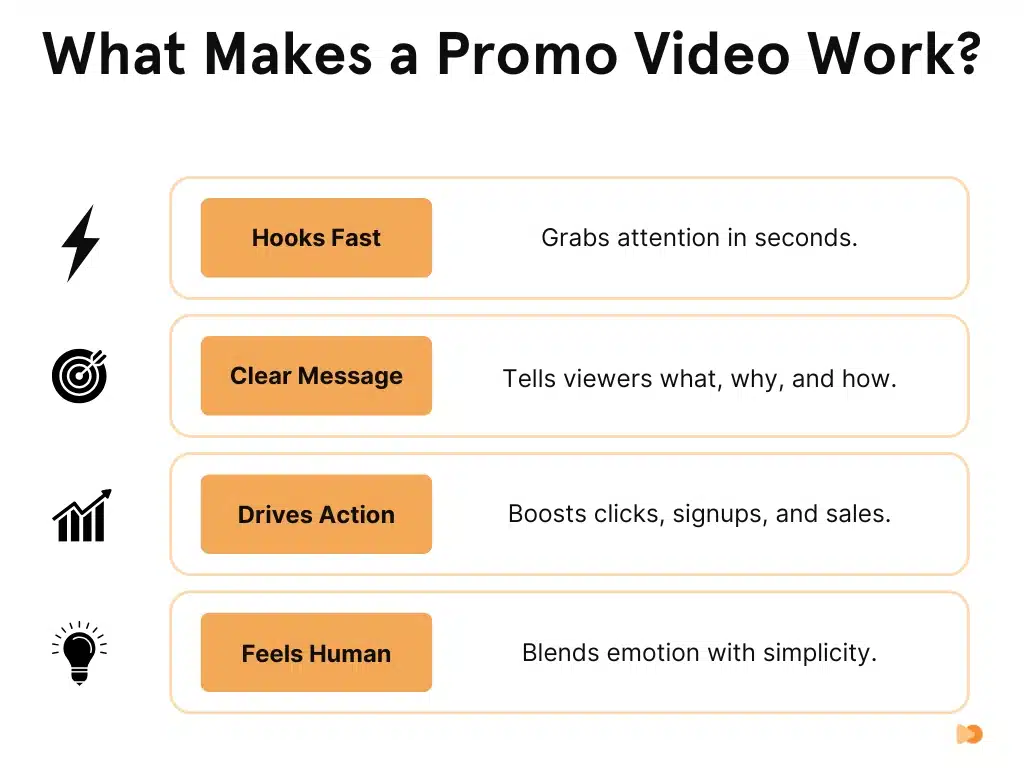
Effective promotional videos share four characteristics, regardless of budget or industry.
1. A hook in the first 3 seconds. Viewers decide whether to keep watching almost immediately. The strongest promotional videos open with a visual surprise, a relatable problem, or a bold statement. Dollar Shave Club opens with “Are the blades any good? No. Our blades are f***ing great.” That’s a hook.
2. One clear message per video. Every example above delivers a single core idea. Apple sells a feeling. Slack solves a problem. GoPro celebrates adventure. Trying to communicate multiple value propositions in one video dilutes all of them.
3. Emotion over information. A 2022 study published in the Journal of Marketing found that emotional ad content generates 2x higher brand recall than purely informational content (Journal of Marketing, 2022). The most-shared promotional videos make viewers feel something before they understand anything.
4. A clear next step. Every promotional video should guide the viewer toward an action, whether that’s visiting a website, signing up for a free trial, or sharing the video. The call-to-action doesn’t need to be aggressive, but it needs to exist.
For teams producing promotional videos regularly, building reusable templates and brand asset libraries makes each new video faster and more cost-effective than the last.
How to Plan Your Promotional Video
Planning determines whether your promotional video drives results or gets lost in the noise. Here’s the process that works across industries.
Define the goal first. Is this video for awareness, consideration, or conversion? The goal dictates everything: length, platform, tone, and call-to-action. A LinkedIn awareness campaign needs different creative than a landing page conversion video.
Know your audience’s problem. The best examples above all start with the viewer’s world, not the brand’s world. What frustration does your audience feel? What outcome do they want? Build the video around that.
Write the script around one message. Distill everything into a single sentence: “This video will convince [audience] that [core message] so they [desired action].” If you can’t write that sentence clearly, the video won’t be clear either.
Choose the right format. Match the format to the message:
- Complex product? Animated explainer
- Emotional brand story? Live-action narrative
- New technology? Product demonstration
- Customer proof? Testimonial video
Plan for repurposing. A single promotional video production can yield 10 to 40+ content pieces when you plan ahead: social cutdowns, ad variations, GIFs, email thumbnails, and landing page assets. Build the shoot list with repurposing in mind.
Set success metrics before production starts. Define what “worked” means before you hit record. Views? Click-through rate? Signups? Cost per acquisition? Without predefined metrics, you can’t optimize future campaigns.
The most successful promotional campaigns start with a documented creative brief that ties every production decision back to a measurable business goal.
FAQs
How long should a promotional video be?
The ideal length depends on the platform and funnel stage. Social media promos perform best at 15 to 30 seconds. Website explainers and consideration-stage content work well at 60 to 90 seconds. According to Wistia’s video engagement data, videos under 2 minutes get the most consistent engagement across platforms (Wistia, 2023).
How much does a promotional video cost?
Promotional video costs range from $1,000 for simple in-house productions to $50,000+ for fully produced brand campaigns with custom animation, live-action crews, and professional talent. Most B2B companies invest $5,000 to $20,000 per video. For a detailed breakdown, see our video production cost guide.
What makes promotional videos more effective than other marketing formats?
Video combines visual, auditory, and emotional elements in a way that text and static images can’t match. Viewers retain 95% of a message when they watch it in a video, compared to 10% when reading the same information in text (Insivia, 2023). Video also performs better on social algorithms, earning more reach and engagement per post.
Can small businesses create effective promotional videos?
Yes. Dollar Shave Club’s viral video cost $4,500. The key is a clear message and strong script, not a large production budget. Tools like Canva and InVideo make basic video creation accessible, and DIY approaches work for social media content. For higher-stakes campaigns like product launches or brand videos, working with a professional production team ensures the quality matches the stakes.
The Bottom Line
The best promotional videos succeed because they lead with emotion, deliver one clear message, and match the format to the goal. Every example on this list proves that production budget matters less than creative clarity and audience understanding.
Whether you’re planning a product launch, brand campaign, or explainer video, the framework is the same: hook viewers in the first 3 seconds, show them something they care about, and give them a clear next step. Vidico, a B2B explainer video company, has produced over 2,000 campaigns using this approach for brands like Square, Spotify, and Airtable.
Start with a documented creative brief, define your success metrics before production, and plan for repurposing from day one. That’s how a single promotional video becomes a full content system.