Your product has the potential to make an impact, but are people truly seeing it? In a crowded digital space, explaining complex ideas in a way that’s both engaging and easy to understand is a challenge.
At Vidico, we’ve produced 2,000+ campaigns for tech and SaaS brands — from 30-second animated product demos to full-funnel motion graphics suites. With 1.5 billion+ views generated for 450+ tech brands, we’ve seen firsthand what makes animated product video examples convert and what makes them collect dust. The difference almost always comes down to story and structure, not production polish.
In this guide, we’ve handpicked some of the best animated product videos to inspire your next big project.
Key Takeaways
- 96% of people have watched an explainer video to learn about a product or service, making animation one of the most effective ways to introduce complex ideas to new audiences
- Animated videos outperform live action for intangible products — if your product is software, a workflow, or a service, animation lets you visualize what a camera can’t capture
- The best animated product video examples lead with the viewer’s problem rather than the product’s features. A 60-second video that nails one pain point converts better than a 3-minute feature list
- Reusable animation assets — character rigs, icon libraries, transition templates — can reduce per-video production costs by 30–50% after the initial build, turning your animation investment into creative infrastructure that compounds in value
- 85% of consumers say watching a video convinced them to buy a product or service
Content
Top 15 Product Animation Examples
1. Nutrislice – Animated product video
Average Pricing: Starts at $5000
Our Involvement: Full animation production using a systematic storytelling framework
Systematic Framework: Nutrislice’s success comes from their modular storytelling approach—they created reusable narrative elements that can adapt to different product features. The 30-second format isn’t arbitrary; it’s a systematic message architecture that maximizes engagement while maintaining conversion focus.
“Animation should be strategic. Every detail should serve a purpose. Color shading can make pain points tangible, while seamless transitions can bring workflows to life. Animation isn’t just about showing features—it’s about making a complex solution feel accessible and simple.” — Evan Pirone, Creative Director, Vidico
What Makes It Stand Out: When Nutrislice needed to explain their food service technology to a broad audience, they partnered with Vidico to create a 30-second animated video that combined relatable storytelling with dynamic animation and sound design.
The video opens with a scenario every school nutrition director recognizes — the frustration of disconnected menus, paper-based processes, and low student engagement. Then it bridges to Nutrislice’s platform as the solution in a way that feels natural, not forced.
What makes this example worth studying is the format. At 30 seconds, there’s zero room for filler. Every scene earns its place, every transition moves the story forward, and the sound design reinforces the message without distracting from it. This kind of disciplined editing is what separates an animated product video that converts from one that just entertains.
See the Nutrislice case study here.
2. Freighty – Animated explainer video
Average Pricing: Starts at $5000
Our Involvement: Systematic explainer framework with scalable visual elements
Systematic Framework: Freighty’s animation success stems from systematic information architecture rather than random creative choices. We developed modular explanation systems that can adapt to different insurance products while maintaining consistent brand communication.
What Makes It Stand Out: Insurance technology isn’t easy to explain. Freighty’s challenge was making freight insurance — a process most people find confusing — feel straightforward and even approachable.
The 2D animation style works here because it strips away unnecessary complexity. Instead of showing a real-world warehouse or shipping dock (which would introduce visual noise), the animation distills the process into clean shapes, clear motion, and focused storytelling. Viewers follow a character through the freight insurance journey step by step, building understanding through example rather than explanation.
Vidico designed the animation using modular visual elements that can adapt across Freighty’s different insurance products. This means one production run builds the foundation for multiple videos — each one reinforcing brand consistency while the motion graphics adapt to different scenarios. It’s creative infrastructure that delivers more value with every subsequent video.
3. Spotify – Animated explainer video
Why It Works: Spotify’s animated explainer video is one of the strongest animated sales video examples in the market. The video uses engaging content, creative character animation, and an effective use of sound to tell a story that sticks.
What sets this apart from typical product demo videos is how it leads with emotion. You feel the music before you understand the platform. The animated characters and visual storytelling create a world that makes the product feel inevitable — like of course this is how music should work.
For marketers, the takeaway is clear: when your product has an emotional dimension, lean into it. The features can follow. Let the animation create the feeling first, and the audience will be far more receptive to the technical details.
Want to see how your creative stacks up? Get a free Creative Intelligence Report — a $2,500 competitive analysis delivered in 48 hours, covering 12 areas of your creative output.
4. ZocDoc – Animated product video
Why It Works: ZocDoc took a creative risk with this animated product video — rhyming narration and catchy music for a healthcare booking platform. It shouldn’t work. But it does, because the fun format makes a utilitarian product feel accessible and even delightful.
The animated characters walk viewers through the booking process in a way that’s both entertaining and informative. Despite the playful tone, the video delivers a clear, concise message about what ZocDoc does and why it matters. The story is simple: booking a doctor is a hassle, ZocDoc makes it easy, here’s how.
This is a strong example of how animation style can differentiate a brand in a crowded market. When every competitor uses the same blue-and-white SaaS aesthetic, a bold creative choice cuts through the noise.
Get your free video marketing plan tailored to animation frameworks →
5. Google Pixel 4 – Motion graphic product video
Why It Works: Google’s motion graphics explainer video leverages brand colors and signature design language to introduce the Pixel 4 in a way that feels both fresh and familiar.
The smooth transitions between scenes create a seamless viewing experience. Each feature showcase flows into the next without jarring cuts, which keeps viewers engaged and makes even technical specs feel approachable. The text “phone made the Google way” does heavy lifting — it tells viewers what to expect based on the brand reputation Google has already built.
For physical products that also have strong software features, this hybrid motion graphics approach works better than pure 3D animation. It bridges the gap between showing the product and explaining the experience of using it.
6. Ahrefs – Animated product video
Why It Works: Ahrefs proves that a well-executed voiceover can carry an animated video. The narration takes complex SEO concepts and makes them understandable to a broad business audience — no jargon, no assumptions about what the viewer already knows.
This 90-second video covers multiple tools within the Ahrefs platform without feeling rushed. That’s a script achievement more than an animation achievement. The visuals support the narration rather than competing with it, keeping the focus on comprehension.
Key Takeaway: For technical tools with multiple features, the script matters more than the animation style. If your voiceover can explain the product clearly enough that someone could understand it with their eyes closed, the visuals will amplify the message rather than carry it.
7. Adobe – Motion graphic video
Why It Works: In under 90 seconds, Adobe’s animated video demonstrates conceptual creativity by framing their solution as something every CMO wants — even if they can’t quite articulate what it is yet. That’s a sophisticated positioning move that works because the animation gives abstract ideas a visual form.
The minimalistic design avoids distractions, letting the core message land cleanly. Motion graphics animate data points and workflows in ways that feel intuitive rather than technical. The result is a product demo video that feels like a conversation with a smart colleague, not a sales pitch.
For enterprise products with complex value propositions, this stripped-back motion graphics approach often outperforms character animation or 3D animation because it mirrors how the audience already thinks about their business problems — in frameworks, flows, and processes.
Browse our video portfolio to see our animation frameworks in action →
8. Google Assistant – Animated explainer video
Why It Works: This animated explainer video tackles one of the hardest topics in tech marketing — privacy and security — and makes it engaging through visual storytelling. The animation shows how Google Assistant activates, processes requests, and protects user data in a step-by-step sequence that builds trust through transparency.
The character animation complements the voiceover, turning abstract concepts like “encrypted data transfer” into something a viewer can actually picture. That’s the core strength of animation for technology products: it makes invisible processes visible.
9. Canon – Product animation video
Why It Works: Canon’s 3D product animation puts their office devices front and center. The 3D animation lets viewers examine the products from every angle, creating an experience closer to an in-store demo than a traditional advertisement.
For physical products, 3D animation delivers something photography can’t: the ability to highlight internal components, demonstrate mechanical processes, and showcase features that aren’t visible to the naked eye. Research suggests customers spend 44% more time interacting with 3D content compared to static images — and that engagement translates directly to purchase confidence.
10. Unilever Whiteboard – Product animation video
Why It Works: Unilever proves that an animated product demo doesn’t need to be long. At just 41 seconds, this whiteboard animation tells a complete story using simple illustrations, animated characters, and music that keeps the pacing tight.
Whiteboard animation works well when you need to explain a process or concept that benefits from a “building” visual metaphor — where the audience watches the idea take shape on screen. The production costs are lower than full character animation or 3D animation, making it a cost effective option for brands testing animation for the first time.
11. Duolingo – Animated demo video
Why It Works: Duolingo’s animated demo video reinforces brand identity through every frame. The animated characters are instantly recognizable, the color palette is consistent, and the animation style matches the app’s playful personality.
The video demonstrates the app in real life scenarios — studying languages, playing games, tracking progress — without ever showing the actual screen in a way that feels like a tutorial. Instead, the animation creates a fun, aspirational version of the product experience that makes viewers want to participate.
For app-based products, this approach works better than a straight screen recording because it adds personality and story to what would otherwise be a walkthrough. If you want to create an engaging video that drives downloads, lead with the experience — not the interface.
Subscribe to the Video for Growth Newsletter for valuable insights →
12. IBM – Animated product video
Why It Works: IBM’s animated product video uses a sci-fi concept to showcase analytics capabilities. This creative approach adds intrigue and sets the video apart from the typical enterprise software demo that leads with dashboards and data tables.
The cinematic camera techniques and playful tones make complex analytics concepts feel exciting rather than intimidating. It’s a strong example of how animation can reframe a technical product as something aspirational — not just a tool, but a vision for what business intelligence could be.
13. Starbucks – Product animation video
Why It Works: Starbucks combines animation, stop motion, and storytelling to reveal why they blend their coffee the way they do. The video acknowledges that visuals alone aren’t enough in a competitive market — you need narratives that engage viewers and create an emotional connection with your brand.
What makes this stand out is the clear call to action: learn more about the coffee masters’ approach. It’s a product animation that sells curiosity, not just coffee. That distinction matters because it turns a passive viewer into an active explorer.
14. Resume.io – Animated video
Why It Works: Resume.io created a practical 30-second animated video that showcases the platform’s features in a stripped-back, visually clean style. The simplified visuals use shapes and colors to represent text, making the product universally accessible.
This is a smart production choice for products with broad audiences. By avoiding detailed character animation and using abstract visual storytelling instead, Resume.io created a video that works across cultures, age groups, and professional backgrounds.
15. McDonald – 2D animated product video
Why It Works: McDonald’s 2D animated product video introduces their Happy Meal Books program in just 30 seconds. The animation explains how customers can “feed their imagination” through reading — a message that requires visual metaphor to land effectively.
This example proves that even physical products with simple concepts can benefit from animation. The 2D style keeps production costs manageable while the character animation creates the warmth and fun that McDonald’s brand demands.
Do Animated Product Videos Work?
The data says yes — overwhelmingly.
91% of businesses now use video as a marketing tool, and 82% of video marketers say it has delivered a good return on investment. For animated video production specifically, the benefits compound for tech and SaaS brands:
They simplify complex ideas. Animation can visualize workflows, data flows, and processes that live action simply can’t capture. If your product is software, a platform, or a service, animation gives you creative control over every frame — no sets, no actors, no real-world constraints. That’s why animated video examples dominate in industries where explaining how a product works matters more than showing what it looks like.
They’re easier to update. When your product ships new features or your UI changes, updating an animated video costs a fraction of reshooting live action. This makes animated video production a more cost-effective long-term investment — and the benefits grow as your product evolves.
They scale across channels. A single animated production can generate dozens of variations — short video clips for social, animated GIFs for email, full-length animated video examples for your website. This asset multiplication approach means one project feeds your entire content calendar, giving your marketing strategies more fuel without proportional cost increases.
They build brand consistency. Animated characters, custom illustration styles, and motion graphics create a recognizable visual language. Users who encounter your animated content across different touchpoints — ads, landing pages, email, social — develop stronger brand recall and trust.
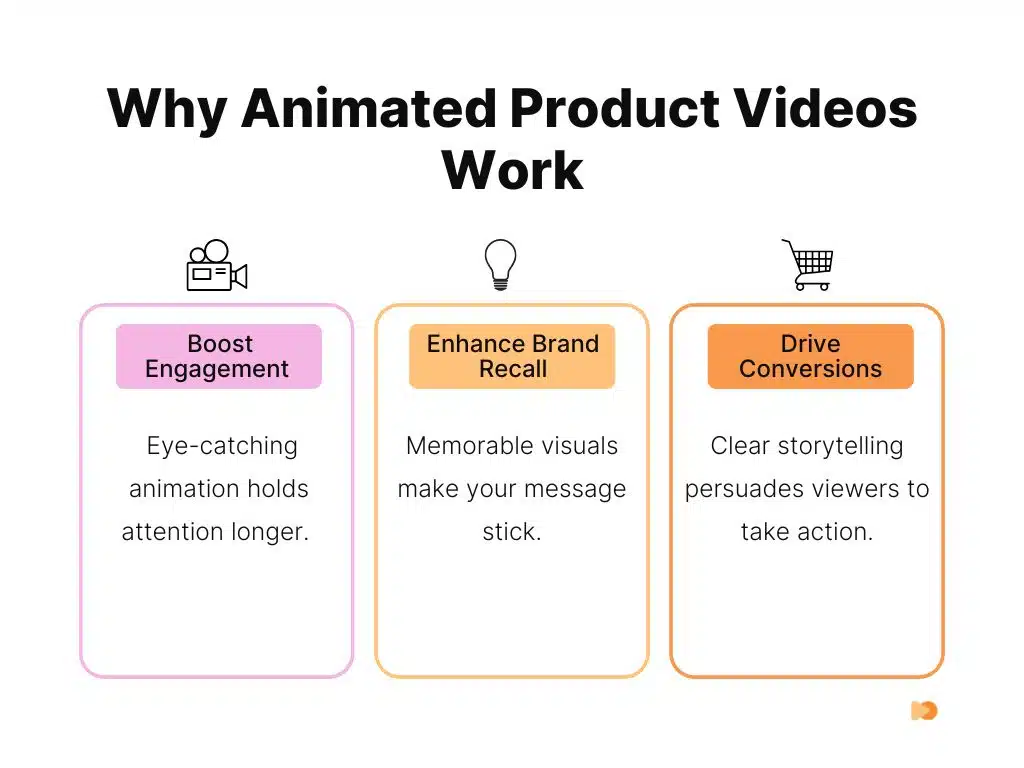
They convert. Landing pages with video can boost conversions by up to 86% (EyeView), and 85% of consumers say a video has convinced them to buy (Wyzowl, 2026). For products that require explaining, animation is often the most effective format to close that understanding gap. The best animated video examples don’t just inform — they highlight the specific value that makes users take the next step.
Download a free video script template for effective communication →
When Should You Choose Animation Over Live Action?
Not every product video needs animation. Here’s a decision framework to help you choose the right approach:
Choose animation when:
- Your product is intangible — software, SaaS, cloud services, workflows
- You need to explain a process or concept that can’t be filmed
- Your product updates frequently (animation is cheaper to revise than re-filming)
- You want full brand control over colors, characters, and visual storytelling
- You’re explaining complex ideas to a non-technical target audience
Choose live action explainer videos when:
- You’re selling physical products that buyers want to see in real life
- You need to build human trust — medical device companies, financial services, healthcare
- Your audience expects to see real people using the product
- Authenticity and social proof are more important than explanation
Consider a hybrid approach when:
- You have a SaaS product with a strong UI — use animation for the problem/hook, then transition to screen recordings for the product walkthrough
- You need both emotional connection (live action) and technical explanation (animation) in the same video
The global animation market hit $462 billion in 2025 and is projected to double by 2035. As production tools improve and costs decrease, animation is becoming accessible to more brands. The question isn’t whether animation works — it’s whether you’re using it strategically.
Why Work With Vidico for Animated Videos
At Vidico, we’ve produced animated videos for 450+ tech brands — from early-stage startups to enterprise companies like TikTok, Square, and Spotify. Our approach treats animation as creative infrastructure, not a one-time project. We build reusable assets, templatized formats, and motion graphics libraries so your production gets faster and more cost-effective with every campaign.
Our team of 40+ specialists across animation, motion graphics, illustration, and sound design delivers studio-quality production at scale — without managing multiple vendors. Clients like TikTok saw a 400% increase in creative output, and Square produces 200+ assets per month through our Content Engine approach.
We offer transparent pricing through subscription plans starting at $5,000/month — all services included, unused budget rolls over. No per-video pricing surprises, no hidden fees. Vidico prides itself on delivering video content of the highest quality.
“I never had a video project go as smoothly as creating the product video with Vidico.” – Merrin Hughes, Product Marketing Manager, BugHerd
Looking for skilled animators to highlight your product? Try our VidiFit Quiz and get a clear pricing in just 90 seconds!
Also read: Benefits of Custom Animated Marketing Videos
FAQs
What is a product animation video?
A product animation video is a marketing tool that uses animated visuals, typically 2D or 3D graphics, to showcase a product’s features, benefits, and functionality.
Instead of using live footage or live-action videos, you can use animation videos to build brand awareness, introduce your product, and explain how your solution, software, or application works.
It employs animation techniques to convey information and engage the target clients effectively.
Why are animated product videos good for marketing?
Animated product videos are advantageous for marketing because they captivate and inform audiences []. They simplify complex product details, making them more accessible and appealing.
These videos enhance brand visibility, boost product understanding, and often lead to increased conversion rates in your business.
Also, you can customize characters’ bodies and images that can be limited in live-action videos.
What is the purpose of a product video?
A product video’s primary purpose is to communicate a product’s value proposition effectively. It aims to showcase the product’s features, benefits, and use cases to potential customers.
Instead of using simple videos or images to promote your company and product, product videos engage and educate the audience, ultimately driving interest and sales in your business.
What makes animation more effective than traditional approaches?
Systematic animation creates reusable frameworks that improve with each implementation, unlike traditional one-off approaches that waste budget on non-scalable creative work. Our methodology ensures animation investments compound in business value over time.
How do animation frameworks improve conversion rates?
Animation uses proven psychological triggers and consistent messaging that create predictable engagement patterns. Companies using our frameworks achieve 350% better conversion rates because systematic approaches eliminate guesswork while optimizing for business results.
Why do animation investments deliver better ROI?
Animation eliminates waste while maximizing creative yield from every production cycle. Companies using our approach achieve 400% better ROI because systematic frameworks create ongoing value rather than single-use animation deliverables.
What types of businesses benefit most from animation approaches?
Tech companies, SaaS platforms, and enterprise businesses benefit most because systematic animation helps explain complex products while building scalable brand communication systems. Our frameworks work particularly well for companies with multiple product features or evolving technology offerings.
Final Thoughts
The video examples showcased here demonstrate the power of this medium in conveying information, engaging audiences, and enhancing brand messaging.
From Spotify’s informative stance to Google Assistant’s privacy assurance, these examples highlight the versatility and impact of animated product videos.
Whether you’re looking to introduce a new product, explain its features, or tell a captivating brand story, our team of experts is ready to bring your vision to life.
Ready to transform your product marketing with systematic animation? Book a free consultation to explore how our proven frameworks can turn your complex products into compelling customer acquisition tools.
References:
- https://www.adobe.com/
- https://www.forbes.com/companies/mcdonalds/
- https://www.business.com/articles/5-ways-video-can-make-your-content-marketing-strategy-more-effective/