39% of B2B marketing leaders now lean on storytelling, humor, and emotion to cut through the noise (LinkedIn, 2025). The old playbook of dry whitepapers and feature-dump webinars? It’s losing ground fast.
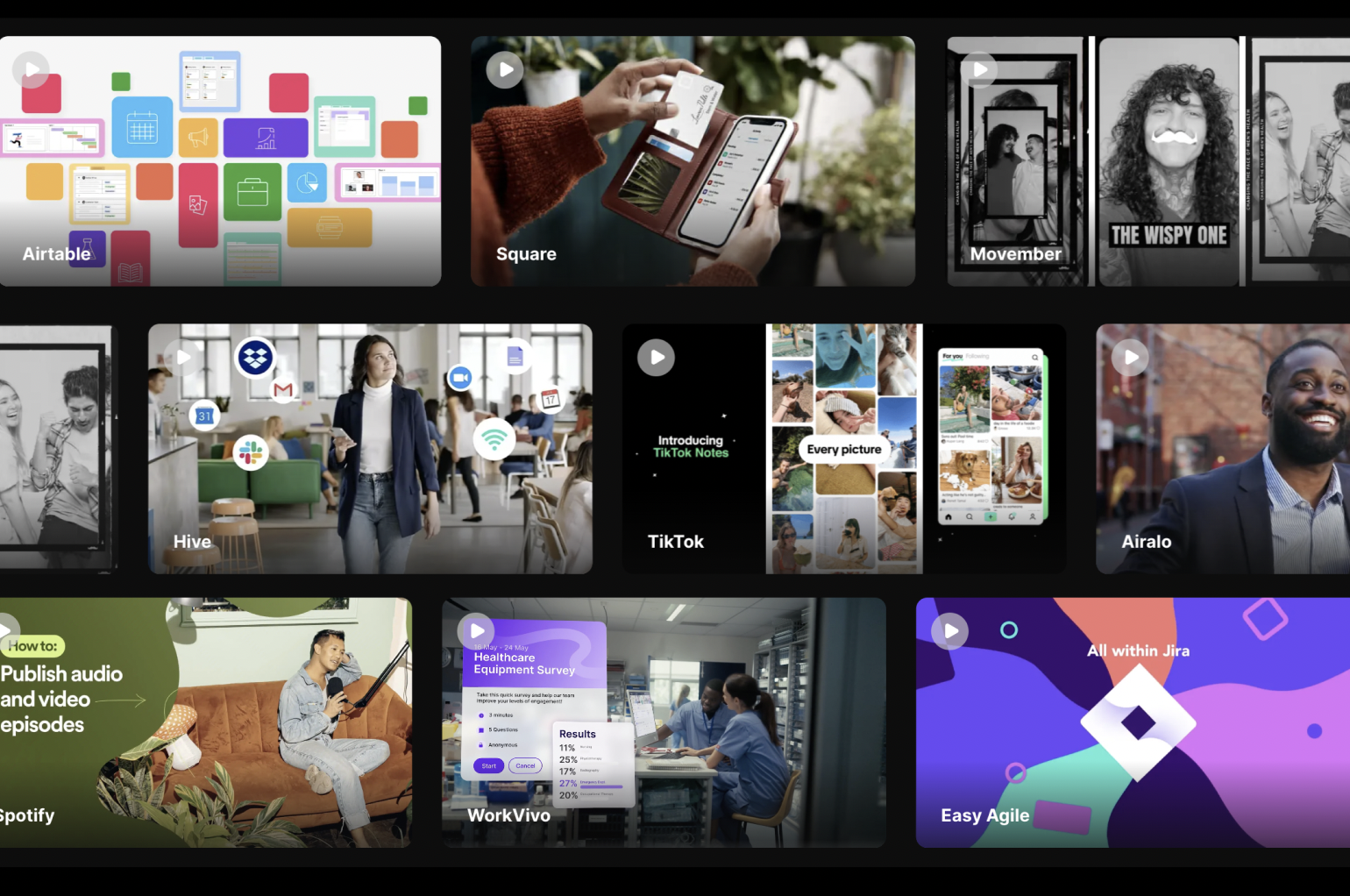
We’ve produced 2,000+ campaigns for brands like TikTok, Square, and Spotify — and the ones that actually move pipeline share a few common traits. Here are B2B marketing campaigns worth studying, plus what made each one land.
Key Takeaways
- The best B2B marketing campaigns pair creative risk with measurable ROI — emotional connection and data-backed results aren’t mutually exclusive
- Video content dominates — 91% of businesses use video as a marketing tool in 2026, and companies using video grow revenue 49% faster than non-video users
- Scaling creative is the real bottleneck — 45% of B2B marketers still lack a repeatable model for producing campaign assets at volume (Content Marketing Institute, 2025)
- Brand building matters more than you think — only 5% of your target audience is actively buying at any given time, so the best marketing campaigns invest in the other 95%
Content
Top 10 B2B Marketing Campaigns
1. Vidico x TikTok — Turning One Brief Into a Content Engine
Campaign type: Video content + Design System + Motion System
Check it here: Vidico x TikTok Case Study
TikTok needed to promote new features and creator tools across multiple regions simultaneously. The challenge wasn’t making one great video — it was producing dozens of variations without the quality dropping off a cliff.
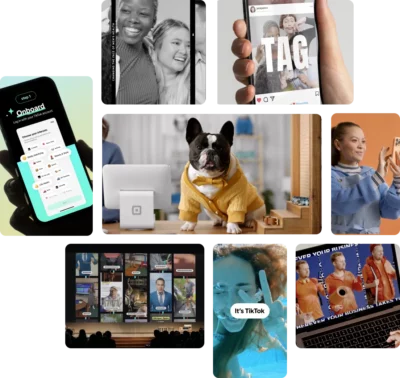
We built a content infrastructure around TikTok’s brand that let their marketing teams pull from a library of reusable motion templates, branded design components, and pre-approved creative frameworks. Instead of briefing a new project every time a campaign is launched, TikTok’s team could spin up assets in hours, not weeks.
The results: a 400% increase in creative output and 1M+ organic views in just 5 days from a single campaign push. That’s what happens when your creative infrastructure runs alongside your marketing strategy — not behind it.
Why it worked: TikTok didn’t just buy video production. They invested in a repeatable creative model that got faster and more efficient with every campaign. One brief turned into 40+ variations across formats and regions.
2. Spotify “Spreadbeats” — Meeting Buyers Where They Actually Work
Campaign type: Content marketing + personalized communication + event marketing
Watch it: Spotify Spreadbeats on Ads of the World
Spotify’s advertising team had a perception problem: media planners thought of them as an audio platform, not a video ad destination. So Spotify did something nobody expected — they coded a full music video inside an Excel spreadsheet and embedded it directly into their sales RFP responses.
Partnering with Coachella headliner John Summit, the creative team at FCB New York turned millions of data cells into a four-minute animated experience. Each file was personalized with the recipient’s name and brand. With zero paid ads, Spotify’s sales reps emailed planners their RFP responses with the music video surprise tucked inside.
Results: 17:1 ROI, +5,650% more email forwards than the B2B marketing average, and +870% ad engagement compared to previous paid social campaigns. The campaign won the Cannes Grand Prix in Digital Craft and multiple Clio Grand Awards.
Why it worked: Spotify turned the most mundane artifact in advertising — the media plan spreadsheet — into the campaign itself. It proved their video capabilities by demonstrating them in exactly the format decision makers already use every day.
Wondering how your creative stacks up against competitors? Get a free Creative Intelligence Report — a competitive analysis covering 12 areas of your creative output, delivered in 48 hours.
3. Dell x Reddit “I.T. Squad” — Building Brand Loyalty Through Community Engagement
Campaign type: Video content + influencer marketing + community engagement
Dell Technologies faced a trust gap among IT decision-makers — 49% of business-to-business buyers didn’t trust IT providers to understand their challenges. Instead of running another round of paid ads on LinkedIn, Dell partnered with Reddit to create an original animated comedy series based on real Reddit threads.
The show featured two characters, Bryan and Ryan, who solved IT problems drawn directly from trending conversations on the platform. Dell also hosted Reddit Talks and Ask Me Anything sessions with real tech influencers from their team.
Results: 72 million impressions, a 1,000% increase in followers, 200x increase in brand credibility metrics, and all three episodes exceeded Reddit’s upvote benchmarks by 48% or more.
Why it worked: Dell met their target audience on a platform they already trusted, using content formats native to that community. The campaign’s success came from authentic stories and humor — not corporate messaging. It’s a masterclass in how influencer marketing and community engagement can rebuild trust that paid social alone can’t buy.
Planning your next campaign? Download the State of Creative in Tech Report for benchmarks from 200+ SaaS marketers on what’s working in 2026.
4. Monday.com “Work Without Limits” — B2C Tactics for B2B Growth
Campaign type: Digital marketing + paid ads + event marketing
Monday.com broke B2B convention by buying a Super Bowl ad — typically the domain of beer and car brands. Their 30-second “Work Without Limits” spot used physics-defying acrobatics to visualize a world where teams could build any workflow they needed, reaching 30 million viewers across the 20 largest US markets.
But the TV ad was just one piece of a multichannel approach. Monday.com backed it with billboard and subway ads in nine cities, a full digital marketing push across YouTube, LinkedIn, Facebook, Instagram, and TikTok, plus a behind-the-scenes content strategy that showed how the campaign itself was managed on their platform.
Why it worked: Monday.com targeted individual new users, not just decision makers — betting that bottom-up adoption would drive enterprise accounts. They used control cities (markets without ads) to measure incrementality, proving the campaign’s success with real attribution data rather than vanity metrics.
5. Loom — Hyper-Personalized Account-Based Marketing at Scale
Campaign type: Account-based marketing + paid social + landing pages
Loom’s marketing teams built one of the most effective account-based marketing campaigns in recent memory. They created a target account list of top B2B brands, then developed LinkedIn ads that auto-populated each company’s logo, teammate count, and custom copy — making every prospect feel like the ad was built exclusively for them.
Each ad linked to a personalized landing page that continued the experience, reinforcing the message that Loom was already integrated into their workflow, whether they knew it or not.
Why it worked: Instead of broadcasting a generic message to a wider audience, Loom invested in highly targeted creative that spoke directly to key accounts. The emotional connection was personal — “this company already knows us” — which shortened the path from awareness to demo request. It’s a textbook example of how account-based marketing delivers measurable roi when the creative matches the precision of the targeting.
6. GfK “Human vs. AI” — Thought Leadership That People Actually Watched
Campaign type: Thought leadership + video content + content marketing
GfK, Germany’s largest market research company, wanted to establish authority in AI-powered data insights. Instead of publishing another dense whitepaper, they staged a live debate between their CMO, Gonzalo Garcia Villanueva, and an AI-powered robot named Ruby (built using ChatGPT, D-ID, and ElevenLabs).
The debate covered five marketing questions, with a moderator scoring each answer. The campaign included teaser videos, social media posts, programmatic advertising, and B2B influencer partnerships. The video has amassed 60,000+ views.
Results: 6.87 million impressions (projected 5 million), with Google Ads and social platforms driving 90% of impressions on just 34% of the budget.
Why it worked: GfK turned a potentially dry topic — AI in market research — into entertainment. The format was inherently shareable and sparked genuine debate about industry trends. It’s proof that thought leadership doesn’t have to mean 40-page PDFs. Video content with a strong concept outperforms traditional content marketing formats for brand awareness.
View Vidico’s case studies and see how we’ve helped brands like TikTok and Airtable scale their content.
7. Atlassian — Community-Led Growth as a Marketing Strategy
Campaign type: Content marketing + community engagement + partner marketing
Atlassian didn’t run a traditional marketing campaign. Instead, they built an entire ecosystem around their developer community — open APIs, plugin marketplaces, forums, badges, and annual conferences like Team ’24. Contributors earn recognition and swag. Partners build apps and share revenue.
Results: 1 million+ community members, 50,000+ monthly discussions, 5,000+ apps in the Atlassian Marketplace.
Why it worked: Atlassian invested in sustainable growth through existing customers and developers rather than paid acquisition. By turning users into advocates and partners into co-sellers, they created a self-reinforcing engine where every piece of user-generated content and every new marketplace app strengthened brand loyalty. The community itself became the marketing strategy.
8. Upwork “Hey World” — Bold Creative That Names Names
Campaign type: Digital marketing + paid ads + content marketing
Upwork directly targeted household-name executives — including Elon Musk — through billboard and digital ad placements, playfully nudging them to hire freelancers on the platform. The OOH campaign was backed by targeted digital marketing across Google Ads, social media posts, and content partnerships.
Why it worked: By naming real people and real companies, Upwork generated massive organic social sharing. People photographed the billboards and posted them, turning paid ads into viral content. The campaign proved that even in business-to-business marketing, a little audacity goes a long way. Upwork didn’t need potential customers to see the billboard — they needed the internet to talk about it.
See how leading tech brands approach campaign creative. Explore Vidico’s portfolio for examples across video production, motion graphics, and ad creative.
9. HubSpot — Product-as-Campaign for Evergreen Lead Generation
Campaign type: Content marketing + lead generation + content strategy
HubSpot didn’t just write about inbound marketing — they built free tools that embodied it. Their “Make My Persona” tool, Website Grader, and blog topic generator each function as standalone marketing campaigns that generate new leads indefinitely without ongoing ad spend.
Why it worked: Each tool solves a specific problem for the target market — giving potential customers immediate value while capturing their contact information. HubSpot treats valuable content not as a cost center but as permanent infrastructure. Years after launch, these tools still generate leads, rank in search, and establish authority across dozens of competitive keywords. That’s what sustainable growth looks like when your content strategy doubles as your lead generation engine.
10. Mailchimp “Did You Mean?” — Turning a Weakness Into Brand Loyalty
Campaign type: Digital marketing + content marketing + influencer marketing
Mailchimp turned one of their biggest branding challenges — people constantly misspelling their name — into a full creative campaign. They bought ads for over 100 common misspellings like “MailKimp,” “MailShrimp,” and “KaleLimp,” creating bizarre short films, products, and experiences for each variation.
Why it worked: The campaign was so weird that it became impossible to ignore. It expanded Mailchimp’s reach beyond email marketing into creative industries and B2B sectors like finance and manufacturing. Rather than correcting people, Mailchimp leaned into the confusion and used it to spark conversation. The result was a successful campaign that built a deeper emotional connection than any feature-comparison ad ever could.
What the Best B2B Marketing Campaigns Have in Common
After studying these campaigns and producing 2,000+ of our own for clients like TikTok, Square, and Spotify, a few patterns keep showing up.
“For B2B audiences, especially those making high-stakes purchase decisions, a great explainer video starts with talented writing. The message must be carefully crafted to resonate with their challenges, then conveyed on screen in a way that builds confidence.”
They lead with emotion, not features. LinkedIn’s 2025 B2B Marketing Benchmark found that marketing leaders are increasingly prioritizing storytelling and humor over product specs. Every campaign on this list — from Dell’s animated comedy to Spotify’s spreadsheet music video — made people feel something before asking them to buy something.
Video content is the anchor asset. 91% of businesses now use video as a marketing tool (Wyzowl, 2026), and 82% of video marketers report positive ROI. Eight of the 10 campaigns above feature video content as a primary format. If your next campaign doesn’t include video, you’re leaving measurable ROI on the table.
They’re built for multiple channels. Not a single successful campaign on this list lived on one platform. Monday.com ran TV, OOH, and six digital channels simultaneously. Dell used Reddit, AMAs, and animated content. The best B2B marketing campaigns are designed for a multichannel approach from day one, adapting the core concept to each channel’s native format.
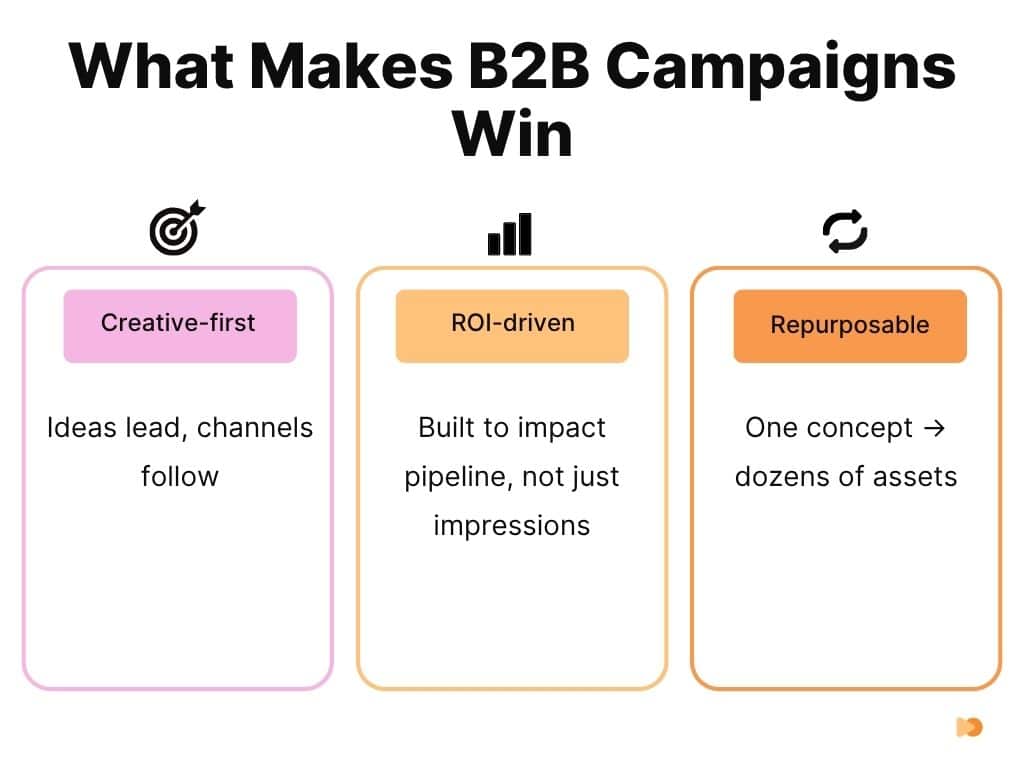
They solve the production problem. Here’s what most “best campaigns” roundups won’t tell you: the biggest barrier to running marketing campaigns like these isn’t strategy — it’s creative production. 45% of B2B marketers lack a scalable model for producing campaign assets (Content Marketing Institute, 2025). One hero video doesn’t become a campaign until it’s cut for LinkedIn (1:1), Stories (9:16), YouTube (16:9), email thumbnails, landing pages, and paid social variations. That’s why we build Content Engines — reusable creative frameworks that turn one campaign brief into 40+ assets across formats and regions.
Our work with Square illustrates this exactly. Their marketing teams needed 200+ assets per month across 200+ markets in 17 languages — all while maintaining brand consistency. The Motion System we built for them delivered a 43% conversion lift while keeping production velocity high enough to support global campaign rollouts without missing deadlines.
FAQs
How do you measure B2B marketing campaign success?
The key performance indicators that matter depend on your campaign’s goal. For brand awareness campaigns (like Dell’s Reddit series), track impressions, engagement rates, brand lift surveys, and sentiment. For lead-generation campaigns (such as HubSpot’s tools), track new leads, cost per click, and conversion rates. For revenue-focused campaigns, connect your marketing data to the pipeline — track influenced pipeline, customer acquisition cost, and measurable ROI. The best marketing teams measure across all three layers.
What’s the difference between B2B and B2C marketing campaigns?
B2B marketing campaigns target other businesses — typically involving longer sales cycles, multiple decision makers, and higher contract values. B2C targets individual consumers with shorter purchase paths. The gap is narrowing, though. As these examples show, B2B marketing increasingly borrows B2C tactics: emotional storytelling, influencer marketing, community engagement, and video content that entertains rather than just informs. The target audience is still a business buyer, but they’re a human first.
How much should you spend on a B2B marketing campaign?
B2B marketing budgets vary widely. Lead generation accounts for the largest share, at about 36% of the typical B2B marketing budget, followed by brand building at 30% (LinkedIn). What matters more than total ad spend is how efficiently your budget translates into campaign assets. A subscription-based creative partner can turn a fixed monthly investment into dozens of campaign variations — versus the traditional model where each asset requires a separate scope, timeline, and invoice.
What types of video work best for B2B marketing campaigns?
Short-form video delivers the highest ROI — 104% more marketers named it their most valuable channel in 2025 versus 2024 (KLIQ Interactive). Beyond short-form, explainer videos, customer success stories, and product demos consistently perform well for B2B. The format should match the campaign objective: brand videos for awareness, demo videos for consideration, and customer success stories for closing deals. Repurposing one hero video into multiple formats is more cost-effective than creating each from scratch.
What B2B marketing trends should you watch in 2026?
Three new trends are reshaping the landscape. First, AI-led discovery is changing how buyers find brands — your content needs to show up in LLM responses, not just Google. Second, employee advocacy outperforms company culture pages and corporate social posts in organic reach. And third, short-form video content continues to dominate, with LinkedIn video views up 36% year-over-year. The marketing teams winning in 2026 are investing in owned media (content, email, community), not just renting attention through paid social.
Run Your Next Campaign Like the Best
The B2B marketing campaigns that win in 2026 aren’t the most expensive. They’re the ones built on creative that scales — where one concept becomes dozens of assets across every channel your target market actually uses.
That requires more than a good marketing strategy. It requires the creative infrastructure to execute it. Whether you need video content, motion graphics, ad creative, or all three at once — the question isn’t what to make. It’s whether your production model can keep up with your ambition.
Book a free strategy session to talk through your next campaign with our team.
References:
- https://business.linkedin.com/content/dam/business/marketing-solutions/global/en_US/site/pdf/wp/2025/2025-b2b-marketing-benchmark-trust-is-the-new-kpi.pdf
- https://contentmarketinginstitute.com/b2b-research/b2b-content-marketing-trends-research-2025
- https://kliqinteractive.com/insights/b2b-reports-benchmarks-and-statistics-2025-2026/
- https://www.oneclub.org/awards/theoneshow/-award/57159/spreadbeats/
- https://shortyawards.com/15th/zales-the-one-where-she-proposed