
Tech companies allocate 11–15% of revenue to marketing — more than almost any other industry. Yet 59% of CMOs say they still don’t have enough budget to execute their strategy. The problem isn’t spending. It’s how the money gets turned into marketing assets, campaigns, and pipeline.
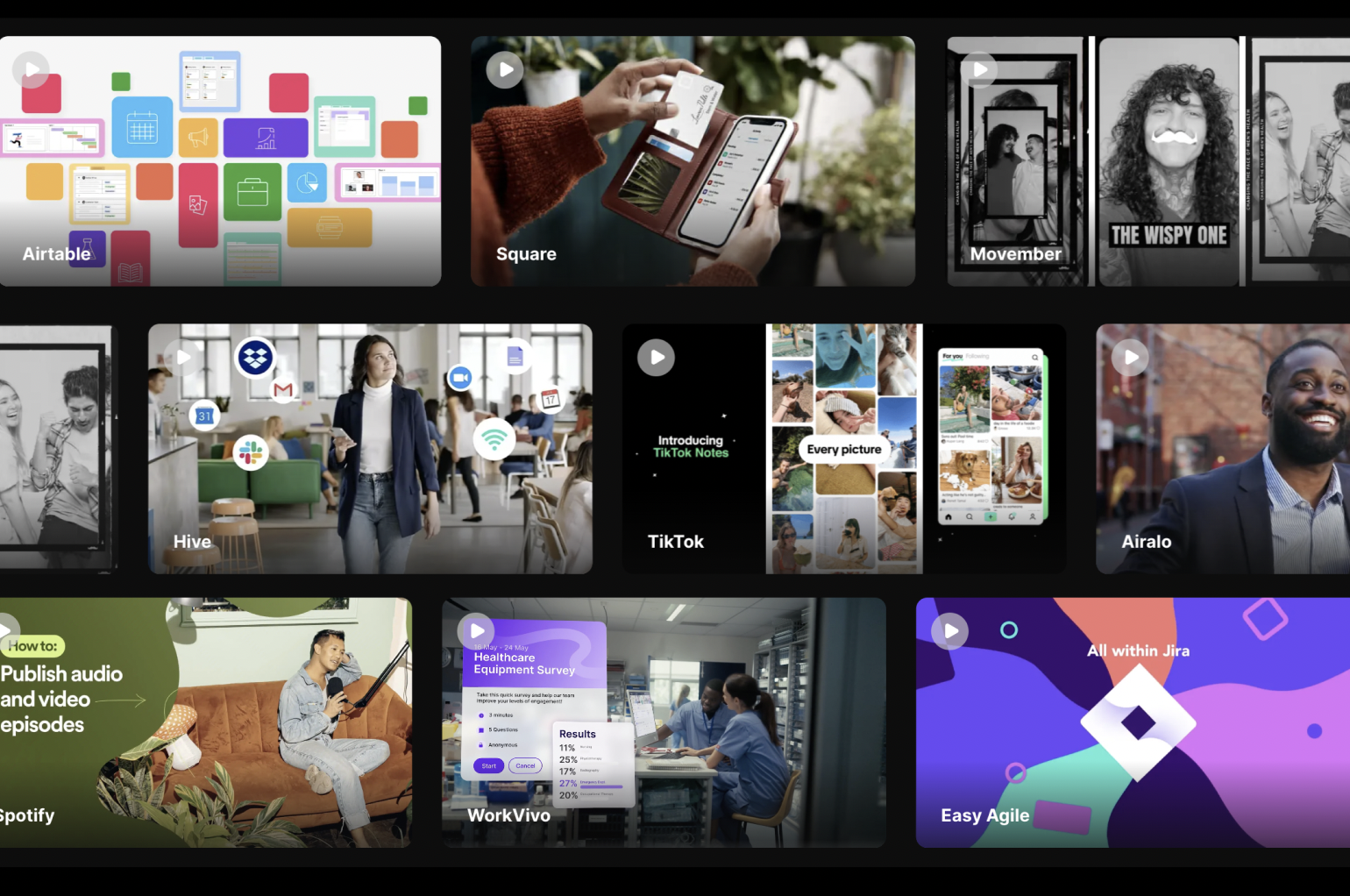
At Vidico, we’ve worked with 450+ technology companies, including TikTok, Square, and Spotify. Here’s what separates digital marketing strategies that drive results from ones that just burn budget.
Key Takeaways
- Digital marketing for tech companies requires a multichannel approach — search engine optimization, video content, paid advertising, email marketing, and social media working together, not in silos
- Video is the most underused digital marketing channel in tech — 91% of businesses use it, yet most technology companies still treat it as an afterthought rather than a strategic pillar
- 45% of B2B marketers lack a scalable model for content production — the gap between digital marketing strategies and execution is a creative production problem, not a strategy problem
- 81% of B2B buyers choose a vendor before ever talking to sales — your digital presence, blog posts, and video content are doing the selling, whether you realize it or not
Content
Why Digital Marketing for Tech Companies Is Different
Marketing for technology companies isn’t the same as marketing consumer goods or professional digital marketing services. Your target audience — technical decision makers, product leaders, and engineering managers — researches differently, evaluates differently, and buys differently.
How tech buyers evaluate vendors:
The average B2B tech sales process takes 84 days. During that time, prospective customers:
- Visit vendor websites and read blog posts
- Watch product demos and explainer videos
- Ask peers on Reddit, Slack, and LinkedIn
- Consult AI tools like ChatGPT and Perplexity
- Compare vendors through review sites and case studies
By the time they talk to your sales team, they’ve already formed an opinion. Your digital marketing efforts need to influence that opinion at every stage — from the first search engine query to the final vendor comparison.
Where your digital marketing needs to show up:
Your online marketing strategy can’t just exist on your blog. It needs to appear across:
- Search engines — organic and paid results
- Social media platforms — LinkedIn, YouTube, Reddit
- Email marketing — nurture sequences and newsletters
- Paid media — Google Ads, LinkedIn Ads, programmatic display
- AI-generated responses — ChatGPT, Perplexity, Google AI Overviews
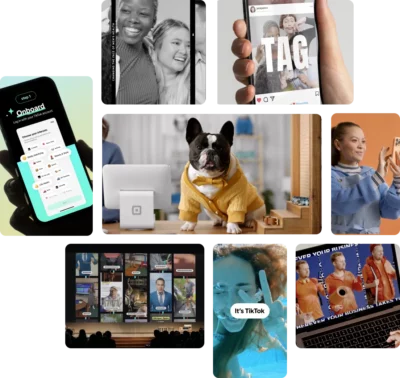
Every one of those digital marketing channels requires native-format creative — different dimensions, different hooks, different lengths. This is where most technology companies hit a wall. The marketing strategy is sound. The execution breaks down because there aren’t enough marketing assets to support it.
Want to see how your creative stacks up? The State of Creative in Tech Report has benchmarks from 200+ SaaS marketers on what’s working in 2026.
Top Digital Marketing Strategies for Tech Companies

1. Search Engine Optimization and Content Marketing
Search engine optimization remains the foundation of any digital marketing strategy for tech companies. SEO claims about 9% of the average digital marketing budget (Gartner, 2025), and it’s the top-performing owned channel for driving organic traffic and lead generation.
But SEO for the tech industry has shifted. Traditional marketing methods — targeting broad keywords with thin content — don’t work against AI Overviews and zero-click results. Google’s organic click-through rate dropped from 44.2% to 40.3% year-over-year.
What’s working for tech companies in search engines now:
- Long-form guides and original research that demonstrate deep expertise
- Product comparisons and technical how-tos targeting buyer personas at each stage of the sales funnel
- Answer engine optimization — structuring content so digital tools cite it (58% of marketers report AI referral traffic has significantly higher intent than traditional search, per HubSpot 2026)
- High quality content over high volume — depth and specificity beat thin pages
Digital content marketing costs 62% less than traditional advertising while generating 3x more leads (DemandMetric). For tech companies with long sales cycles and technical target markets, this makes content the most cost-effective path to building online visibility and establishing authority.
2. Video Marketing
Here’s the gap most technology companies aren’t closing: 91% of businesses use video as a digital marketing tool in 2026, but the majority of tech brands still treat video content as a one-off project rather than an ongoing digital marketing channel.
The numbers make the case:
- 104% jump in marketers naming short-form video their most valuable channel (KLIQ Interactive, 2025)
- 36% increase in LinkedIn video views year-over-year
- 49% faster revenue growth for companies that invest in video marketing vs. those that don’t
Which video formats work for tech companies?
| Video Format | Best For | Funnel Stage |
|---|---|---|
| Explainer videos | Simplifying complex tech solutions | Awareness |
| Product demos | Showing the product in action | Consideration |
| Customer success stories | Building trust with prospective customers | Decision |
| Short-form social video | Building brand awareness on social media platforms | Awareness |
| Motion graphics | Website, ads, landing pages | All stages |
The challenge isn’t convincing marketing teams that video matters. It’s producing enough of it. One explainer video isn’t a video marketing strategy. You need cuts for every social media platform, email, landing pages, and paid advertising — each with its own dimensions, hooks, and pacing. That’s where most digital marketing efforts stall — not at the strategy level, but at the production level.
We built our Content Engine model to solve exactly this problem for tech companies:
- TikTok: We created a motion template library that powered a 400% increase in creative output and 1M+ organic views in 5 days — without restarting production from scratch for each new launch
- Square: Our Motion System delivered 200+ marketing assets per month across 200+ markets in 17 languages — the kind of multichannel production volume that digital marketing for technology companies demands, driving a 43% conversion lift in the process
Curious how your creative output compares to competitors? Get a free Creative Intelligence Report — a competitive analysis across 12 areas of your digital marketing, delivered in 48 hours.
3. Paid Advertising and Digital Advertising
Paid media captures 30.6% of total marketing investment (CMO Survey, 2025), making it the largest single budget category for most technology companies. Google Ads, LinkedIn Ads, and programmatic display all play a role in reaching potential customers who are actively searching for tech solutions.
The paid advertising paradox for tech companies:
- 84% of marketers report positive PPC results
- 40% still struggle to prove marketing ROI from their digital advertising (Fello Agency)
The disconnect usually comes from creative. Common mistakes include:
- Running the same static ad across every platform
- Ignoring the need for native formats per channel
- Failing to refresh creative frequently enough to combat ad fatigue
- Sending paid traffic to generic landing pages instead of campaign-specific ones
Digital advertising for tech companies works best when it’s paired with strong creative production — dedicated ad variations for each social media platform, landing pages tailored to each campaign, and retargeting creative that moves prospective customers through the sales funnel.
4. Email Marketing and Marketing Automation
Email marketing remains one of the highest-ROI digital marketing channels, returning an average of $36 for every $1 spent. For technology companies with long sales cycles, email is how you stay in front of potential customers during the evaluation process.
How to segment your email marketing for tech buyers:
| Segment | Content Type | Goal |
|---|---|---|
| Evaluators (technical) | Product deep-dives, technical docs | Build confidence |
| Decision makers | ROI data, customer success stories | Justify investment |
| Engineering leads | Technical comparisons, integration guides | Remove objections |
| Existing customers | Feature updates, training content | Drive retention |
Marketing automation makes this scalable. Tools like HubSpot, Marketo, or ActiveCampaign let marketing and sales teams coordinate nurture sequences that deliver the right marketing message at the right time without manual effort.
The tech companies seeing the best results from email aren’t sending more — they’re sending smarter.
5. Social Media Marketing
Social media marketing for technology companies has evolved past posting company news and hoping for social media engagement. LinkedIn is now the primary B2B digital marketing channel — 89% of B2B marketers use it for lead generation — and its algorithm increasingly rewards video content and employee-generated posts over branded corporate content.
“Vidico has been an incredible creative agency partner, and we couldn’t be happier with their work. From graphic design and video production to copywriting, they consistently deliver high-quality results—quickly, reliably, and at a fair price. They truly understand our business and always go the extra mile to ensure our partnership is both effective and enjoyable.” — Jennah Blau, Global Head of Publisher Development @ TikTok
The three elements of effective social media for tech brands:
- Thought leadership from executives and industry influencers — not polished corporate posts, but real insights from real people
- Video content — product demos, behind-the-scenes, short-form clips that stop the scroll
- Paid social — amplifying high-performing organic posts to reach a wider audience
Social media management tools like Sprout Social, Hootsuite, or Buffer help marketing teams schedule and track performance across social media platforms. But the real bottleneck isn’t scheduling — it’s producing enough high quality content to fill the channels. Tech companies that invest in reusable design templates and motion graphics can maintain consistent social media engagement without burning out their creative team.
6. Account-Based Marketing
Account-based marketing has moved from experimental to mainstream for tech companies selling to enterprise buyers. 57% of B2B marketers now plan or execute ABM programs (KLIQ Interactive).
The three pillars of ABM for technology companies:
- Intent data — identifying which key accounts are actively researching your category
- Personalized creative — custom landing pages, targeted ads, tailored content for each account
- Sales alignment — ensuring marketing and sales teams pursue the same accounts with coordinated messaging
The creative production demands of ABM are significant. Each key account may need its own ad variations, landing pages, and outreach materials. Without a scalable production model, ABM becomes a resource drain rather than a growth engine.
The Production Gap Nobody Talks About
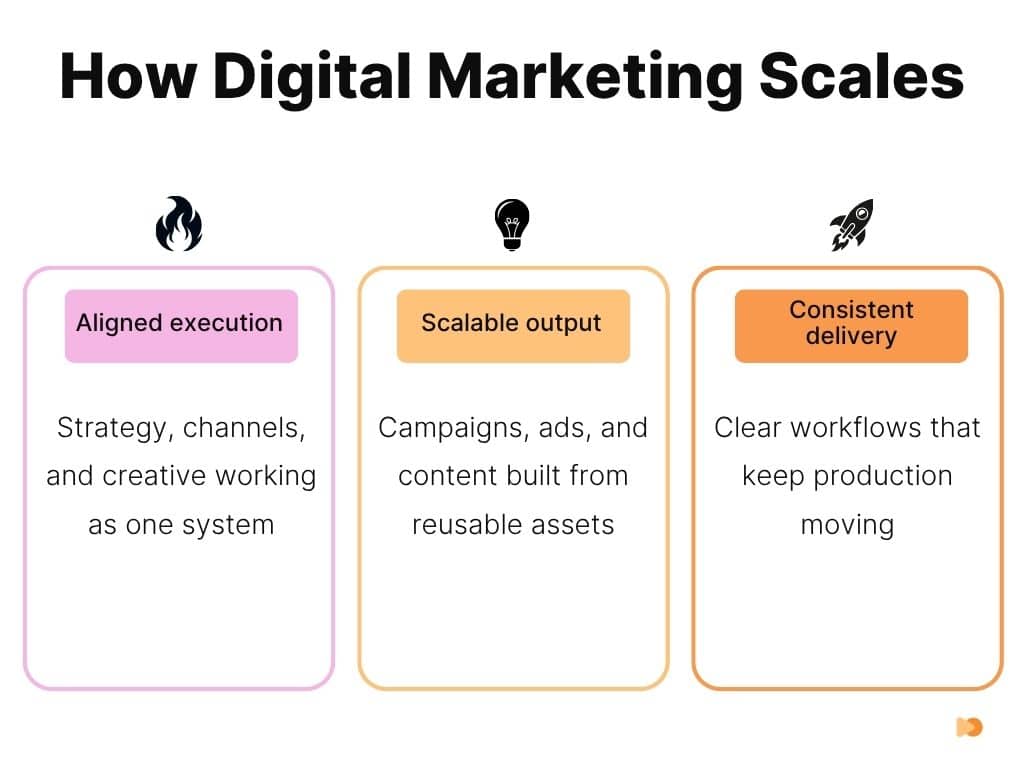
Every digital marketing strategy article will tell you to invest in SEO, content marketing, video marketing, paid advertising, email marketing, social media marketing, and account-based marketing. That’s seven channels, each requiring native-format creative across multiple touchpoints.
Here’s what those articles skip: who actually produces all of this?
The numbers tell the story
- 45% of B2B marketers lack a scalable content creation model (Content Marketing Institute, 2025)
- 77% of marketing teams report increased project volume year-over-year (MarTech/Canto, 2026)
- 45% can’t keep up with increasing content demands
The result is what the tech industry knows well — a bottleneck. Creative teams get overwhelmed. Deadlines slip. Marketing campaigns launch with half the marketing assets they need. Or worse, teams “go rogue” and produce off-brand content just to keep up.
See how leading tech brands approach creative production. Explore Vidico’s portfolio for examples across video marketing, motion graphics, and ad creative.
Why traditional solutions fall short:
| Production Model | Limitation |
|---|---|
| In-house team | Capacity maxes out, expensive fixed costs, skills gaps |
| Project-based agencies | Slow, new scope to create targeted campaign, no institutional memory |
| Freelancers | Inconsistent quality, no strategic alignment, hard to coordinate |
That’s why 46% of companies are moving to a hybrid model in 2026 (Sagefrog) — combining in-house strategy with external production partners who can execute at volume.
The most efficient version of this is a subscription creative partner that builds reusable frameworks — design templates, motion systems, branded asset libraries — so every new digital marketing campaign builds on the last one instead of starting from scratch.
Our work with technology companies like TikTok, Square, Spotify, and Airtable follows exactly this model. We plug into your marketing operations as an extension of your team, with 40+ specialists across video, motion, design, and ad creative — all accessible through a flexible monthly plan.
Planning your digital marketing strategy for 2026? Watch the Scaling B2B Creative Masterclass for expert insights on building creative infrastructure that keeps pace with your growth.
FAQs
How do tech companies measure digital marketing success?
The key performance indicators that matter depend on your digital marketing channels and goals. For content marketing and SEO, track organic traffic, search engine rankings, and the content-assisted pipeline. For paid advertising, track customer acquisition cost, cost per click, and return on ad spend. For video marketing, track engagement rate, view-through rate, and influenced pipeline. For email marketing, track open rates, click rates, and marketing-qualified leads. The best marketing teams tie every channel back to pipeline and revenue — not just website traffic or social media engagement.
What should a tech company’s digital marketing budget look like?
Technology companies typically allocate 11–15% of revenue to marketing (etropo, 2026). Startups pursuing aggressive growth may push that to 15–30%, while mature companies usually settle between 7–10%. The average split across B2B is roughly 42% on programs (campaigns, content, events, digital advertising), 35% on personnel, and 23% on technology like marketing automation, CRM, and analytics (Forrester, 2026). Within digital programs, paid media takes the largest share at about 30%, followed by content marketing, SEO, and events. The specific allocation depends on your growth stage, target market, and whether you’re optimizing for brand awareness or direct lead generation.
What’s the biggest digital marketing mistake tech companies make?
Treating digital marketing as a set of disconnected tactics rather than an integrated system. Most technology companies run SEO, social media marketing, paid advertising, and email marketing as separate workstreams with separate teams and separate creative assets. The result is inconsistent messaging across digital marketing channels, duplicated effort between marketing teams, marketing campaigns that don’t reinforce each other, and wasted budget on marketing efforts that pull in different directions. The tech companies that outperform consolidate their digital marketing efforts into a unified content marketing strategy where every channel, every piece of content, and every marketing asset works toward the same business growth objectives.
What role does AI play in digital marketing for tech companies?
AI integration in marketing has doubled since 2022 and now powers 17.2% of marketing efforts (CMO Survey, 2025). 49% of marketers say AI has improved time efficiency, and 72% of B2B marketers are actively using AI tools. For tech companies, AI accelerates digital marketing tactics like audience segmentation, content personalization, market research, and campaign optimization. But AI hasn’t replaced the need for high-quality creative. 71% of marketers say they need more distinctive, human-centered content to stand out in an increasingly automated digital world. The most effective approach uses AI for speed and analysis while keeping humans in charge of strategy, storytelling, and brand voice.
Build a Digital Marketing Engine, Not a To-Do List
The technology companies winning in 2026 aren’t running more digital marketing campaigns. They’re building digital marketing infrastructure:
- Reusable creative frameworks that speed up production
- Templatized pipelines that maintain brand consistency
- Always-on content engines that turn every campaign into fuel for the next one
Your digital marketing strategy is only as good as your ability to execute it. If your marketing teams are stuck waiting on creative, recycling the same tired assets, or cutting corners to meet deadlines, no amount of strategic planning will fix the output.
Book a free strategy session to talk through how your tech company can scale digital marketing production without scaling headcount.
References:
- https://www.gartner.com/en/newsroom/press-releases/2025-05-12-gartner-2025-cmo-spend-survey-reveals-marketing-budgets-have-flatlined-at-seven-percent-of-overall-company-revenue
- https://contentmarketinginstitute.com/b2b-research/b2b-content-marketing-trends-research-2025
- https://www.hubspot.com/marketing-statistics
- https://martech.org/breaking-through-creative-ops-bottlenecks-your-2026-technology-roadmap/