Most Facebook video ad advice tells you to “hook viewers in the first three seconds” and “optimize for mobile.” That is not wrong. It is just not enough to explain why some brands get 4x the return on the same platform with the same budget.
Facebook video advertising is getting harder. The feed is more competitive, attention is shorter, and brands that were getting away with mediocre creative two years ago are now paying more per result for the same output. The platform has not changed that much. The creative bar has.
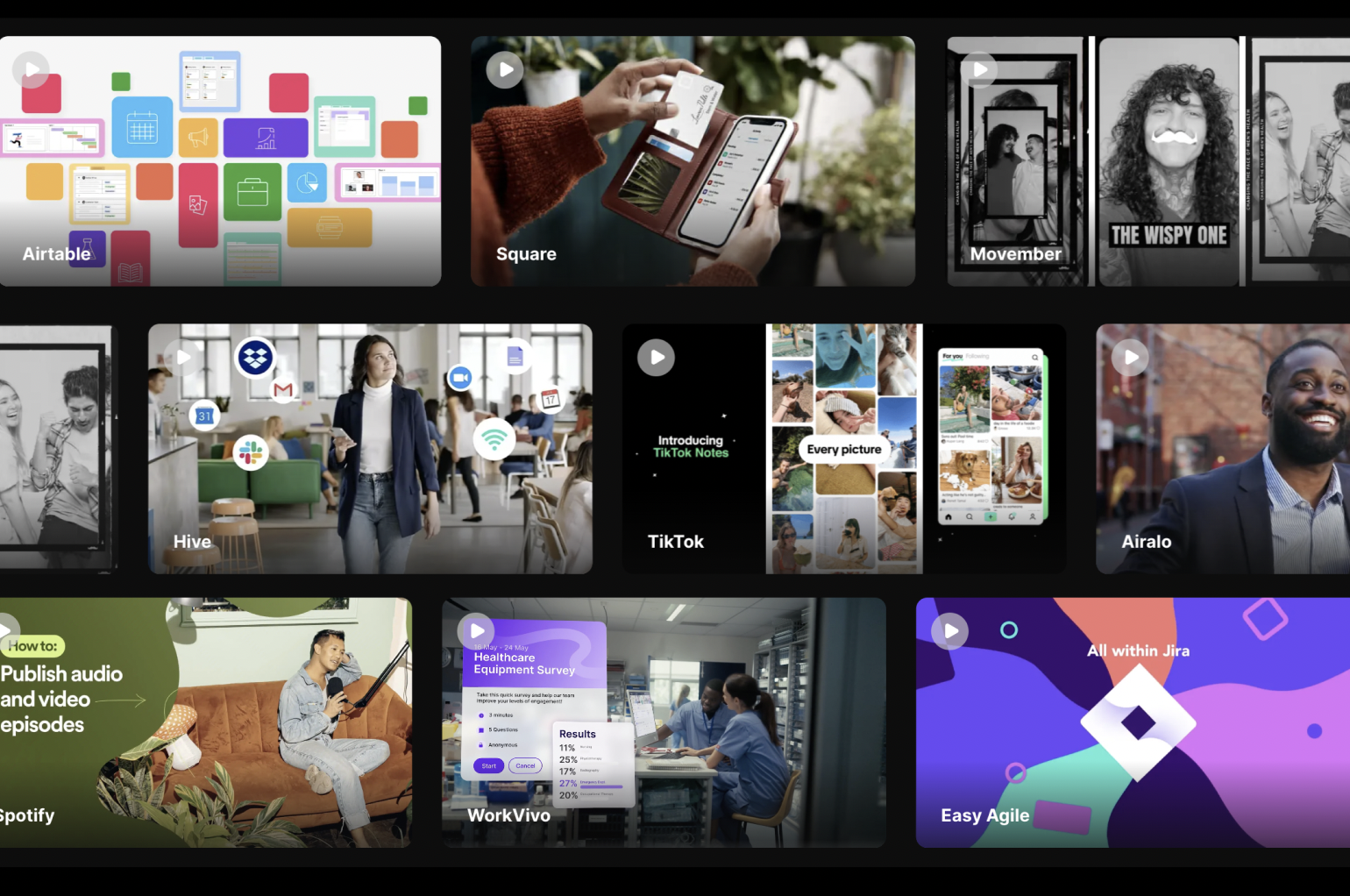
After producing 1,200+ video projects for tech brands including TikTok, Spotify, Square, and Airtable, we have identified what actually separates campaigns that perform from campaigns that just spend. This guide covers the best practices behind high-converting Facebook video ads in 2026, the data that supports them, and real examples of what each one looks like in practice.
Key takeaways
- The first three seconds decide everything: People who watched under three seconds of a Facebook video ad created up to 47% of total campaign value, according to Nielsen research commissioned by Meta. Earning attention early is not a nice-to-have. It is the single variable with the most impact on campaign performance.
- 85% of Facebook video is watched on mute: Your visual layer needs to carry the message without audio. Captions are not an accessibility feature. They are the primary text layer for the majority of your viewers.
- Vertical formats outperform on every metric that matters: Adding 9:16 video with audio to always-on strategies produces 34.5% lower cost per acquisition than image ads on Reels, according to Meta’s own data.
- Systems beat one-off campaigns: Tech brands running creative systems (multiple hooks, format-native variants, asset banks) consistently outperform brands producing standalone videos by 300-500% in cost-per-acquisition.
- Facebook video time spent grew 20% year-over-year in the US: The platform is not declining, and neither is its advertising efficiency. Brands that build systematic production approaches are capturing outsized returns while competitors run the same creative until it fatigues.
- 79% of people say they purchased a product after watching Reels: Short-form vertical video is no longer just a brand awareness tool. It drives direct conversion at scale.
Content
- What are Facebook video ads?
- Why Facebook video ads work
- The 3 formats that matter in 2026
- 10 best practices for Facebook video ads in 2026
- Facebook video ad benchmarks by industry (2025)
- Creative strategy: what to test and in what order
- Common mistakes to avoid
- Technical specs that actually matter
- Case studies: Vidico clients on Facebook
- Why work with Vidico
- FAQs
- Sources
What are Facebook video ads?
Facebook video ads are paid video placements across Meta’s surfaces: in-feed on Facebook and Instagram, Stories, Reels, and in-stream. In 2026, the distinction that matters most is not where an ad runs but whether it was built for that placement specifically.
Facebook video time spent grew 20% year-over-year in the US, according to Meta’s Q2 2025 earnings. More than 10 million active advertisers now run ads on the platform monthly. Global social media ad budgets allocate over 75% of spend to Facebook and Instagram combined.
The platform is not getting quieter. The brands winning on it are not outspending their competitors. They are out-creating them.
“Taste is the secret sauce. Even the biggest companies, Apple and Microsoft, still hire agencies. Why? They’re not just buying production, they’re buying taste. Something their in-house teams can’t always replicate.” (Michael Pirone, Co-Founder, Vidico)
Why Facebook video ads work
Nielsen analyzed data from 173 brand studies on behalf of Meta to measure how video ads affect brand recall, awareness, and purchase intent. The findings changed how serious advertisers think about video measurement.
From the moment a video ad was viewed (even before one second passed) lift happened across all three metrics. People who never watched the video but saw the initial impression were still affected by the ad.
More importantly: people who watched under three seconds created up to 47% of total campaign value. People who watched fewer than 10 seconds created up to 74%, depending on the metric.
That means the value of a Facebook video ad is not concentrated in the middle or the end. It starts at zero seconds and accumulates from there. An ad that earns three attentive seconds from a thousand people can outperform an ad that earns thirty seconds from a hundred.
Optimizing for completion rate misses the point. Optimizing for the first three seconds is where performance is made or lost.
The 3 formats that matter in 2026
Reels: native beats adapted
Reels gets 200 billion daily views across Facebook and Instagram. Adding 9:16 video with audio to always-on strategies produces 34.5% lower cost per acquisition than image ads in Reels placements, according to Meta’s own performance data. Reels ads with vertical video and audio see 35% higher CTR than other Reels ad formats.
The creative essentials Meta recommends: build for vertical with 9:16, add audio, build in the safe zone so key messages are not overlapped by the Reels interface. Repurposed landscape video with letterboxing consistently underperforms content shot natively for the format.
79% of people surveyed by Meta say they purchased a product or service after watching Reels. The format is not just for awareness.
Stories: urgency and directness
Stories gets 300 million daily active users. It is the most direct format on the platform: full screen, no competing content, a viewer who has actively engaged with the interface. The creative that works here is faster and more direct than in-feed. One message, one CTA, no preamble.
Sound-on vertical videos in Stories increase brand recall by 67%, according to IncRev data. This is also the placement where ad frequency fatigue happens fastest, so creative rotation matters more here than anywhere else.
In-feed: the workhorse
In-feed is where most budgets go and where the most creative variety exists. The average CTR across all industries for traffic campaigns is 1.71% in 2025, up from 1.57% the previous year. Average CPC for traffic campaigns is $0.70, down from $0.77.
For cold audiences, 15 to 30 seconds. Up to 60 seconds when the viewer is already familiar with the brand. The first frame has to work as a static image because a meaningful portion of viewers never unmute.
10 best practices for Facebook video ads in 2026
1. Design for silence from the first frame
85% of Facebook video is watched without sound. Most brands know this and still produce ads where the voiceover carries the message. The visual layer needs to work independently, not as a companion to audio, but as the primary communication channel.
The practical test: watch your ad on mute. If you cannot tell what the product is and why you should care within 10 seconds, the creative has a problem that sound design will not fix.
Captions increase video viewing time by 12% and completion rates by up to 80%. Auto-generated captions produce enough errors to undermine the message. Reviewed, corrected captions are part of the production process, not a post-launch task.
One approach that takes this further: Hotels.com built an entire Facebook ad concept around silence. The ad shows someone appearing to play piano in a hotel lobby. Through captions, the player admits he cannot play at all. No audio track exists. The humor, the narrative, and the CTA are delivered entirely through text on screen. It works because it was built for the way Facebook video is actually watched, not the way brands wish it was watched.
2. Earn attention in the first two seconds, not the first ten
The opening frame of a Facebook video ad is not an introduction. It is the decision point. The viewer is making one call in roughly two seconds: does this feel relevant to me?
Relevance comes from specificity. An ad that opens with “Are you a marketing team struggling to produce enough content?” is more relevant to a marketing director than an ad that opens with a product shot and ambient music. The first speaks to a person. The second speaks to no one in particular.
What earns attention in two seconds: a specific situation the viewer recognizes, a number that creates immediate curiosity, a visual that catches the viewer off guard, or a direct question that names the viewer’s exact problem. What does not: logos, brand names, establishing shots, and any opening that requires context to understand.
According to Meta’s Nielsen research, people who watched under three seconds created up to 47% of total campaign value. The first frame is not setup. It is the ad.
3. Lead with the customer, not the product
The ads that earn the most attention in competitive feeds open with a person or a situation, not a product. The product earns its place in the story rather than introducing it. If you want to see how the best brands apply this in practice, our guide to best brand video examples breaks down what makes each one work.
This is harder to brief and harder to approve internally. It requires trusting that showing a small business owner at the moment a sale closes will communicate more about a payment product than showing the payment terminal. But brands that make that trade-off consistently outperform those that lead with features.
Adding a human face to video improves CTR by up to 40%, according to Marketing LTB data. The reason is not that faces are inherently more engaging. It is that a face signals that a real person is in the video, which means the viewer is watching something that might be relevant to them rather than something built to sell them a product.
When Vidico produced Finder’s UGC savings series for Facebook, each video opened with a person navigating a specific financial frustration before introducing the app as the solution. The series was designed to feel like a conversation, not a commercial. That distinction is what made it work across Facebook, TikTok, and Instagram simultaneously.
4. Build for the placement before shoot day, not after
An ad planned for in-feed and adapted to Reels in post-production almost always underperforms an ad planned for Reels from the start. Camera angle, pacing, text placement, safe zones, and hook timing are all placement-native decisions. They cannot be fixed after the fact without rebuilding the creative.
The three placements have real differences that matter in production:
Reels: 9:16 vertical, audio expected, fast cuts, text overlays from the first second, key message in the safe zone away from UI elements.
Stories: 9:16 vertical, full screen, single message, single CTA, no competing content. The most direct placement on the platform.
In-feed: 1:1 square for mobile, 16:9 for desktop only, silent-first, first frame works as a static image.
If your production workflow produces one format and adapts to others, you are producing in-feed ads and calling them a multi-placement campaign. Brands that plan all three placements before shoot day get materially better results from the same production budget.
5. Run creative systems, not individual ads
A single Facebook video ad, no matter how well produced, will fatigue. Audiences who see the same creative more than five or six times start to tune it out, and frequency costs money. The brands with the most efficient cost-per-acquisition on Facebook run creative systems: a core video with multiple hooks, static variants, a Reels cut, and a Stories version, all from the same production effort.
The asset bank methodology works like this: one production day captures everything needed for the core video plus interchangeable scenes, alternative hooks, and format-specific variants. Rather than briefing five separate ads, you brief one production with five outputs built in.
When Vidico worked with TikTok on their Advertising Academy content, one production system generated 40+ creative video assets in multiple formats over 2.5 months. That volume would be impossible to sustain with a project-by-project approach at the same budget level.
The math matters: brands running creative systems consistently outperform one-off campaigns by 300-500% in cost-per-acquisition, based on our analysis across 1,200+ projects.
6. Test message before format
Most teams A/B test ad formats and lengths. That is useful but it answers a narrow question. The tests that generate the most actionable data are message tests: two ads with different opening hooks, two ads making different claims about the same product, two ads framing the same feature from different angles for different audience segments.
A format test tells you whether 15 seconds beats 30 seconds for your audience. A message test tells you what your audience actually cares about. The second is more valuable and harder to run, because it requires producing meaningfully different creative rather than trimming the same video.
Test in this order:
Hook first (the opening two seconds): test two radically different openings before changing anything else. This is where the majority of campaign value is made or lost.
Message second (the core claim): once you know which hook earns attention, test what argument converts that attention into action.
Format third (length and placement): only after you know the hook and message work should you optimize for length and placement variants.
Production style last (animation vs. live-action vs. UGC): production style is the most expensive variable to test. Test it after the cheaper variables are resolved.
A/B testing improves ad performance by 30-50% on average. Most brands test in the wrong order and optimize format before they know whether the message is working.
7. Use specificity instead of quality to earn relevance
There is a version of Facebook video advertising that almost every brand does: clean production, a voiceover explaining what the product does, a logo at the end. It looks professional. It communicates the product accurately. And it gets scrolled past by almost everyone who sees it.
The problem is not production quality. It is that the ad was built to satisfy a brief, not to earn attention from a specific person in a specific feed. An ad that opens with “built for marketing teams running lean creative budgets” is more relevant to that viewer than an ad with higher production value and a generic opening.
Specificity earns attention faster than quality. A specific problem, a specific person, a specific number, a specific situation: any of these outperforms a polished but vague opening in a competitive feed.
Blendtec’s “Will it Blend?” series on Facebook worked not because of production quality but because the concept was so specific: one question, one product, one absurd test per video. Dollar Shave Club’s founding ad was shot in a warehouse with a low budget. It converted because the founder spoke directly to one specific frustration with one specific claim about cost and convenience.
8. Make retargeting creative feel different from prospecting creative
Retargeting campaigns produce 10 times better conversion rates than prospecting campaigns on average. But most brands run the same creative to both audiences, which wastes the advantage retargeting provides.
Cold audiences need a hook that earns attention and a message that explains why the product matters. Warm audiences already know the product exists. They need a reason to act now rather than later: a specific outcome, a comparison, a testimonial, or a deadline.
The creative should feel visibly different. A cold-audience ad that opens with a problem statement will feel repetitive to someone who has already visited your site three times. A warm-audience ad that opens with a customer result or a direct CTA will feel abrupt to someone encountering the brand for the first time.
Segmenting creative by audience temperature is one of the highest-leverage changes a Facebook advertiser can make without increasing media spend.
9. Let UGC do what polished production cannot
UGC-style creative (ads filmed to look and feel like organic social posts rather than produced commercials) earns 4x higher click-through rates at 50% lower cost-per-click compared to standard ad creative, according to inBeat Agency research. The format reduces production cost while increasing trust.
The reason UGC works on Facebook is the same reason it works anywhere: it does not look like an ad. A viewer scrolling a feed has trained themselves to recognize and skip commercial creative. UGC bypasses that filter because it matches the visual language of the content around it.
For tech and SaaS brands, UGC works especially well for top-of-funnel awareness and for testimonials. A customer talking to their phone camera about a product they use daily converts differently than a produced testimonial shot in a studio, because it signals that a real person chose to talk about the product without being asked to perform.
The most effective approach pairs UGC-style creative with a systematic asset bank. Vidico’s series for Finder used eight UGC-style videos to test different hooks and messaging angles across Facebook simultaneously. Each video isolated one variable, generating clear data on what resonated with which segment, all from a single production investment.
10. Measure what the platform optimizes for, not just what you care about
Facebook’s algorithm optimizes ad delivery against your stated campaign objective. A traffic campaign optimizes for clicks. A leads campaign optimizes for form fills. An awareness campaign optimizes for reach and impressions.
The metric you track should match the objective you set. Measuring cost-per-lead on a traffic campaign, or measuring reach on a leads campaign, produces misleading data that leads to wrong creative conclusions.
Beyond objective alignment, the metrics that most consistently correlate with real business outcomes on Facebook video are: hook rate (percentage of viewers who watch past 3 seconds), hold rate (percentage who watch past 15 seconds), and cost-per-result against the specific conversion event you care about. View counts and likes tell you almost nothing about whether an ad is working.
For B2B tech brands, the gap between engagement metrics and pipeline impact is particularly wide. An ad that generates high engagement from people who will never buy is a cost center, not a success. Connecting creative elements to pipeline influence, not just platform metrics, is what separates brands that improve over time from those that optimize toward vanity.
Creative strategy: what to test and in what order
Most growth teams A/B test ad formats and lengths. That is useful but it answers a narrow question. The tests that generate the most actionable insight are message tests: two ads with different opening hooks, two ads making different claims about the same product, two ads framing the same feature from different angles for different audience segments.
A format test tells you whether 15 seconds beats 30 seconds for your audience. A message test tells you what your audience actually cares about. The second is more valuable and harder to run, because it requires producing meaningfully different creative rather than trimming the same video.
Test in this order: hook first (the opening two seconds), then message (the core claim), then format (length and placement), then production style (animation vs. live-action vs. UGC). Most brands test in the wrong order and optimize format before they know whether the message is working.
Common mistakes to avoid
Leading with your logo. An ad that opens with your company name and logo has already lost. The viewer is not looking for information about your product. They are looking for something that feels relevant to their situation. Open with a situation, not an introduction.
Producing for in-feed and adapting to Reels. An ad planned for in-feed and adapted to Reels in post almost always underperforms an ad planned for Reels from the start. Camera angle, pacing, text placement, and hook timing are placement-native decisions that cannot be fixed after the fact.
Ignoring mute performance. If your ad’s message collapses without audio, you have built an ad for roughly 15% of your audience. Watch every ad on mute before approving it.
Running one ad until it stops working. Ad frequency above 5 produces measurable fatigue. Brands that refresh creative every 2-4 weeks maintain performance. Brands that run the same creative until CTR collapses pay more per result and recover slowly.
Testing format before testing message. Running the same message in five different lengths tells you almost nothing useful. Running five different messages in the same format tells you what your audience responds to.
Building individual ads instead of systems. The cost-per-result advantage of systematic production compounds over time. Brands that think in campaigns consistently outperform brands that think in individual ads, based on our analysis across 1,200+ projects.
Technical specs that actually matter in 2026
Aspect ratio before everything else. A landscape video in a vertical placement is immediately recognizable as an ad that was not made for that surface. 9:16 for Stories and Reels. 1:1 for in-feed on mobile. 16:9 only for desktop in-feed placements. If your production workflow does not build all three from the same shoot, you are either wasting budget on underperforming placements or paying to produce the same content three times separately.
Captions are not optional. Auto-generated captions produce errors that undermine the message. Reviewed, corrected captions are part of the production process, not a post-launch checklist item.
Video length by format and audience temperature:
- Reels and Stories: 15 seconds maximum for cold audiences
- In-feed, cold: 15-30 seconds
- In-feed, warm: up to 60 seconds
- In-stream: Meta recommends a maximum of 15 seconds
File quality at upload. Facebook’s compression is aggressive. Upload at the highest quality your workflow allows (H.264 MP4 at maximum bitrate). The difference between well-compressed and poorly-compressed versions of the same video is visible on any decent screen.
Safe zones. Build key messages into the center of the frame where platform UI elements (Reels controls, Story tap targets) will not overlap them. This is a pre-production decision, not a post-production fix.
Case studies: Vidico clients on Facebook
Square: 43% better conversion across global markets
Square needed Facebook video creative that could run across global markets without losing the specificity that makes ads perform. The challenge with global campaigns is that localization usually means translation, and translated ads rarely feel native to the market they reach.
Vidico built modular creative assets: a core brand story with interchangeable scenes and voiceover tracks, designed from the start to be adapted rather than translated. The visual storytelling carried the emotional narrative without relying on specific language, so each market got creative that felt local rather than dubbed.
- 43% better conversion vs. previous campaign assets
- Assets continued running effectively months after production completed
- Single production investment served multiple global markets
“The quality of the output was impressive.” (Quentin Jayat, Head of User Experience, Square)
Cascade: 93% view rate on Facebook and YouTube
Cascade partnered with Vidico to produce a brand video built for Facebook and YouTube distribution. Using an interview-based approach filmed in a professional studio, the video combines on-screen talent with dynamic product UI visuals from the user’s perspective. The result communicates Cascade’s value without feeling like a product demo.
- 93% view rate on Facebook and YouTube distribution
- Aligned brand messaging across paid and organic channels
- Increased conversion rates for inbound prospects
“With Vidico, every single detail matters. They make sure everything looks clean, beautiful and very professional.” (Karim Zuhri, Chief Operating Officer, Cascade)
Juni: 75% outperformance after switching to native video
Juni’s previous Facebook ads were produced in a standard format: clean, professional, and consistent with what their category looked like. They also underperformed. When Juni switched to native video creative built specifically for Facebook placements, the gap between their ads and the competition closed fast.
The shift was not about production budget. It was about building creative that felt like it belonged in the feed rather than creative that was placed there.
- 75% outperformance vs. previous ads after switching to native video creative
- Improved cost-per-result across all Facebook placements
- Creative system generated ongoing variants without restarting production
Finder: 8-video UGC testing system from a single production
Vidico produced eight UGC-style videos for Finder to test paid ads across Facebook, TikTok, and Instagram simultaneously. Each video used conversational dialogue to address a specific financial pain point before positioning Finder as the solution.
The series was designed as a testing system, not as eight individual ads. Each video isolated a different hook and messaging angle, generating clear data on what resonated with which audience segment.
- Eight creative variants from a single production investment
- Simultaneous testing across Facebook, TikTok, and Instagram
- Conversational format that fit natively in Facebook feed without looking like an ad
“What makes creative content stand out is its ability to be different and unique. It’s this originality that draws attention and leaves a lasting impression.” (Michael Pirone, Co-Founder, Vidico)
Why work with Vidico
“Video has everything: visuals, sound, story. It’s why video is such a powerful medium. But it also takes everything to make it. Every frame needs attention, every detail matters, and every role, from the director to the sound engineer, plays a part.” (Evan Pirone, Co-Founder, Vidico)
After producing 1,200+ projects for brands including TikTok, Spotify, Square, Airtable, and Amazon, Vidico has developed a systematic approach to social media creative production that treats creative as an investment, not an expense.
Systems-based production. One production investment generates your main video plus social cuts, Reels variants, Stories versions, and ad variations. TikTok increased creative output by 400% using our video system. Square achieved 43% better conversion across global markets. Juni outperformed their previous creative by 75% after switching to native video production.
Asset bank methodology. Rather than starting from scratch for every campaign, we build modular creative systems: individual animations, graphics, voiceovers, music stems, and component assets that recombine into multiple variations. This approach reduces per-asset cost by up to 60% compared to project-by-project production.
Transparent pricing. Use our VidiFit Quiz to get a clear, upfront estimate in under two minutes. No hidden fees, no surprises.
“Whether it’s creating a unique visual identity, producing sizzles, developing educational resources, or handling translations, Vidico has helped us hit key business goals and elevate our efforts. Hands down the best agency we’ve partnered with.” (Jennah Blau, Global Publisher Growth & Education, TikTok)