A crowdfunding video costs anywhere from a few hundred dollars to $25,000+ in 2026. This guide uses $1,500 to $15,000 as a planning range for freelancer or agency production, and the number comes down to who makes the video and how it’s made. A founder shooting on a phone pays almost nothing but time. A premium campaign with actors and 3D animation can run past $25,000.
The price also depends on one thing creators often miss: the platform fees that sit on top of the video, separate from production. This guide breaks down the real tiers, what pushes the cost up, and how to budget the whole thing so nothing surprises you at launch.
Key Takeaways
- The range is wide. DIY runs $0 to $1,500, a freelancer $1,500 to $5,000, a boutique or agency $5,000 to $15,000, and premium work with actors or 3D animation $15,000 to $25,000 or more.
- Platform fees are separate. Kickstarter and Indiegogo each take about 5% plus roughly 3% payment processing. Budget that on top of your video, not inside it.
- Video presence is associated with campaign success. Kickstarter reports 50% success for projects with a video versus 30% without. That comparison does not establish how much extra funding a video causes or whether its production cost is recovered.
- What moves the price: length, live-action versus animation, talent and crew, music licensing, and revisions. The platform you pick barely touches production cost.
- Match spend to stakes. A $500 community project and a $50,000 hardware launch should not spend the same on video.
Content
How Much Does a Crowdfunding Video Cost? (2026 Price Tiers)
Crowdfunding video pricing falls into four tiers, from a DIY phone shoot to a full production with a cast and crew. Prices run from under $1,500 for DIY work up to $25,000 or more for premium productions, as planning ranges for comparing production scope, rather than a surveyed market average.
| Production Tier | Typical Price (2026) | What You Get | Best For |
|---|---|---|---|
| DIY / self-shot | $0 to $1,500 | Smartphone or mirrorless camera, clip-on mic, simple editing | Personal, community, and micro-budget projects |
| Freelancer / local videographer | $1,500 to $5,000 | One to two day shoot, proper lighting, external audio, basic motion graphics, professional edit | First-time creators and modest hardware or creative projects |
| Boutique / agency | $5,000 to $15,000 | Scripting, storyboards, multi-camera, B-roll, color grading, sound design, voiceover | Serious product launches that need the video to convert |
| Premium / full-scale | $15,000 to $25,000+ | Actors, sets, 2D or 3D animation, visual effects, product reveals | Multi-thousand-dollar tech, hardware, and board-game launches |
Freelance videographers charge $600 to $1,200 per filming day as of 2026, which is why a short freelancer project can stay under $5,000. Agency work starts higher because the price includes strategy, scripting, and a full crew. Neutral directory data backs this up: Clutch’s video production pricing page puts US agency rates at $100 to $149 per hour, with most video projects costing less than $10,000.

What Drives the Cost of a Crowdfunding Video
Five factors move a crowdfunding video’s price far more than the platform you launch on: length, format, talent, location, and revisions. Understanding them tells you where your budget goes and where you can trim without hurting the pitch.
Length and scripting. Most crowdfunding videos run two to three minutes, and going longer costs more to shoot and edit while losing viewers. A shorter 60 to 90 second cut often performs better. Most of the quality gap between a cheap video and a great one lives in scripting and storyboarding, the planning that happens before anyone turns on a camera.
Live-action versus animation. Neither format is universally cheaper, but they cost in different ways. Live-action adds day rates, a crew, a location, and gear. Animation replaces all of that with artist labor hours, so the cost scales with complexity instead of logistics. A simple 2D explainer and an elaborate 3D product reveal sit at opposite ends of the range. For a deeper look, see our breakdown of animation cost.
Talent and crew. Actors, a voiceover artist, a director, and grips all add to a live-action shoot. Union talent in particular raises the bottom line, since professional performers are paid per session plus pension and health contributions. This is the main reason a scripted, acted video costs more than a founder talking to camera.
Location and permits. Studio rentals, travel, and location fees add up fast. Shooting in one controlled space costs less than moving a crew across several locations.
Music and revisions. Licensed music and multiple rounds of revisions are easy to forget at quote time. A single commercial-use music license typically runs anywhere from a few dollars for a stock track to a few hundred for a premium one. Revisions and extra cutdowns for social or ads also add cost, so confirm how many are included before you sign.
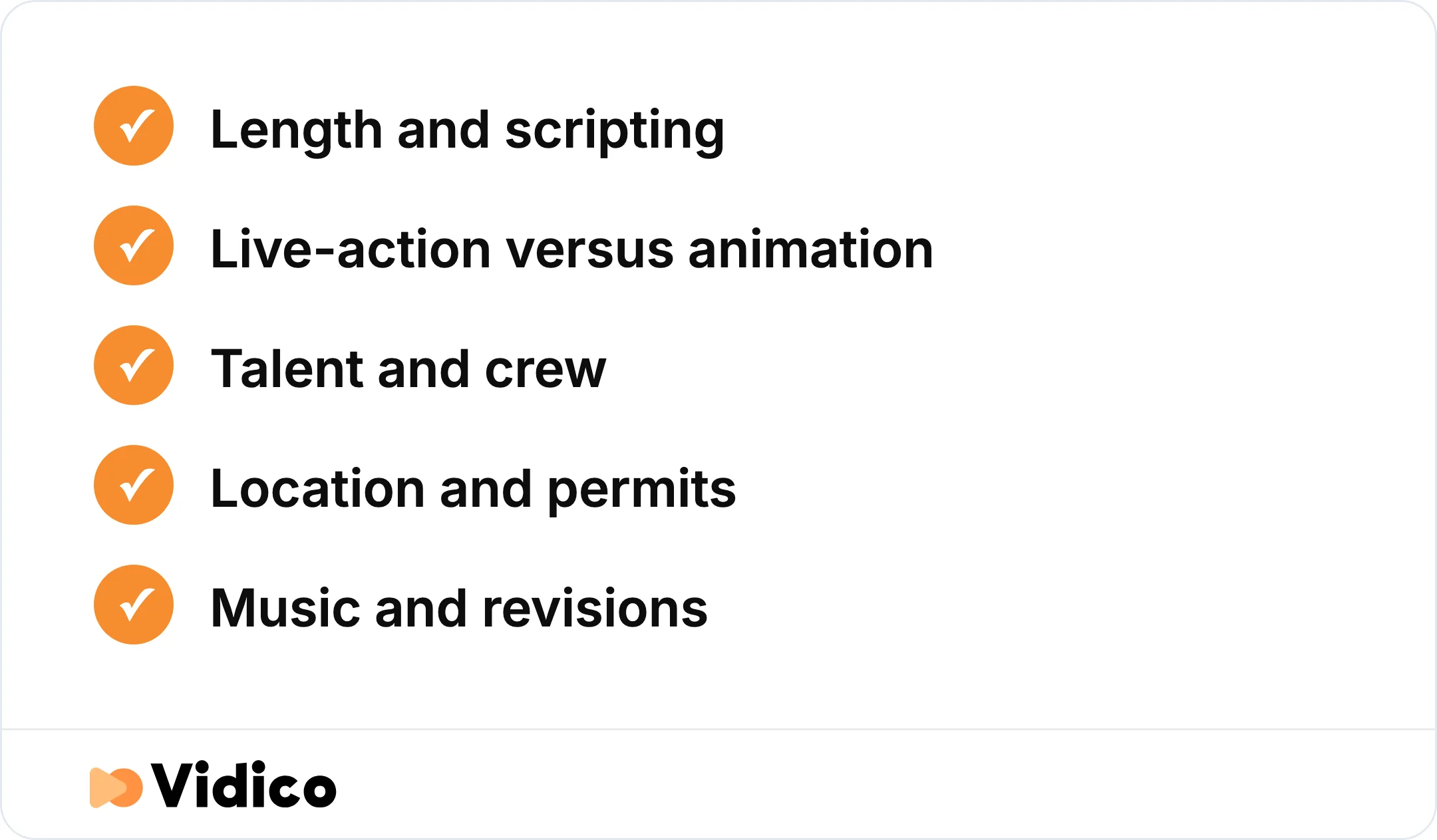
Five factors move the price far more than the platform you launch on.
Platform and Payment Fees: The Cost Most Creators Miss
Your video is one line item. The crowdfunding platform takes another, and the two are completely separate. Plan for both or your net raise will come in lower than you expect.
Kickstarter and Indiegogo both charge a platform fee plus payment processing on the money you raise, and their 2026 fee structures for US campaigns are nearly identical. Here is how each one breaks down.
| Platform | Platform Fee | Payment Processing | When Charged |
|---|---|---|---|
| Kickstarter | 5% of funds raised | About 3% plus roughly $0.30 per pledge (micropledges under $10: 5% plus $0.08) | Only if the project is funded |
| Indiegogo | 5% of funds raised | 3% plus $0.20 per transaction (USD) | All-or-nothing by default |
Kickstarter’s fees page lists a 5% platform fee plus payment processing, with no fees if a project is not funded. Indiegogo’s fees page lists a 5% platform fee plus 3% and $0.20 per transaction for USD campaigns. As a hypothetical example, raising $10,000 through 100 transactions produces $500 in platform fees and $320 in processing fees, leaving $9,180 before other campaign costs. A different transaction count changes that net amount.
In the $10,000 Indiegogo example above, the combined fees total 8.2% of funds raised. That percentage changes with the number of transactions. If your video and campaign depend on hitting a specific net number, build those fees into your funding goal from the start. For more on budgeting a campaign end to end, see our guide to fundraising videos.
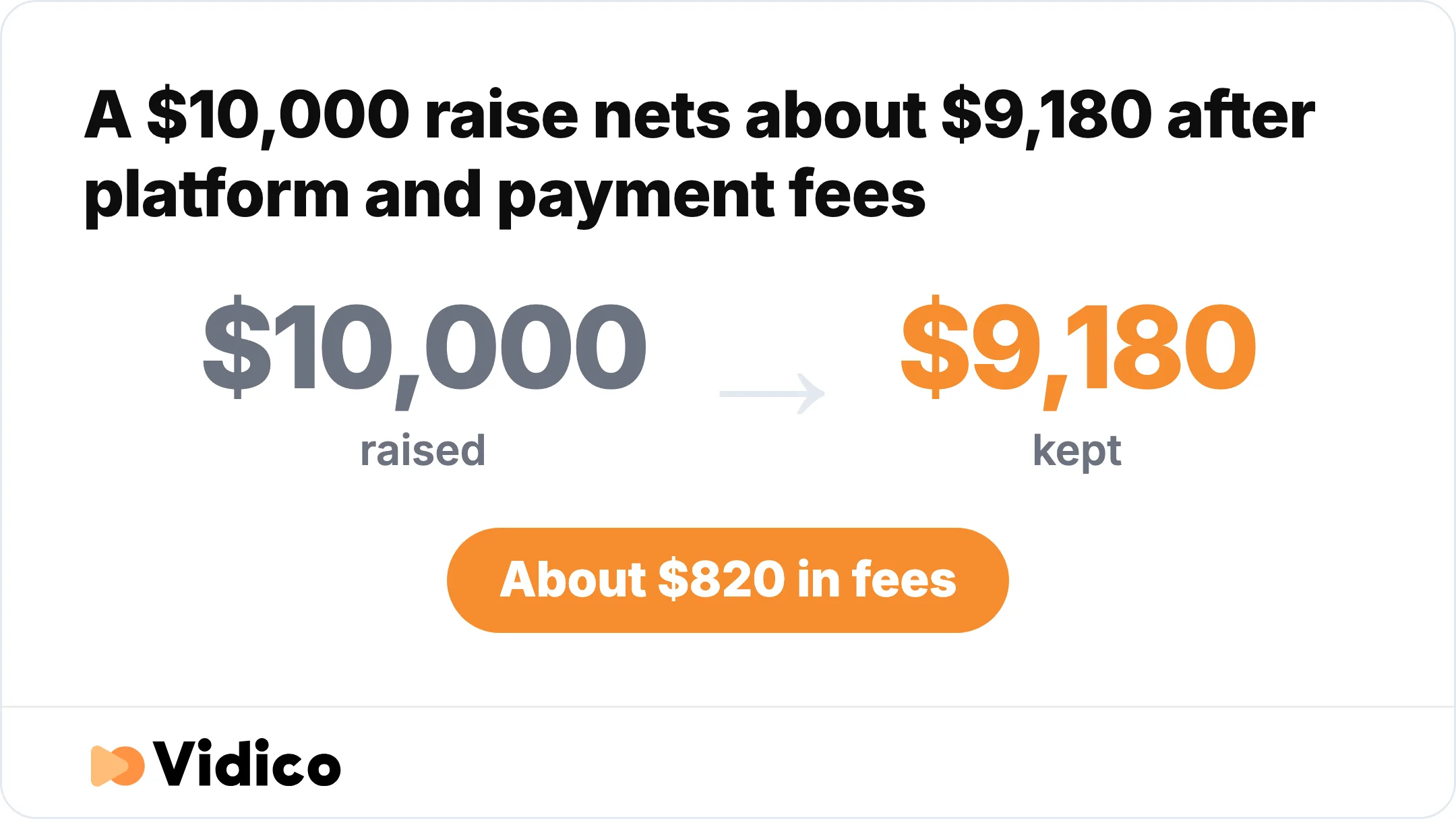
Hypothetical USD example: a $10,000 raise across 100 transactions leaves $9,180 after Indiegogo’s 5% platform fee and 3% plus $0.20 per transaction processing fee. Transaction count changes the result. Source: Indiegogo fees page.
Is a Crowdfunding Video Worth the Cost?
A video can help explain the product, team, and campaign, but the available success-rate comparison does not prove financial payback. Kickstarter’s guide reports 50% success for projects with a video versus 30% without. Kickstarter does not disclose the sample behind that figure or isolate video from other differences between campaigns. Use it as an association when deciding how much your campaign can afford to spend.
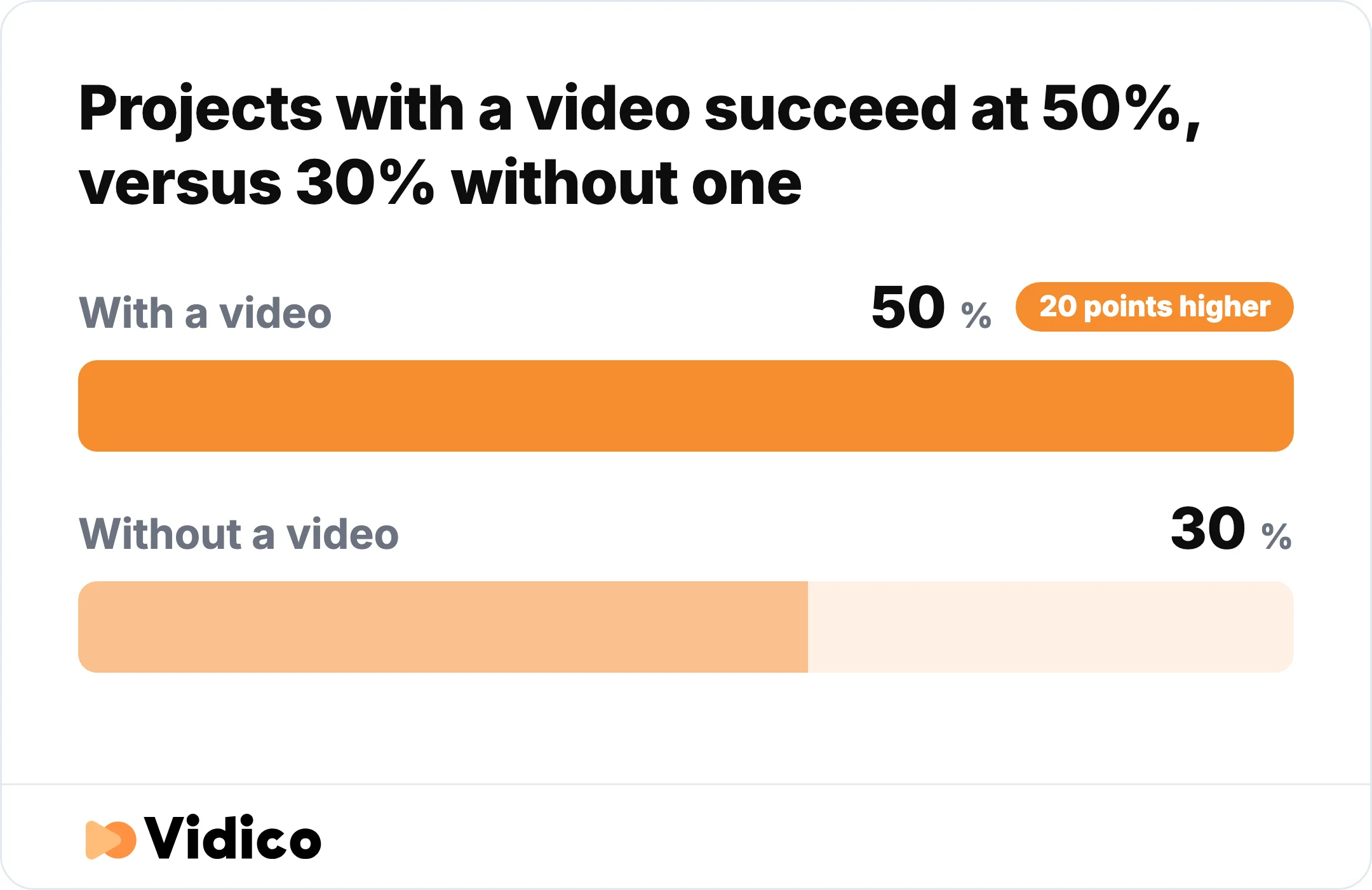
Kickstarter’s own data on success rates with and without a pitch video. Source: Kickstarter.
Timing matters as much as quality. One short-film creator on Reddit’s r/kickstarter said they added the campaign video around day 50 and wished they had included it from day one. They believed the delay hurt discovery; that is their account, not a platform finding. Put the video on the page from day one.
The upside is real when the video is done well. At Vidico, we produce crowdfunding and campaign videos for founders and B2B teams who need the raise to land. Healthcare startup Montu raised $1 million in 13 minutes and $2 million in five hours. Fintech company Unhedged raised $2.3 million and hit its minimum target in 45 minutes. Both leaned on videos built to convert, not just to look good.
If you’re weighing whether to spend at all, a good filter is stakes. Match the video budget to what the campaign is trying to raise and to how competitive your category is. A modest community project is fine with a DIY or freelancer video. A hardware or tech launch chasing a large raise should treat the video as core infrastructure, not an afterthought. Not sure where you land? Our video cost quiz gives you an estimate in a couple of minutes.
Frequently Asked Questions
How long should a crowdfunding video be?
Keep a crowdfunding video to two to three minutes at most, and front-load the hook in the first 30 seconds. Many backers won’t watch to the end, so the most important message belongs at the start, and a tighter 60 to 90 second cut often performs better.
What video format does Kickstarter accept?
Kickstarter accepts common video formats, including MOV, MP4, and WMV, with a file-size limit on direct uploads. Check Kickstarter’s current help documentation before you export, since the exact size cap and supported formats can change. When in doubt, a standard MP4 at your platform’s recommended resolution is the safe choice.
How much does Kickstarter take in fees?
Kickstarter charges a 5% platform fee plus payment processing of about 3% plus roughly $0.30 per pledge, and only if your project is funded. Micropledges under $10 are processed at 5% plus $0.08. If the project doesn’t reach its goal, there are no fees at all.
Does a video really raise more money?
Kickstarter’s guide reports a higher success rate for campaigns with video, 50% versus 30% without. It does not show how much additional money a video causes a campaign to raise, or whether production spend pays back. A video can explain the product, team, and story; set its budget against your campaign economics.
Are there hidden fees with a crowdfunding video?
A crowdfunding video’s price should be fixed and quoted up front, so there are no hidden production fees from a reputable producer. The real costs creators forget are the platform and payment fees on the money they raise, plus extra revisions or social cutdowns if those weren’t scoped into the original quote. Confirm revision rounds and deliverables before you agree to a price.
How can I lower the cost of a crowdfunding video?
The biggest savings come from a tight script and a shorter video, since both cut shoot and edit time. Supplying your own footage and hiring an editor only, as some creators do, drops the price to a few hundred dollars. Choosing animation over a live-action shoot can also remove crew, location, and travel costs. The trade-off is that cutting the wrong corner, like a weak script or poor audio, can cost you backers, so protect the parts that carry your pitch.
The Bottom Line
A crowdfunding video costs anywhere from a few hundred dollars to $25,000+ in 2026, and the right number depends on your campaign. Match production scope to your available budget, account for platform and payment fees separately, and use the video to explain what backers are funding. A higher success rate among campaigns with video does not establish a guaranteed return on production spend.
We produce B2B explainer and campaign videos at Vidico, and our crowdfunding work has helped founders raise more than $15 million. We work on monthly plans suited to teams with ongoing creative needs, so a single-campaign founder is often best starting with a quick video strategy session to scope the project before committing.