Most professional B2B animation costs $1,000 to $15,000 per finished minute. The final price depends on three things: animation style, project complexity, and who produces it. Premium work runs higher, reaching $20,000 per minute for 2D, $30,000 for mixed media, and $50,000 or more for 3D, with cinematic broadcast work exceeding $100,000. Template-based video starts as low as $150 per minute.
A basic 60-second motion graphics video runs $1,000 to $5,000. A standard 2D animated explainer sits between $5,000 and $15,000. A 3D animated video of the same length runs $10,000 to $25,000, and the most cinematic, broadcast-grade work reaches six figures.
The global animation market is projected to reach roughly $492 billion this year and nearly double to about $953 billion by 2035, a 7.52% compound annual growth rate, according to Precedence Research. That growth means more studios competing for your budget, more pricing variability, and more options at every price tier. This guide breaks down the real costs behind each animation style, what factors drive pricing up or down, and how to get the most from your animation budget in 2026.
Key Takeaways
- Animated video costs $1,000 to $15,000 per finished minute for most professional B2B work. Premium work runs higher, up to $20,000 for 2D, $30,000 for mixed media, and $50,000 or more for 3D, and template-based work starts near $150.
- 2D animation typically costs $1,500 to $20,000 per minute based on complexity level.
- 3D animation costs $5,000 to $50,000+ per minute, with photorealistic work reaching six figures.
- Motion graphics run $1,000 to $15,000 per minute, one of the most budget-friendly styles for professional B2B content.
- DIY and AI tools cost $0 to $500 per minute but require significant time and offer limited customization.
- Per-minute rates drop for longer projects because character development and asset creation get spread across more content.
- Pre-production (scripting, storyboarding, concept art) is 20 to 30% of total cost and the best place to prevent expensive mid-production changes.
Content
Animation Cost by Style
Animation style is the single biggest factor in pricing. 2D character animation, 3D modeling, motion graphics, and mixed media each require different tools, skill sets, and production timelines that directly affect cost.
Here is the per-finished-minute range for each style and the work it suits best.
| Animation Style | Cost Per Finished Minute | Best For |
|---|---|---|
| Template / whiteboard | $150 to $1,500 | internal training, simple tutorials, onboarding |
| Motion graphics | $1,000 to $15,000 | UI demos, data visualization, corporate explainers |
| 2D character animation | $1,500 to $20,000 | product explainers, homepage videos, brand marketing |
| Mixed media | $2,000 to $30,000 | campaigns combining live-action footage with animation |
| 3D animation | $5,000 to $50,000+ | product visualization, engineering detail, high-end effects |
| Cinematic / broadcast | $20,000 to $100,000+ | national TV commercials, film-grade and game-trailer work |
2D Animation Cost Per Minute
2D animation costs $1,500 to $20,000+ per minute depending on the level of character detail, scene complexity, and frame rate. Most B2B explainer videos fall in the $3,000 to $15,000 range.
Basic 2D ($1,500 to $5,000 per minute)
- Simple character movements and limited animation
- Static backgrounds with basic transitions
- Stock music and sound effects
- Best for: internal communications, low-stakes explainers
Standard 2D ($5,000 to $12,000 per minute)
- Fluid character animations with custom illustrations
- Multiple scenes with environmental movement
- Professional voiceover and custom sound design
- Best for: product explainers, homepage videos, ad campaigns
Premium 2D ($12,000 to $20,000+ per minute)
- Complex character expressions and interactions
- Dynamic backgrounds with parallax effects
- Advanced effects and fully custom design elements
- Best for: brand campaigns, television commercials, flagship product launches
3D Animation Cost Per Minute
3D animation costs $5,000 to $50,000+ per minute. The higher cost reflects the technical complexity of 3D modeling, rigging, texturing, lighting, and rendering, each handled by specialists whose median pay in the US tops $100,000 a year.
Basic 3D ($5,000 to $15,000 per minute)
- Simple 3D models with basic textures and lighting
- Limited character movement in simple environments
- Stock assets with minimal customization
Standard 3D ($15,000 to $30,000 per minute)
- Custom 3D modeling with professional lighting and rendering
- Fluid character movements in custom environments
- Custom texturing and material work
Premium 3D ($30,000 to $50,000+ per minute)
- Photorealistic rendering with cinema-quality lighting
- Complex character rigs, physics simulations, and nuanced movement
- Multiple characters interacting in fully built environments
Motion Graphics Cost
Motion graphics cost $1,000 to $15,000+ per minute, one of the most cost-effective animation types for B2B video content. They use graphic elements, text, and icons rather than characters, which cuts both design and animation time.
Basic ($1,000 to $3,000 per minute): Template-based designs with simple movements. Stock elements and basic typography animation.
Standard ($3,000 to $8,000 per minute): Custom-designed elements with fluid transitions. Brand-consistent visuals, data visualization, and professional typography.
Premium ($8,000 to $15,000+ per minute): Complex custom illustrations, advanced particle effects, 3D elements integrated with 2D, and highly branded visual systems.
Mixed Media Animation Cost
Mixed media combines live-action footage with animated elements. Costs range from $2,000 to $30,000+ per minute, with the final price driven by the balance between filmed and animated portions.
Basic ($2,000 to $7,000 per minute): Simple overlay of graphics on stock footage. Text animations and callouts.
Standard ($7,000 to $15,000 per minute): Professional filming combined with custom motion tracking and illustrated overlays.
Premium ($15,000 to $30,000+ per minute): Complex compositing, 3D elements in live environments, and cinema-quality production value.
Animation Cost by Provider Type
Who produces your animation is the other major cost driver. The same 60-second explainer can cost $1,500 from a freelancer or $25,000 from a full-service production company. Here is how costs break down by provider type.
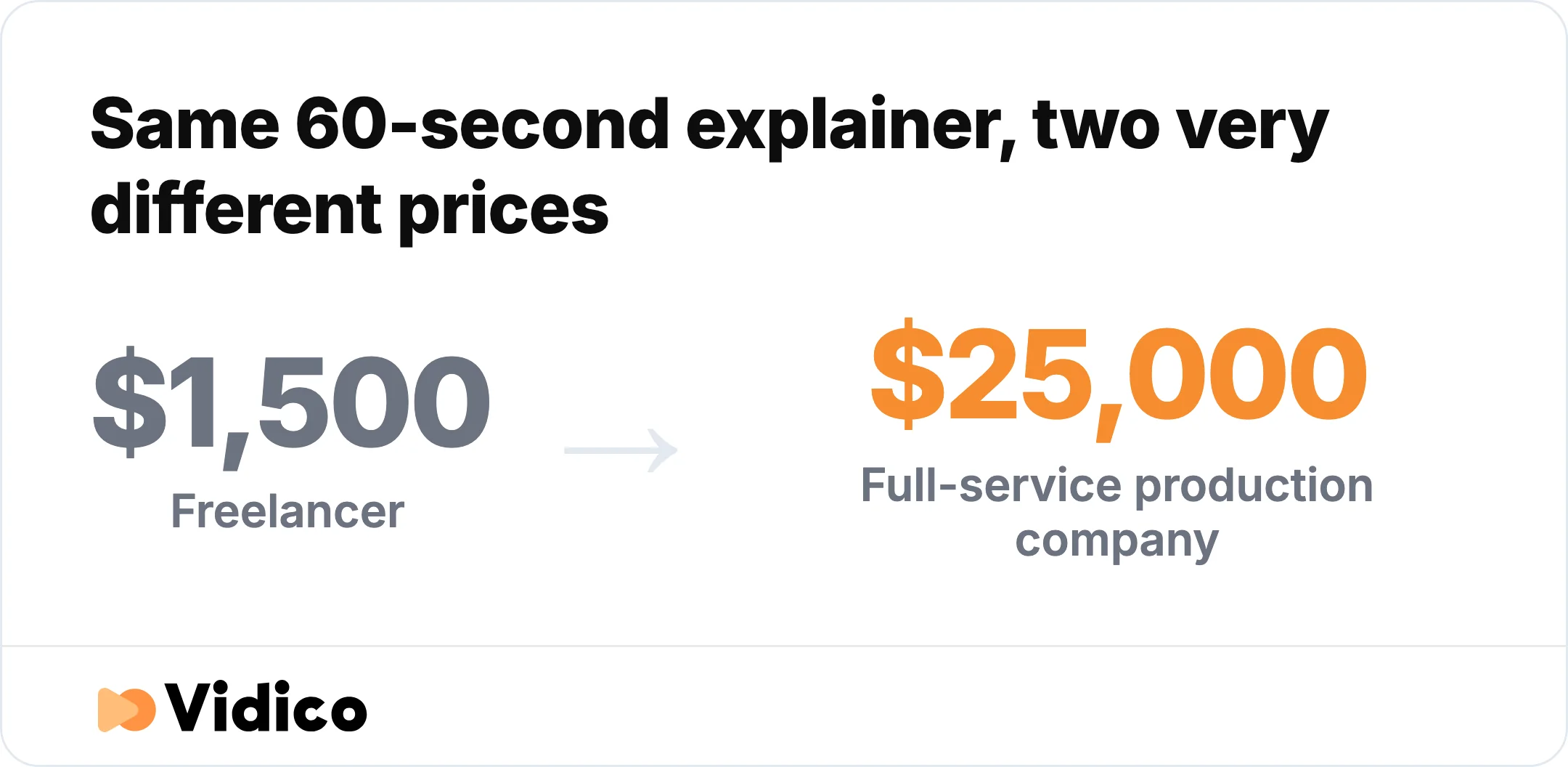
Who produces your animation is the other major cost driver: the same 60-second explainer can cost $1,500 from a freelancer or $25,000 from a full-service production company.
DIY and AI Animation Tools ($0 to $500 Per Minute)
AI video tools like Synthesia, Vyond, Powtoon, and Canva’s animation features have created a new bottom tier for animated video production. Monthly subscriptions run $20 to $100, and per-minute costs approach zero for anyone willing to invest the time.
The trade-off: DIY tools offer limited customization, generic character libraries, and restricted animation quality. They work for internal training videos and quick social content but rarely produce the quality needed for customer-facing brand content.
Freelance Animators ($1,000 to $5,000 Per Minute)
Individual animators or small teams (1 to 2 people) offer affordable custom work. Freelancers typically specialize in one animation style, which keeps costs lower but limits flexibility. Hourly rates usually land between $40 and $150.
Pros: Lower cost, direct communication with the creator, faster turnaround for simple projects.
Cons: Variable quality and reliability, limited capacity for complex work, you manage scripting and creative direction yourself, no built-in project management.
Small to Mid-Size Studios ($5,000 to $15,000 Per Minute)
Studios with 3 to 15 team members offer the middle ground between freelancer rates and agency-level production. They handle pre-production through post, provide project management, and typically deliver more consistent results than solo freelancers.
This is the sweet spot for most B2B animated videos. A standard 60-second 2D explainer from a mid-size studio runs $5,000 to $10,000 with scripting, storyboarding, animation, voiceover, and sound design included.
Want a number for your own project? Take the Vidico pricing quiz for a range matched to your project scope and goals.
Full-Service Production Companies ($15,000 to $50,000+ Per Minute)
Full-service production companies bring specialized expertise across multiple animation styles, established production processes, and capacity for complex, multi-format projects.
The higher price covers dedicated creative directors, specialized animators per style, full sound design, multiple revision rounds, and the capacity to repurpose one campaign into many platform-specific assets.
What Drives Animation Cost
Six factors determine where your project falls within the price ranges above. Understanding these helps you control budget without sacrificing the elements that matter most.
Project Complexity
The number of characters, scene complexity, and motion detail have the biggest impact on cost after style selection.
Characters:
- Each additional character adds 15 to 25% to the project cost
- Complex character designs (specific features, multiple expressions) add another 20 to 50%
- Expressive character animation with lip sync and body language adds 25 to 75%
Environments:
- Animated backgrounds vs. static adds 30 to 50%
- Each additional unique scene adds 10 to 20%
- Environmental detail and interactive elements add 20 to 60%
Movement Detail:
- Higher frame rate (24fps vs. 12fps) adds 40 to 60%
- Fluid animation vs. limited animation adds 30 to 70%
- Physics-based natural movement adds 25 to 50%
Video Length and Economies of Scale
Animation cost per minute drops as project length increases because character development, asset creation, and production setup costs get spread across more content.
- 30-second animation: 100% of per-minute rate
- 60-second animation: 80 to 100% of per-minute rate
- 2 to 3 minute animation: 70 to 90% of per-minute rate
- 5+ minute animation: 60 to 80% of per-minute rate
This discount fades above 5 to 7 minutes because longer narratives add complexity that offsets production efficiencies.
Asset Creation and Design
The approach to visual assets directly impacts the budget:
- Custom illustrations vs. pre-designed assets: +30 to 70%
- Rich illustration vs. flat design: +30 to 80%
- Unique assets vs. reused elements: +20 to 50%
- Hand-drawn animation vs. computer-assisted: +70 to 120%
Technical Requirements
Resolution, effects, and rendering complexity affect cost:
- 4K vs. 1080p rendering: +20 to 40%
- Advanced visual effects: +25 to 75%
- Complex compositing: +15 to 40%
- 3D rendering time (for 3D animation): +30 to 60%
Audio and Sound Design
Audio is a separate budget line from animation production:
- Professional voice talent: $300 to $1,000 per minute
- Custom music composition: $500 to $3,000
- Sound effects design: $300 to $1,500
- Audio mixing and mastering: $300 to $1,000
- Music licensing for commercial use: $300 to $1,000+
Revisions and Project Management
The production process adds overhead:
- Each additional revision round: +5 to 15% of project cost
- Rush delivery (under 2 weeks): +25 to 50%
- Project management for complex stakeholder structures: +10 to 20%
How AI Is Changing Animation Pricing
AI-assisted production is shifting animation economics. Studios increasingly use AI to speed up the repetitive layer of the work: in-betweening, background generation, asset tagging, and first-pass rendering. That frees experienced teams to spend more time on the creative decisions that drive results.
For buyers, this has opened a price point between pure DIY output and traditional mid-tier studio quality, where studios pair human creative direction with AI production tools to move faster without dropping to template quality.
AI has not replaced the creative and strategic work behind an effective animation. Pre-production planning, character design decisions, and narrative structure still require experienced people. These phases are 20 to 30% of your total budget regardless of the production tools used.
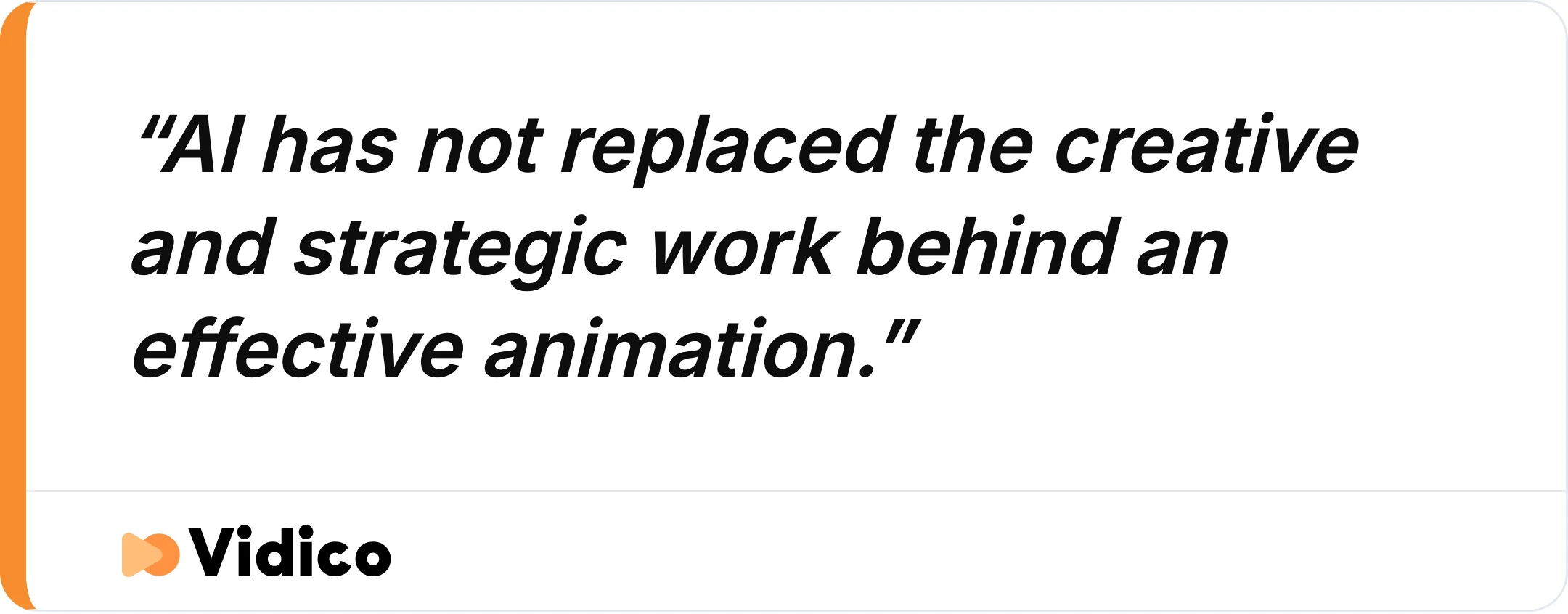
AI speeds up the repetitive layer of animation, but pre-production planning, character design, and narrative structure still require experienced people and make up 20 to 30% of the budget.
Animation Cost by Video Length
Most B2B animated videos are 60 to 90 seconds long. Costs scale with duration, but not linearly, thanks to shared asset development and production setup costs.
30-Second Animation
A 30-second animated video costs $500 to $15,000, depending on style.
- Motion graphics: $500 to $2,500
- 2D character animation: $2,000 to $10,000
- 3D animation: $5,000 to $15,000
30-second animations are common for social media ads, pre-roll, and short-form explainers. Per-second costs are higher because asset development gets compressed into less runtime. See our breakdown of 30-second commercial costs for more detail.
60-Second Animation
A 60-second animated video costs $1,000 to $25,000 across styles. This is the most common duration for B2B explainer videos, and most explainers land in the $3,000 to $15,000 range.
- Motion graphics: $1,000 to $5,000
- 2D character animation: $5,000 to $15,000
- 3D animation: $10,000 to $25,000
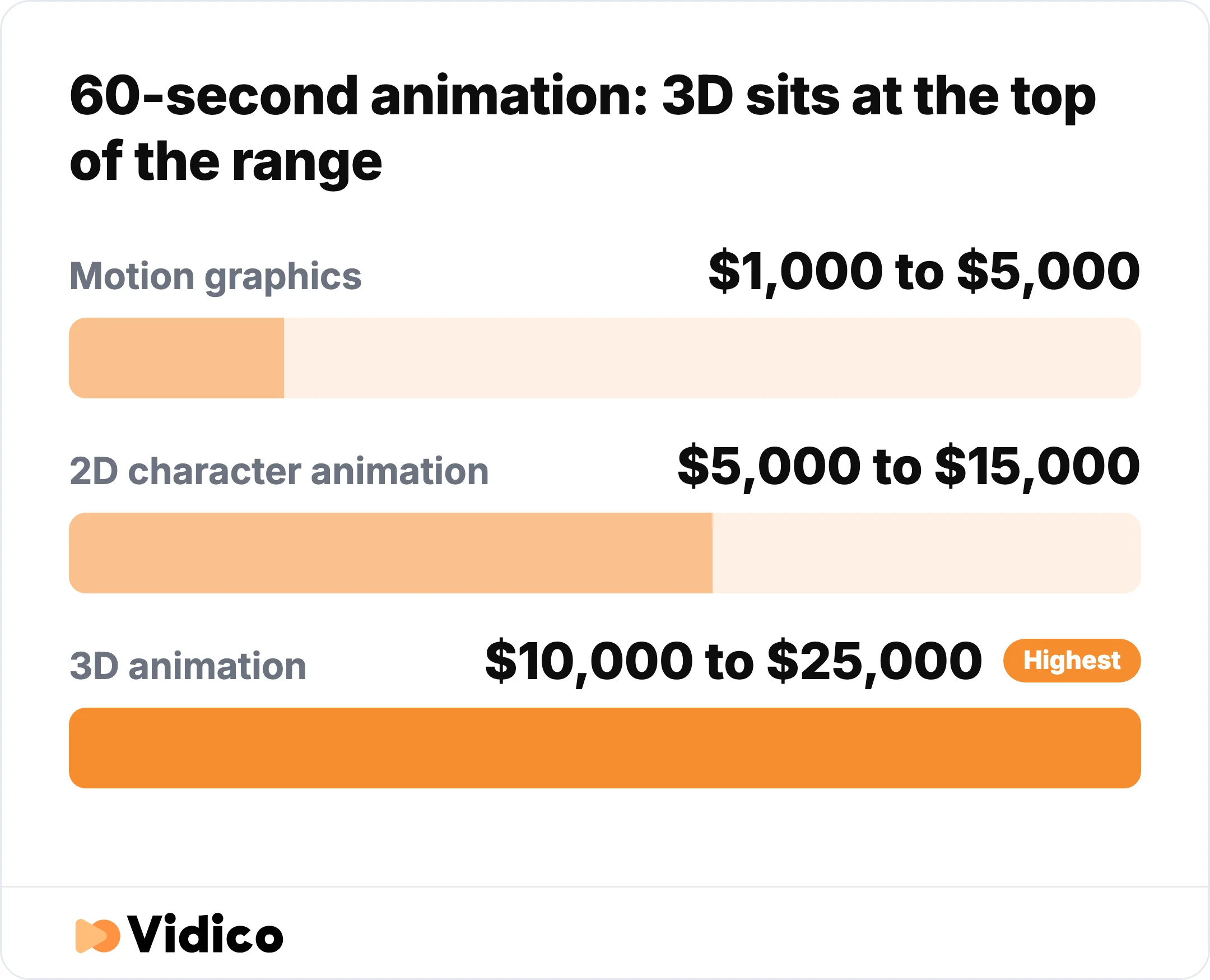
A 60-second animated video costs $1,000 to $25,000 across styles, with motion graphics at the low end and 3D at the top. Bars show the top of each range.
2-Minute Animation
A 2-minute animation costs $2,000 to $40,000. Per-minute rates drop 10 to 20% compared to 60-second projects because character assets and backgrounds carry over between scenes.
- Motion graphics: $2,000 to $8,000
- 2D character animation: $8,000 to $25,000
- 3D animation: $15,000 to $40,000
5+ Minute Animation
Animations over 5 minutes cost $5,000 to $100,000+ for the full project. Per-minute rates decrease significantly, but total project cost rises. At this length, education and training videos are the most common use case.
- Motion graphics: $5,000 to $30,000
- 2D character animation: $20,000 to $60,000
- 3D animation: $30,000 to $100,000+
Animation Production Process and Cost Breakdown
Pre-production, production, and post-production split the budget roughly 25/50/25. Understanding how costs distribute helps you budget and shows where up-front investment prevents expensive changes later.
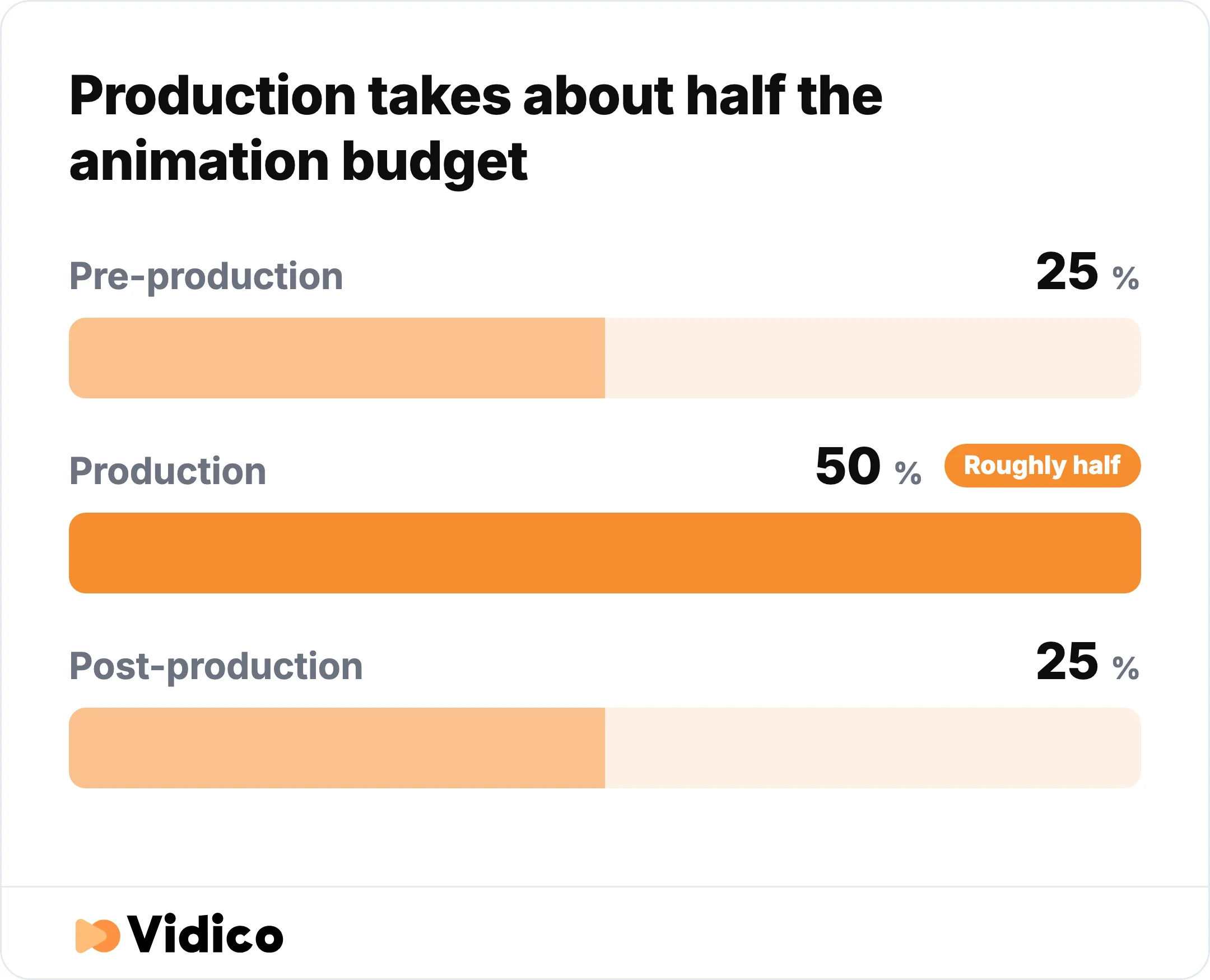
Pre-production takes 20 to 30% of the budget, production 50 to 60%, and post-production 20 to 30%, which works out to roughly a 25/50/25 split.
Pre-Production (20 to 30% of Budget)
This planning phase sets the foundation. Cutting corners here typically increases total project cost.
| Pre-Production Element | Cost Range | Impact |
|---|---|---|
| Script Development | $500 to $3,000 | Narrative clarity and flow |
| Storyboarding | $1,000 to $5,000 | Visual planning and timing |
| Style Frames and Concept Art | $1,000 to $5,000 | Visual direction and consistency |
| Character Design | $500 to $3,000 per character | Audience connection and brand alignment |
| Animatic Creation | $1,000 to $3,000 | Timing and pace validation |
| Voice Talent Casting | $300 to $1,000 | Narrative delivery quality |
Production (50 to 60% of Budget)
The core animation work, where scripts and storyboards become moving visuals.
| Production Element | Cost Range (Per Minute) | Key Factors |
|---|---|---|
| Asset Creation | $1,000 to $10,000 | Style complexity, uniqueness |
| Character Animation | $1,000 to $15,000 | Movement detail, number of characters |
| Background Animation | $500 to $8,000 | Static vs. dynamic environments |
| Special Effects | $500 to $5,000 | Complexity and quantity |
| Compositing | $500 to $3,000 | Scene complexity, layer management |
Reusing assets and characters across scenes reduces production costs without compromising quality. This is where template-based production delivers the biggest savings.
Post-Production (20 to 30% of Budget)
Refinement, audio, and delivery.
| Post-Production Element | Cost Range | Impact |
|---|---|---|
| Color Correction | $500 to $2,000 | Visual consistency and mood |
| Sound Design | $500 to $3,000 | Immersion and emotional impact |
| Music | $300 to $3,000 | Emotional tone and pacing |
| Final Rendering | $300 to $2,000 | Image quality and file formats |
| Revisions | $500 to $3,000 | Stakeholder alignment |
Define revision rounds in your contract before production starts. Feedback that is not consolidated across stakeholders is the most common source of scope creep in post-production.
Get a free Creative Intelligence Report with a competitive analysis of your brand’s video performance across 12 areas.
How to Get More From Your Animation Budget
Four strategies consistently reduce animation costs without sacrificing the elements that actually drive results.
1. Front-Load Pre-Production
A strong script and locked storyboard prevent the most expensive mid-production changes. Finalizing style frames and securing all stakeholder approvals before animation starts can reduce revision costs by 30 to 50%.
2. Simplify Where It Does Not Affect the Message
Limit characters to what the narrative requires. Use static backgrounds for secondary scenes. Focus animation detail on the 2 to 3 key moments that carry your core message. Simpler does not mean worse. It means intentional.
3. Design for Reusability
Character assets, branded animation templates, and modular design elements can be reused across campaigns. Organizations producing 3+ animations per year see 30 to 40% lower per-project costs when they invest in reusable asset libraries upfront.
4. Set Timelines Early
Rush delivery (under 2 weeks) adds 25 to 50% to project cost. Planning production timelines 4 to 6 weeks out avoids rush premiums and gives your team time to consolidate feedback before each review cycle.
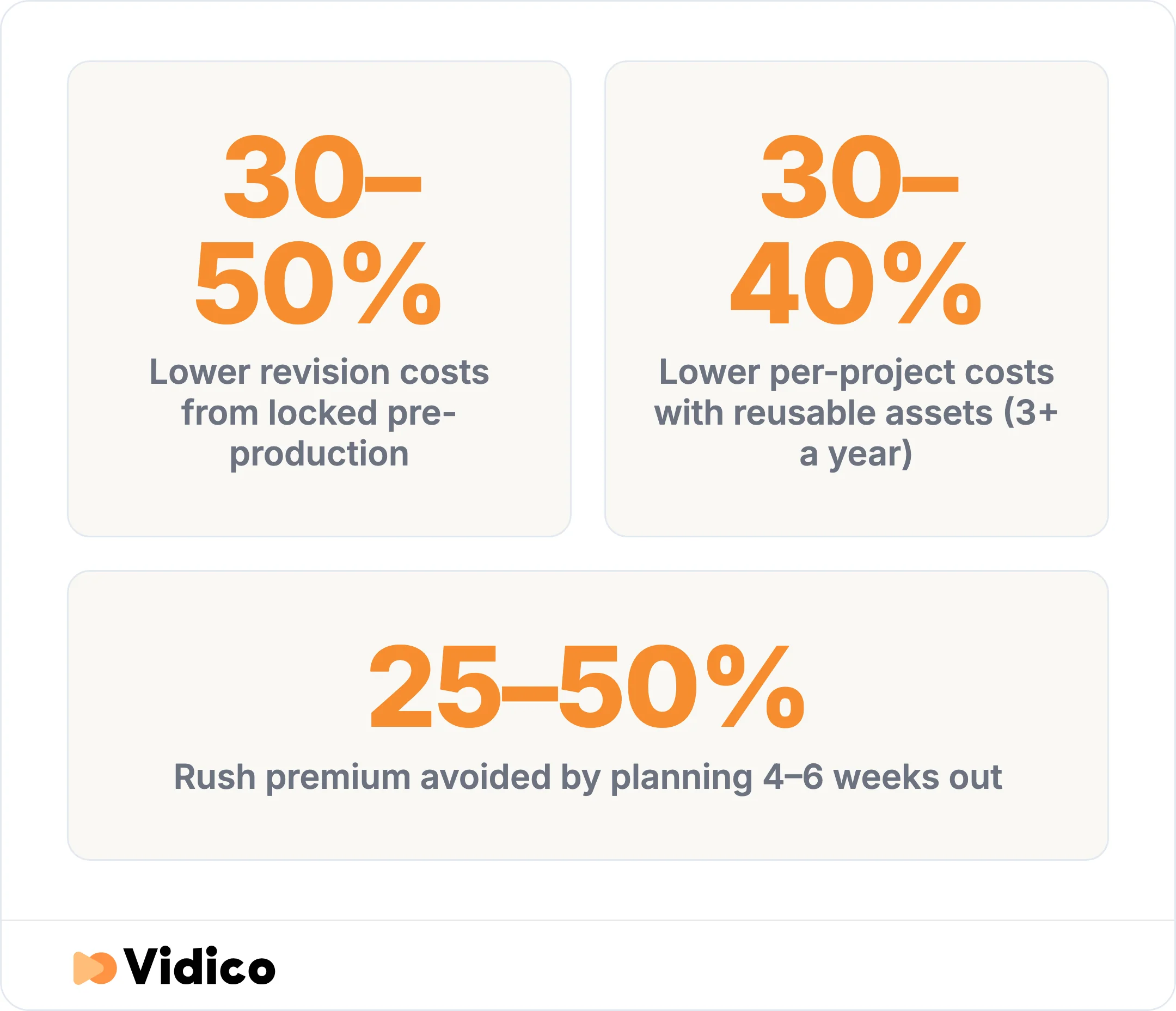
Front-loading pre-production, building reusable asset libraries, and planning timelines early are the moves that cut animation costs without cutting what drives results.
How Reusable Systems Lower Animation Cost Over Time
Organizations producing multiple animations per year can cut per-project costs by building a library of reusable templates and brand assets. We build that reusability into the animation work itself for the teams we work with:
- Animation asset banks: Character systems with reusable expressions and movements, reconfigurable environment components, and branded transition libraries. These reduce production time for each new project because the foundational assets already exist.
- Modular animation architecture: Content designed in component parts that can be rearranged for different narratives, updated individually, and scaled to different aspect ratios and platforms.
- Production templates: Standardized character rigs, motion principles, and effect systems. Each template includes pre-defined specifications, which makes budgeting more predictable and turnaround faster.
Vidico is a B2B explainer video company built for ongoing animation work, and this is the approach behind it. One campaign becomes 40 or more platform-specific assets this way. EverString used it for their animated explainer campaign, and the result was 1.8 million on-site views and a 27% increase in customer signups, with time on site jumping from 0:35 to 2:11.
FAQs
What is the minimum budget for a professional animated video?
A professionally produced 60-second animation starts at $3,000 to $5,000 at the entry level, using simpler motion graphics or basic 2D. Mid-range quality runs $10,000 to $15,000, and high-end work costs $25,000 or more. Projects below these thresholds require significant compromises in quality, length, or complexity.
Why does 3D animation cost more than 2D?
3D animation requires specialized skills in modeling, rigging, texturing, lighting, and rendering. Each stage uses expensive software and hardware. The US Bureau of Labor Statistics reports that special effects artists and animators earn a median salary of $102,030 in May 2025. Those labor costs drive the price difference.
How much does a 30-second animation cost?
A 30-second animation costs $500 to $15,000 depending on style. Motion graphics run $500 to $2,500, 2D character animation costs $2,000 to $10,000, and 3D animation ranges from $5,000 to $15,000.
How much does a 1-minute animated video cost?
A 1-minute animated video costs $1,000 to $25,000. Motion graphics sit at the lower end ($1,000 to $5,000), 2D character animation in the middle ($5,000 to $15,000), and 3D animation at the top ($10,000 to $25,000). Most B2B explainer videos are 60 seconds long and fall in the $3,000 to $15,000 range.
How much does a 2-minute animated video cost?
A 2-minute animation costs $2,000 to $40,000. Per-minute rates drop 10 to 20% compared to 60-second projects because character assets and backgrounds carry over between scenes.
How much does animation cost per hour?
Freelance animators bill $40 to $150 per hour depending on experience and style. Studios rarely quote hourly and price by the finished minute or by the project instead, because animation time varies so much with complexity that a per-minute rate gives buyers a more predictable number.
Why does animation cost so much?
Animation is labor-intensive and specialist-heavy. A single finished minute can take weeks of scripting, design, frame-by-frame animation, and sound work, and the people who do it are skilled professionals whose median pay in the US tops $100,000 a year. The price reflects the hours and the expertise behind each second on screen.
How much does a long-form or 30-minute animation cost?
A 30-minute animated video is priced by the project, not the minute, and typically runs $60,000 to $300,000+ depending on style and reuse. Per-minute rates fall sharply at this length because characters, environments, and templates carry across the whole runtime, but the total still climbs because there is far more content to produce.
How can I reduce animation costs without cutting quality?
Focus on four areas: invest in pre-production planning to prevent expensive revisions, simplify complexity in scenes that do not carry your core message, design reusable assets that work across multiple projects, and set timelines early to avoid rush premiums.
Should I hire a freelancer or a production studio?
Freelancers work well for simple, one-off projects under $5,000. Studios are better for complex or ongoing animation work where you need consistent quality, project management, and capacity across multiple styles. For strategic brand content, the per-project investment in a studio typically delivers better long-term value because assets get reused and production gets faster over time.
The Bottom Line on Animation Costs
Most professional B2B animation costs $1,000 to $15,000 per finished minute, and most 60-second explainers land between $3,000 and $15,000. Premium 3D and cinematic work runs higher, and template-based video runs lower, but the three biggest price drivers are always the same: animation style, who produces it, and project complexity.
The smartest way to reduce animation costs is not to find the cheapest studio. It is to invest in reusable systems that make every future project faster and cheaper. Vidico builds reusable video production systems for B2B teams, with subscription plans that cover animation, motion graphics, and design under one monthly fee.
If you are scoping animation for an upcoming project, book a free strategy session for a tailored production plan and cost estimate.