

Video marketing ROI measures the profit attributable to video against the cost of producing and promoting it, written as a percentage. Use ROI = ((Attributed Contribution – Total Video Marketing Costs) / Total Video Marketing Costs) × 100. Attributed contribution is revenue credited to the video minus the cost of delivering those sales, before video marketing costs. The math takes a minute. The hard part, especially in B2B, is attribution: video often influences a sale without a click, and the deal closes weeks later.
At Vidico, we produce B2B explainer videos for SaaS and tech teams like Square and NinjaOne, and the question marketing leaders bring us most is whether that spend actually pays back. This guide answers it: the formula with a worked example, what to count on each side of it, how to handle attribution and long B2B sales cycles, and what a good number really looks like. We focus on the method, not a stat dump.
Key Takeaways
- The formula is ROI = ((Attributed Contribution – Total Video Marketing Costs) / Total Video Marketing Costs) × 100. Subtract the cost of delivering attributed sales before calculating the contribution available to cover marketing spend.
- A revenue-to-spend ratio is not profit ROI. Set a target using your contribution margin, acquisition costs, attribution method, and sales cycle.
- Attribution is the real problem, not arithmetic. In Vidico’s 2026 State of Creative in Tech report, measurement and attribution was the second-biggest constraint B2B tech teams named, behind only budget.
- Creative success has several measures. In Vidico’s 2026 State of Creative in Tech report, 52.1% of B2B tech marketers selected engagement and views, 36.3% revenue influenced, and 35.0% conversion rate or CPL. These are creative-wide survey responses, not video-specific results or mutually exclusive groups.
- ROI compounds when you reuse one shoot across many assets. The more formats a single production feeds, the lower your cost per asset, and the higher the return on the original spend.
Content
What Is Video Marketing ROI?
Financial video marketing ROI measures the profit attributable to a video against its total marketing cost, expressed as a percentage. A positive ROI means the contribution from attributed sales exceeded the video marketing cost. A 300% ROI means three dollars of profit for every dollar spent.
Video ROI behaves differently from a paid-ad metric you can read in a dashboard. Part of a video’s return is direct and immediate, like a demo that drives sign-ups this month. Part of it is delayed and indirect: brand lift, recall, and trust that move a buyer closer to purchasing long after they watched. A measurement approach that only counts same-session conversions will undercount video every time. That is why proving video ROI is as much about why video marketing is effective over a full buying cycle as it is about one campaign.
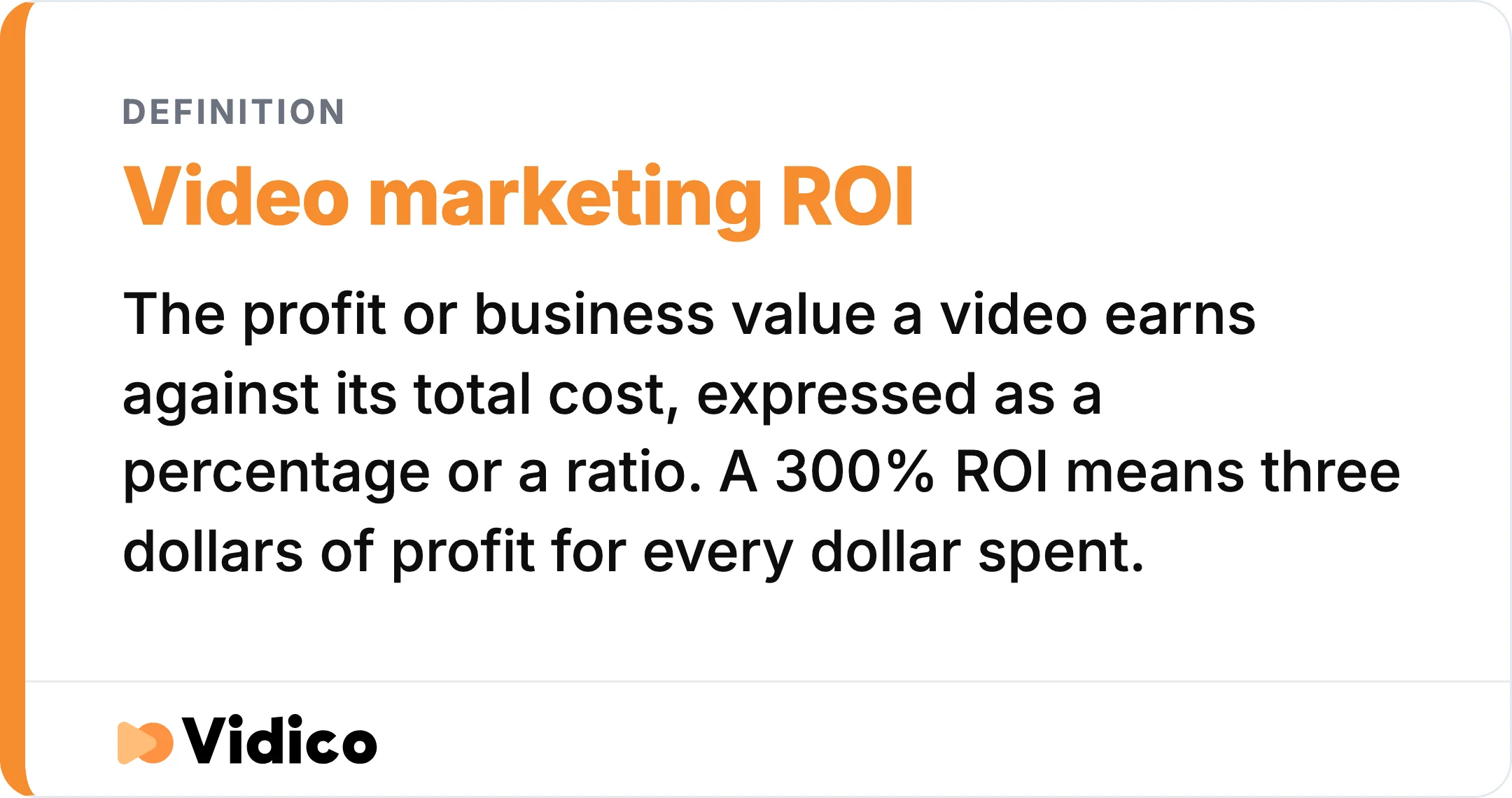
A 300% ROI means three dollars of profit for every dollar spent.

The Video Marketing ROI Formula (With a Worked Example)
The video marketing ROI formula is:
Video Marketing ROI = ((Attributed Contribution – Total Video Marketing Costs) / Total Video Marketing Costs) × 100
For financial ROI, first subtract the cost of supplying the products or services sold from attributed revenue. Google Ads’ ROI guidance includes both product costs and advertising costs when calculating profit. Track brand lift, recall, and influenced pipeline separately; they are useful signals, but they are not realized profit.
Here is a hypothetical example. You produce an explainer for $12,000 and spend $8,000 on distribution, for $20,000 in video marketing costs. Over the quarter, your chosen attribution model credits the video with $80,000 in closed revenue. Assume the cost of supplying those sales is $40,000, a 50% contribution margin before video marketing costs.
- Attributed revenue: $80,000
- Cost of supplying those sales: $40,000
- Attributed contribution before video marketing costs: $40,000
- Total video marketing costs: $20,000
- Profit after those costs: $20,000
- ROI = (($40,000 – $20,000) / $20,000) × 100 = 100%
Revenue divided by video marketing spend is 4:1 in this example. That ratio is different from the 100% profit ROI. Both the contribution margin and attributed revenue are explicit assumptions, not a client result.
What Counts as Cost (the ROI Denominator)
Total video cost is every dollar required to make the video and get it in front of people. Miss a line item here and your ROI looks better than it is. Count:
- Production: scripting, filming or animation, editing, talent, music, and licensing.
- Software and tools: editing suites, stock assets, hosting, and analytics platforms.
- Distribution and media: paid ad spend, sponsorships, and platform fees.
- Internal time: the hours your team spends briefing, reviewing, and managing the project.
- A revision buffer: budget for the reshoots and re-edits that real projects need.
Production is usually the largest input, and it varies widely by format and quality. For current ranges, see our guide on how much a marketing video costs. If you are sizing a budget before you calculate a target return, our budget quiz gives you a starting range in a couple of minutes.
What Counts as Return (the ROI Numerator)
For the financial ROI numerator, use attributed contribution less video marketing costs. Other outcomes help diagnose performance, but keep them separate from realized profit:
- Direct revenue: trace sales or subscriptions to the video, then subtract the cost of delivering those sales to calculate contribution.
- Leads and pipeline: form fills, demo requests, and influenced pipeline, often measured as cost per lead (CPL). Channel matters here. Sprout Social reports that LinkedIn’s cost per lead runs 28% lower than Google AdWords, a platform-level comparison rather than a measured return for your video.
- Customer lifetime value (CLV): use contribution over a defined customer lifetime when modeling long-term return. Label forecasts separately from realized ROI and avoid counting the same sale in both.
- Soft value: brand recall, trust, and on-page conversion lift. Track these as supporting outcomes; a conversion change alone does not establish profit attributable to video.
Soft value is real, but do not double-count it as revenue. Track it as a supporting metric alongside the dollars so the financial ROI stays honest.
The Metrics That Signal ROI
Video measurement works as a ladder, and most of the return lives on the top rung that teams reach last. There are three tiers:
- Engagement tier: watch time, average view duration, drop-off and retention curves, and click-through rate. These tell you if the creative works.
- Lead tier: form fills, demo requests, and cost per lead. These tell you if the video moves people to act.
- Revenue tier: closed-won revenue, delivery costs, and resulting contribution. These connect video outcomes to financial ROI; influenced pipeline remains a separate forecast.
Engagement metrics are leading indicators worth optimizing. Length is one lever: Wistia’s State of Video report, built on more than 13 million videos and 79 million hours of viewing data, finds that the shorter the video, the higher the engagement rate, while longer videos tend to drive more action. Wistia reported 53% to 55% form click-through when forms appeared in the first, second, or fourth quarter of 5-to-30-minute videos, and 67% to 75% in the second or fourth quarter of videos over 60 minutes. These are placement-specific platform benchmarks, not conversion targets for every video. For the wider set of industry benchmarks behind these metrics, see our video marketing statistics roundup.
Vidico’s 2026 State of Creative in Tech report asked B2B tech marketers how they evaluate creative success: 52.1% selected engagement and views, 36.3% revenue influenced, and 35.0% conversion rate or CPL. The survey covers creative as a whole. It does not show that engagement respondents exclude revenue measurement or isolate video-specific measurement.
Attribution: Why Video ROI Is Hard to Measure
Attribution is the single hardest part of video ROI, because video rarely earns a clean, same-session click. A prospect watches, does nothing, and converts weeks later through a branded search or a direct visit. The short conversion windows most tools default to miss that influence entirely, and B2B cycles make it worse: a video watched in January can shape a deal that closes in July.
The fix is choosing an attribution model that fits how people actually buy:
- First-touch credits the first interaction. Good for measuring awareness, blind to everything after.
- Last-touch credits the final interaction. Simple, but it almost always under-credits video, which tends to sit early or in the middle.
- Linear splits credit evenly across every touch. Fair, but it treats a throwaway touch like a decisive one.
- Time-decay gives more credit to touches closer to the sale. Best when recent touches should weigh more.
- Multi-touch distributes credit across the real path, usually position-weighted. This fits B2B best because it captures the many touches a deal actually takes.
- View-through credits a conversion that follows a view without a click, inside a set window (24 hours is a common default). This is how you catch video’s no-click influence.
No single model is perfect, so pair it with method stacking: run your multi-touch model and ask buyers directly how they heard about you. Self-reported attribution catches the pipeline that tracking never will, because some influence is genuinely untraceable. This is not a niche problem. In Vidico’s 2026 report, measurement and attribution was the second-most-cited constraint among B2B tech marketers, named by 14.1% and trailing only budget. If you want a read on how your own creative is tracking against your category, our Creative Intelligence Report is a free competitive analysis.
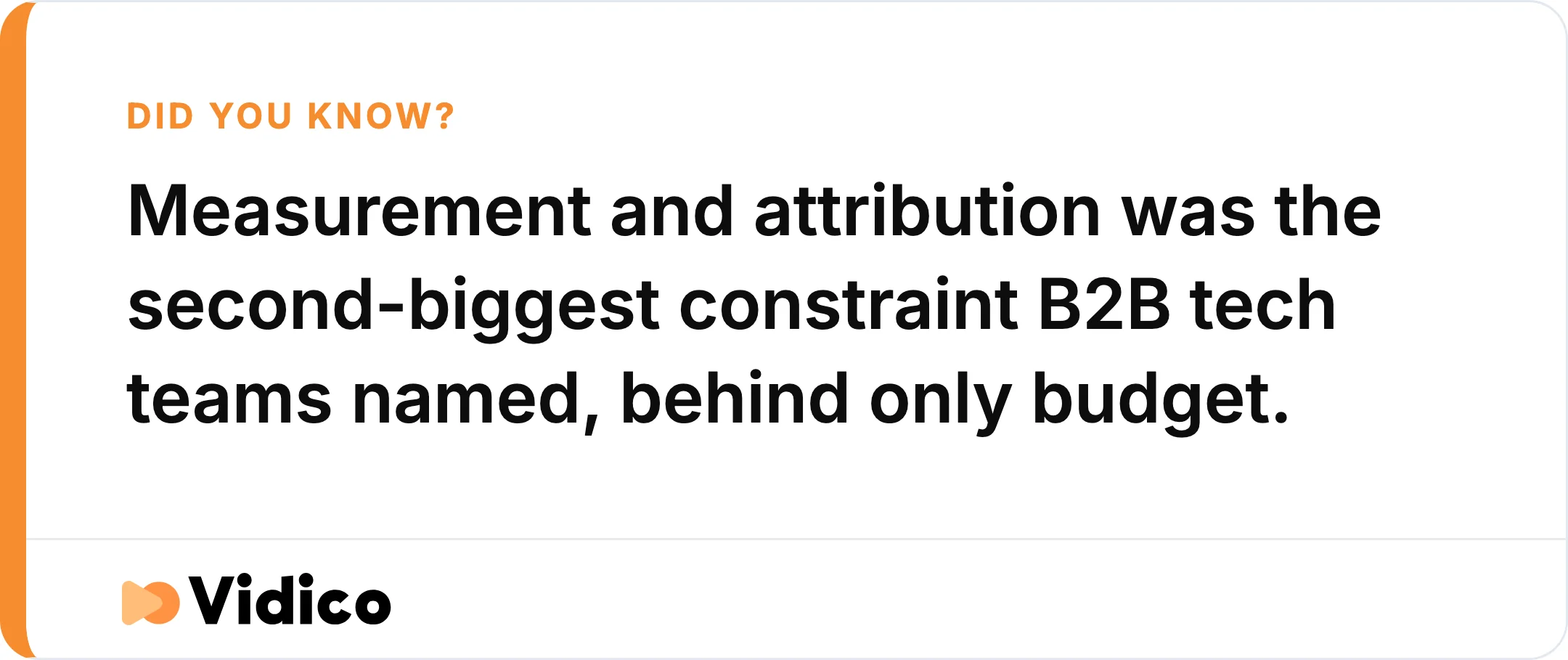
Named by 14.1% of respondents, trailing only budget. Source: Vidico 2026 State of Creative in Tech report.
What Counts as Good Video Marketing ROI?
A good financial ROI depends on your contribution margin, acquisition economics, attribution model, and time horizon. A revenue-to-spend target such as 5:1 cannot establish profit ROI without the cost of supplying those sales.
A direct-response video tied to sign-ups can be evaluated over a defined sales cycle. A brand film may need a longer measurement window and separate brand metrics. The financial break-even point is where attributed contribution equals total video marketing costs. With a 50% contribution margin and $20,000 in video marketing costs, that requires $40,000 in attributed revenue. Use your own margin and costs to set the target.
How B2B Teams Measure Creative Success
Vidico’s 2026 State of Creative in Tech report surveyed more than 230 B2B tech marketing leaders about creative as a whole. Engagement and views were the most-selected success measure, while 42.7% named customer outcomes and results as the most persuasive proof. These findings describe different survey questions; they do not establish how much video ROI respondents measure or leave unreported.
To evaluate your own video ROI, connect video analytics to closed sales and delivery costs, then apply a stated attribution method. The report also found that 76% of respondents expected their creative production budgets to grow, making a clear measurement plan useful when assessing new spend.
How to Improve Your Video Marketing ROI
You raise video ROI by lifting the return, lowering the cost per asset, or both. The moves that matter most:
- Fix the target and the goal before you produce. A video built for a specific audience and a defined conversion beats a general-purpose video on every ROI measure.
- Distribute harder than you produce. Most video ROI is lost in weak distribution, not weak production. Budget for promotion, not just the shoot.
- Match format to intent. HubSpot reports that the top three ROI-driving content formats are all video: short-form video at 49%, long-form at 29%, and live-streaming at 25%. Use short-form to capture attention and longer formats to drive considered action.
- Reuse one production across many assets. A single shoot can become a hero video, social cutdowns, ad variations, and email clips. The more a production feeds, the lower your cost per asset, which lifts the return on the original spend. We call the reusable template library behind this a Content Engine, and the idea is simple: creative that compounds in value instead of starting from zero each time.
This is where a systems approach pays off. Vidico builds reusable video production systems for B2B teams, so every campaign ships faster than the last and the cost per asset keeps falling. The results show up in the numbers: Bambee cut cost per lead by 50% and saw a return on its investment in under a month, and NinjaOne’s campaigns generated 66.6 million views, 1.42 million clicks, and a 20% year-over-year lift in branded search. For more results like these, browse our case studies.
Frequently Asked Questions
What does ROI mean in marketing?
Financial ROI, or return on investment, is the profit attributable to an investment divided by its cost, expressed as a percentage. For video, account for the cost of delivering attributed sales as well as production and promotion.
What is the formula for video marketing ROI?
The formula is ROI = ((Attributed Contribution – Total Video Marketing Costs) / Total Video Marketing Costs) × 100. Attributed contribution is attributed revenue minus the cost of supplying those sales, before video marketing costs. Revenue divided by spend is a separate ratio.
What is a good ROI for video marketing?
Set a target using your contribution margin, acquisition costs, sales cycle, and attribution method. Positive financial ROI means attributed contribution exceeds video marketing costs. A revenue-to-spend ratio by itself cannot show whether the video earned a profit.
How do you track video marketing ROI?
Track it with UTM parameters on your video links, dedicated landing pages for video traffic, and a CRM that connects views to leads and closed revenue. Choose an attribution model that fits B2B, usually multi-touch or view-through, and confirm it with self-reported “how did you hear about us” data.
The Bottom Line
Financial video marketing ROI needs attributed revenue, the cost of supplying those sales, and every video marketing cost. Apply a stated attribution method and time horizon. Track revenue-to-spend ratios and brand signals separately so they do not get mistaken for profit.
The teams that prove video ROI are the ones that connect creative to revenue and reuse each production across every channel. Vidico is a B2B explainer video company built for exactly that kind of ongoing, compounding production, with 2,000+ campaigns shipped across SaaS, finance, and enterprise. If you want to pressure-test your own approach, book a free strategy session and we will map it with you.