
Issuing a video production RFP is how you get real, comparable bids instead of a pile of quotes you cannot line up side by side. This guide gives you a complete video production RFP template you can copy and paste, realistic US budget ranges by video type, a scoring matrix to compare proposals fairly, and the exact questions to ask every vendor. We are Vidico, a B2B video production company that has made explainer and brand videos for teams like Square, Spotify, and NinjaOne, and we see these documents from the vendor’s side of the table, so the template below is built to get you sharper proposals and a faster decision.
Key Takeaways
- An RFP compares how vendors would solve a defined problem, not just their price. Send one when the project is big or complex enough to justify a formal process. For a single small video, a short brief and a direct quote are faster.
- Lead with the business problem, not the camera style. “We need to fill 40 roles this quarter” gets smarter proposals than “we need a 90-second recruitment video.” Vague deliverables turn price into the only thing you can compare.
- State a budget or a range. Most US video production runs from $1,500 to $50,000 or more depending on type. Hiding the number just produces proposals you cannot compare.
- Publish your evaluation criteria and their weights up front, and score scope before price. Vendors invest effort where the points are.
- A focused shortlist beats a mass send. Invite only the three or four companies you can review properly.
Content
What a Video Production RFP Is (and When You Actually Need One)
A video production RFP (Request for Proposal) is a formal document that asks production companies to submit their creative approach, scope, timeline, and pricing for a defined project. You send it to a shortlist of vendors, they respond with proposals, and you compare those proposals against criteria you set in advance.
It is easy to confuse three documents that do different jobs:
- Creative brief: an internal document that defines the idea, audience, and message for one video. It briefs the team that is already hired. You can start from our creative brief template once a vendor is chosen.
- RFP: the document you send to several vendors to choose who to hire.
- Production proposal: the vendor’s response to your RFP. It is what comes back, not what you send.
You do not need a formal RFP for every project. For a single, simple video with a clear deliverable and a known budget, a one-page brief and a direct quote are faster and get you to production sooner. Reach for an RFP when the budget is significant, several teams need to sign off, the creative direction is still open, or procurement requires a competitive process. The larger and less defined the project, the more an RFP earns its overhead.
You send it to a shortlist, they respond with proposals, and you compare them against criteria you set in advance.

RFP vs RFI vs RFQ: Which Document Should You Send?
For a video project where you want to compare creative and production approaches rather than just prices, the RFP is the right document. The three procurement documents sound similar but answer different questions:
- RFI (Request for Information): used early, when your requirements are still unclear and you want to understand what the market can do. It gathers options, not bids.
- RFP (Request for Proposal): used when you have a defined problem and want to evaluate how each vendor would solve it. Coupa’s procurement guidance describes an RFP as a formal document that gives a project overview, sets requirements, and solicits vendor bids. It compares total value, including the proposed approach, rather than price alone.
- RFQ (Request for Quote): used when the deliverable is already precisely defined and you only need to compare pricing.
Video rarely fits the RFQ mould, because two companies can deliver the same brief in very different ways. You are buying judgment, process, and craft, so you want proposals, which means an RFP. Coupa’s procurement overview draws the same line between gathering information, requesting proposals, and quoting a fixed spec.
What to Include in a Video Production RFP: The 12 Essential Sections
A complete video production RFP covers twelve sections. Neutral template providers and procurement teams land on the same core structure. Demand Metric’s video marketing RFP template lists “Company Information, Statement of Work, Proposal Submission Procedure, Scope of Work & Business Requirements, Vendor Information, and Estimated Budget & Resources Required.” The twelve sections below expand that spine into everything a vendor needs to give you a tight proposal.
- Company and project background: who you are, what you do, and why you need this video now.
- Project overview and objectives: the business problem you are solving and the goal the video serves. Lead with the outcome, not the format.
- Target audience and core message: who the video is for, what you want them to think or do, and the single idea they should remember.
- Scope of work and deliverables: the video type (animated explainer, corporate brand film, social series, live-action), runtime, number of versions and cutdowns, captions, graphics, and delivery formats. Separate required deliverables from optional ones.
- Production phases required: which phases the vendor must handle. Pre-production covers scripting, storyboarding, casting, location scouting, and scheduling. Production covers filming, crew, lighting, audio, and on-site direction. Post-production covers editing, color grading, sound design, motion graphics, music licensing, and revision rounds. Our video production process breaks down what each phase involves.
- Creative direction and references: tone, non-negotiables, two or three example links, and whether AI workflows are permitted and where.
- Technical specifications: aspect ratios, resolution, per-platform versions, and delivery file formats.
- Timeline and milestones: target dates for draft reviews and feedback rounds, the final delivery date, and the deadline for vendors to submit their proposals.
- Budget or budget range: state a figure or a range, or ask vendors for a line-item breakdown that separates agency fees from direct production costs.
- Evaluation criteria: the criteria you will score against and how much each one weighs.
- Submission instructions: the format, recipient, deadline, required attachments, and any procurement steps.
- Questions for the vendor: the specific information each vendor must provide so you can compare answers, not guesses.
The Video Production RFP Template (Copy-Paste)
Copy the template below into a document, replace the prompts in brackets, and send it to your shortlist. It is written to be lifted whole, so delete the sections that do not apply and keep the rest.
VIDEO PRODUCTION REQUEST FOR PROPOSAL

1. COMPANY & PROJECT BACKGROUND
{Company name, what you do, and a one-paragraph summary of the project and why it matters now.}

2. PROJECT OVERVIEW & OBJECTIVES
Business problem: {the problem this video solves, e.g. "low trial-to-paid conversion"}
Primary goal: {the measurable outcome, e.g. "increase demo sign-ups from the pricing page"}
Secondary goals: {awareness, sales enablement, recruitment, etc.}

3. TARGET AUDIENCE & CORE MESSAGE
Audience: {role, industry, stage of awareness}
Core message: {the one idea the viewer should remember}
Desired action: {what you want them to do after watching}

4. SCOPE OF WORK & DELIVERABLES
Video type: {animated explainer / corporate brand film / social series / live-action / product demo}
Runtime: {e.g. 60-90 seconds}
Required deliverables: {hero video + X social cutdowns + captions + thumbnail}
Optional deliverables: {GIFs, stills, alternate language versions}
Delivery formats: {MP4, platform-specific aspect ratios}

5. PRODUCTION PHASES REQUIRED
Pre-production: {script, storyboard, casting, location, scheduling - mark what the vendor owns}
Production: {filming, crew, lighting, audio, direction - or "none, animation only"}
Post-production: {edit, color, sound design, motion graphics, music licensing, revision rounds}

6. CREATIVE DIRECTION & REFERENCES
Tone: {e.g. confident, plain-spoken, not corporate}
Must-haves: {brand guidelines, logo usage, mandatory shots}
Reference links: {2-3 videos you like and one line on why}
AI workflows: {permitted for X, not for Y - state your position}

7. TECHNICAL SPECIFICATIONS
Aspect ratios: {16:9, 9:16, 1:1}
Resolution: {1080p / 4K}
Platform versions: {YouTube, LinkedIn, website hero, paid social}

8. TIMELINE & MILESTONES
Proposal submission deadline: {the date vendors must respond by}
Questions due / Q&A period: {window for vendor questions}
Vendor selected: {the date you will decide}
Draft reviews: {your review dates}
Final delivery: {final delivery date}

9. BUDGET / BUDGET RANGE
Budget range: {state a range, or request a line-item breakdown}
What it must cover: {production, licensing, revisions, delivery}

10. EVALUATION CRITERIA (WEIGHTED)
{List each criterion and its weight, e.g. Strategic understanding 25%, Creative approach 25%,
Scope clarity 15%, Team & execution 15%, Communication 10%, Price/value 10%}

11. SUBMISSION INSTRUCTIONS
Format: {PDF proposal + reel links}
Send to: {name, email}
Required attachments: {case studies, references, cost proposal}

12. QUESTIONS FOR THE VENDOR
{Paste the vendor-questions list from this guide here.}
How Much to Budget (Realistic US Video Production Ranges)
Most US video production projects run from $1,500 to $50,000 or more, and the right number depends on the video type, crew size, and post-production work. Every RFP guide tells you to “include a budget range,” but almost none tells you what a realistic range is. These figures come from our own video production cost and animation cost guides, updated for 2026. Treat them as planning estimates rather than surveyed market averages or quotes for your specific brief.
| Video type | Typical US cost (finished) | Notes |
|---|---|---|
| Any video production project (overall) | $1,500 to $50,000+ | Varies by type, crew, and post-production |
| Standard corporate or explainer video | $4,500 to $20,000 | Most common B2B spend |
| Corporate video (common project band) | $3,000 to $50,000 | Scope and production tier can push costs outside this band |
| 60-second B2B 2D explainer | $3,000 to $15,000 | Animation complexity and scope set the quote |
| 2D animation (60 seconds) | $5,000 to $15,000 | Script, storyboard, animation, VO |
| 30-second commercial (B2B) | $5,000 to $50,000 | National campaigns run far higher |
| Testimonial video | $5,000 to $15,000 | Scripting, filming, platform edits |
Source: Vidico’s published US video production and animation cost guidance, plus its corporate video and testimonial video guides. The ranges are planning estimates. If you prefer to compare on effort, US production agencies charge roughly $100 to $149 per hour, according to Clutch.
State your range in the RFP. It makes proposals comparable and tells vendors how much craft they can put on the table. If you run video regularly rather than once, a monthly production plan is an alternative to issuing a fresh RFP every time. Our subscription plans start around $5,000 a month and roll unused budget over, which suits teams with ongoing needs more than one-off project pricing does.
How to Tailor the RFP to Your Video Type
The RFP changes most in the scope and production-phase sections, because an animated video and a live-action shoot need different things from a vendor.
For an animated or explainer video, there is no filming, crew, or location to brief. Scope the script, storyboard, style frames, animation, voiceover, and music instead, and weight your evaluation toward pre-production (script and storyboard) and post-production (the animation itself). A 60-second B2B 2D explainer has a published planning range of $3,000 to $15,000, so set the budget section against that. Our animation production work gives you a sense of what sits inside that range.
For a live-action video, spell out the production-day logistics: filming days, crew size, locations and permits, talent and casting, and equipment. These drive both cost and risk, so ask vendors how they handle them. Live-action ranges run wider than animation because a shoot day carries fixed costs that a render does not.
Questions to Ask Every Video Production Company
The right questions separate a vendor who runs a real process from one who improvises after you pay. Paste this block into section 12 of your RFP and require written answers.
- How big is your team, and who will I actually work with week to week?
  Are they the same people on this call?
- Walk me through your process from kickoff to final delivery.
- How many revision rounds are included, and what happens if we need more?
- Who owns the raw footage and final files, and what usage rights do we get?
- Can you show case studies in our industry or for this exact video type?
- How do you handle versioning and formatting for each channel we need?
- What are the most likely things that could delay the timeline?
- Where, if anywhere, does AI sit in your workflow?
Two answers matter more than the rest. Get revision rounds, usage rights, raw-footage ownership, and the delivery date in writing before any work starts. And watch for vendors who promise there could never be delays or who cannot explain their own process clearly, because a vague answer here usually means a vague process later.
Two answers matter more than the rest. These four terms belong in writing before the first invoice.
On that last question, there is a right answer and a wrong one. The right answer describes AI used for the repetitive layer, such as localization, repurposing, and variation, with humans owning the brief and every final deliverable. The wrong answer is a vendor who hands creative judgment to a tool. That is how we work, and it is worth asking any vendor to be specific rather than to wave at being “AI-powered.”
How to Score the Proposals (Evaluation Matrix)
Score every proposal against the same criteria, agree the scale before you start reading, and evaluate scope before you look at price. The matrix below gives each proposal a number on each axis using a simple scale: 1 means the proposal does not address it, 3 means it addresses it with gaps, and 5 means it clearly meets the need.
| Criterion | What you are judging | Vendor A | Vendor B | Vendor C |
|---|---|---|---|---|
| Strategic understanding | Do they get the business problem, not just the video? | |||
| Creative approach | Is the idea strong and right for the audience? | |||
| Scope and deliverables clarity | Are the deliverables specific and complete? | |||
| Team and execution | Who does the work, and can they deliver it? | |||
| Post-production and communication | Revisions, formats, and how they keep you informed | |||
| Price and value | Cost against what you get, judged last |
Publish these criteria and their weights inside the RFP so vendors invest where the points are. If two reviewers score the same proposal very differently, hold a short moderation step to reconcile them against the evidence in the proposal rather than averaging a gut feeling. Scoring scope first stops a cheap proposal with a thin plan from beating a well-scoped one on price alone.
If you want a read on how your current creative compares before you brief anyone, our Creative Intelligence Report runs a free competitive analysis you can use to sharpen the brief inside your RFP.
Common Video Production RFP Mistakes to Avoid
The failures below show up again and again, and every one of them makes proposals harder to compare or scares off the vendors you most want.
- Hiding the budget. Without a range, vendors guess, and you get proposals you cannot line up. State a number.
- Vague deliverables. “A marketing video” could mean a dozen things. If scope is fuzzy, price becomes the only comparison, and the cheapest thin plan wins.
- An unrealistic timeline. Good teams decline rushed work or cut corners to hit it. Build in time for reviews and revisions.
- Inviting too many vendors. A focused shortlist of three or four companies you can review fairly beats a mass send you cannot process. More proposals is not more signal.
- Prescribing every creative choice. If you dictate the whole execution, you lose the ideas you are paying to get. Set the problem and the guardrails, then let vendors solve it.
- Not publishing evaluation weights. Vendors cannot invest where the points are if they cannot see the points.
- Describing the video instead of the business problem. The best proposals come from teams who understand the outcome you need, not just the asset you asked for. Roughly half of projects run into scope creep, according to the Project Management Institute, and a tightly scoped RFP is the cheapest insurance against it.
If you are still building a shortlist, our guide to video production companies can help you decide who to invite before you send anything.
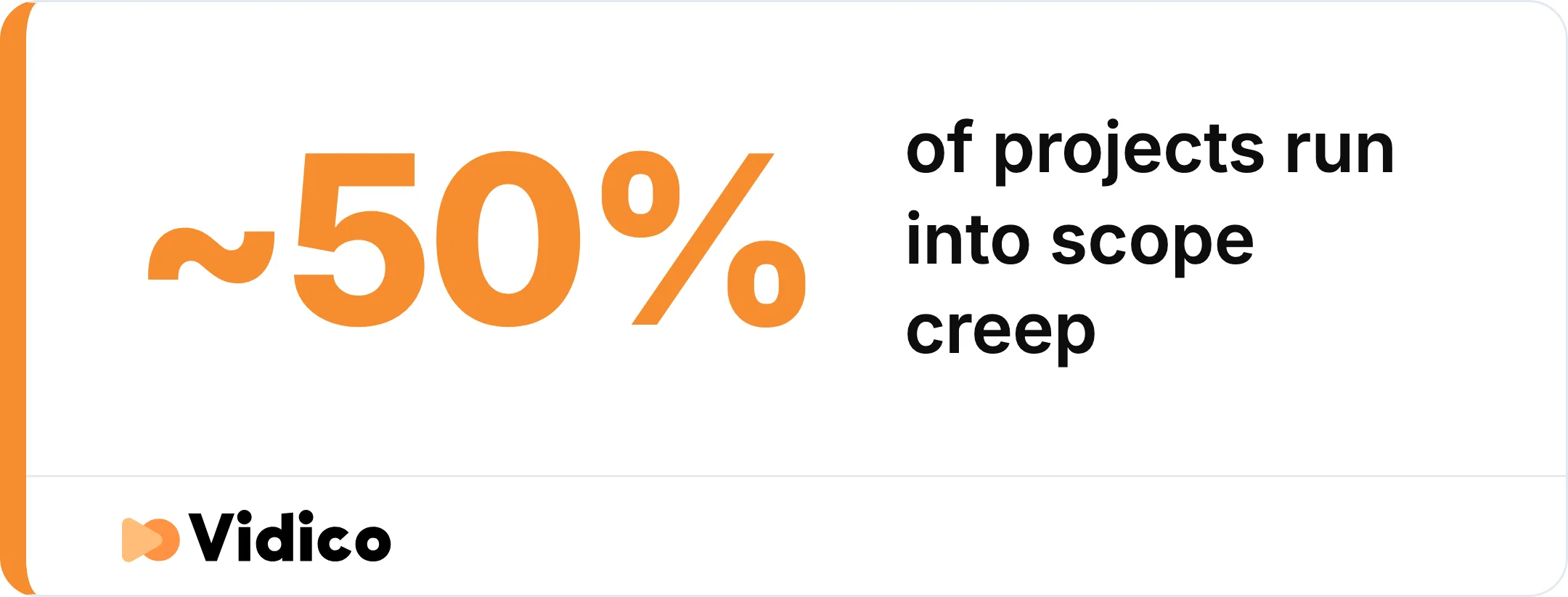
A tightly scoped RFP is the cheapest insurance against scope creep. Source: Project Management Institute.
Frequently Asked Questions
What should a video production RFP include?
A video production RFP should include twelve sections: company and project background, project objectives, target audience and message, scope and deliverables, production phases required, creative direction, technical specifications, timeline and milestones, budget, evaluation criteria, submission instructions, and questions for the vendor. The copy-paste template above covers all twelve.
What is the difference between a video production RFP, a creative brief, and a production proposal?
An RFP is the document you send to several vendors to choose who to hire. A creative brief is an internal document that defines the idea and message for one video, used after a vendor is chosen. A production proposal is the vendor’s response to your RFP, so it is what comes back rather than what you send.
Should I include a budget in the RFP, and what is a realistic range?
Yes, include a budget or a range. Hiding it produces proposals you cannot compare. Most US video production runs from $1,500 to $50,000 or more, with standard corporate and explainer videos landing around $4,500 to $20,000 and 60-second B2B 2D explainers around $3,000 to $15,000, based on our published planning guidance.
How many video production companies should I send the RFP to?
Send it to a focused shortlist of three or four companies you can review properly. A mass send produces more proposals than you can evaluate fairly and signals to vendors that you are shopping on price, which lowers the quality of the responses you get back.
How do I compare video production proposals fairly?
Score every proposal against the same weighted criteria, agree the scoring scale before you read, and judge scope before price. Use an evaluation matrix that rates strategic understanding, creative approach, scope clarity, team and execution, communication, and value, so the decision rests on evidence rather than on whichever proposal you happened to read first.
Do I need an RFP for a single small video?
No. For one simple video with a clear deliverable and a known budget, a short creative brief and a direct quote are faster and get you into production sooner. Save the formal RFP for larger or less defined projects, or where procurement requires a competitive process.
The Bottom Line
A strong video production RFP template does one job well: it gets you comparable, decision-ready proposals from the right vendors so you can choose on fit and craft, not just price. Define the business problem first, state a real budget, publish how you will score, and send it to a focused shortlist. The scoring matrix and vendor questions above turn a stack of proposals into a clear decision.
At Vidico, we produce B2B explainer and brand videos for SaaS and tech teams, and we have shipped more than 2,000 campaigns across finance, ecommerce, and enterprise with a subscription model built for ongoing production rather than one-off projects. If you would rather skip the RFP cycle for recurring work, or just want a second opinion on your brief before you send it, book a free strategy session and we will walk through it with you.