UGC pricing depends on the deliverable, rights, and buying model. As one marketplace benchmark, Collabstr’s 2026 report recorded an average UGC asking price of $180 and an average actual payout of $154. Billo separately advertises creator videos from $99. These are different offers and measurements, not a universal average price for one video.
When buying UGC for your own channels, start with deliverables and usage rights. Paying a creator to publish to their audience is a separate purchase. This guide helps brand marketers compare entry prices, build a brief, and budget for the four buying models, including software demos and other B2B content.
We’re Vidico, a B2B explainer and creative video company that has shipped more than 2,000 campaigns on monthly subscription plans. We run UGC as one part of that work, so we will be straight about where paid UGC is cheap, where it is not, and where an ongoing program makes more sense than buying clips one at a time.
Key Takeaways
- Use scoped price benchmarks. Collabstr’s 2026 marketplace report recorded a $180 average UGC asking price, a $154 average payout per engagement, and a separate $197 average UGC campaign cost. None is a universal per-video rate.
- Know what an entry price includes. Billo advertises basic creator videos from $99, including two revisions within the brief and usage rights after approval. Editing, extra hooks, and other options change the order total.
- Compare the buying model. Billo’s optional managed service starts at $2,000/month; its separate CreativeOps data tool starts at $149/month. A software fee and a production service buy different things.
- Scope SaaS content before pricing it. Software access, screen capture, technical review, versions, and rights belong in the brief.
- Compare like-for-like totals. Count finished videos, hooks, crops, editing, and license terms before dividing a quote by its asset count.
Content
How Much Does UGC Cost in 2026?
Billo advertises a basic creator video from $99. Its October 2026 pricing explanation describes raw creator footage from your brief, without captions, music, or graphics. Creator compensation, platform fees, two revisions within the brief, and full usage rights after approval are included. Product costs, shipping, and optional extras are additional.
| Price example | Amount | What the number measures |
|---|---|---|
| Billo basic creator video | From $99/video | Advertised entry price; length, creator choice, and extras affect the total |
| Collabstr UGC asking price | $180 average | Posted marketplace engagement price in its 2026 report |
| Collabstr actual UGC payout | $154 average | Marketplace payout per engagement, rather than a fixed video specification |
| Collabstr UGC campaign cost | $197 average | Separate campaign metric in the same report |
These figures come from different purchases. Collabstr’s 2026 report describes marketplace activity including 2025 engagements; it is not a survey of every creator’s current rate. Billo’s advertised entry price describes one supplier’s basic offer. The dollar figures above retain each provider’s published denomination; confirm billing currency and any conversion costs before purchase.
For simple budget arithmetic, five videos at a $99 entry price would equal $495 before extras. That is an illustration using the advertised floor, not a five-video package, checkout total, or promise that every brief qualifies.
UGC Pricing by Creator Experience
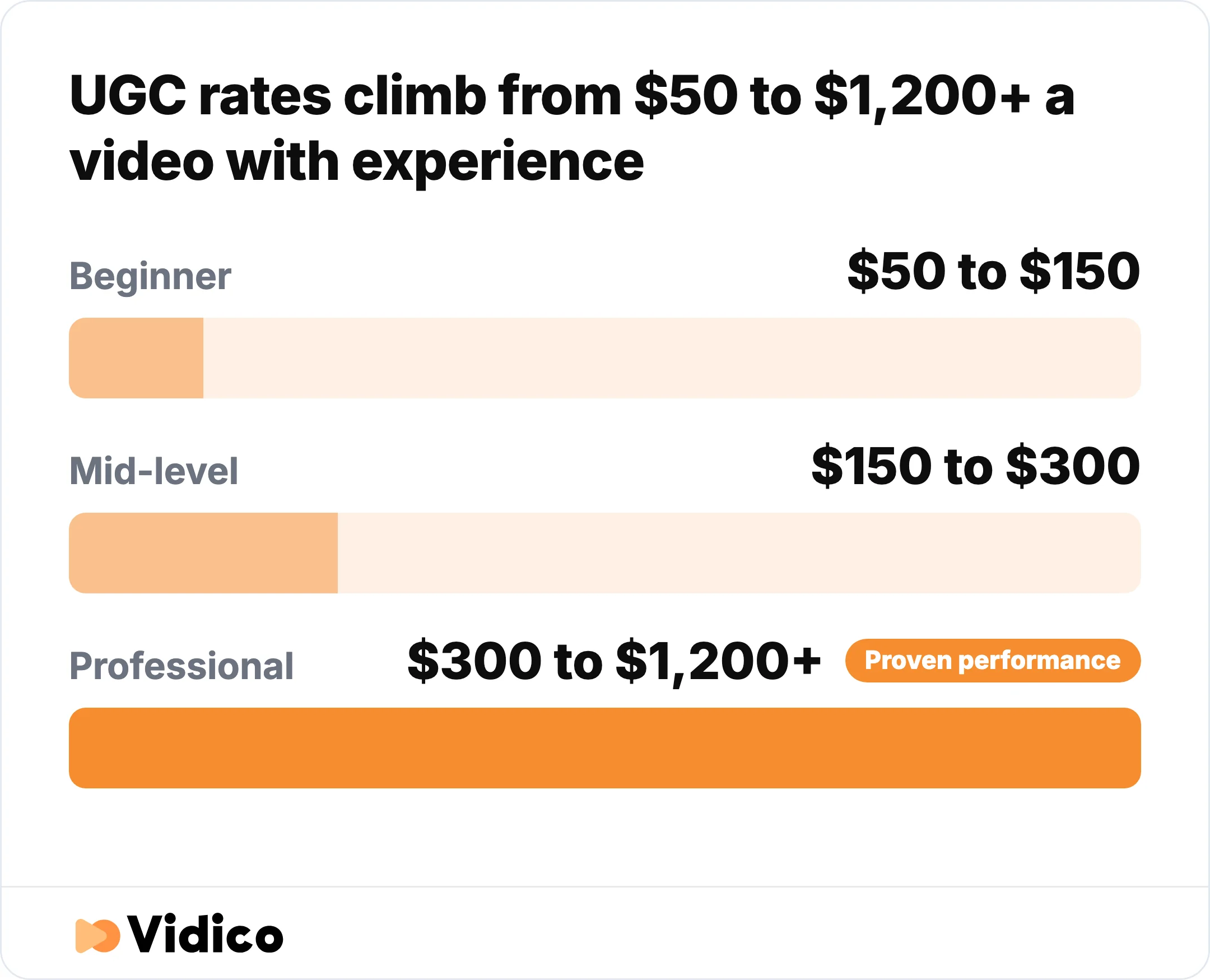
Compare creators on work that matches your brief. Ask to see a product demo, testimonial, or ad in your category, then check who handles scripting, filming, and revisions. A higher fee alone does not establish better performance.
Billo distinguishes Regular and Premium creators as a pricing choice. Its advertised $99 starting point does not establish separate market-wide beginner, mid-level, and professional rate bands. Compare two creators using the same deliverable list and rights terms, and ask what their price includes.
UGC Pricing by Content Type
Specify the finished output before comparing prices. Billo lists video length, format, creator type, extra hooks, and variations among the choices that change its order price.
| Deliverable | What to specify in the brief | Budget implication |
|---|---|---|
| Static photos | Number of images, settings, crops, and editing | Price the photo deliverables separately from video |
| Short video | Exact duration, script, aspect ratio, captions, and music | A raw creator clip and an edited ad have different scope |
| Product demo or unboxing | Product access, demonstration steps, and required shots | Include preparation and any product or shipping costs |
| Testimonial or review | A genuine user’s experience, interview time, and approved claims | Budget for sourcing and approvals as well as recording |
| Extra hooks or CTA versions | Number of distinct openings or endings and exports | Count these separately from unique videos |
A 15-second ad, a 60-second demo, and a three-minute walkthrough are useful brief choices, not standard price brackets. For the testimonial format specifically, see our breakdown of testimonial video cost.
Not sure which formats your budget should cover? Our pricing quiz maps a monthly budget to the mix of content that fits your goals.
The Hidden Costs: Usage Rights and Add-Ons
Check the contract before adding a blanket rights surcharge. Billo includes full usage rights after approval for ads and your own channels, while creator-handle advertising is an optional service. Other agreements may define different channels, terms, or renewal fees.
| Item | What to confirm before ordering |
|---|---|
| Brand-channel paid ads | Included channels, territories, license duration, and renewal terms |
| Creator-handle ads | Permission to run Partnership Ads or Spark Ads, access period, and fee |
| Extended or perpetual use | Whether the license already includes it; ownership and licensing are different |
| Raw footage | Whether you receive just the approved clip or additional source footage |
| Exclusivity | Competing categories, territory, duration, and any separate fee |
| Rush delivery | Deadline, approval schedule, and the quoted rush fee |
| Revisions | Included rounds, reshoots, and what counts as a changed brief |
| Editing and versions | Captions, music, graphics, additional crops, hooks, and exports |
Billo includes two revisions within the original brief. Additional hooks, crops, editing, and extra footage are optional purchases. Ask for an itemized total so a lower base price does not hide a larger finished-ad cost. There is no single percentage uplift that applies to all these services.
Want a clear read on where your current creative spend is working before you add more? Our free Creative Intelligence Report breaks down your existing creative in 48 hours.
How to Save: Bundles and Volume Discounts
Compare the cost of the same brief at different volumes. Billo uses prepaid monetary packs and adds a larger balance bonus to larger packs. That is a supplier-specific volume mechanism, not a universal percentage discount for ordering two, five, or ten videos. Its credits stay valid for 12 months, so include expected usage and the upfront payment in your comparison.
Request a total for the number of unique videos you need, then list hooks and crops separately. Buy the channels and rights your test requires, and compare an initial order with a repeat order using the same brief. Avoid prepaying for more production than you can use.
The Four Ways to Buy UGC (and What Each Costs)
Choose the model that matches the work you want to manage yourself.
| How you buy | Price basis or published example | What to compare |
|---|---|---|
| Self-serve marketplace | Billo basic videos from $99/video | Footage, editing, extras, rights, and your briefing time |
| Managed campaign | Fee for a defined campaign | Unique videos, creator count, strategy, production, and reporting |
| Monthly managed service / subscription | Billo managed service from $2,000/month | Monthly scope, creator sourcing, briefing, post-production, and commitment |
| In-house | Staff time, equipment, tools, and other production costs | Capacity, management time, and cost per usable finished asset |
Billo also lists CreativeOps from $149/month as an optional data tool. That subscription is separate from buying videos or its managed production service; it is not a monthly video allowance.
Marketplaces let you brief creators directly and manage the output. Billo advertises videos from $99 through prepaid monetary credit packs, with no monthly subscription required. Credits are valid for 12 months. The basic creator video includes two revision rounds within the brief and full usage rights after approval; shipping and optional add-ons cost extra. A pack’s dollar value is not a fixed video count.
Managed campaigns hand the work to an agency that sources, briefs, and delivers. You do less, you pay more, and the cost is per campaign rather than per video. In-house means hiring or assigning a creator, buying gear, and owning the whole process. It gives you the most control and the steadiest volume, but the upfront cost and ramp time are real.
Monthly retainers and subscriptions are the model for brands that need UGC as an ongoing program rather than a one-time push. This is where our UGC Engine fits: our subscription model covers explainer, motion graphics, ad creative, and UGC under one monthly fee, with plans starting around $5,000 a month and unused budget rolling over.
One shoot becomes 40 or more assets, and reusable templates make each cycle cheaper than the last. We are the ongoing-program option, not the cheapest route to a single clip, so if all you need is one video by Friday, a marketplace is the better buy. To see how teams run UGC as a system, our Scaling B2B Creative Masterclass walks through it.
How to Budget for B2B and SaaS UGC
Price the job the creator must perform. A software demo can require account access, screen recordings, product training, and review by someone who knows the product. Include those tasks in the brief rather than applying a fixed SaaS surcharge to a consumer-video price.
| SaaS content brief | Scope that needs pricing |
|---|---|
| Meta problem/solution ad | One clear problem, approved product claim, hooks, and ad-ready exports |
| TikTok day-in-the-life video | Creator fit, real workflow, filming setup, and any screen capture |
| LinkedIn testimonial | A genuine customer, interview or recording time, and claim approval |
| YouTube tutorial | Product access, demonstration steps, narration, and editing |
| Website onboarding walkthrough | Current UI, step accuracy, accessibility, and future update needs |
| Split-screen reaction | Source material permissions, creator commentary, and final edit |
Use the $99 basic-video example as a defined entry offer, not a SaaS rate. For three software demos, ask for the total covering all three scripts, screen recordings, edits, hooks, and rights. Divide that total by three only if each deliverable is a complete demo; a hook variation is not another demo.
In our 2026 State of Creative in Tech report, a survey of more than 230 B2B tech marketing leaders, 76% said their creative production budget is increasing this year, and paid-social video and customer-proof video tied as the highest-impact formats. That describes creative priorities, rather than establishing a price for SaaS UGC.
For B2B teams that need recurring demos and variations, a managed program can bring these tasks into one brief. Through our UGC Engine, we recruit the creators, write the briefs, build the hook variations, and version every cut, so a marketer at a company like Finder or Picjam gets ready-to-publish content without managing a roster across three marketplaces.
Running UGC inside a system also bends the cost curve down. In our own client work, a built-out content engine delivers 30% to 40% better creative ROI and ships 40% to 60% faster once the template library exists, so the cost per asset keeps dropping as the program matures. For more on this vertical, see our guide to SaaS video production.
Cheap vs Premium UGC: What You Actually Get
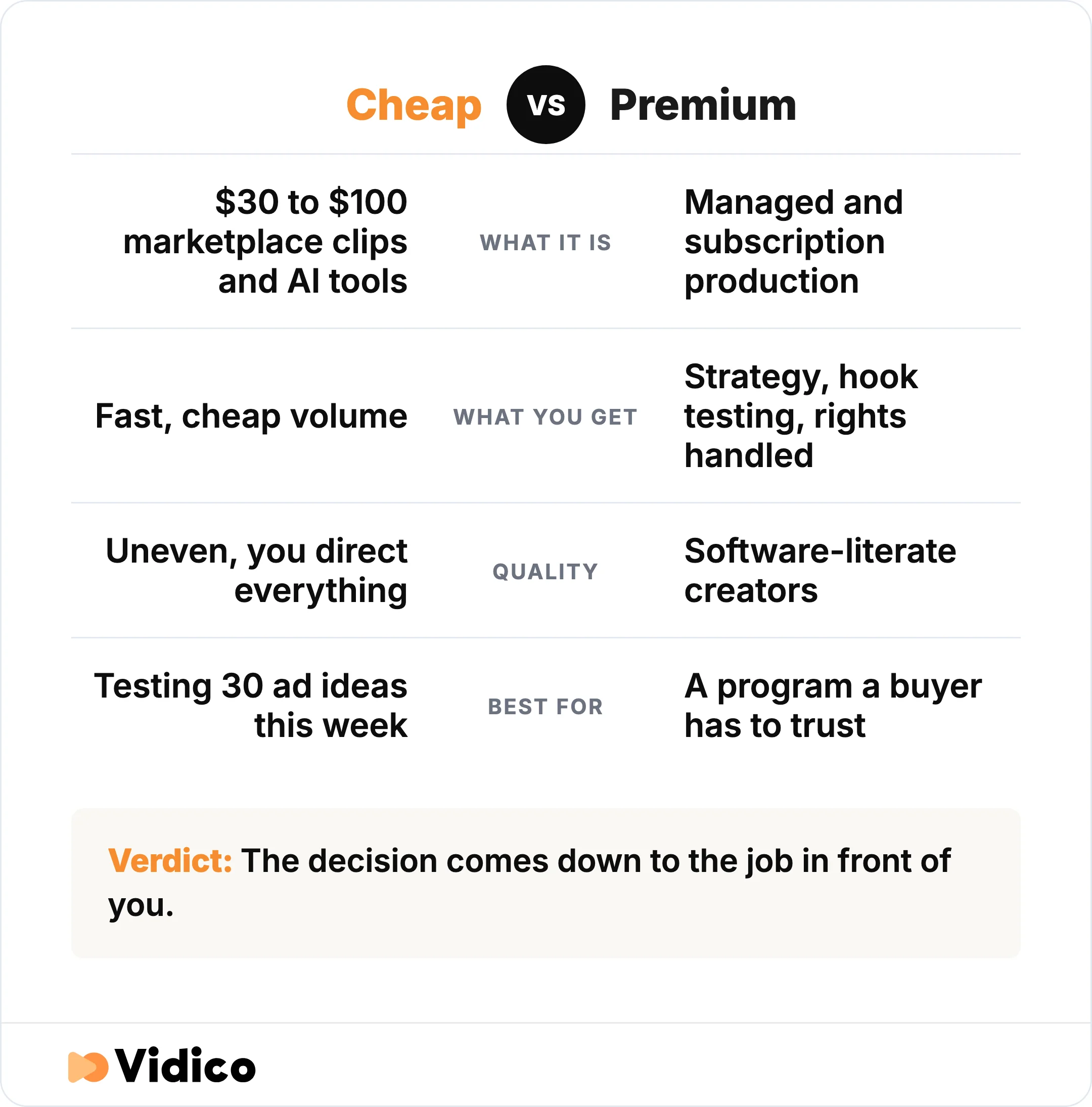
The price gap between cheap and premium UGC reflects a real difference in what you get, not just polish. At the entry end, Billo advertises basic creator footage from $99 per video. You supply the brief; editing and extra versions are separate choices. At the premium end, managed and subscription production brings strategy, software-literate creators, hook testing, rights handled for you, and a system that compounds.
Where does AI sit on this price curve? At the production layer, not the creative one. We use it to spin up variations, localize a clip for new markets, and recut long footage into short, while the brief and the final sign-off stay with a person. Hand the whole job to AI and the output slides toward generic, which is the quickest way to lose the authenticity a buyer is paying for in the first place.
So the cheap-versus-premium decision really comes down to the job in front of you. Testing 30 ad ideas this week? Cheap clips are the right tool. Building a content program a buyer has to trust? The premium end earns its price.
Is UGC Worth the Cost?
UGC is worth the cost when you run it as tested creative rather than a one-off expense, because the format consistently returns more than it costs. Featuring UGC on product pages increases revenue per visitor by 154%, according to Bazaarvoice. And the format most UGC lives in, short-form video, is the top ROI-driving content type in HubSpot’s marketing statistics: 49% of marketers rank it among their highest-ROI formats, ahead of long-form video at 29% and live-streaming at 25% in the same top-three ranking.
The value shows up in acquisition cost. Strong creative lowers your cost per result, so a higher per-video price can still bring down your blended cost of acquiring a customer.
In our broader video work, HR platform Bambee cut its cost per lead by 50% and saw a return in under a month. That campaign used animated product and ad creative, so its result is not a UGC benchmark. For the wider view, see what a marketing video costs across formats.
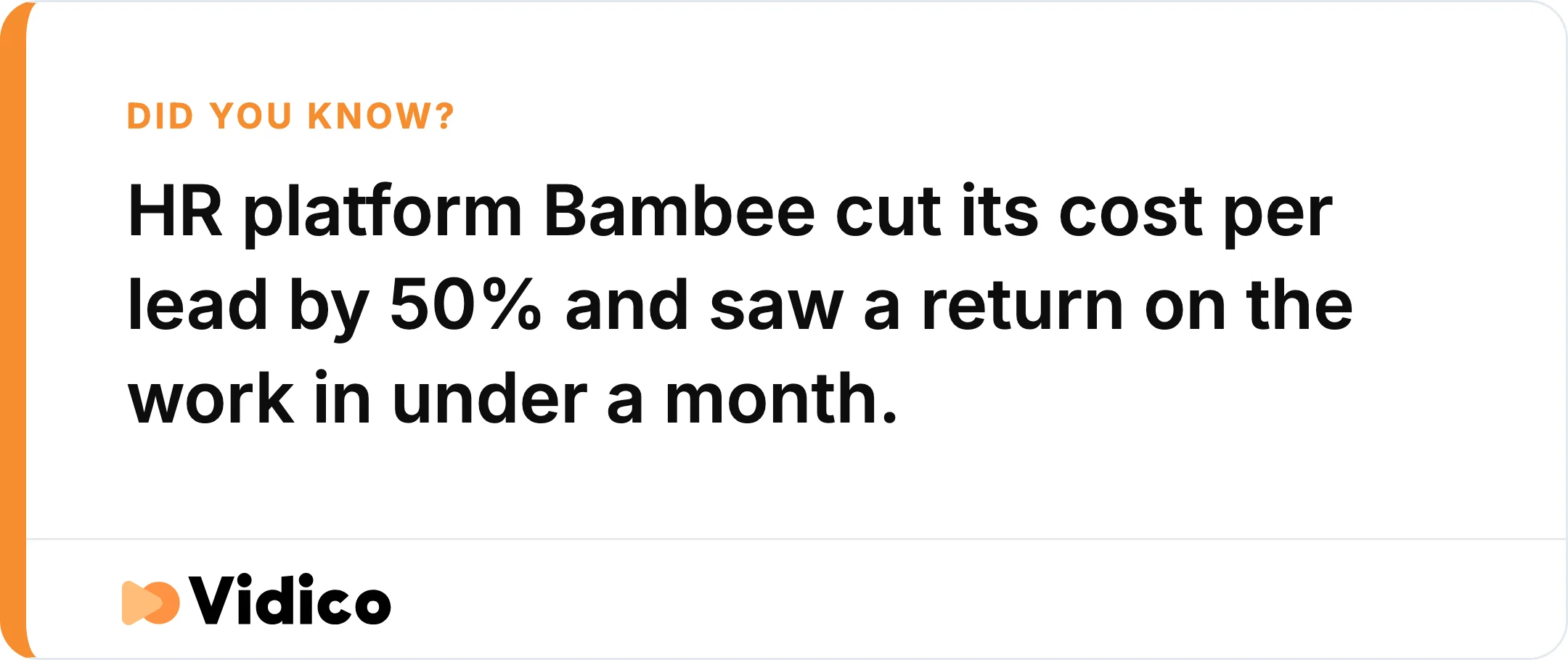
Bambee’s result comes from animated product and ad creative. It illustrates broader video performance, not a measured UGC outcome.
Frequently Asked Questions
How much does UGC cost per video?
There is no universal per-video average. Collabstr’s 2026 marketplace report recorded average UGC asking prices of $180 and actual payouts of $154 per engagement. Billo advertises creator videos from $99. Confirm the number of deliverables, revision rounds, usage rights, and add-ons in your own quote.
How much do UGC creators charge?
A creator’s fee depends on the brief, deliverables, rights, and services included. Collabstr’s 2026 marketplace report recorded $180 average UGC asking prices and $154 actual payouts per engagement. Billo advertises basic creator videos from $99. Those observations do not establish separate beginner and professional per-video rates.
Are UGC creators worth it?
Yes, when the content is run as tested creative. UGC lifts revenue per visitor by 154% according to Bazaarvoice, and short-form video, where most UGC lives, is the top ROI content format. The return comes from testing several variations and spending behind the winners, not from one clip.
How much does B2B or SaaS UGC cost?
Budget from a defined software brief: product access, screen capture, scripting, technical review, editing, hooks, and usage rights. Billo’s $99 basic-video starting price and $2,000/month managed-service starting price describe different supplier offers. Neither is a fixed price for a finished SaaS demo.
How can I lower my UGC costs?
Compare repeat-order or volume pricing for the same brief, count hooks and crops separately from unique videos, and avoid rights or extras you do not need. Billo offers larger balance bonuses on larger prepaid packs; weigh that against its 12-month credit validity and the amount of content you will use.
The Bottom Line
UGC pricing comes down to the deliverable, the rights, and how you buy. Marketplace payout data, an advertised entry price, and a managed agency fee describe different purchases. Compare their scope before setting a budget, then decide whether you need clips for a test or ongoing creative production.
Vidico produces B2B explainer and creative video for SaaS and tech brands, and our UGC Engine runs creator content for teams like Finder and Picjam as one managed part of an ongoing subscription rather than a stack of one-off clips. That is what lets the content compound in value, with the cost per asset falling as the template system builds. For a quick, high-volume test, a marketplace will serve you well. For an ongoing program a buyer will trust, that is the gap we built for.
If you want UGC built and tested like performance creative, tell us about your product and budget when you book a free strategy session.