
Customer education videos teach the people who already bought your product how to get value from it, so they adopt faster, stay longer, and open fewer support tickets. They are made for existing customers in the post-purchase stages of onboarding, adoption, and expansion. That makes them different from internal employee training and from customer-service soft-skills videos, which teach your staff instead of your users.
At Vidico, we produce the explainer, product, and tutorial videos B2B software teams use to educate their customers, work we have shipped across 2,000+ campaigns for brands like Square and NinjaOne. This guide covers what these videos are, why they move retention and support costs, the types worth making, how long they should run, and how to build a library without the cost climbing with every new clip.
Key Takeaways
- Education lifts adoption and value. A 2024 Forrester Consulting study commissioned by Intellum found that US organizations surveyed reported 38.3% higher product adoption and 35% higher customer lifetime value per trainee from their customer education programs. These are program-level findings, not a video-only experiment.
- They cut support load. The same study tied education programs to a 15.5% drop in support costs, and 61% of customers already prefer self-service for simple issues (Salesforce).
- Short wins. 65% of viewers finish a video under one minute, while only 20% finish a video over 20 minutes (Vidyard). One task per video is the rule.
- Know the types. Product walkthroughs, feature tutorials, onboarding-to-value series, in-app microlearning, self-serve help videos, and customer-academy courses each do a different job.
- Sequence before volume. Map the adoption path first, then build the library. A reusable template system keeps production cost from scaling with the size of your catalog.
Content
What Are Customer Education Videos?
Customer education videos are short videos that show existing customers how to use your product and get results from it. The audience is the user who already signed up, not a prospect and not an employee. The goal is faster time-to-value: the customer learns the task, succeeds on their own, and comes back.
This is a different job from two things people often confuse it with. Internal training teaches your own staff how to do their work. Customer-service training teaches support agents how to handle people. Customer education teaches your customers how to use what they bought. If you are producing content for your own team, our guide to educational video production and animated training videos covers that use case instead.
Customer education videos show up across the customer journey. They start at onboarding, where a short series gets a new user to their first win, then continue through adoption as the customer learns deeper features, and into expansion as they grow into higher tiers. Onboarding is its own discipline, and our customer onboarding video guide goes deep on that first stage. The rest of this guide covers the full post-purchase picture: tutorials, help content, and the library that holds it all.
The audience is the user who already signed up, which is what separates this from internal training.
Why Customer Education Videos Matter
Customer education pays off in three places a business already measures: adoption and retention, support cost, and revenue. The numbers below come from research into customer education programs broadly, and video is the format most of those programs lean on.
Faster adoption and higher retention. Educated customers reach value sooner and stick around. A 2024 Forrester Consulting study commissioned by Intellum, surveying 300 US customer-education decision-makers, reported a 38.3% increase in product adoption along with higher customer retention for organizations with these programs. The study was sponsored by an education-software vendor, so read it as directional, though the direction matches other onboarding data: Airship found a high-performing onboarding series drove a 34% lift in 30-day retention for mobile users. When we produced an explainer and animation set for EverString, the videos drove 82% viewer retention and a 27% increase in customer signups.
Lower support load. Every question a video answers is a ticket your team never works. The Forrester study commissioned by Intellum tied customer education to a 15.5% decrease in support costs. Customers want this too: Salesforce found that 61% of customers prefer self-service for simple problems. A well-placed tutorial is cheaper than a support seat and available at 2 a.m.
More revenue per customer. Adoption and retention compound into money. In the same Forrester research, organizations reported a 7.6% average increase in top-line revenue, a 35% increase in customer lifetime value per trainee, a 26.2% improvement in customer satisfaction, and 86% reported a positive return on their education investment; 96% at least broke even. Treat the exact figures as vendor-sponsored estimates. The pattern they describe is the reason customer success teams keep asking for video.
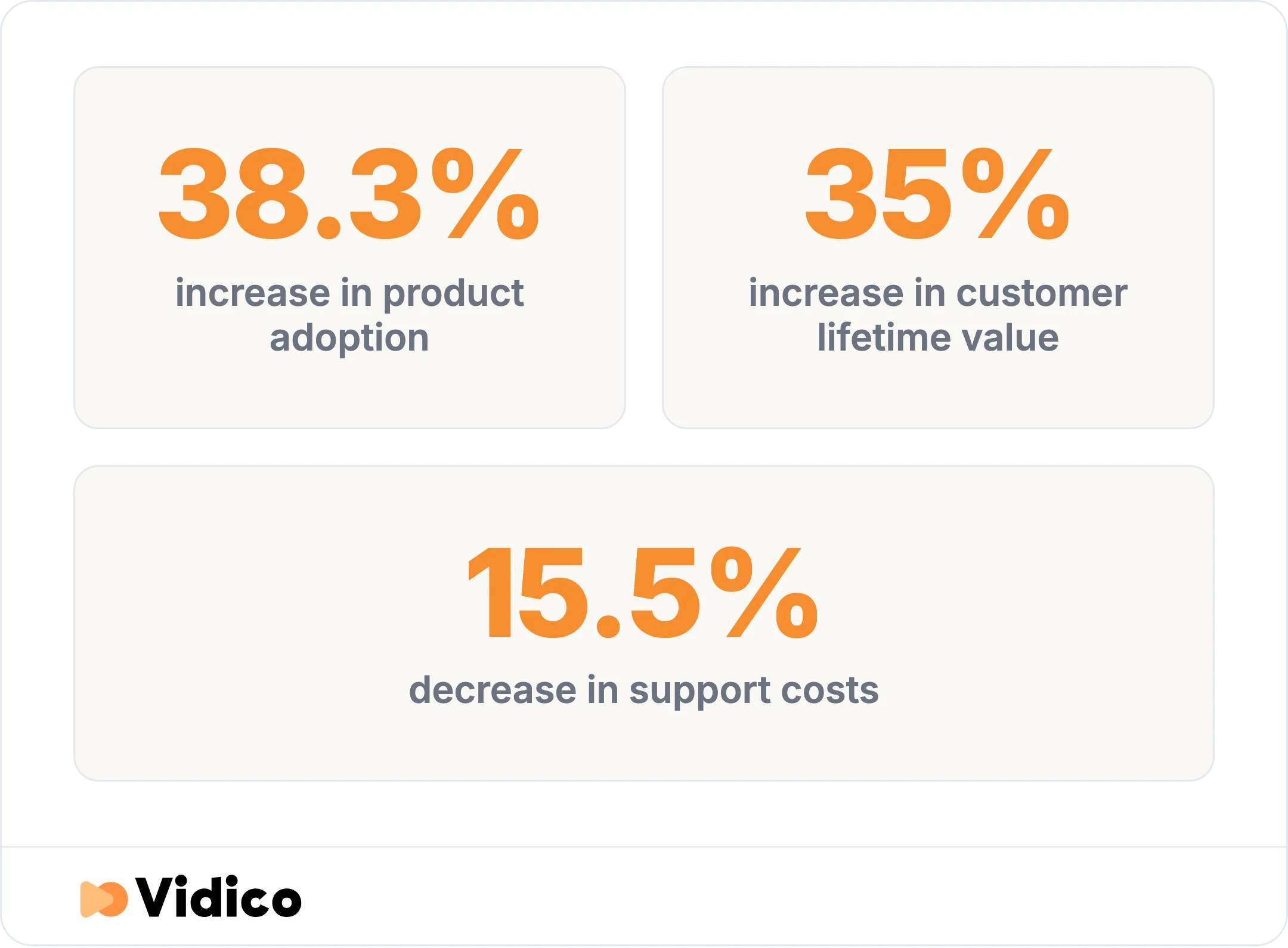
Reported impact of customer education programs across 300 US decision-makers. Source: 2024 Forrester Consulting study commissioned by Intellum, so read the figures as directional.
Not sure where video fits your growth plan? Our Video for Growth newsletter breaks down what works for B2B teams.
The 7 Types of Customer Education Videos
Customer education is not one video format. It is a set of them, each matched to a moment in the customer journey. Here are the seven types worth knowing, what each one does, when to use it, and how long it should run.
| Video type | What it does | Best moment in the journey | Ideal length |
|---|---|---|---|
| Product walkthrough | Tours the product and shows how the core pieces fit together | First login, onboarding | 2 to 4 minutes |
| Feature tutorial | Shows how to complete one specific task or feature | Adoption, when a user hits a new feature | Under 2 minutes |
| Onboarding-to-value series | A short sequence that gets a new user to their first real win | First week after signup | 1 to 3 minutes each |
| In-app microlearning clip | Answers one question inside the product, in context | Any point of friction during use | Under 60 seconds |
| Self-serve help video | Lives in the knowledge base and answers a common support question | When a customer would otherwise file a ticket | 1 to 3 minutes |
| Release or feature announcement | Explains a new feature and why it matters | Product updates, expansion | Under 2 minutes |
| Customer-academy course module | Structured lessons that build a skill or certify a user | Deep adoption, power users | 3 to 8 minutes each |
Most teams start with feature tutorials and self-serve help videos, since those two cut the most tickets fastest. Walkthroughs and onboarding series come next because they carry the first-week experience. Academy courses are the mature end of the spectrum. Structured course libraries like HubSpot Academy and Webflow University show what that looks like at full scale, and the videos inside them are exactly the kind of asset we produce. A clean software walkthrough video is often the first piece a customer education library needs.
How Long Should a Customer Education Video Be?
A customer education video should cover one task and end. For most tutorials and how-to content, that lands between one and three minutes. Microlearning clips that answer a single in-product question are often under a minute. The ceiling matters more than the floor: long videos lose people.
The data is blunt. Vidyard’s business video benchmarks show that 65% of viewers finish a video under one minute, while only 20% finish a video longer than 20 minutes. Practitioners who build these libraries report the same thing, with engagement on how-to content holding through the two-to-five-minute range and falling off after that. The fix is not a shorter cut of a long video. It is a different video scoped to one outcome.
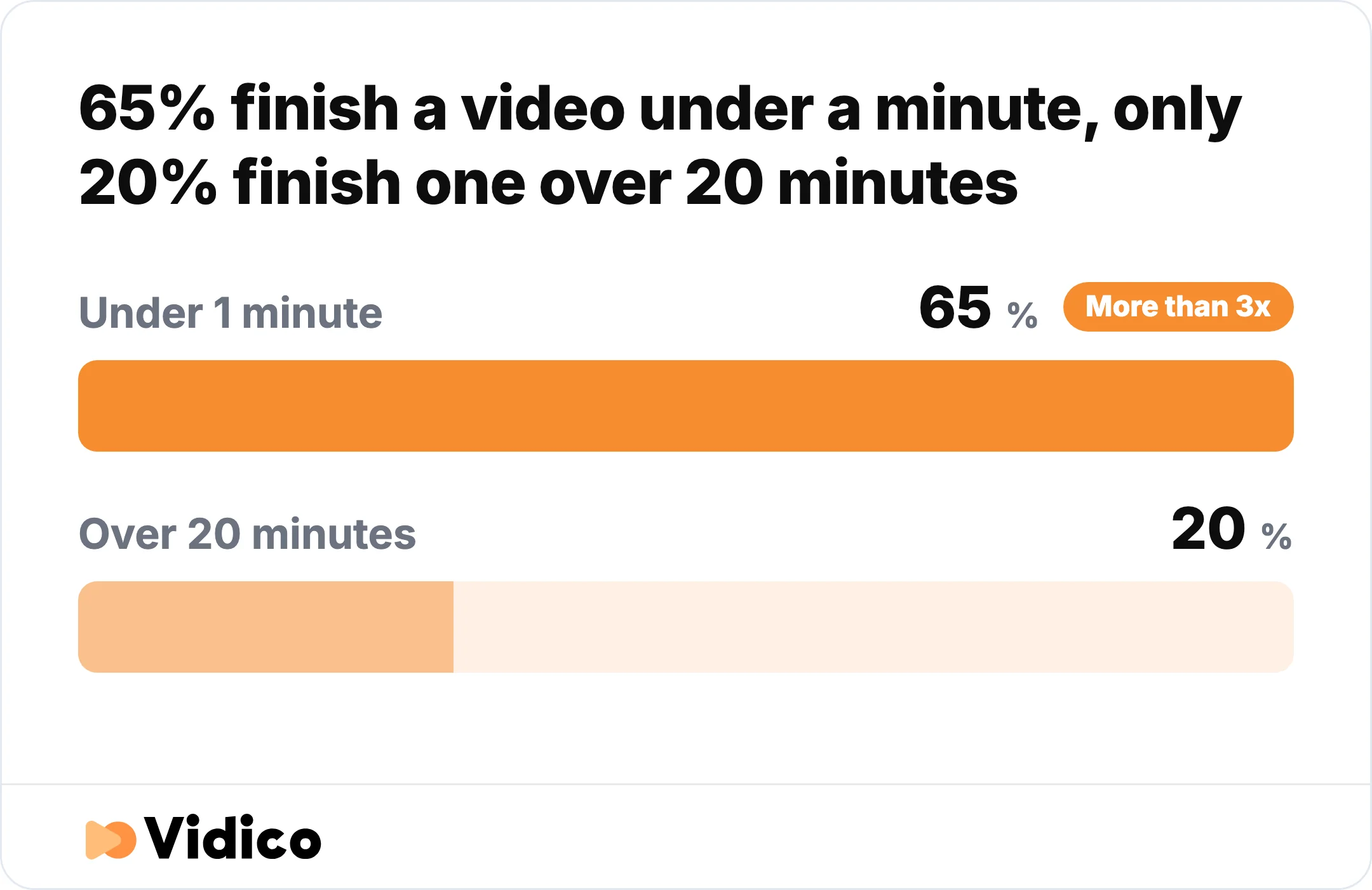
Completion falls off hard with length, which is why one task per video is the rule. Source: Vidyard business video benchmarks.
Watch out for fake microlearning. Slicing a 45-minute webinar into nine clips is chunking, not microlearning, because each clip still assumes the other eight. True microlearning answers one question on its own, so a viewer can watch a single clip and finish the task without the other eight.
Video vs. Written Documentation: When to Use Each
Use video to show a sequence of actions and build first-time confidence, and use written docs for anything a customer needs to search, scan, or copy. The best customer education teams do not choose. They ship a short written version alongside each video so the customer can watch once and reference later.
Video wins when the task is visual or spatial: where to click, what the screen looks like after each step, how a workflow flows end to end. A new user following along with a walkthrough gets there faster than one parsing a wall of text. Written documentation wins on everything video is bad at: finding a specific step without scrubbing a timeline, copying a code snippet, reading on a locked-down work laptop, and getting updated in seconds when a button moves. Pairing the two also covers accessibility and the customer who simply prefers to read.
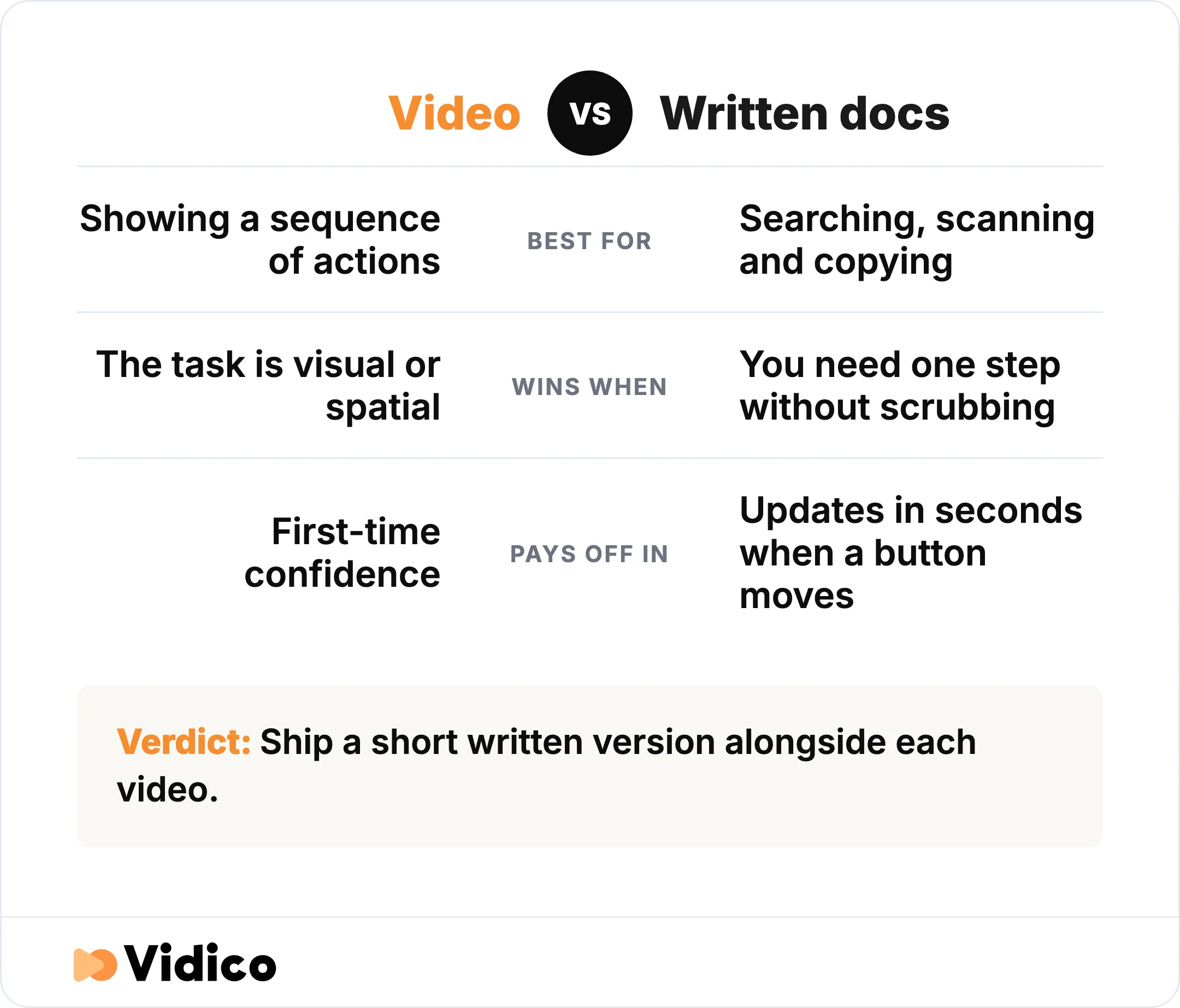
Video builds first-time confidence, documentation handles reference. The best teams ship both.
Best Practices for Customer Education Videos That Work
The teams that get results from customer education video follow a short list of habits. None of them are about production polish. They are about scope and sequence.
- Anchor each video to one outcome. Name the single task the viewer can do after watching. If you cannot name it in a sentence, the video is trying to do too much.
- Map the adoption path before you build. List the five to ten actions that separate an activated customer from a churned one, then make videos for those first. Building a large catalog before you know the path is the most common waste: effort scales but activation does not.
- Match the format to the job. Short video for how-to, written docs for reference, in-app clips for contextual help, and courses for deep skills. One format rarely fits everything.
- Build education into the product. The highest-value microlearning lives inside the product at the moment of friction, not on a help site the customer has to go find.
- Caption and localize. Captions serve the majority who watch without sound, and localization extends every video to your non-English customers without a reshoot.
- Measure and cut. Track which videos get watched and which deflect tickets, then kill the ones that do neither.
On production itself, speed usually comes from systems, not shortcuts. We use AI to handle the repetitive layer, including caption generation, localization, and cutting one recording into several variants, while our team owns the brief and the final edit. That keeps a growing library consistent without turning every video into a from-scratch project. If you want a running plan for this, our free video marketing plan maps content to the customer journey.
How to Scale a Customer Education Video Library Without Blowing the Budget
The hard part of customer education video is not the first video. It is the hundredth. A catalog that grows one bespoke video at a time means cost climbs in a straight line and the look drifts as different people make different clips. The way out is a reusable template system: branded intros, lower-thirds, motion, and layouts built once, then reused so each new video ships faster and cheaper than the last.
This is the core of how we work. We build a template and asset library for each customer, so the production work drops with every new video and the whole library keeps a consistent look. For Josys, we produced an eight-part feature-demo system as a reusable motion setup rather than eight unrelated videos, which is what a scalable customer education library actually looks like. The same single recording can also be cut into a full walkthrough, a set of feature tutorials, and in-app microlearning clips, so one shoot feeds several slots in the library.
Vidico produces B2B explainer, product, and tutorial videos for SaaS and tech teams, with a subscription model that covers video, animation, and design under one monthly fee. That structure is what makes an always-on customer education library affordable instead of a series of one-off invoices.
Curious how your current video stacks up? Our Creative Intelligence Report gives you a free competitive analysis in 48 hours.
How to Measure Customer Education Video Success
Measure customer education video against the three outcomes it exists to drive: adoption, support deflection, and retention. View counts alone tell you nothing about whether a customer learned anything.
Tie one or two metrics to each video’s single outcome. For a feature tutorial, track feature adoption and activation rate before and after the video goes live. For a self-serve help video, track ticket volume on that topic and whether tickets per account fall. Across the library, watch video completion rate as a quality signal, time-to-value as the headline onboarding number, and CSAT and renewal rate as the long-game measures. A video with high views, low completion, and no change in tickets is a video to rework, not celebrate.
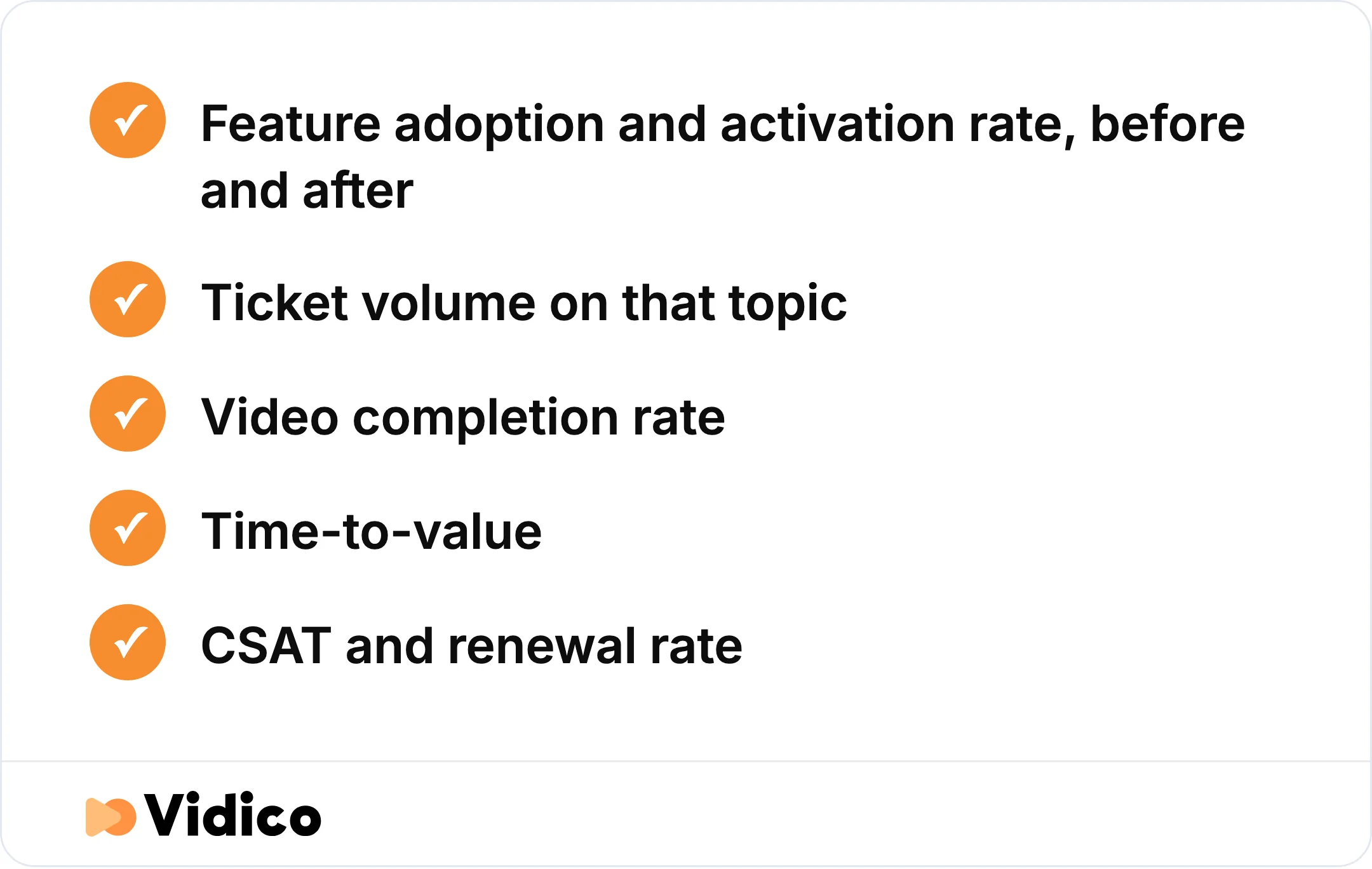
What to track instead of view counts. View counts alone say nothing about whether a customer learned anything.
Customer Education Video Examples Worth Studying
The best customer education videos share one trait: each teaches a single thing well. Here are three worth studying, with the lesson each one carries.
- Airtable product tutorial (Vidico). Our Airtable tutorial video walks a user through the product itself rather than talking about it. The lesson is scope discipline: it teaches the task on screen, in the product, without a detour into brand storytelling.
- Josys feature-demo system (Vidico). The Josys eight-part system shows what a library looks like when it is built as a set, not a pile. The case study describes reusable frame layouts, custom transitions, and a shared set of effects across the eight-demo brief. The lesson is to specify those reusable components at the start, so new clips can build on the same system.
- Structured customer academies. Course libraries like HubSpot Academy and Webflow University are the benchmark for mature customer education at scale. The lesson is sequencing: lessons build on each other toward a skill, rather than sitting as a flat list of clips.
Study what makes each work, then borrow the pattern that fits your stage. A single clean walkthrough is the right start for most teams. A structured academy is where you grow.
Frequently Asked Questions
What is a customer education video?
A customer education video is a short video that teaches an existing customer how to use a product and get value from it. It targets users in onboarding, adoption, and expansion, and its goal is faster time-to-value and fewer support tickets, which separates it from internal employee training.
How long should a customer education video be?
Most customer education videos should run one to three minutes and cover a single task. In-product microlearning clips are often under a minute. Vidyard’s benchmarks show 65% of viewers finish a video under one minute while only 20% finish videos over 20 minutes, so shorter and task-focused almost always beats long.
What types of videos work best for customer education?
The highest-impact types are feature tutorials and self-serve help videos, because they cut support tickets fastest, followed by product walkthroughs and onboarding-to-value series that carry the first-week experience. In-app microlearning, feature-announcement videos, and customer-academy courses round out a mature library.
Do customer education videos actually reduce support tickets?
Yes, when they answer the questions customers would otherwise ask support. A 2024 Forrester Consulting study commissioned by Intellum tied customer education programs to a 15.5% decrease in support costs, and Salesforce reports that 61% of customers prefer self-service for simple issues. A help-center video on a common question deflects those tickets around the clock.
Should I use video or written documentation for customer education?
Use both. Video is best for showing a sequence of steps and building first-time confidence, while written documentation is best for searching, scanning, and copying. The strongest customer education teams publish a short written version alongside each video so customers can watch once and reference later.
The Bottom Line
Customer education video earns its keep when it is short, scoped to one task, mapped to the moment a customer needs it, measured against adoption and support, and built on a system that keeps the library affordable as it grows. Start with the feature tutorials and help videos that cut the most tickets, then grow toward walkthroughs, onboarding series, and a structured academy as adoption deepens.
Vidico builds reusable video production systems for B2B teams, so a customer education library gets faster and cheaper to produce every month instead of more expensive. We have shipped 2,000+ campaigns across SaaS, finance, and enterprise, and we build the template system that makes an always-on library possible. If you want to map customer education video to your product, book a free strategy session and we will help you plan the first set.