The best video hooks win attention in the first few seconds by stacking three things at once: a visual that stops the scroll, a short line of on-screen text that makes a promise, and a spoken line that opens a gap or names a pain. Get that stack right and the viewer gives you the next few seconds. Get it wrong and they never see the rest of your video.
This guide covers the 10 hook types that actually work, the fill-in-the-blank formula for each, and real examples. We wrote it for B2B marketing teams, so the focus is hooks that drive sign-ups and leads, not hooks that chase vanity views. These are the openings we build and test at Vidico for brands like Spotify, TikTok, and Koala.
Key Takeaways
- Attention is decided in the opening, not the edit. Videos under one minute keep 65% of viewers all the way to the end (Vidyard). The hook is what buys that retention.
- A few hook families do most of the work. Across 3.1 million analyzed hooks, problem-solution and direct-address or question openings show up more than any other type (Opus Clip). You do not need an exotic hook, you need the right common one.
- Hooks are now a tested variable, not a guess. In Vidico’s 2026 State of Creative in Tech report, 38.0% of B2B tech marketers named the hook or opening one of their most-tested creative variables, the third most-tested overall.
- The best hook is a stack, not a line. Pair a visual, a line of on-screen text, and a spoken line in the first frame instead of leaning on one alone.
- Treat hooks as a system. Cut several hook variations from a single shoot, run them against the same offer, and keep the winner.
Content
What Makes a Video Hook Work
A video hook is the opening that stops the scroll and earns the next few seconds of attention. It is not the whole intro. It is the first frame and the first spoken line, the part a viewer judges before deciding to stay or swipe.
The reason the opening matters so much is simple: attention is decided almost instantly. Videos under one minute hold 65% of viewers to the end, according to Vidyard’s business video benchmarks. For more on how fast that window closes, see our guide to average attention span statistics.
The stakes are highest on short-form video, which is now the top ROI-driving content format for marketers at 49%, ahead of long-form and live-streaming (HubSpot). When the format is short and the feed is fast, the opening carries the whole result.
The strongest hooks work because they do three jobs at the same time:
- Visual hook: movement, an unusual angle, a prop, or a fast reveal in the first frame. The eye catches it before the brain reads anything.
- Written hook: a 3-to-5 word line of on-screen text that reads like a magazine cover and states a clear promise.
- Verbal hook: a short spoken line, 5 to 8 words, that challenges a belief or names a pain point.
Weak videos lean on one of these. Strong videos stack all three in the same opening, so the hook lands whether the viewer is watching with sound on, sound off, or just glancing.
The hook is the first frame and the first spoken line, not the whole intro.
Want a running start? Vidico’s 100+ Winning Hooks collects opening lines you can adapt to your own product.
The 10 Best Video Hook Types (With Formulas and Examples)
Every hook type here includes the concept, a copy-paste formula, and an example. Pick the type that fits your message, fill in the formula, then test a few against each other.
1. The Question Hook
A question hook opens with a direct question that your exact viewer would answer “yes” to. It pulls people in because an open question is hard to ignore.
- Formula: “Are you still doing the hard/old way when you could reach a better outcome?”
- Example: “Still spending Friday afternoons building the same report by hand?” A question like this works best when it names a task your buyer actually dreads, not a vague benefit.
2. The Curiosity (Open-Loop) Hook
A curiosity hook opens a gap the viewer needs closed, then holds the answer until later in the video. An open loop creates a small itch the brain wants to scratch, so the viewer stays for the payoff.
- Formula: “I tested thing for time period so you don’t have to. Here’s what surprised me.”
- Example: “A team tested the same ad with six different openings for 30 days, and the winner wasn’t the one they expected.” The promise of a payoff keeps people watching for the reveal.
3. The Problem / Pain-Point Hook
A problem hook names the exact frustration your viewer feels right now, in their own words. It works because people stop scrolling when they feel understood. Problem hooks work especially well for B2B, where the buyer has a real, specific headache.
- Formula: “If specific pain, you’re probably making this one mistake.”
- Example: We built NinjaOne’s “Beat IT Misery” campaign around this idea. The concept leads with the pain its IT audience lives with every day, and the animated paid-social creative reached 321 million impressions. When the opening names the problem, the right viewer leans in.
4. The Contrarian Hook
A contrarian hook challenges a belief your audience holds, then promises a better way. Disagreement is interesting, and a confident claim earns a second of trust.
- Formula: “Most people think common belief. Here’s why that’s costing you outcome.”
- Example: “Most teams think more videos means more results. The teams that win make fewer and test the openings harder.” Keep the claim honest, or you lose trust the moment the body contradicts the hook.
5. The Shocking-Stat Hook
A shocking-stat hook opens with a number big enough to make the viewer pause. It works because a specific figure feels like proof before you have said anything else.
- Formula: “Surprising number of group do/experience X. Here’s what that means for you.”
- Example: “Videos under a minute keep 65% of viewers to the end, yet most teams still spend all their time on the edit, not the opening.” Use a real, sourced number. A made-up stat is the fastest way to lose a professional audience.
6. The Visual Pattern-Interrupt Hook
A visual pattern-interrupt hook leads with an image that breaks the feed: sudden movement, an odd angle, a prop, or a fast transformation. The eye reacts to the break before the viewer decides to scroll.
- Formula: Open on unexpected visual + a 3-to-5 word on-screen line, before anyone speaks.
- Example: A product that snaps together in one second, or a split screen showing a messy “before” and a clean “after.” In animation, that often means a bold shape or color move in frame one. The visual earns the attention; the words keep it.
7. The Story / Anecdote Hook
A story hook drops the viewer into the middle of a moment instead of setting it up. It works because a scene in motion feels like something is already happening.
- Formula: “The day specific moment happened, I realized turning point.”
- Example: “Three weeks before launch, the ad everyone was counting on suddenly stopped converting.” Starting mid-scene beats “Hi, today I want to talk about” every time, because there is no runway before the hook.
8. The Result-First (Transformation) Hook
A result-first hook shows the end state before you explain how to get there. People want the outcome, and seeing it first makes them want the steps.
- Formula: “This is impressive result. Here’s exactly how we did it.”
- Example: “This one shoot became 40 ads running across five channels. Here’s the system.” Leading with the payoff is especially strong for case-study and demo videos, where the proof is the point.
9. The FOMO / Urgency Hook
A FOMO hook signals that the viewer is about to miss something time-sensitive or widely known. It works because people do not want to be the last to know or the one who missed out.
- Formula: “Everyone in category is already doing X. If you’re not, here’s what you’re missing.”
- Example: “Your competitors are already testing five ad openings a week. Most teams still ship one.” Urgency has to be real. A fake deadline reads as a gimmick and costs you the next video.
10. The Personal Confession Hook
A confession hook opens with an honest admission, often a mistake or a cost. Candor is rare in marketing, and a real admission disarms a skeptical viewer.
- Formula: “I wasted time or money on thing before I learned lesson.”
- Example: “I spent two years making videos nobody finished before I fixed the first three seconds.” A confession hook builds trust fast, which makes it a strong opening for founder-led and brand videos.
See more of these openings in action in our portfolio.
Which Video Hooks Actually Get Used
The data says you do not need a clever new hook, you need the right common one. Opus Clip analyzed 3.1 million classified hooks across 13.5 million clips, and a small set of categories accounts for most of what creators actually publish (Opus Clip). Problem-solution setups and direct-address or question openings lead the pack.
The concentration is striking inside a single genre. In the health and fitness category Opus Clip studied, 90% of hooks came from just three types: problem-solution, direct address or question, and shock or surprise (based on 33,807 clips analyzed). That split is specific to fitness, but the lesson carries across B2B: a few families do the heavy lifting.
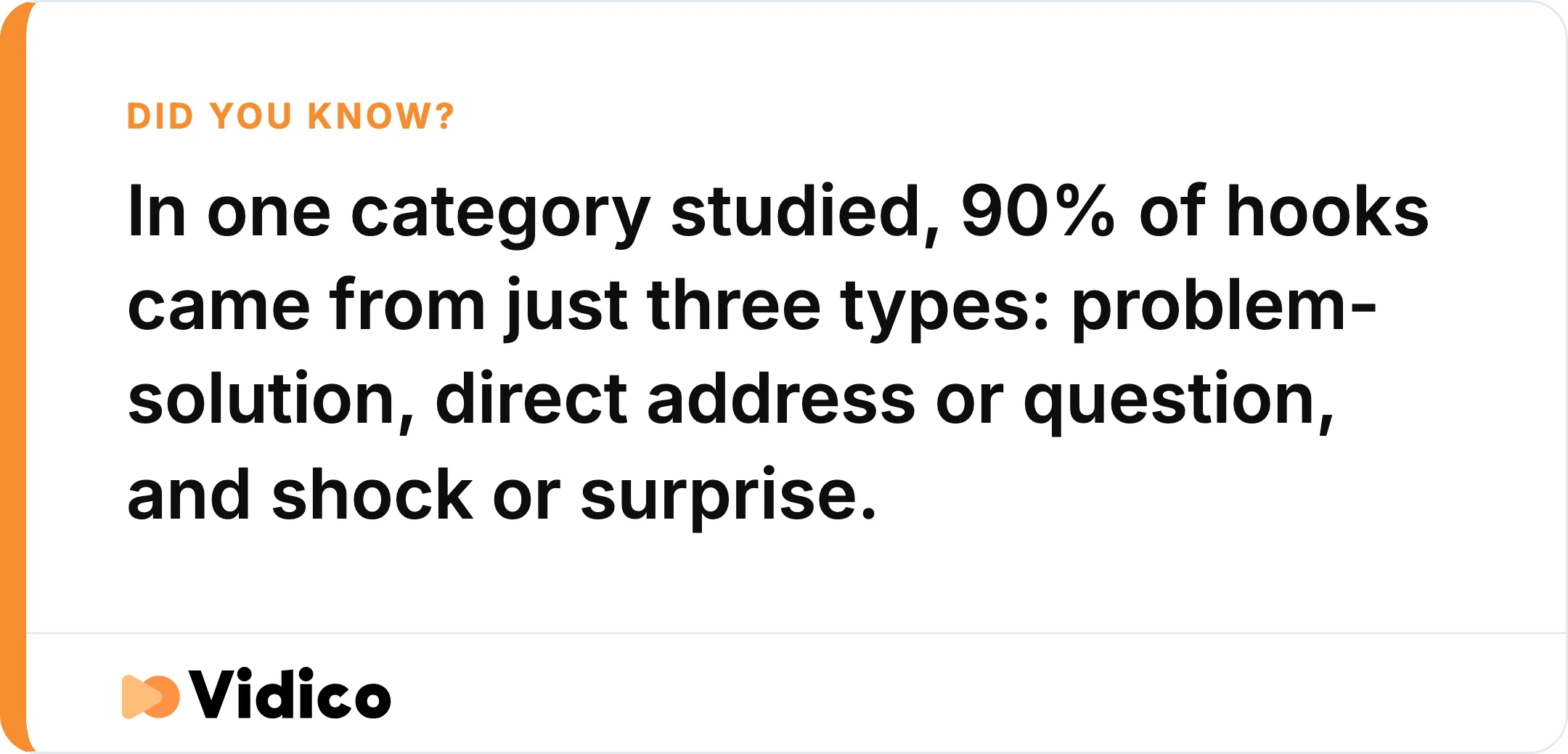
Problem-solution, direct address or question, and shock or surprise accounted for 90% of hooks across 33,807 clips. Source: Opus Clip.
For a marketing team, that is good news. Instead of inventing novelty, pick the two or three hook types that fit your buyer, write a handful of versions of each, and test them. Depth on the proven families beats breadth across gimmicks.
Video Hooks by Platform
The hook types stay the same across platforms, but the delivery changes with how people watch each one. Match the format to the feed.
TikTok and Instagram Reels
On TikTok and Reels, lead with a native, fast visual and put on-screen text in the first frame, because most viewers watch with the sound off at first. The hook has to read in silence. Keep the opening line short and the first motion obvious. For more on this format, see our short-form video advertising tips.
YouTube (Shorts and Long-Form)
On YouTube, pair a verbal hook with a visual one and restate the promise within the first few seconds. Shorts behave like TikTok, but long-form viewers give you a beat longer, so the opening should preview the payoff clearly rather than tease forever.
On LinkedIn, lead with the business problem or the outcome, not a personality-driven cold open. The audience is there for work, and video there earns an average engagement rate of around 6% (Sprout Social), so a hook tied to a real business result travels. See our best LinkedIn video ad examples for openings that fit the platform.
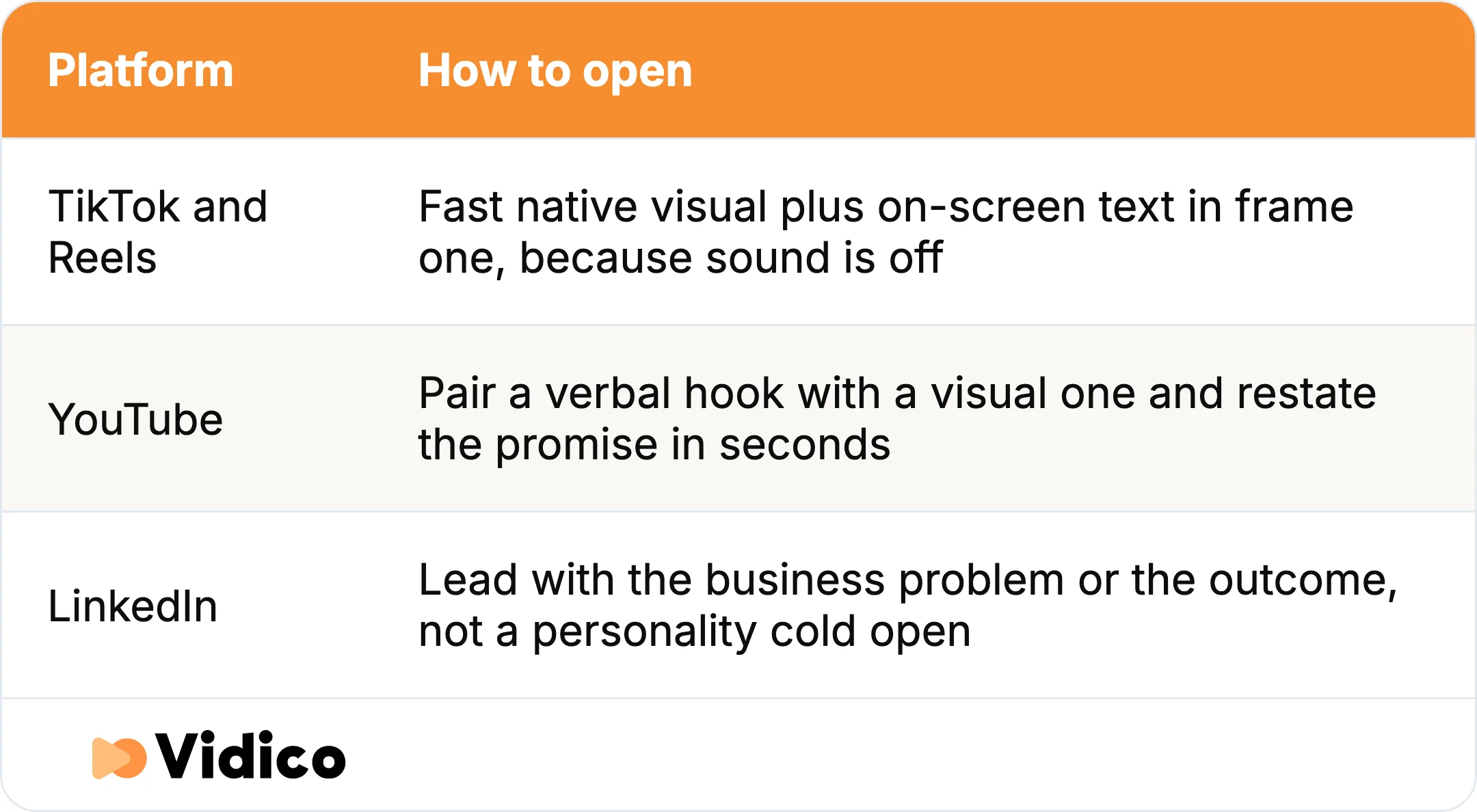
The hook types stay the same across platforms. The delivery changes with how people watch each feed.
Not sure which openings your competitors are winning with? Our free Creative Intelligence Report breaks down the creative in your space in 48 hours.
How to Write and Test Hooks Like a System
Great hooks are produced and tested, not guessed. The teams that win treat the opening as the highest-impact edit in the whole video and run it like an experiment.
Start with a few writing rules that hold across every hook type:
- Keep it simple. The viewer has to register the hook in a split second. One idea, plain words.
- Use negative or loss framing where it fits. Words like “stop,” “avoid,” and “mistake” tap loss aversion, which pulls attention harder than a positive promise.
- Lead with your strongest type. Do not bury the best opening three seconds in. The hook is the first thing or it is nothing.
- Keep the spoken hook short. Five to eight words. Say the interesting thing first, explain after.
Then use the hook swap: if a video underperformed, keep the body, cut a brand-new first three seconds, and re-publish. You are not remaking the video, you are changing the one part that decides whether anyone watches the rest.
Testing the opening is now standard practice, not a nice-to-have. In Vidico’s 2026 State of Creative in Tech report, 38.0% of B2B tech marketers named the hook or opening one of their most-tested creative variables, behind only audience and message angle. The teams getting results are not writing one hook, they are writing many and letting the numbers choose.
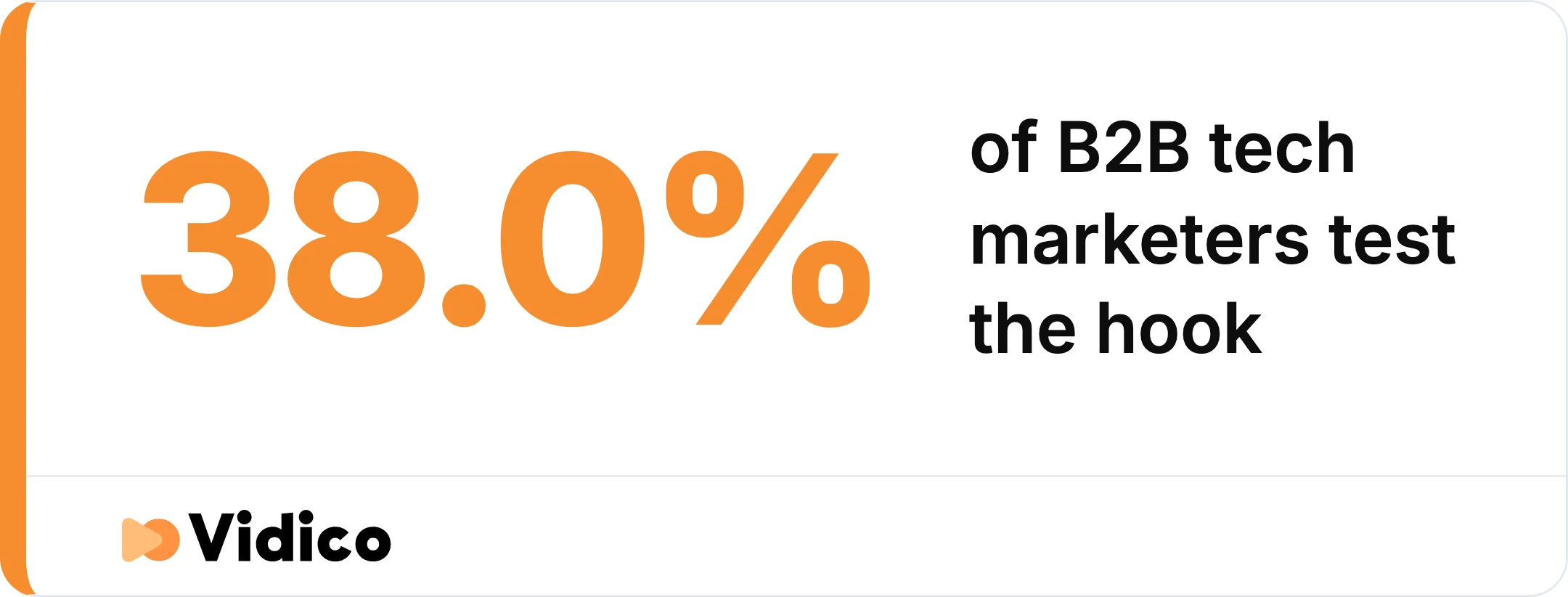
The third most-tested creative variable, behind only audience and message angle. Source: Vidico 2026 State of Creative in Tech report.
That is where production becomes the bottleneck for most teams, and where our model helps. We cut a single shoot or campaign into hook variations and test openings against the same offer. In Vidico’s HoneyBook case study, an A/B test lifted waitlist signups by 9%. That result does not establish that the opening hook was the only variable tested.
If you are testing on a tight budget, AI hook generators and template packs are a reasonable starting point for ideas. They are the DIY option: fast and cheap, but generic. We use AI to speed the repetitive layer, like variation and localization, while our team owns the brief and every final cut. The opening is a creative decision, and creative decisions stay human.
Frequently Asked Questions
What are the main types of video hooks?
The main video hook types are the question, curiosity or open-loop, problem or pain-point, contrarian, shocking-stat, visual pattern-interrupt, story, result-first, FOMO, and personal confession hooks. Most lists that promise “7 types of hooks” are a shorter cut of the same set. Start with the problem, question, and curiosity hooks, since those three carry most winning videos.
What is a catchy hook?
A catchy hook is an opening that makes a clear promise or opens a curiosity gap in the first few seconds, using a visual, a line of on-screen text, and a short spoken line together. “Catchy” is less about being clever and more about being instantly clear to the exact person you want watching.
What makes a video go viral?
A video spreads when a strong hook is matched by a payoff worth sharing. The hook earns the first few seconds, but reach comes from delivering real value, emotion, or surprise in the body, so viewers watch to the end and pass it on. A great hook on a weak video just means more people see that it was not worth their time.
What are some good hook ideas to start with?
Start with the three highest-yield formulas: the problem hook (“If specific pain, you’re probably making this one mistake”), the question hook (“Are you still old way when you could reach a better outcome?”), and the curiosity hook (“I tested thing for time so you don’t have to”). Write three versions of each, then test them against the same video body.
The Bottom Line
The opening is the highest-impact edit in any video. The best video hooks are not luck or talent, they are a short list of proven types, a formula for each, and the discipline to test a few before you commit. Pick the hook that fits your buyer’s problem, write it plainly, and let the numbers pick the winner.
That last part is where most teams stall, because writing and producing many hook variations takes time they do not have. At Vidico, we produce and test B2B ad creative for SaaS and tech marketing teams, with 2,000+ campaigns behind us and a template system that turns one shoot into dozens of hook variations. That is how the winning opening gets found by data instead of guesswork. When the hook is a system and not a guess, every video starts with a better first three seconds.
Ready to make your openings work harder? Book a free strategy session and we’ll map the hooks worth testing for your next campaign.