The best UGC agency for your brand depends on three things: how you want the work delivered, what you can spend each month, and whether you sell to consumers or to businesses. A dropshipper who needs 30 cheap product clips by Friday and a SaaS marketer who needs creators to demo software on screen are shopping for very different partners, even though both are called “UGC.”
Most UGC roundups are built for skincare, snacks, and dropshipping brands. B2B SaaS UGC is a different craft. Showing software on a screen is not the same job as holding a bottle up to a phone camera, and the creators, the briefs, and the testing look different too.
Below are nine UGC agencies and platforms, grouped by the job they are hired for. We’re Vidico, a B2B creative production company, so we’re on this list, and we’ve been honest about where we fit and where we don’t. The numbering is for navigation, not a quality ranking. Match the model to your need and the right pick becomes obvious.
Key Takeaways
- Pick the delivery model before the agency. Self-serve marketplaces (cheap, high-volume, you direct the brief), managed shops (done-for-you campaigns), platforms (software plus a creator roster), and managed creative partners (UGC inside ongoing production) each solve a different problem.
- UGC pricing depends on scope and buying model. In Collabstr’s 2026 marketplace report, the average UGC asking price was $180 and the average actual payout was $154. Those are marketplace engagement figures, not a universal per-video price. Billo separately advertises creator videos from $99.
- Usage rights and performance measurement separate a clip vendor from a content system. Confirm who owns the content, for how long, and whether the work is built to be tested, not just handed over.
- B2B SaaS UGC needs product-on-screen demos and creators who can speak to a business buyer. Consumer-led agencies default to lifestyle clips, which is why B2B teams often run UGC as one output of a managed creative engine.
- The numbering below is navigation, not a leaderboard. The right choice is the one whose model matches your product, budget, and buyer.
Content
Top 9 UGC Agencies in 2026
These nine are grouped by the job you are hiring for, from managed creative partners through to self-serve marketplaces. The number next to each is for navigation. It is not a quality ranking, and no option here is “best overall,” because the right fit depends entirely on your model and buyer.
| # | Agency | Designed for | Model | Starting price | Key attribute |
|---|---|---|---|---|---|
| 1 | Vidico | B2B SaaS and tech teams | Managed creative partner (subscription) | ~$5,000/mo | UGC as one engine inside ongoing production |
| 2 | inBeat | Done-for-you creator-led performance UGC | Managed agency | Standard UGC guide $1,500–$2,500; Clutch project minimum $50,000+ | Proprietary micro and nano creator database |
| 3 | Brighter Click | Recurring paid-social creative tests | Managed, package-based | 12-video package $4,500; 18-video package $6,500 | 525+ vetted creators, full usage rights in perpetuity |
| 4 | Billo | High-volume ecommerce testing clips | Self-serve marketplace | From $99/video; prepaid credit packs | Fast turnaround, you direct the brief |
| 5 | Cohley | Enterprise content at scale | Enterprise platform + managed | Custom quote | UGC, influencer, and reviews in one platform |
| 6 | Insense | Self-serve with optional managed layer | Platform + marketplace | Self-Service $400 to $800/mo | Influencer discovery blended with UGC rights |
| 7 | Moburst | UGC inside broader growth strategy | Full-stack agency | Project minimum $5,000+ | 600+ creator network, app-growth focus |
| 8 | miniSocial | Managed micro-influencer campaigns | Managed service | From $3,000 for 10 creators | Licensed lifestyle content and product seeding |
| 9 | New Engen | UGC unified with media buying | Creative + media agency | Quote-based | In-house UGC studio plus paid media |
Prices are entry points as of October 2026 and move with scope, volume, and usage rights. Treat them as a starting line, not a quote.
1. Vidico: a managed creative partner for B2B UGC

We produce B2B explainer and creative content on monthly subscription plans, and our UGC Engine manages creators who make content variations for testing across paid and organic channels. For teams at Skymesh, Finder, and Picjam, that means UGC sits alongside motion graphics, ad creative, and short-form video, all under one plan, rather than as a one-off clip order.
Designed for: B2B SaaS, tech, and enterprise marketing teams that want UGC as one managed output inside ongoing creative production, not a single campaign.
The difference is the system. One shoot becomes 40 or more assets, reusable templates make each project faster than the last, and we localize content across 200-plus regions in 17 languages for distributed teams. Square has produced 200-plus assets a month with us across 200-plus markets, with a 43% lift in conversion, and TikTok saw a 400% output increase and 1 million-plus organic views in five days (first-party results from our client work).
Honest boundary: we are not a consumer UGC marketplace, and we are not built for one-off, low-cost single clips. Our subscription plans start around $5,000 a month, so if you only need a stack of cheap one-off clips by Friday, we are not the right fit. For B2B teams building a content program, that subscription model is the point. See our B2B video production work for the full picture.
2. inBeat
inBeat sources micro and nano creators from a proprietary database and runs done-for-you UGC production with creative strategy and paid-social testing across Meta, TikTok, and YouTube. It is a managed agency built for brands that want creator-led performance content without running the process themselves.
Designed for: brands wanting done-for-you creator-led performance video, with specific creator requirements.
inBeat’s performance creative pricing guide gives $1,500 to $2,500 for a standard UGC asset with four hook variations, with $1,750 shown as its regular figure. Complex UGC is listed at $2,500 to $5,000. These are its published planning ranges from agency experience, not fixed package quotes. Separately, its Clutch profile lists a $50,000+ minimum project size. Do not use an individual-asset estimate as the budget for hiring the agency.
3. Brighter Click
Brighter Click is a performance-first UGC agency for Meta and TikTok ads, with a roster of 525-plus vetted creators and full usage rights in perpetuity on the content it produces. It handles strategy, creator matching, briefing, production, and licensing as a package.
Designed for: performance and DTC brands running recurring paid-social creative tests.
The published packages are $4,500 for 12 edited videos from four creators and $6,500 for 18 edited videos from six creators; custom packages start at $7,500. Full usage rights in perpetuity are included. The entry package is a batch of 12 videos, so a brand needing only one or two clips should compare that scope with a smaller marketplace order.
4. Billo
Billo is a self-serve marketplace for short-form product video. You brief creators directly and ship them a product sample. Its self-serve model uses prepaid credit packs and does not require a monthly subscription.
Designed for: ecommerce, DTC, and dropshipping brands that want cheap, high-volume testing clips and are happy directing the creative themselves.
Billo advertises videos from $99. Its packs are monetary credits, not fixed bundles of 6, 14, or 37 videos; credits are valid for 12 months. The basic creator video includes two revision rounds within the brief and full usage rights after approval. Product shipping and optional add-ons cost extra. The practical limit is the prepaid-credit model: budget for the videos you can brief, approve, and use before the credits expire. The model suits brands with someone available to direct the creative and manage the order.
5. Cohley
Cohley is an enterprise managed content platform that runs UGC, influencer, product-seeding, and review-generation briefs at scale, producing both photo and video with full licensing and reporting. It is built for brands that need a lot of content across formats with governance around it.
Designed for: enterprise and mid-market brands needing content at scale across formats.
Engagements use a custom quote. Cohley offers an optional three-month paid pilot for its platform or managed services; the pilot is an entry option, not a mandatory minimum for every engagement. The important plan distinction is who manages production. Cohley’s Platform plan does not include campaign strategy, budgeting, or full creator-relationship management; its Managed Services plan includes those tasks. A platform license is therefore a different scope from a fully managed engagement.
6. Insense
Insense is a hybrid platform that blends influencer discovery with direct UGC creation rights, offering a self-serve tool plus an optional managed-services layer. It suits brands that want control over sourcing while keeping the option to hand off execution.
Designed for: brands wanting self-serve control that blends influencer marketing with UGC, with the option to add a managed layer.
Self-Service plans run about $400 to $800 a month, with the Brand plan at $500 a month billed quarterly, plus per-seat and per-brand add-ons. Creator payments are additional to the platform subscription, and the pricing page adds a marketplace fee to creator payments. The platform grants perpetual digital usage rights after approval and payment, while the creator retains copyright; a brand seeking full intellectual-property ownership needs a separate agreement. Compare the whole content budget and rights scope, not just the monthly software fee.
7. Moburst
Moburst is a full-stack digital and mobile growth agency that folds UGC into a broader acquisition strategy, with a 600-plus creator network and its own AI tooling. It covers app marketing, media buying, creative strategy, and analytics alongside content.
Designed for: mobile apps, gaming, tech, and enterprises that want UGC inside a wider growth strategy.
Moburst works at a premium, with hourly rates of $150 to $199 and a listed project minimum of $5,000+. Those directory figures describe the agency overall; ask for a UGC-specific scope and quote. On Clutch, reviewers are largely positive but some note room for better communication and flexibility. A brand that needs only creator videos may not need the wider service.
8. miniSocial
miniSocial runs fully-managed micro-influencer UGC campaigns with content licensing, producing lifestyle content for consumer categories. You brief once and it handles sourcing, production, and rights for a batch of creators.
Designed for: consumer, CPG, and DTC brands that want managed product seeding plus licensed lifestyle content.
Campaigns start around $3,000 for 10 creators, inclusive of creator fees. The limitation is structural: there is no software, roster, or ongoing system, so when a campaign ends you have content but no program infrastructure to build on, and turnaround runs about three to four weeks.
9. New Engen
New Engen is a full-funnel creative and media agency with an in-house UGC studio (Donut Studios), unifying content production with paid media, CTV, and measurement. It is built for brands that want UGC and media buying under one roof.
Designed for: scaling consumer and enterprise brands that want UGC unified with media buying.
Pricing is quote-based across project and retainer engagements, with fees not published. The agency is enterprise-weighted, which makes it less suited to small brands that only need a handful of creator videos.
What a UGC Agency Actually Does
A UGC agency sources, briefs, and manages everyday creators to produce authentic-feeling photo and video assets your brand can use in ads or organic content under the agreed rights. You are buying the content and the rights to use it, plus the process that produces it at volume.
That makes it different from influencer marketing, where you pay for access to someone’s audience. With UGC, the creator’s following rarely matters. You are buying content, not reach. It is also different from traditional production, which centers on one polished hero asset. UGC lives on volume and iteration, dozens of variations tested against each other.
The reason brands keep buying it is performance. Featuring UGC increases revenue per visitor by 154%, according to Bazaarvoice. And short-form video is now the top ROI-driving content format, named first by 49% of marketers in HubSpot’s marketing statistics, ahead of long-form video at 29%. For a deeper look at the format, see our guide to short-form video statistics.
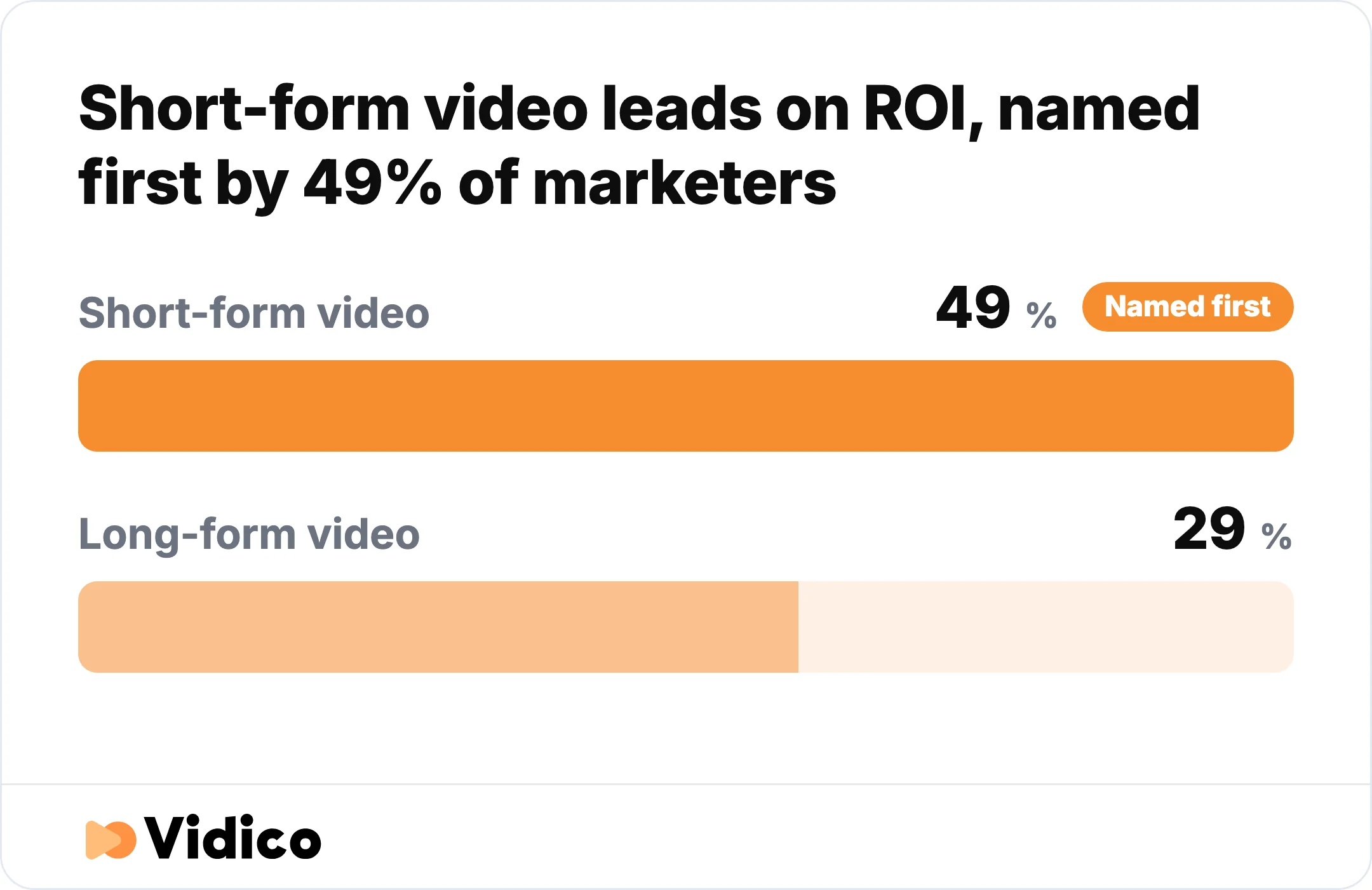
Short-form video, where most UGC lives, outranks long-form as the top ROI content format. Source: HubSpot marketing statistics.
The Four UGC Delivery Models
UGC work comes in four shapes, and knowing which one you need narrows the list fast.
- Self-serve marketplace. You brief creators directly and manage the output. Cheapest and fastest for volume, but the creative direction is on you. Billo is the clearest example.
- Managed shop. A done-for-you campaign: the agency sources, briefs, and delivers. Less work for you, priced per campaign. miniSocial and inBeat work this way.
- Platform. Software plus a creator roster, often with an optional managed layer. You get tooling and control. Cohley and Insense sit here.
- Managed creative partner. UGC runs as one engine inside ongoing creative production, alongside explainer, motion, and ad creative. This is the systematized option for B2B teams, and where our UGC Engine fits.
Three quick questions decide the model. What is your product and industry? Are you running organic content, paid ads, or both? And what is your monthly budget? A dropshipper testing ad creative wants a marketplace. A B2B SaaS team building a content program wants a partner. To see how teams build that program, our Scaling B2B Creative Masterclass walks through the system.
What UGC Agencies Cost
UGC pricing depends on the deliverable, usage rights, and buying model. Collabstr’s 2026 marketplace report recorded an average UGC asking price of $180 and an average actual payout of $154. These describe engagements on that marketplace, not a market-wide per-video average or the cost of a managed agency service.
For a concrete entry offer, Billo advertises basic creator videos from $99. That includes raw creator footage without captions, music, or graphics, two revisions within the brief, and full usage rights after approval. Product costs, shipping, and optional extras are additional. Longer videos, Premium creators, hooks, crops, and editing can change the total.
Billo separately advertises CreativeOps, a data tool, from $149/month and managed production from $2,000/month. Neither number is a per-video fee or a universal agency retainer. The dollar figures retain the provider’s published denomination; confirm billing currency before purchase.
Compare agency quotes using the same scope: unique videos, hooks, editing, creator sourcing, license terms, revisions, and management. Divide the total by complete finished videos only when the deliverables are equivalent.
How to Choose a UGC Agency: Criteria and Red Flags
Judge a UGC agency on five things: creator sourcing and vetting, content rights and licensing, production volume and turnaround, performance and ROAS measurement, and category experience. The last one matters most for B2B. An agency that only has skincare and supplement work in its portfolio will struggle to brief a creator on your software.
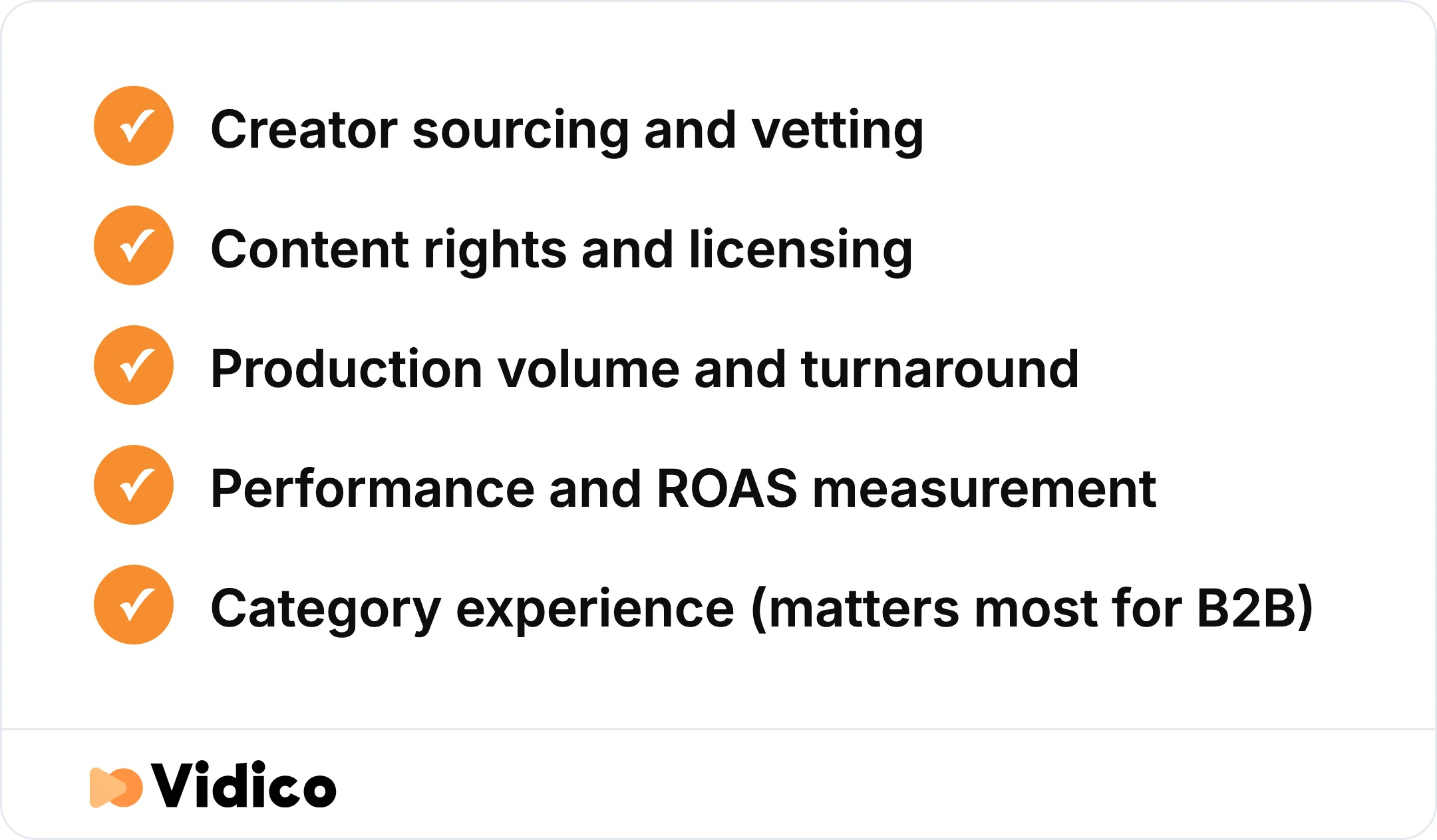
The five things to judge a UGC agency on. Category experience matters most for B2B.
On rights, confirm whether you own the content outright or license it for a window, and whether in-perpetuity use is included or an add-on. On measurement, ask whether the agency treats content as a testing system with reporting, or just hands over files.
The red flags are consistent: no clear rights terms, a portfolio that does not match your category, a one-off clip mindset with no testing or iteration, and vague pricing that turns into surprise add-ons like expiring credits or premium-creator surcharges. One more habit worth keeping: buyers often vet UGC agencies in community discussions and forums like Reddit, not just on vendor sites, so cross-reference independent experiences before you commit.
Why B2B SaaS UGC Needs a Different Approach
B2B SaaS UGC is a distinct craft, and most consumer-led agencies are not built for it. A skincare creator holds a product to the camera. A B2B creator has to demo software on screen, speak credibly to a marketer or developer, and carry content through a longer consideration cycle. The brief, the creator, and the testing all change.
The money is following this shift. In our 2026 State of Creative in Tech report, 76% of B2B tech marketers said their creative production budget is increasing this year, and paid-social video and customer-proof video tied as the highest-impact formats. Demand for B2B video content is rising, but the consumer-UGC playbook does not transfer cleanly.
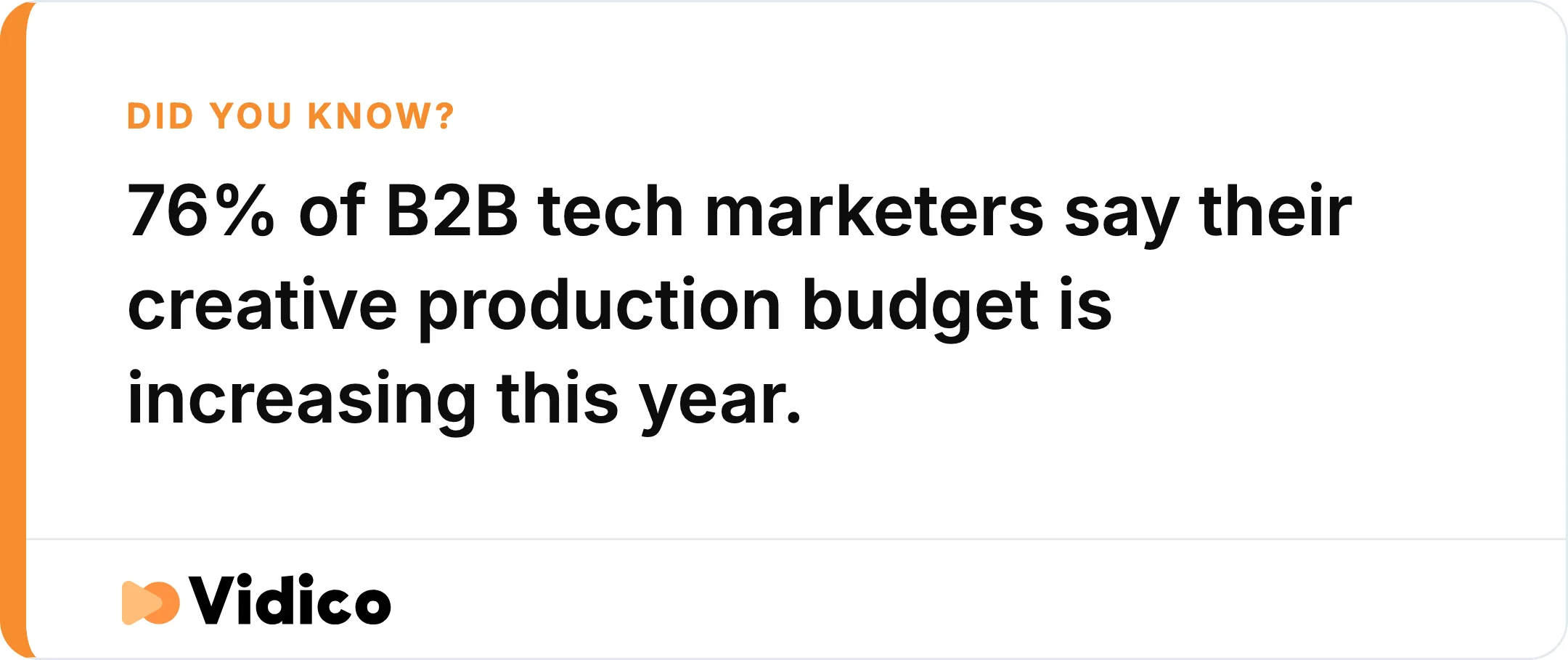
B2B creative budgets are growing, with paid-social and customer-proof video tied as the highest-impact formats. Source: Vidico 2026 State of Creative in Tech report.
This is why B2B teams tend to run UGC as part of a managed system rather than a standalone buy. When UGC is one output of an ongoing creative engine, it compounds. Reusable templates, 40-plus assets from a single shoot, and faster turnaround with each cycle. AI helps here too, but in a specific way: it speeds production, handling repetitive layers like variation and localization, while humans own the brief and every final deliverable.
The honest read is that the right choice depends on the job. For a B2B team building a content program, a managed creative partner like ours fits. If all you need is 30 cheap one-off clips fast, that is a different job than the one we solve. Not sure where you land? Our free Creative Intelligence Report analyzes your current creative and shows where the gaps are.
Frequently Asked Questions
What companies need UGC creators?
Brands that run paid or organic social at volume benefit most from UGC creators. That has traditionally meant DTC, ecommerce, and consumer apps, but B2B SaaS and tech companies are a fast-growing group as they shift ad spend toward authentic short-form video.
Is UGC still worth it in 2026?
Yes. UGC continues to drive measurable results, with featuring UGC lifting revenue per visitor by 154% according to Bazaarvoice. Short-form video, where most UGC lives, is also the top ROI format named by marketers, so the format underpinning UGC is still growing.
Who makes UGC?
Everyday creators and customers make UGC, not celebrities or large influencers. A UGC agency, marketplace, or managed partner sources and briefs these creators, then handles rights and delivery so the brand can run the content as ads or organic posts.
What is the best entry point for a brand new to UGC?
Start small with a focused test before committing to a system. A marketplace or a short managed campaign lets you learn what creative works for your product and audience, then scale into an ongoing program once you see which content drives results.
The Bottom Line
The best UGC agency is the one whose delivery model matches your product, your budget, and your buyer. The nine options above span self-serve marketplaces, managed shops, platforms, and managed creative partners, each built for a different job. B2B SaaS teams building an ongoing program need a different approach entirely, because showing software on screen is not the same job as a lifestyle clip.
That is the gap we built for. Vidico builds reusable video production systems for B2B teams, and UGC is one engine inside that system, not a one-off clip order, which is what lets the content compound in value over time. For teams that want UGC as part of ongoing creative production rather than a single campaign, that model does the heavy lifting.
If you are weighing your options, book a free strategy session and we will map the right creative model to your goals, whether that is UGC, explainer, or a full content program.