HeyGen and Synthesia are the two biggest names in AI avatar video. Both promise fast, cheap video production at scale. But they serve different buyers and prioritize different features.
HeyGen builds hyper-realistic avatars for marketing teams and creators. Synthesia builds polished, stable presenters for corporate training and L&D teams.
This comparison breaks down the real differences in features, pricing, hidden costs, and user satisfaction. It also covers the gap neither tool fills: when your video needs creative direction, brand strategy, or multi-format output that AI avatars can’t deliver.
Key Takeaways
- HeyGen wins on avatar realism. Its Avatar IV technology produces the most lifelike AI presenters available, but premium features consume 20 credits per minute, pushing real costs 40 to 60% above advertised prices.
- Synthesia wins on enterprise compliance. SOC 2 Type II, ISO 27001, and ISO 42001 certifications plus a slide-deck editor make it the default for corporate training teams.
- Hidden costs change the math for both. HeyGen’s credit system and Synthesia’s minute caps mean advertised prices rarely reflect what you’ll actually pay.
- Neither tool handles brand-quality campaigns. AI avatars work for training modules and social clips. Brand video, emotional storytelling, and multi-format campaigns still need professional production with human creative direction.
- User satisfaction depends on where you look. HeyGen scores 4.8 out of 5 on G2 but drops to 2.4 out of 5 on Trustpilot. Synthesia holds steady at 4.7 and 4.0 respectively.
Content
HeyGen vs Synthesia at a Glance
Both platforms create AI avatar videos, but they target different buyers and prioritize different capabilities. This table covers the core specs as of June 2026.
| Feature | HeyGen | Synthesia |
|---|---|---|
| Best for | Marketing, sales, creators | L&D, training, enterprise |
| Stock avatars | 700+ | 240+ |
| Languages | 175+ | 140+ |
| Editor style | Creative studio with timeline | Slide-deck (PowerPoint-like) |
| Max resolution | 4K (Business plan and above) | 1080p |
| Free tier | 3 videos per month, watermarked | 10 minutes per month, watermarked |
| Custom avatar | Included in paid plans | $1,000 per year add-on |
| SCORM export | All plans | Enterprise only |
| G2 rating | 4.8/5 (1,500+ reviews) | 4.7/5 (2,700+ reviews) |
| Trustpilot rating | 2.4/5 | 4.0/5 |
Avatar counts vary by source. HeyGen claims 1,100+ avatars on its own comparison page. Synthesia claims 662+ on its site. Independent reviews from G2 and other testing sites consistently report lower numbers for both platforms. The figures above reflect independent reviewer consensus.
The gap between vendor claims and independent counts is worth noting before you commit. HeyGen’s 1,100+ figure likely includes variations (different outfits, poses, and settings for the same base avatar). Synthesia’s 662+ may include avatars restricted to Enterprise plans. When evaluating either platform, test the free tier first and count how many avatars are actually available at your plan level.
Avatar Quality and Realism
HeyGen produces the most lifelike AI avatars available right now. Its Avatar IV technology uses a credit-heavy rendering process (20 credits per minute) to generate presenters that look close to real footage. In a hands-on test of 50 AI videos, three out of three testers believed Avatar IV output was recorded with a real person.

In a hands-on test of 50 AI videos, every tester mistook HeyGen’s Avatar IV for a real person. Source: BlogRecode 50-video test.
Synthesia’s Express-2 avatars take a different approach. They look polished, professional, and consistent across long-form content. For a 15-minute training module where the presenter needs to look stable and trustworthy the entire time, Synthesia’s avatars hold up better than HeyGen’s more expressive but occasionally inconsistent output.
Voice cloning highlights the gap between the two platforms. HeyGen supports voice cloning across multiple languages. Synthesia offers voice cloning in 32 languages. Both platforms handle lip-synced translation, but HeyGen’s lip-sync quality rates higher in independent reviews, scoring 5 out of 5 versus Synthesia’s 4.7 out of 5 on G2’s hands-on comparison.
Custom avatars tell a pricing story worth knowing before you commit. HeyGen includes custom avatar creation in paid plans (or charges a $99 one-time fee on lower tiers). Synthesia charges $1,000 per year as an add-on. For teams that need branded presenters, that cost difference compounds fast.
The uncanny valley hasn’t disappeared from either platform. AI-generated presenters still trigger artificiality detection in viewers, especially in dialogue-heavy or emotionally driven scenes. Simple everyday actions (a presenter gesturing while explaining a concept) create higher expectations than clearly stylized content, and that’s where the artificiality shows most. For training content and social clips where viewers expect a digital presenter, this matters less. For brand campaigns where emotional connection drives conversion, it matters a lot.
For broader data on how B2B teams view AI accuracy in creative production, Vidico’s 2026 State of Creative Marketing in Tech report found that accuracy is the number one AI risk concern among B2B tech marketing leaders, and the most protected output from AI is final copy. The takeaway: even teams using AI tools still draw a line at final deliverables.
Video Editor and Workflow
Synthesia’s editor works like PowerPoint. You build slides, add avatars, drop in text, and export. L&D teams adopt it quickly because they already think in slide decks. The learning curve is close to zero.
HeyGen’s editor is a creative studio with timeline editing, a built-in asset library, and AI Playground. AI Playground gives access to video generation models like Veo 3.1 and Sora 2 on higher-tier plans. More flexibility, but a steeper learning curve than Synthesia’s drag-and-drop approach.
AI Video Agents is HeyGen’s automation feature. It lets marketing teams set up automated video pipelines that generate content at volume: personalized sales outreach, product update announcements, localized ad variations. This feature consumes 20 credits per minute, same rate as Avatar IV.
Content updates favor Synthesia. Its text-swap feature lets teams update training content (changed policies, new product names, updated compliance language) without re-rendering the entire video. For L&D teams pushing quarterly updates across hundreds of modules, this saves significant production time.
Integrations split along audience lines. HeyGen connects to Zapier, HubSpot, Make, and n8n for marketing automation workflows. Its API lets developers build custom video generation pipelines, which makes it the better fit for teams automating personalized outreach at scale. Synthesia offers 30+ integrations focused on LMS platforms and enterprise toolchains with SAML SSO, SCIM provisioning, and role-based access control.
Content lifecycle management is a gap on both platforms. When a training module needs updating across 50 markets, or when a product launch campaign needs versioning for different audiences, neither tool has a built-in system for managing content libraries at scale. You’ll need external project management and asset management tooling on top of whichever platform you choose.
Language Support and Translation
HeyGen supports 175+ languages with one-click translation and lip-synced dubbing. Synthesia supports 140+ languages with voice cloning available in 32.
Both platforms handle Romance and Germanic languages well. Quality drops with tonal languages like Mandarin, Thai, and Vietnamese, where pitch carries meaning that avatar lip-sync struggles to reproduce accurately.
Translation costs add up on HeyGen. Video translation consumes 5 to 10 credits per minute. A 5-minute video translated into 5 languages could burn through 125 to 250 credits. On the Creator plan (200 monthly credits), that’s most of your allocation spent on a single multilingual project.
Synthesia’s translation works within your existing minute allocation. No extra credits, no surprise charges. You’re still limited by total minutes per month, but the pricing stays predictable.
Neither platform handles cultural adaptation. They translate words, not context. If your content needs localized examples, region-specific regulations, or culturally appropriate imagery, you’ll need human localization on top of the AI translation.
What You’ll Actually Pay
Pricing is where the comparison gets complicated. Both platforms advertise low entry points, but what you’ll spend depends on usage patterns, premium features, and team size.
HeyGen Pricing
| Plan | Monthly | Annual (per month) | Key Limits |
|---|---|---|---|
| Free | $0 | n/a | 3 videos, watermarked, 720p |
| Creator | $29 | $24 | Unlimited standard, 200 premium credits |
| Pro | $99 | $79 | 2,000 premium credits, API access |
| Business | $149 + $20/seat | n/a | 1,000 shared credits, 4K, SCORM, SSO |
| Enterprise | Custom | Custom | Custom allocations |
The credit trap is real. Avatar IV burns 20 credits per minute. On Creator (200 credits), that’s 10 minutes of premium avatar content per month. Users on review sites consistently report spending $50 to $150 per month on additional credit packs. In a hands-on test of 50 AI videos, the tester spent $384 for 50 minutes of Avatar IV content on HeyGen, compared to $95 for equivalent output on Synthesia.
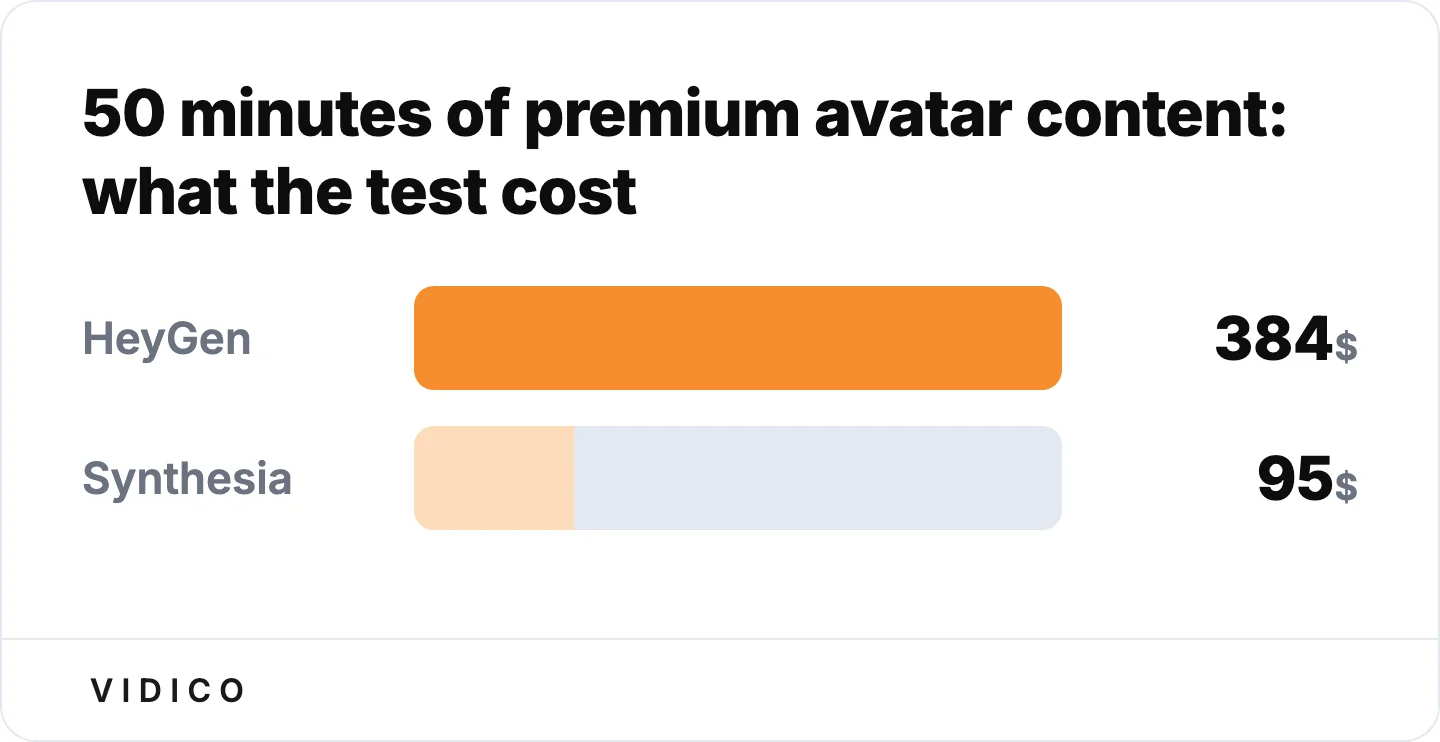
Same 50 minutes of premium avatar content, four times the bill on HeyGen once credits run out. Source: BlogRecode 50-video test.
Synthesia Pricing
| Plan | Monthly | Annual (per month) | Key Limits |
|---|---|---|---|
| Free | $0 | n/a | 10 min, 9 avatars, watermarked |
| Starter | $29 | $18 | 10 min, 125+ avatars |
| Creator | $89 | $64 | 30 min, 180+ avatars, interactive video |
| Enterprise | Custom | Custom | Unlimited min, 240+ avatars, SCORM, SSO |
Minute caps are hard limits with no rollover. Custom avatars cost $1,000 per year as an add-on, regardless of plan tier. Prices reflect publicly listed rates as of June 2026.
What You’ll Spend Over 12 Months
For a solo marketer producing 10 premium avatar videos per month, annual costs run roughly $1,200 to $2,400 on HeyGen (factoring in credit packs) versus $770 to $1,070 on Synthesia. The gap widens the more you rely on premium features like Avatar IV and lip-synced translation.
For a 25-person L&D team, total cost of ownership ranges from $7,500 to $25,000 per year on either platform, depending on usage volume and enterprise feature requirements. At this team size, per-seat pricing on HeyGen’s Business plan ($149 base + $20 per additional seat) adds up fast. Synthesia’s Enterprise pricing is custom-quoted, so you’ll need to negotiate for a number.
The mid-market gap is real. Companies with 15 to 30 users on either platform fall into a pricing dead zone. HeyGen optimizes for solo creators and small teams. Synthesia optimizes for Fortune 500 procurement. If your team is in between, expect to negotiate custom pricing or overpay on a plan designed for a different buyer.
For context on how B2B teams are allocating video production budgets more broadly: in a 2026 survey of 230+ B2B tech marketers, 42.7% reported putting 21 to 35% of their total marketing budget into creative production, and 27.4% named budget as their single biggest constraint.
Before committing to an annual plan on either platform, build a video marketing plan that maps your content needs to realistic production costs.
Enterprise Security and Compliance
Synthesia leads on certifications. SOC 2 Type II, ISO 27001, ISO 42001 (the AI management standard), GDPR, CCPA, SAML SSO, SCIM provisioning, and role-based access control are all available on Enterprise plans.
HeyGen covers the baseline. SOC 2, GDPR, and CCPA compliance. SSO is available on Business plans and above. Its advantage: SCORM export is included on all paid plans, where Synthesia restricts SCORM to Enterprise.
Neither platform offers HIPAA BAA. Healthcare organizations and regulated industries that need a Business Associate Agreement will find a gap on both platforms. This is a non-starter for any video content containing protected health information.
Commercial usage rights differ in ways most buyers miss. HeyGen grants full commercial rights on all paid plans. Synthesia restricts the use of stock avatars in paid advertising campaigns. If you’re making ad creative with AI avatars, check the terms before you commit.
AI governance is still an open question for most teams. When we surveyed 230+ B2B tech marketing leaders earlier this year, fewer than 3 in 10 had a formalized AI governance policy. Nearly half were still building one. Accuracy ranked as the top AI risk concern, ahead of brand safety and legal liability.
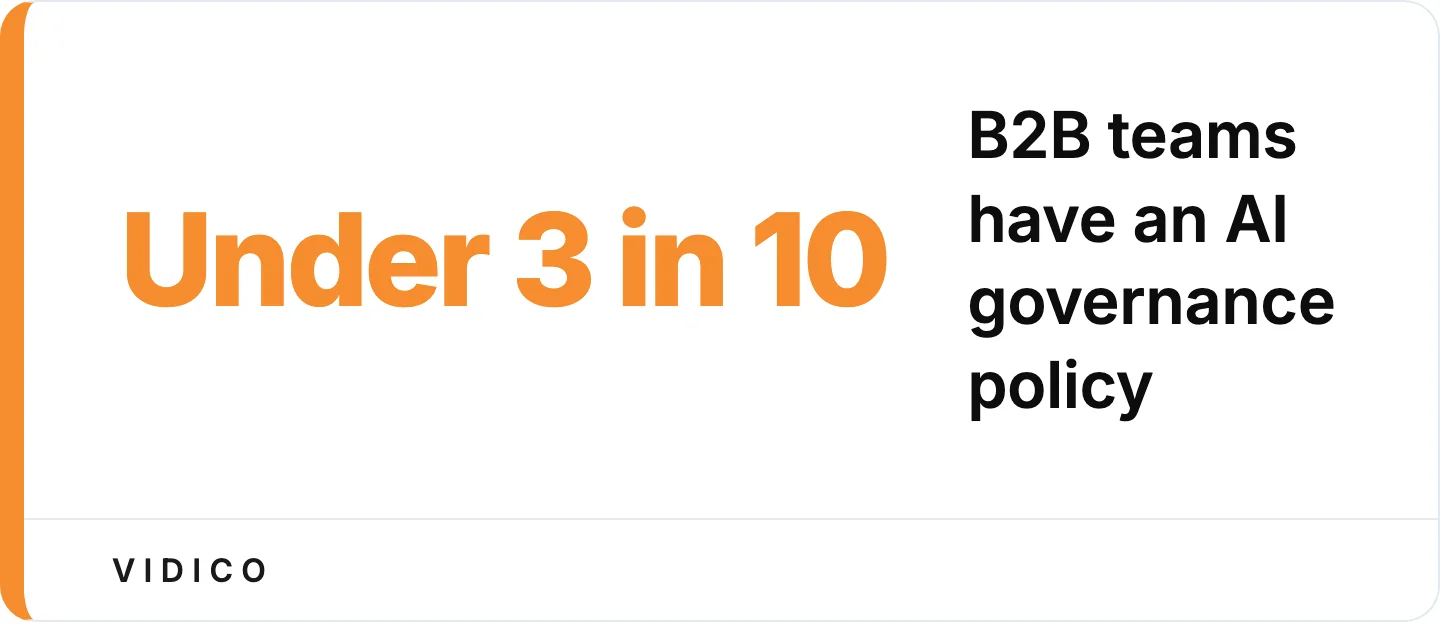
AI video at scale is outpacing the guardrails. Source: Vidico 2026 survey of 230+ B2B tech marketing leaders.
If your team produces AI-generated video at scale without a governance framework, both platforms expose you to brand risk and regulatory uncertainty. This is especially true for customer-facing content: an AI avatar mispronouncing a product name or delivering a compliance statement with the wrong emphasis creates a trust problem no platform feature can fix.
User Satisfaction: What G2 and Trustpilot Show
HeyGen and Synthesia score within 0.1 points of each other on G2, but Trustpilot ratings diverge sharply.
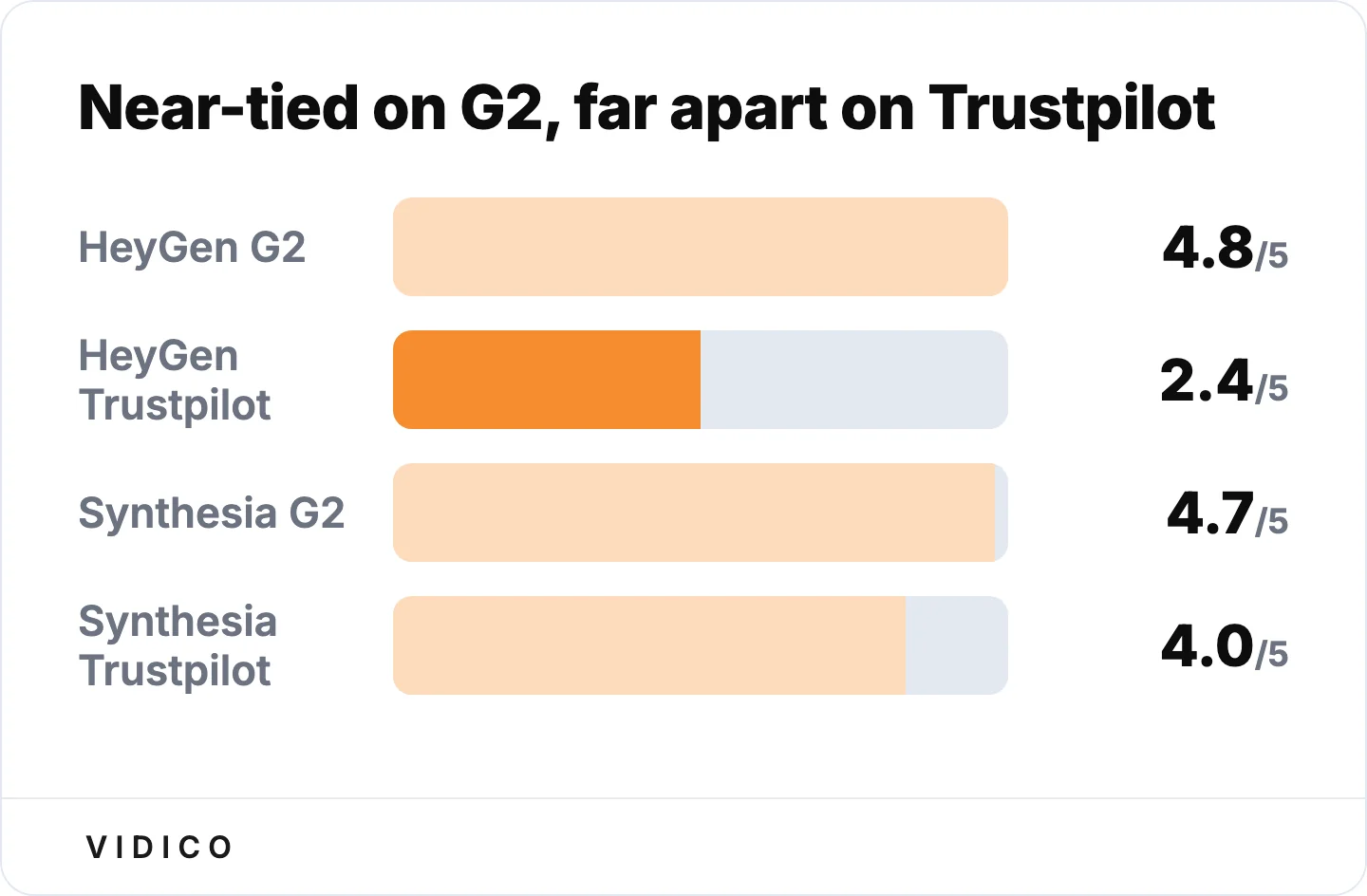
HeyGen’s rating collapses on Trustpilot, where billing and support complaints surface. Source: G2 and Trustpilot at time of check.
G2: HeyGen holds a 4.8 out of 5 rating from 1,500+ reviews. Synthesia scores 4.7 out of 5 from 2,700+ reviews. Near parity, with both platforms rated highly by active users.
Trustpilot: HeyGen drops to 2.4 out of 5, with 80% negative reviews from 1,613 responses at time of check. Synthesia holds at 4.0 out of 5.
What drives the HeyGen complaints? The most common themes across negative Trustpilot reviews: slow customer support with generic responses, difficult refund processes (especially for annual plans), and unexpected charges from the credit system. Several reviewers reported being charged for credit packs they didn’t intentionally purchase. These are billing and support issues, not product quality issues, but they affect the overall experience.
Why the gap between review platforms? G2 attracts satisfied power users who voluntarily submit reviews, often incentivized by G2’s review campaigns. Trustpilot catches frustrated users who proactively seek out a platform to report billing issues or support problems. Both signals are real. A product can be strong while the billing and support experience creates friction.
The takeaway for buyers: test both platforms on free tiers before committing to annual plans. Pay monthly for the first quarter and evaluate the support experience alongside the product itself.
If you’re weighing your video production options more broadly, a Creative Intelligence Report gives you a free competitive analysis of how your current video approach compares to others in your space.
When to Choose HeyGen
Pick HeyGen if:
- You need hyper-realistic avatar videos for marketing, sales outreach, or social content
- Your team creates short-form content at volume (ads, personalized videos, product updates)
- You want 4K video output
- You need API access and marketing automation integrations (Zapier, HubSpot)
- Your team is small (1 to 5 people) and comfortable managing a credit-based system
- You want to experiment with generative video through AI Playground
Watch out for: credit burn on premium features, Trustpilot-documented support friction, and the learning curve of the creative studio editor.
When to Choose Synthesia
Pick Synthesia if:
- You’re building corporate training, onboarding, or compliance video
- You need a slide-deck-style editor your L&D team can use without training
- Enterprise security certifications are required (SOC 2 Type II, ISO 27001, ISO 42001)
- You want predictable minute-based pricing without credit surprises
- Your content needs frequent text-swap updates for policy changes or product updates
- SCORM export and LMS integration are non-negotiable (requires Enterprise plan)
Watch out for: minute caps that limit output volume, the $1,000 per year custom avatar pricing, and SCORM being locked behind Enterprise tier.
When Neither AI Tool Is Enough
HeyGen and Synthesia are strong tools for specific jobs. But they share a common ceiling that no settings toggle or plan upgrade can fix.
Brand video needs creative direction. A 90-second brand film, a product launch campaign, a fundraising video for a Series B raise. These need a creative brief, concepting, storyboarding, and a human creative director who knows the brand. AI avatars execute templates. They don’t create strategy.
Multi-format campaigns need more than one output. AI avatar tools produce one video at a time. Professional production creates 40+ assets from a single shoot: hero video, social cutdowns, ad variations, GIFs, email assets, and landing page content. The cost per asset drops dramatically when you plan for multi-format output from the start.
Ongoing production at scale gets cheaper with systems, not credits. If you need 20+ videos per month across multiple formats, a subscription-based production partner with reusable template systems delivers lower cost per asset over time. The first project builds the templates. Every project after that is faster and cheaper. It’s the same principle that makes HeyGen and Synthesia attractive (repeatability), applied at a higher quality level with human creative oversight.
Regulated industries without full compliance coverage. Neither HeyGen nor Synthesia offers HIPAA BAA. Healthcare, finance, and legal teams with strict compliance requirements need a production partner that can work within those constraints, not a self-service platform that hasn’t closed the compliance gap.
At Vidico, we produce B2B explainer videos and campaign content for SaaS and tech teams, with 2,000+ campaigns shipped for brands like Square, Spotify, and NinjaOne. When NinjaOne partnered with us for a multi-format video campaign, the results hit 66.6M views and drove 1.42M clicks across channels. AI is part of how we work. We use it for the repetitive production layer: localization, repurposing, and variation testing. Humans own the brief and every final deliverable.
In our 2026 State of Creative report, B2B tech marketers said AI works best mid-process, for editing and repurposing. The most protected output from AI? Final copy.
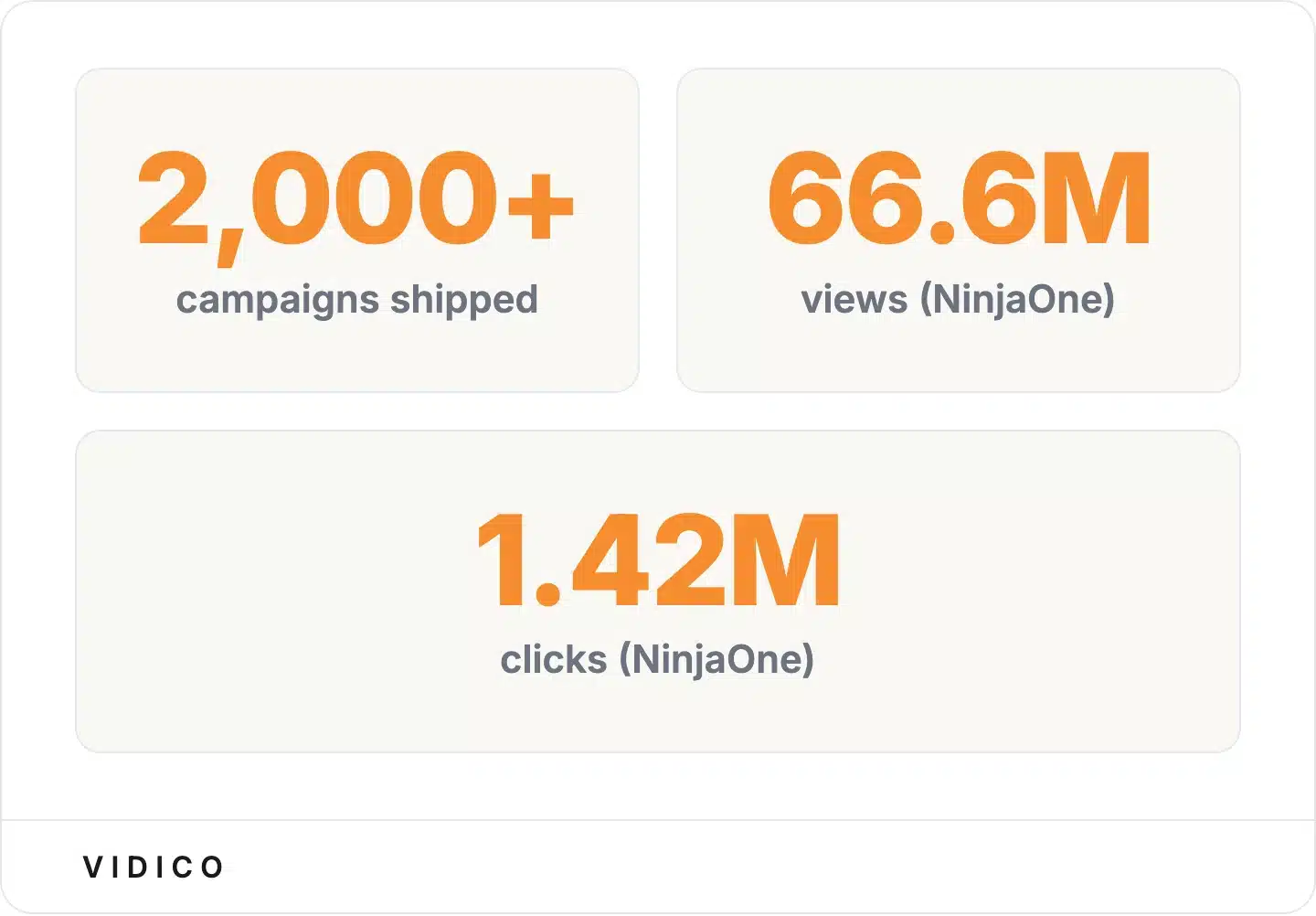
What multi-format production with human creative direction delivers. Source: Vidico NinjaOne case study.
If your video needs go beyond what a DIY tool can deliver, book a free strategy session to map out what a production system looks like for your team.
Also read: Top Synthesia Alternatives
Frequently Asked Questions
Is HeyGen or Synthesia better?
Neither is universally better. HeyGen produces more realistic avatars and offers more creative flexibility for marketing and sales teams. Synthesia provides stronger enterprise compliance, a simpler editor, and predictable pricing for L&D teams. The right choice depends on whether you’re making marketing content (HeyGen) or training and onboarding videos (Synthesia). For brand-quality video that needs creative direction and multi-format output, both platforms have limitations that professional production solves.
How much does HeyGen actually cost per month?
Advertised prices start at $24 per month on the Creator annual plan. But Avatar IV features consume 20 credits per minute, and the Creator plan includes only 200 credits. Most users spend an additional $50 to $150 per month on credit packs, bringing real monthly costs to $75 to $175 for premium content. Budget 40 to 60% above the listed price for realistic usage.
Is there a free alternative to Synthesia?
Both HeyGen and Synthesia offer free tiers. HeyGen gives 3 watermarked videos per month at 720p. Synthesia offers 10 minutes per month with 9 avatars, also watermarked. Neither free tier is suitable for commercial use due to watermarks and limited avatar selection.
Can AI video tools replace professional video production?
For training modules, personalized sales outreach, and social media clips, AI avatar tools are a practical choice. They’re fast, affordable for repeatable content, and improving every quarter. For brand campaigns, product launches, emotional storytelling, and multi-format B2B video marketing needs, professional production delivers results that AI avatars can’t match. The choice depends on the video’s purpose, audience expectations, and the brand standards you need to maintain.
What is the most realistic AI avatar generator?
HeyGen’s Avatar IV is the most realistic AI avatar technology available as of 2026. In independent testing, reviewers couldn’t distinguish Avatar IV output from real footage. The tradeoff is cost: Avatar IV consumes 20 premium credits per minute, making it significantly more expensive than standard avatars on either platform. Synthesia’s Express-2 avatars prioritize stability and polish over raw realism, which makes them better suited for long-form training content where consistency matters more than lifelikeness.
Is HeyGen really unlimited?
HeyGen’s Creator plan includes “unlimited” standard videos, but premium features are credit-gated. Avatar IV, video translation, and AI Video Agents all consume premium credits from your monthly allocation (200 credits on Creator, 2,000 on Pro). Once your credits are spent, you’ll need to buy additional credit packs or wait for the next billing cycle. “Unlimited” applies to standard-quality avatars only.
Final Thoughts
HeyGen and Synthesia are the two strongest AI avatar video platforms in 2026. They’re real tools that solve real problems for the right buyer.
Choose HeyGen for marketing and sales content where avatar realism and creative flexibility matter. Budget for credits beyond the plan price.
Choose Synthesia for corporate training and L&D where compliance, simplicity, and predictable pricing matter. Plan for minute caps and enterprise-tier gating on features like SCORM.
Both tools excel at template-based, repeatable content. They replace expensive per-project work for training videos, social clips, and personalized outreach. But they share a ceiling: no creative direction, no brand strategy, no multi-format output, no emotional storytelling.
Vidico is a B2B explainer video company built for ongoing creative production, with 920+ clients across SaaS, finance, and enterprise. We use reusable templates so every campaign ships faster than the last, and AI speeds our production while humans own the brief and every final deliverable. EverString saw 1.8M on-site views and a 27% increase in customer signups after launching with us. If you need a video that goes beyond what a DIY tool can deliver, talk to us about what that looks like.