A VSL (video sales letter) is a scripted video that pitches one offer and asks the viewer to take one action, such as buying a product, booking a call, or signing up. It does the job a long text sales page used to do, but as a video: it walks a prospect through a problem, presents a solution, and builds enough trust to prompt a decision.
In marketing, “VSL” almost always means video sales letter. The same three letters mean other things in shipping and engineering, but those are unrelated. This guide explains what a VSL is, why it works, what goes into the script, the main formats, and how long one should run.
Key Takeaways
- A VSL is a one-goal sales video. It pitches a single offer and drives a single action, replacing a text-heavy sales page with a scripted video.
- The script carries the conversion, not the production. A strong VSL moves through a hook, the problem, your solution, proof, the offer, and a clear call to action.
- Length follows the offer. A VSL can run from under a minute for a social cut to about 30 minutes for a detailed offer, and a short, tight VSL beats a long, repetitive one.
- Video is where marketing budgets are going. US digital video ad spend is set to pass $80 billion in 2026, up 11% year over year (Interactive Advertising Bureau).
- AI can speed the draft, not the decisions. The offer, the story, and the hook still decide whether a VSL converts.
Content
What Does VSL Mean in Marketing?
VSL stands for video sales letter. It is a promotional video built to pitch an offer and persuade the viewer to act, whether that action is a purchase, a demo booking, or an email signup.
A VSL works like an automated sales conversation. Instead of a rep talking a prospect through a problem and a solution, the video does it the same way every time, at any hour, for any number of viewers. That is why VSLs sit on landing pages, in email sequences, and inside paid funnels.
A VSL is the video version of a text sales letter, sometimes called a TSL. The persuasion structure is the same. The delivery is different: video controls the pace, adds a face and a voice, and holds attention in a way a wall of text rarely does.
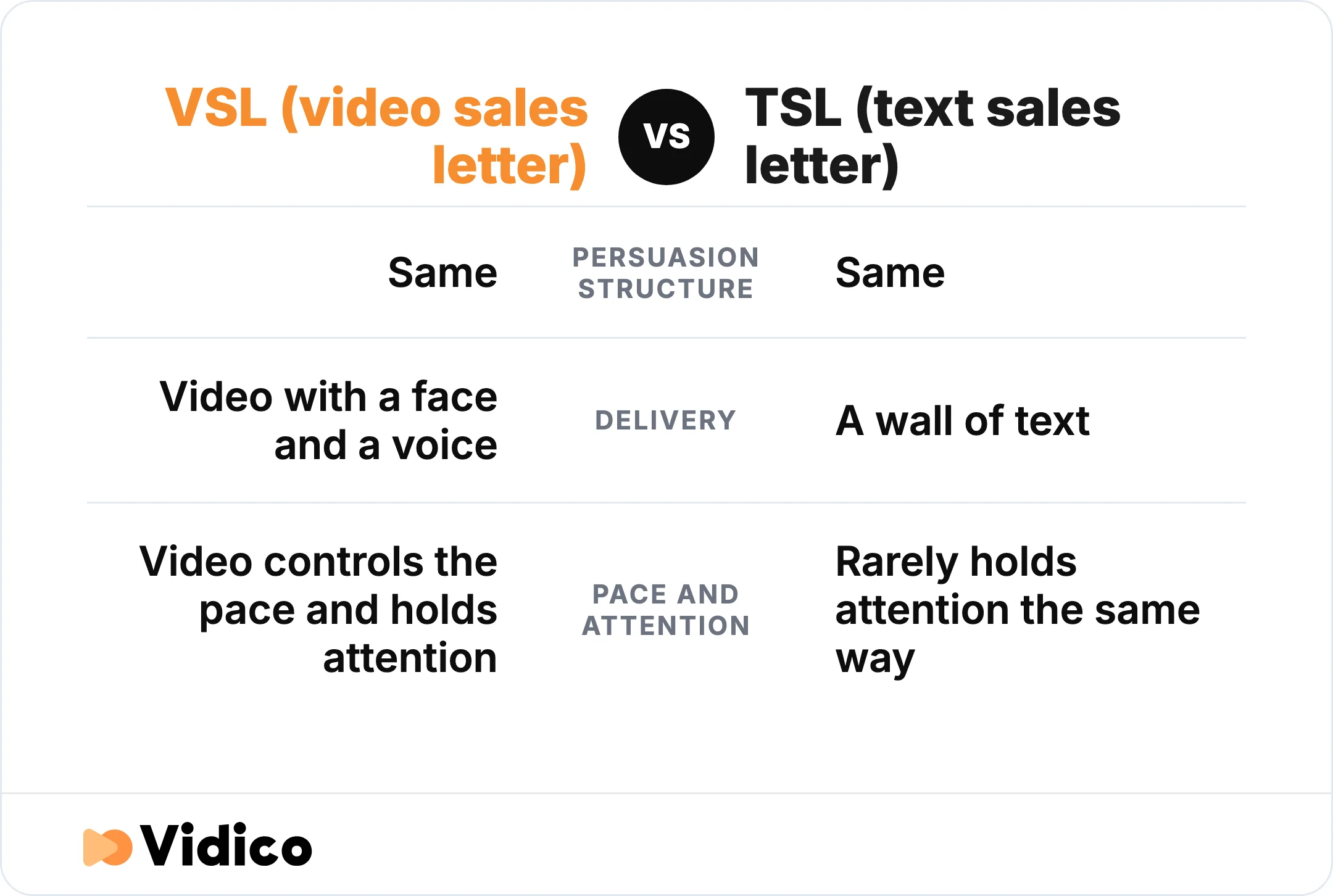
A VSL is the video version of a text sales letter (TSL): the persuasion structure is the same, the delivery is different.
Why VSLs Work
VSLs work because they combine the persuasion of a sales letter with the attention and trust that video earns. Three jobs sit at the center of every effective VSL:
- Explain. A VSL shows how a product or method actually works, not just what it is. Motion, screens, and narration make a hard-to-grasp offer easy to follow in a couple of minutes.
- Build trust. Storytelling, customer proof, and a real voice cut the skepticism that stops a sale. Seeing and hearing a message lands differently than reading it.
- Drive action. A VSL ends on one clear call to action, so the viewer knows exactly what to do next.
The pull toward video is not subtle. US digital video ad spend is set to pass $80 billion in 2026, growing 11% year over year, according to the Interactive Advertising Bureau. Marketers see the returns, too: the three highest-ROI content formats are all video, led by short-form video at 49%, and 93% of marketers call video an important part of their strategy, per HubSpot.
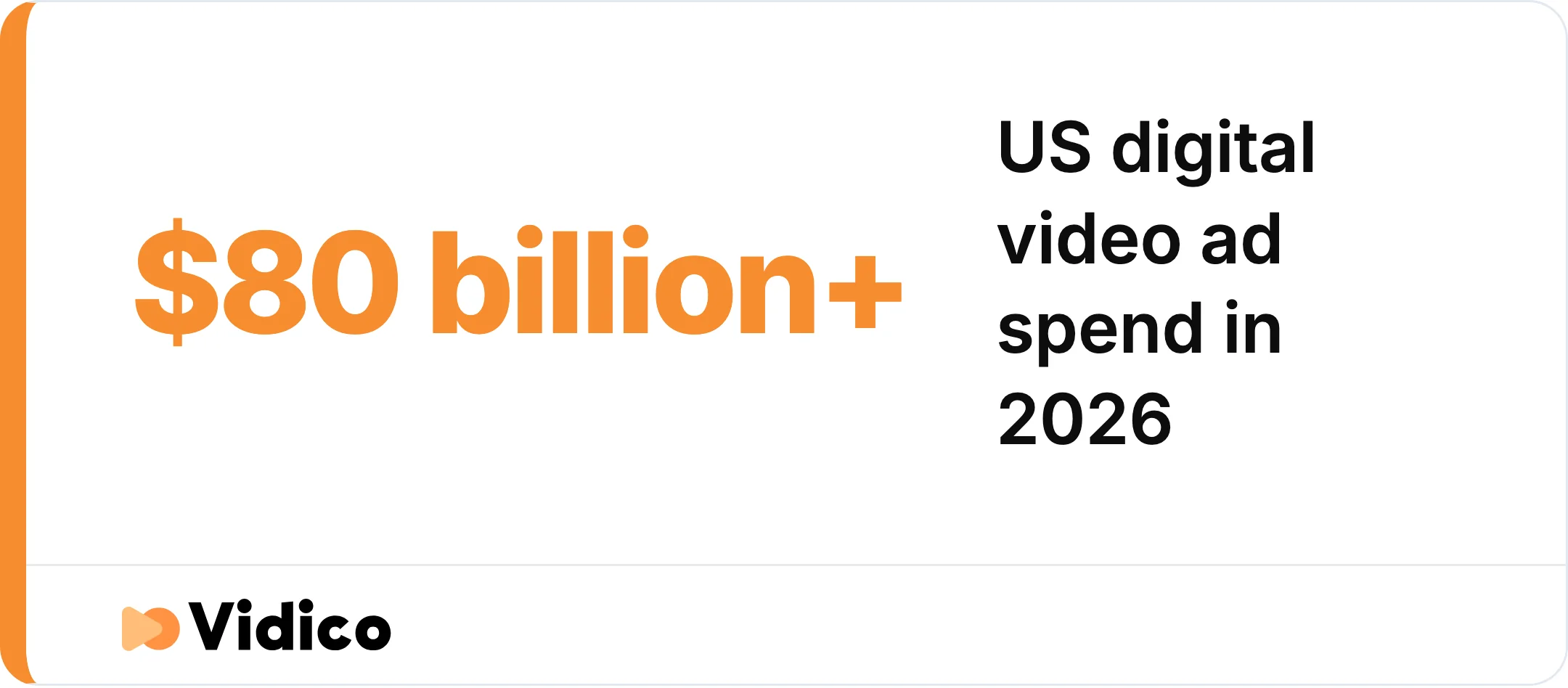
US digital video ad spend is set to pass $80 billion in 2026, growing 11% year over year. Source: Interactive Advertising Bureau.
The Anatomy of a High-Converting VSL
A high-converting VSL follows a script structure built for persuasion. Each beat has one job, and the order matters as much as the words.
- Hook. Open with a pattern interrupt in the first few seconds: a sharp question, a surprising fact, or the exact problem the viewer feels. Lose them here and the rest never gets watched.
- Problem and agitation. Name the problem clearly, then show what it costs the viewer to leave it unsolved.
- Solution and mechanism. Introduce your product as the fix and explain the mechanism, the reason it works, not just the feature list.
- Proof and credibility. Back the claim with customer results, testimonials, data, or recognizable names. This is where skepticism drops.
- Offer and value. Spell out what the viewer gets and why it is worth more than the price.
- Scarcity and urgency. Give an honest reason to act now, such as a limited window or a time-bound bonus.
- Call to action. Ask for one action, stated plainly, with no ambiguity about the next step.
- Close and reinforcement. Restate the core benefit and the action so the last thing the viewer hears is the reason to move.
Storytelling is the thread that ties these beats together. Our roundup of storytelling video examples shows how brands build that narrative arc, and our explainer video script examples break down how the words map to what is on screen.
How to Create a VSL, Step by Step
Creating a VSL comes down to six steps, from a single goal to a published, tested video.
- Set one goal and know your audience’s awareness. Decide the single action the VSL should drive, then match the message to how much the viewer already knows about the problem and your product.
- Write the script first. The script is the VSL. Draft it before you think about cameras or software, using the anatomy above as your outline. Our video creative brief template helps you lock the message before production starts.
- Choose the format. Pick the format that fits the message and budget: talking head, slides with voiceover, animated explainer, or a hybrid.
- Produce the video. Record or animate, add visuals that support the script, and keep the pacing tight. Clean audio matters more than fancy effects.
- Publish it where the decision happens. Place the VSL on a dedicated landing page, in an email sequence, or in a paid funnel, and match the cut to each platform.
- Track and optimize. Watch view-through rate, engagement, and conversion, then test the hook, the offer, and the CTA to lift results over time.
VSL Formats and How Long a VSL Should Be
The right VSL format depends on your offer, your audience, and your budget. These are the formats marketers use most.
| Format | What it is | Best for | Typical length |
|---|---|---|---|
| Talking head | A presenter speaks to camera | Personal brands, coaches, and founders selling on trust | 5 to 30 minutes |
| Slides with voiceover | Narrated slides or text with simple motion | Fast, low-cost tests and information-heavy offers | 3 to 20 minutes |
| Animated explainer | Motion graphics or 2D/3D animation | SaaS and complex products that need a clear visual | 1 to 3 minutes |
| Hybrid | A mix of presenter, screen recording, and animation | Product demos that also need a human voice | 2 to 10 minutes |
| Short-form social | A condensed VSL cut for feeds | Paid social and top-of-funnel awareness | Under 60 seconds |
How long should a VSL be? As long as it needs to be to make the sale, and no longer. A VSL can run from under a minute for a short social cut to about 30 minutes for a detailed offer. A high-priced or complex offer usually needs more time to build the case, while a simple, low-cost offer can convert in a couple of minutes. Length is not the goal, holding attention is. A tight VSL beats a long, repetitive one every time.
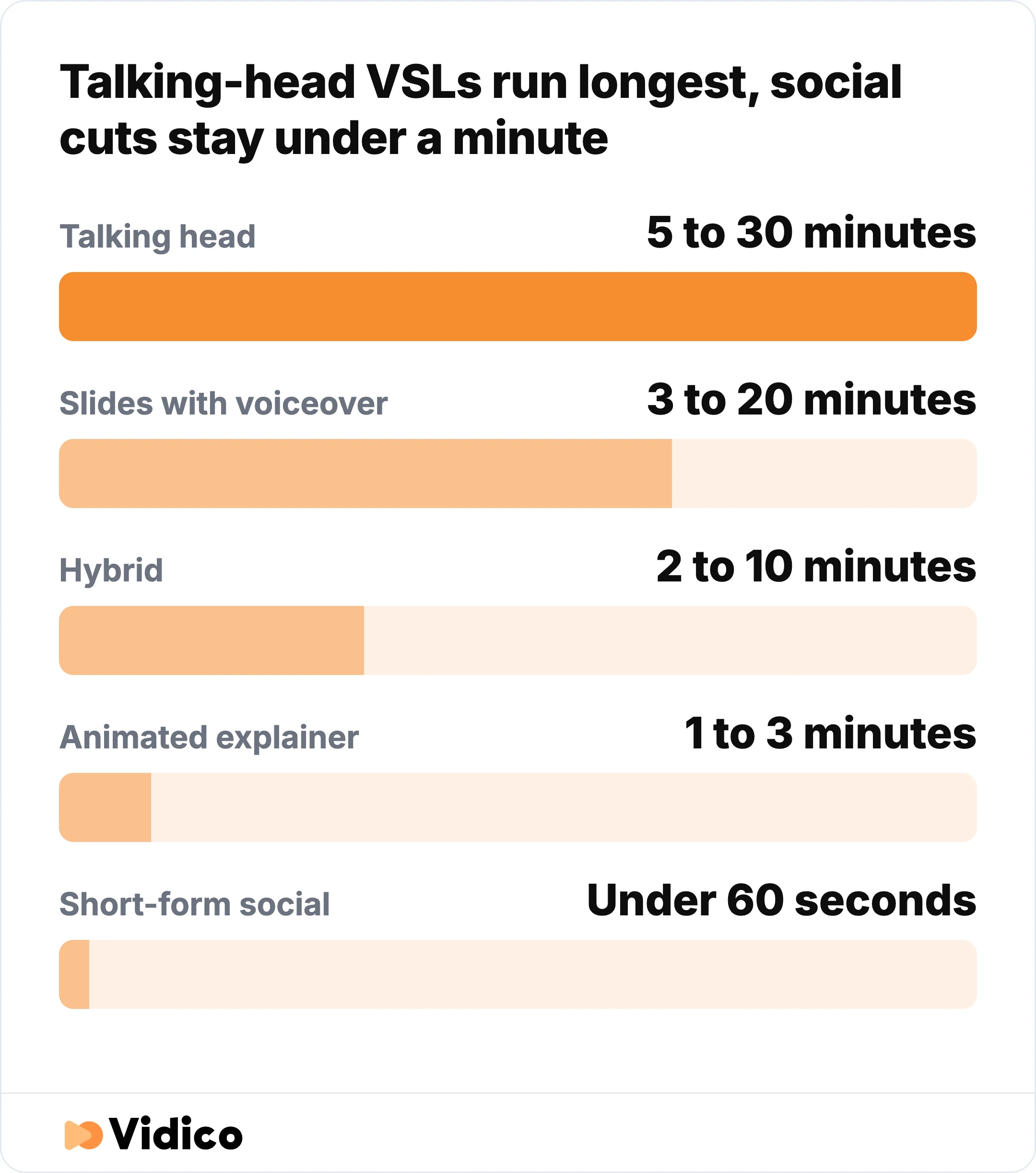
Talking-head VSLs run 5 to 30 minutes, while animated explainers run 1 to 3 minutes and short-form social cuts stay under 60 seconds.
Tips for a High-Converting VSL Script
A few habits separate a VSL that converts from one that loses viewers early.
- Win the first few seconds. Open with a hook that names the problem or promises a clear payoff. Short-form video is now the most-used format among marketers, at 29.18%, per HubSpot, so viewers are trained to judge fast.
- Sell benefits, not features. Explain how the product changes the viewer’s day, then use features as the proof.
- Tell one story. Use a single customer story or scenario the viewer recognizes, rather than a list of use cases.
- Make the CTA impossible to misread. Tell the viewer exactly what to do and the reason to act today.
- Answer objections before they surface. Name the doubt the viewer is already having and address it head-on.
- Match visuals to the script. Every visual should support a line in the script, not decorate it.
Tools and AI for Making a VSL
You can produce a VSL with a small toolset: a script document, a screen or camera recorder, a video editor, and a place to host and track the video.
For a DIY or budget build, marketers commonly script in a doc, record with screen-capture or camera tools, edit in standard video software, and host on YouTube or Vimeo with analytics to track performance. These tools get a first version live quickly and are a fine starting point.
AI is now part of many VSL workflows. 56% of marketers use AI to create short-form video, according to HubSpot. AI can speed up scripting, rough cuts, subtitles, and localized versions. It does not replace the two things that decide whether a VSL converts: a clear offer and a story worth watching. We use AI for the repetitive layer while a human owns the brief and every final cut.
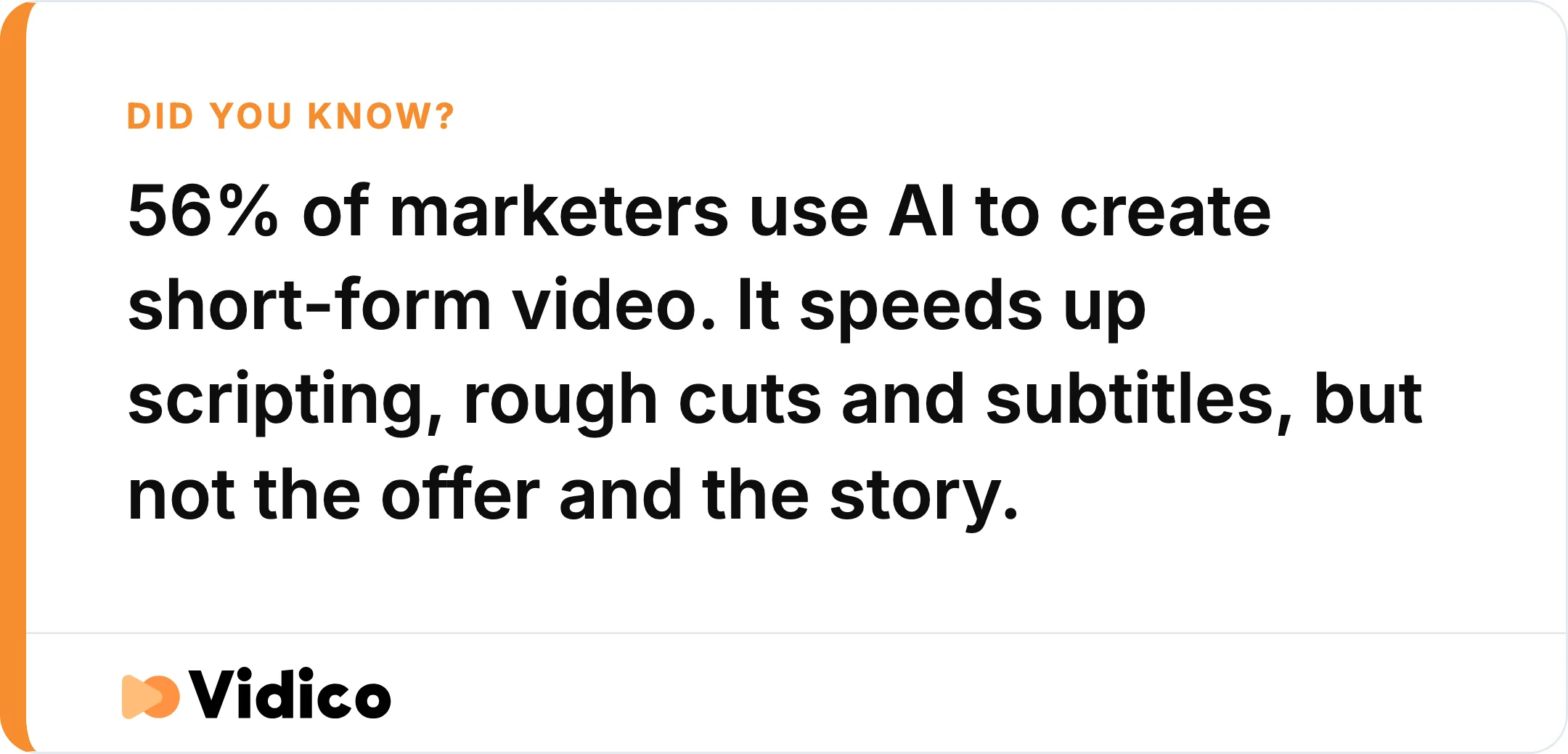
56% of marketers use AI to create short-form video, but the offer and the story still decide whether a VSL converts. Source: HubSpot.
What a Conversion-Focused Sales Video Looks Like
A VSL earns its place when it moves a real metric. Here is what that looks like in practice.
We built Vidico to produce B2B explainer and sales videos for SaaS and tech brands, turning one shoot into 40-plus assets across a brand’s channels. When EverString needed a sales-focused explainer, the video drove a 27% increase in customer signups and held 82% viewer retention. For HoneyBook, an A/B test of the video lifted waitlist signups by 9%. You can watch the EverString explainer to see how a sales video paces a problem, a solution, and a clear next step.
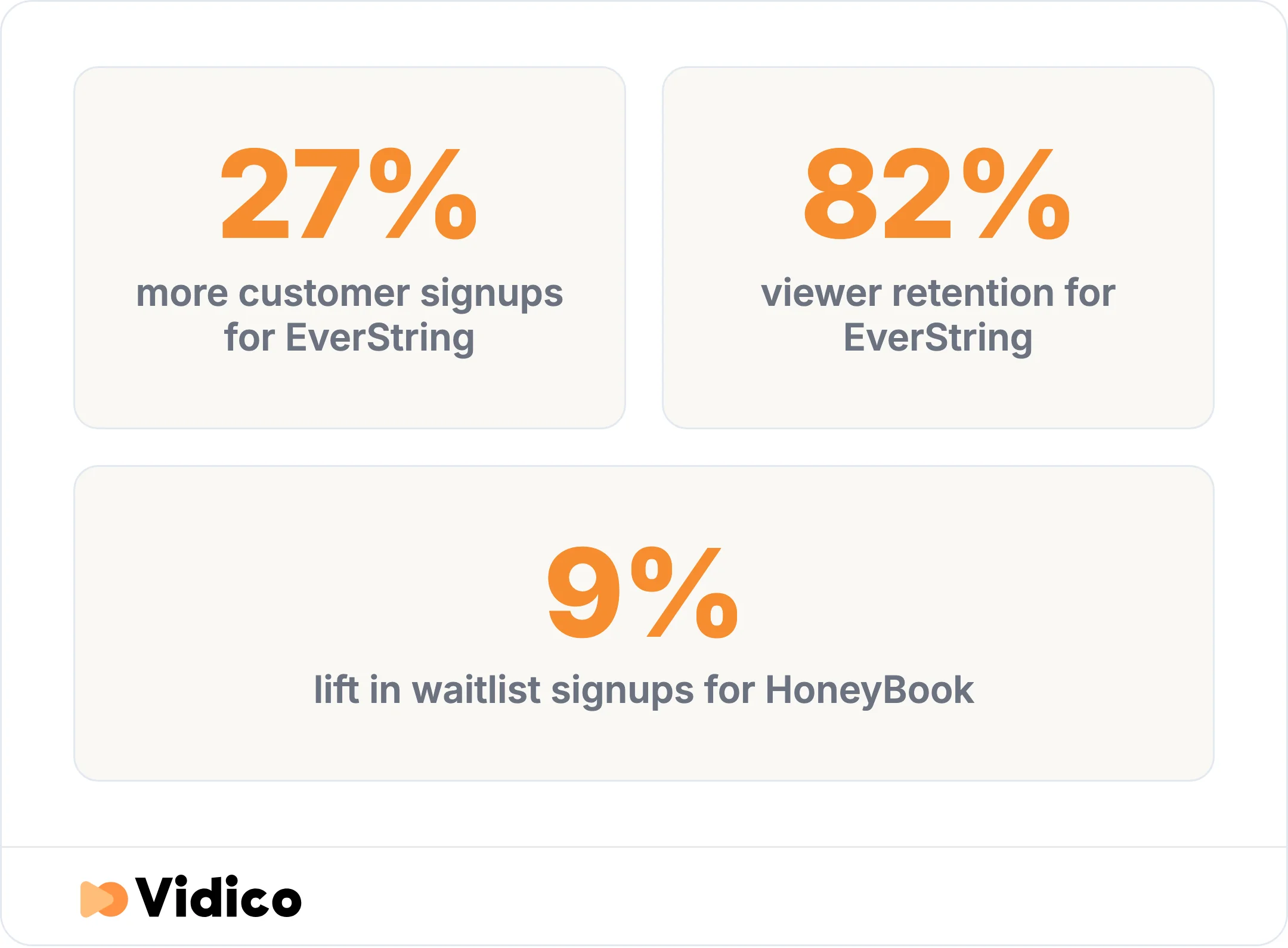
EverString’s sales-focused explainer drove a 27% increase in customer signups with 82% viewer retention, and HoneyBook’s A/B-tested video lifted waitlist signups by 9%.
In our latest State of Creative report, a survey of more than 230 B2B tech marketers, customer-proof video and paid social video ranked as the highest-impact formats for the year. If you want a read on where your own video is winning or losing before you invest, our Creative Intelligence Report gives you a free competitive analysis with 48-hour delivery.
VSL FAQs
What does VSL stand for?
VSL stands for video sales letter. It is a scripted video that pitches an offer and asks the viewer to take one action, such as buying a product or booking a call.
What is a VSL used for?
A VSL is used to sell a product or service through video, usually on a landing page, in an email sequence, or inside a paid funnel. It replaces or supports a text sales page and works around the clock.
How long should a VSL be?
A VSL should be as long as it needs to be to make the sale. It can run from under a minute for a short social cut to about 30 minutes for a detailed offer, with higher-priced or complex offers needing more time and simple offers converting faster.
What is a VSL funnel?
A VSL funnel is a sales path built around a video sales letter. A viewer arrives from an ad or email, watches the VSL on a landing page, and is guided toward one action, such as a purchase or a booked call.
What is a VSL script?
A VSL script is the written narrative that guides the video: the words, the order of the beats, and the cues for visuals. The script does the persuading, so it is written and refined before any filming or animation begins.
The Bottom Line
A VSL is a scripted video that makes one argument and asks for one action. It works because it pairs the persuasion of a classic sales letter with the trust and pace of video, and it keeps selling on a landing page long after it is published. The script is what converts, so build it around a clear hook, a real problem, a believable solution, and an honest call to action.
We produce B2B explainer and sales videos for SaaS and tech brands, with 2,000-plus campaigns and 1.5 billion-plus views behind our work. If you are weighing a VSL for your next launch, our pricing quiz gives you a video recommendation and a cost range to plan your budget.