
Artificial intelligence is now standard equipment in marketing. As of 2026, 88% of organizations report using AI in at least one business function, and 88% of marketers say they rely on it in their day-to-day work. The harder truth sits underneath those numbers: near-universal adoption has not produced near-universal results, only about 1% of companies call their generative AI investment mature, and consumers are starting to push back on content that feels machine-made.
At Vidico, we build explainer video and creative systems for SaaS and tech teams, and we ran the 2026 State of Creative in Tech report, a survey of 230+ marketing leaders, to map exactly this shift. This page pulls together 73 statistics on AI in marketing, grouped by theme and each sourced and attributed to a named publisher, so you can cite the number you need without hunting for it.
Key Takeaways
- Adoption is near-universal, maturity is rare. 88% of organizations use AI in at least one function, but only about 1% describe their generative AI investment as mature.
- Content creation is the top use case. 55% of marketers name content creation as their most common application of AI.
- The market is scaling fast. AI-in-marketing revenue sat near $47 billion in 2025 and is projected to reach $107 billion by 2028.
- The productivity gains are real but uneven. Marketers using AI report saving roughly 11 to 13 hours a week and measurable jumps in output.
- The market is turning on AI slop. 97% of companies edit or review their AI-generated content, and a human-led minimum is becoming the standard buyers expect.
AI Marketing Adoption Statistics
AI adoption in marketing has crossed from early-adopter territory into the mainstream. The headline numbers come from primary survey research, not vendor estimates.
- 88% of organizations use AI in at least one business function, up from 78% a year earlier. Adoption is climbing year over year, according to McKinsey’s State of AI research.
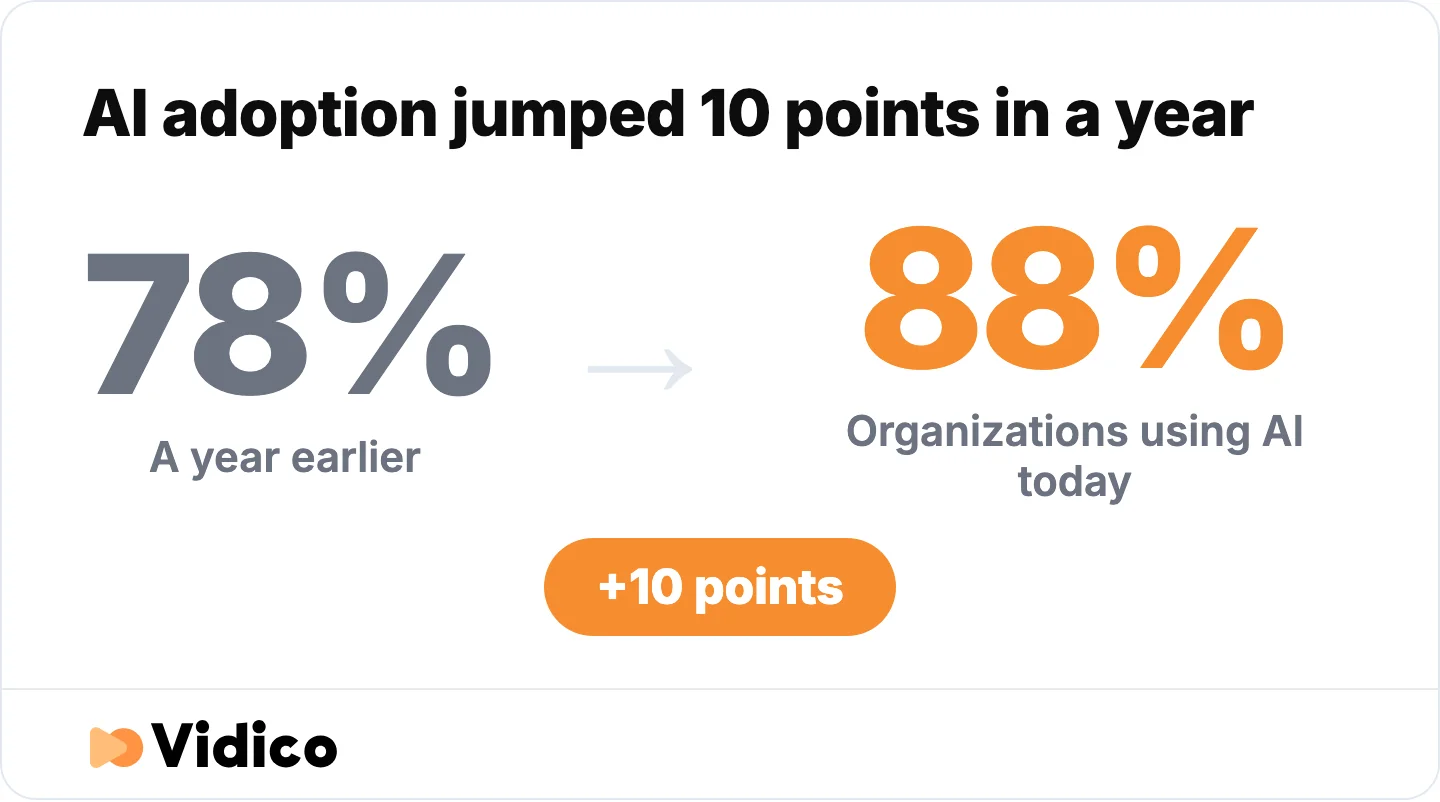
AI adoption across organizations climbed 10 points in a single year. Source: McKinsey State of AI.
-
88% of marketers rely on AI in their current jobs. Day-to-day dependence now matches organization-wide adoption, based on SurveyMonkey’s marketing trends research.
-
67% of small and medium businesses now use AI in marketing. Adoption is no longer limited to enterprise teams, per Semrush.
-
82% of businesses say they use AI for marketing activities. The share of companies applying AI directly to marketing work keeps rising, according to ActiveCampaign.
-
About 1 in 5 US workers now use AI in their job, up from the year before. AI use is spreading across the wider workforce, not just marketing, based on Pew Research.
-
64% of organizations say AI has improved their ability to innovate. The role of AI is shifting from assistant to driver, per McKinsey.
Generative AI in Marketing Statistics
Generative AI is the engine behind most of the recent adoption surge. It is also where the gap between usage and maturity is widest.
-
63% of marketers are currently using generative AI. Nearly two in three now work with generative tools, according to Salesforce’s State of Marketing research.
-
71% of organizations regularly use generative AI in at least one function, up from 65% the prior year. Regular use is growing fast, per McKinsey.
-
Marketing and sales is the business function that most often uses generative AI. No other function adopts generative AI as heavily, based on McKinsey.
-
77% of marketers who use generative AI have adopted it for creative development tasks, such as content creation. Creative work is a leading application, according to Gartner.
-
Only 27% of CMOs report limited or no generative AI adoption in their campaigns. The clear majority have moved past the pilot stage, per Gartner.
-
32% of marketing organizations have fully implemented AI, while 43% are still experimenting. Full implementation trails experimentation by a wide margin, based on Salesforce.
-
92% of businesses plan to invest in generative AI over the next three years. Investment intent is nearly universal, according to McKinsey’s Superagency research.
-
Only 1% of businesses that have adopted generative AI believe their investment has reached maturity. Near-universal adoption has not translated into mature capability, per McKinsey Superagency.
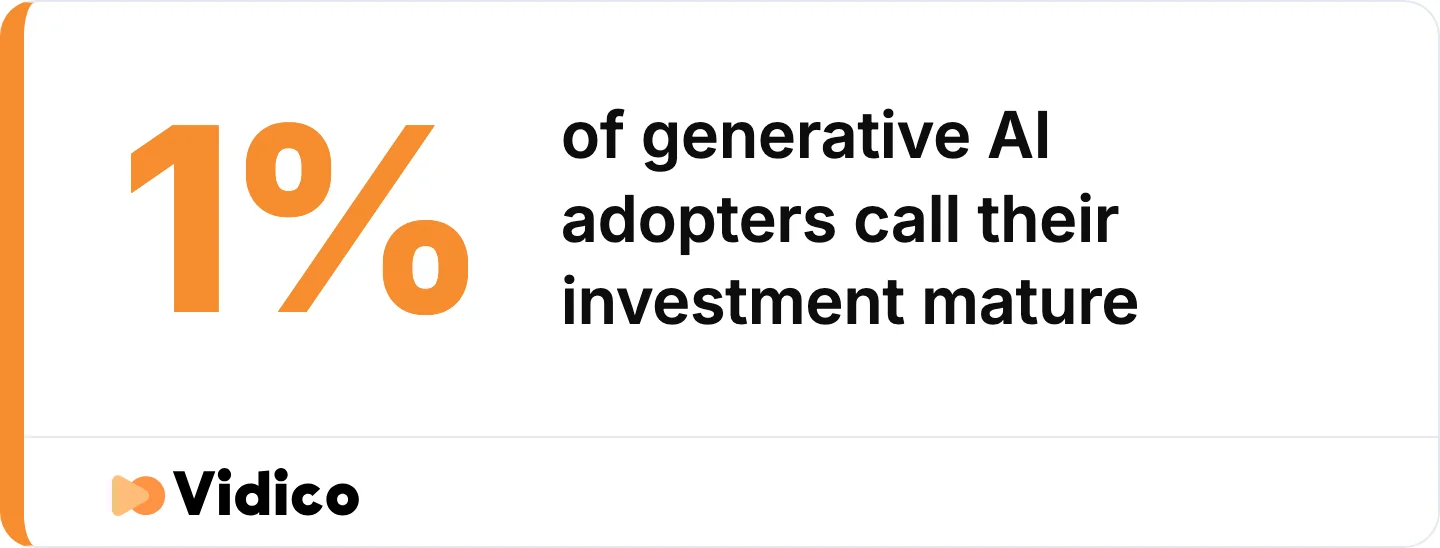
Near-universal adoption has not produced mature capability. Source: McKinsey Superagency.
How Marketers Use AI
Content creation is the single most common use of AI in marketing, followed by content optimization, personalization, and data analysis.
| Use case | Share of marketers | Source |
|---|---|---|
| Content creation | 55% | HubSpot |
| Content optimization (email, SEO) | 51% | SurveyMonkey |
| Personalized customer experiences | 73% | SurveyMonkey |
| Brainstorming content ideas | 45% | SurveyMonkey |
| Automating repetitive tasks | 43% | SurveyMonkey |
| Data analysis for insights | 41% | SurveyMonkey |
| Social media strategy | 43% | SurveyMonkey |
-
55% of marketers cite content creation as the most common use case for AI. It is the clear front-runner, according to HubSpot. For the wider view on content output, see our content marketing statistics.
-
51% of marketers use AI to optimize content, from email campaigns to search engine optimization. Optimization is nearly as common as creation, per SurveyMonkey. This is also where most email-marketing AI use shows up in the data.
-
73% of marketers say AI plays a role in creating personalized customer experiences. Personalization is the most cited value driver, based on SurveyMonkey.
-
73% of businesses agree AI will improve their personalization strategies. The expectation holds beyond marketing teams, according to Contentful.
-
45% of marketers use AI to brainstorm content ideas. Ideation is a leading entry point, per SurveyMonkey.
-
43% of marketers automate repetitive tasks with AI software. Automation frees time for higher-value work, based on SurveyMonkey.
-
41% of marketers use AI tools to analyze data for insights. Analysis is a core application, per SurveyMonkey.
-
43% of marketers say AI is important to their social media strategy. Social teams are folding AI into planning, according to SurveyMonkey.
-
Advertisers generated nearly 70 million AI creative assets in Google’s Performance Max and AI Max in the fourth quarter of 2025. That was part of a threefold year-over-year rise in AI-generated assets, per Google.
-
Demand Gen campaigns saw a 26% increase in conversions per dollar over the past year. AI-driven improvements to bidding and ramp-up lifted performance, based on Google.
-
30% of media agencies and brands have integrated AI into their campaign lifecycles. End-to-end integration still lags experimentation, according to the IAB.
AI tools speed up drafts, but professional video content production is still what turns them into something brands can publish.
AI Marketing ROI and Productivity Statistics
The return on AI in marketing shows up first as time saved and output gained, then as measurable revenue and cost effects. The productivity numbers are the most consistent across sources.
-
Marketers using AI report being 44% more productive and saving an average of 11 hours per week. Time savings are the most tangible payoff, according to ZoomInfo.
-
AI saves marketers 13 hours per week on daily tasks. A separate survey puts weekly savings even higher, per ActiveCampaign.
-
AI could add up to $4.4 trillion a year in corporate productivity gains. The macro-level value is enormous, based on McKinsey Superagency.
-
83% of sales teams using AI saw revenue growth, compared with 66% of teams that did not. AI use correlates with revenue gains, according to Salesforce’s State of Sales research.
-
65% of businesses saw an uplift in SEO performance from AI marketing tools. Search results improved with AI assistance, per Semrush.
-
68% of businesses report increased content marketing ROI from AI. The content channel shows a clear return, according to Semrush’s AI content marketing report.
-
75% of US marketers say AI saves organizational costs. Cost reduction is a widely reported benefit, based on Statista. For how this plays out in video specifically, see our video marketing statistics.
AI Marketing Market Size and Spend Statistics
Estimates of the AI-in-marketing market vary by research firm, but every projection points sharply up. Here is how the leading forecasts compare.
| Source | 2025 to 2026 value | Forecast | CAGR |
|---|---|---|---|
| Statista | ~$47B (2025) | $107B by 2028 | Not stated |
| Grand View Research | $35B (2026) | $82.23B by 2030 | Not stated |
| Precedence Research | $25.83B (2025) | $217.33B by 2034 | 26.7% |
-
Global AI marketing revenue was around $47 billion in 2025. The market is already substantial, according to Statista’s AI-in-marketing research.
-
AI marketing revenue is projected to reach $107 billion by 2028. The near-term trajectory is steep, per Statista.
-
The global AI marketing market reached $35 billion in 2026, up from $20.4 billion in 2024. A different methodology still shows rapid growth, based on Grand View Research.
-
The AI marketing market is projected to hit $82.23 billion by 2030. Grand View Research expects double-digit annual growth through the decade.
-
The AI-in-marketing market is expected to reach $217.33 billion by 2034, up from $25.83 billion in 2025, at a 26.7% CAGR. The longer-range forecast is the most aggressive, according to Precedence Research.
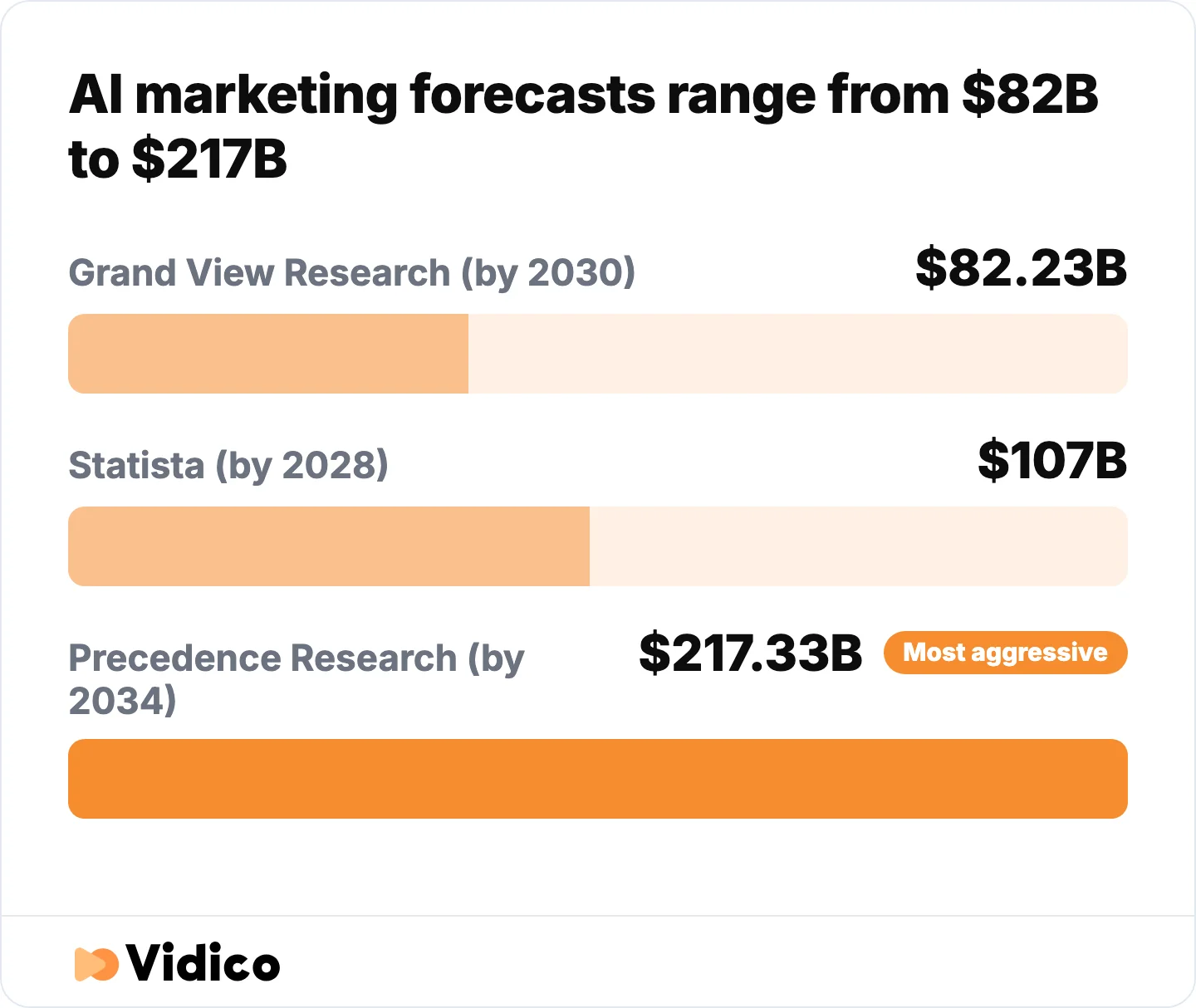
Forecasts agree the market is scaling and disagree on how far. Sources: Statista, Grand View Research, Precedence Research.
-
The market for generative AI in marketing alone is expected to reach $22 billion by 2032. Generative tools are a fast-growing slice of the total, based on Statista.
-
AI-enabled advertising spend is projected to reach $1.3 trillion by 2032, up from $370 billion in 2022. AI is reshaping where ad dollars flow, per Statista’s AI ad-spend data.
-
AI solutions account for 28% of the average marketing technology budget in 2025. More than a quarter of martech spend now goes to AI, according to Statista’s marketing-budget data.
-
71% of CMOs plan to invest at least $10 million annually in AI between 2025 and 2027. Budget commitment at the top is significant, based on BCG.
-
59% of CMOs report having insufficient budgets to execute their strategy in 2025. Ambition is outrunning available spend, per Gartner.
AI, Jobs, and Marketing Teams Statistics
AI is reshaping marketing roles faster than most teams are training for it. The data shows a clear gap between adoption and enablement.
-
65% of CMOs believe advances in AI will dramatically change their role within two years. Leaders expect the job itself to shift, according to Gartner.
-
69% of marketers feel excited or hopeful about AI’s impact on their jobs. Sentiment inside the profession is largely positive, based on SurveyMonkey.
-
70% of marketers say their employer does not provide generative AI training. The enablement gap is the biggest weakness in adoption, according to Salesforce.
-
Only 17% of marketers using AI receive training on it. Most are learning on their own, per Digital Marketing Institute.
-
54% of marketers say generative AI training is important for their role. Demand for training far outstrips supply, based on Salesforce.
-
45% of martech leaders say vendor-supplied AI agents fail to meet promised business performance. Off-the-shelf AI tools often underdeliver, according to Gartner.
AI Marketing Challenges, Risk, and Consumer Trust Statistics
Accuracy and trust are the two forces slowing AI down. Marketers worry about output quality, and consumers are increasingly skeptical of AI-driven experiences.
-
31% of marketers have accuracy and quality concerns about AI. Output reliability is a top internal worry, according to Salesforce.
-
39% of marketers avoid generative AI tools because they do not know how to use them safely. Uncertainty is a real adoption barrier, per Salesforce.
-
30% of marketers believe generative AI poses significant risks to brand safety. Brand risk is a live concern, based on Statista.
-
43% of businesses are put off by the inaccuracies or biases of AI content. Quality problems keep some teams on the sidelines, according to WebFX.
-
53% of consumers distrust AI-powered search results. Skepticism now extends to how people find information, per Gartner.
-
Customer trust in businesses using AI ethically fell to 42%, down from 58% the year before. Trust is moving in the wrong direction, based on Salesforce’s State of the Connected Customer research.
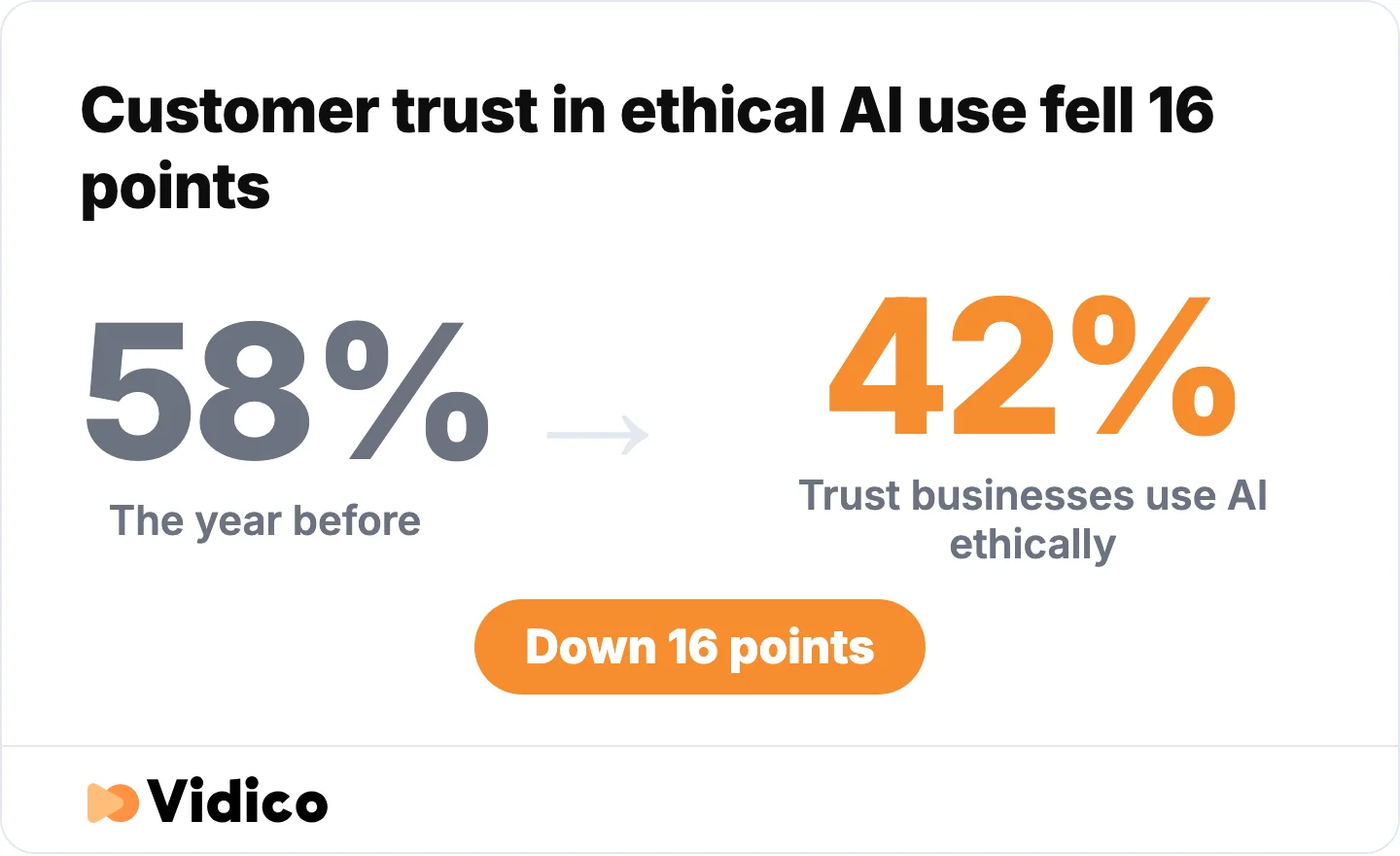
Trust in ethical AI use dropped 16 points year over year. Source: Salesforce State of the Connected Customer.
-
90% of people prefer a human customer service representative to a chatbot. The preference for humans is overwhelming, according to SurveyMonkey.
-
60% of US enterprise and government leaders cite risk and compliance as their primary AI challenge. Governance concerns rank at the top for large organizations, per Deloitte.
Human Oversight and the Anti-Slop Shift
Humans still own the final output, even as AI does more of the middle work. The data on review and editing rates is the clearest signal that the market is correcting against low-quality “AI slop.”
-
97% of companies edit and review their AI content before publishing. Almost nobody ships AI output untouched, according to Ahrefs.
-
80% of companies manually review AI content for accuracy. Human review is the default safeguard, per Ahrefs.
-
87% of content marketers use AI to help create content. AI assists the majority of content work, based on Ahrefs.
-
AI lets companies publish 42% more content per month, a median of 17 articles versus 12 without it. The volume gain is real when humans stay in the loop, according to Ahrefs.
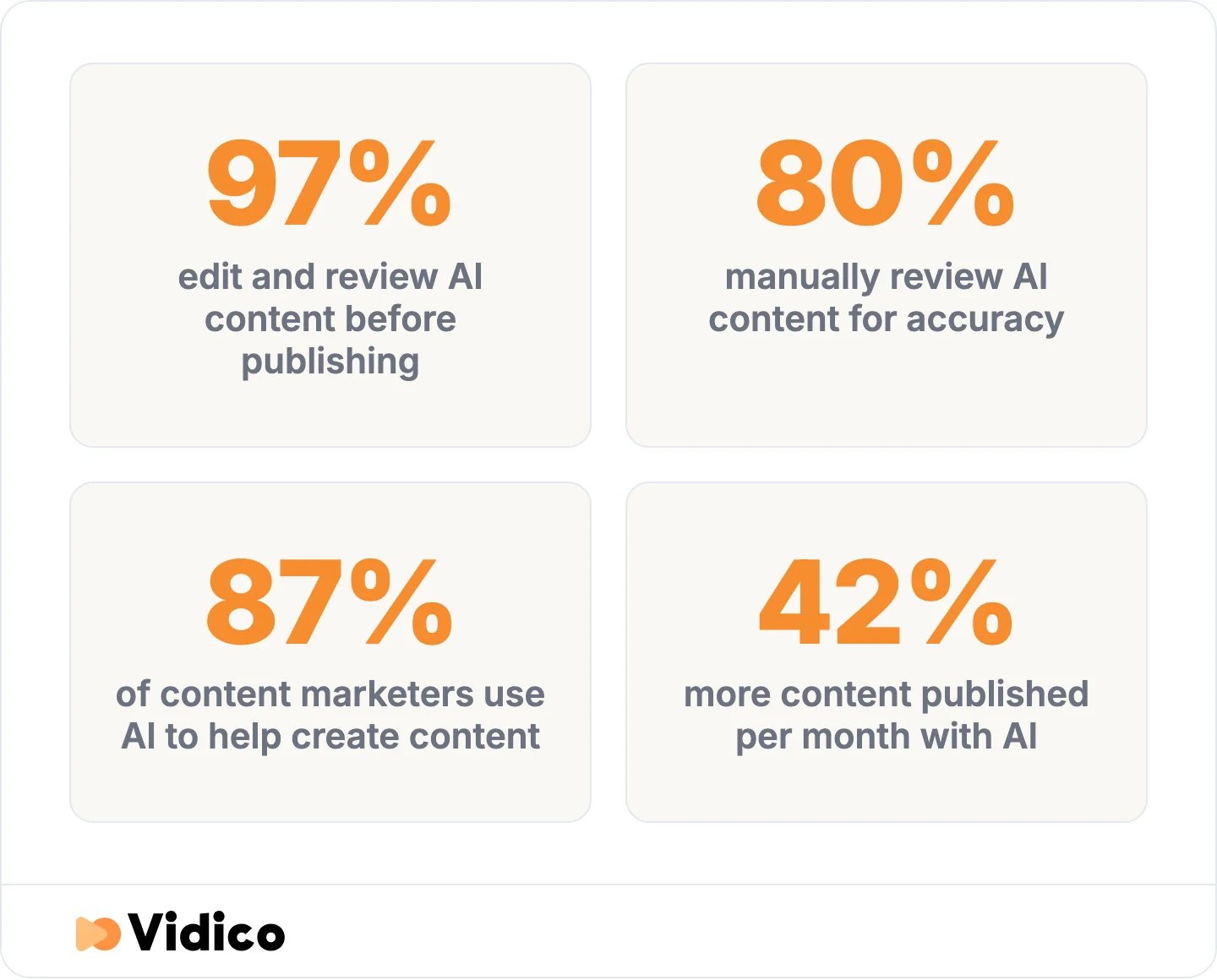
Almost nobody ships AI output untouched, and keeping humans in the loop still raises output. Source: Ahrefs.
- The “30% rule” holds that at least 30% of content must be human-led, through final editing, strategic oversight, and ethical judgment, to avoid consumer distrust. A human-led minimum is emerging as the standard, per Shopify.
Consumer sentiment is moving the same direction. Mentions of “AI slop” across the internet rose ninefold in 2025, with negative sentiment peaking at 54% in October, according to Euronews. Our own research points the same way. In Vidico’s 2026 State of Creative in Tech report, a survey of more than 230 B2B tech marketing leaders, only 29% had a formalized AI governance policy, and accuracy ranked as the number one AI risk concern. The same research found AI does its best work mid-process, on editing and repurposing existing assets, while the brief and the final output stay human. That is the practical shape of what we call anti-slop: AI speeds the work, people own the judgment.
The pattern shows up in production too. AI video tools like the ones we cover in our HeyGen vs Synthesia breakdown are a reasonable do-it-yourself option for quick, low-stakes clips, but the review-and-edit data explains why professional, human-led production still wins for brand work that has to convert.
AI Search and AI Answer Statistics
AI is not just producing marketing content, it is changing how people find it. AI answer summaries and AI chat now sit between search queries and website clicks.
-
Google’s AI answers in Search reached more than 2.5 billion monthly users by 2026. The feature scaled to mass adoption quickly, according to Google’s I/O announcements.
-
AI answers now show for roughly 13% of all Google searches by volume. Coverage keeps expanding across query types, per Ahrefs research on AI answer coverage.
-
AI answers reduce clicks by 34.5%. The answer box keeps more traffic on the results page, based on Ahrefs research on AI answers.
-
Ranking first in traditional results gives a page about a 25% chance of being cited in an AI answer. Classic SEO still feeds AI citations, per ZipTie.
-
31% of Gen Z consumers now most often use AI platforms or chatbots instead of traditional search engines. Younger audiences are shifting search behavior, based on global research from GWI.
-
74.2% of new webpages contain AI-generated content. AI writing is now the norm on the open web, according to Ahrefs research on AI-generated content.
-
91.4% of pages cited in AI answers contain some AI-generated content. AI-assisted pages are not being penalized in AI citations, per Ahrefs. For the video-specific angle, see our video SEO statistics.
-
86% of SEO professionals have integrated AI into their workflows. Search practitioners have adopted AI almost across the board, based on Semrush.
The Future of AI in Marketing
The next wave is agentic AI, software that acts on its own, and “machine customers” that buy on a person’s behalf. These projections point to where marketing budgets are heading.
-
88% of US executives plan to increase AI spending because of agentic AI capabilities. Autonomous agents are pulling budget forward, according to PwC.
-
50% of enterprises already using generative AI are expected to deploy AI agents by 2027, up from 25% in 2025. Agent adoption is forecast to double among current genAI users, per Deloitte.
-
Retailers saw a 693% increase in US site traffic from generative AI tools during the late 2025 shopping season. AI referrals are becoming a real traffic channel, based on Adobe’s US holiday shopping data.
-
There are now 1.3 billion videos on TikTok labeled as AI-generated. AI content volume on major platforms is already enormous, according to The Guardian.
Frequently Asked Questions
What percentage of marketers use AI?
About 88% of organizations use AI in at least one business function, and 88% of marketers say they rely on it in their day-to-day jobs. For generative AI specifically, 63% of marketers report current use.
What is AI in marketing?
AI in marketing is the use of machine learning and generative models to create content, personalize customer experiences, analyze data, and automate campaign tasks. In practice, that means tools that draft copy, build audience segments, generate ad variations, and surface insights from marketing data.
What is the 30% rule in AI marketing?
The 30% rule holds that at least 30% of any AI-assisted content should be human-led, covering final editing, strategic oversight, and ethical judgment. The idea is to keep enough human involvement to protect quality and avoid the consumer distrust that comes with fully automated content.
How big is the AI marketing market?
The AI-in-marketing market was worth roughly $35 to $47 billion in 2025 and 2026, depending on the research firm. Statista projects it will pass $107 billion by 2028, while Grand View Research forecasts $82.23 billion by 2030.
What are the most common uses of AI in marketing?
Content creation is the most common use, cited by 55% of marketers, followed by content optimization for email and search (51%), personalization (73% say AI plays a role), brainstorming (45%), and data analysis (41%).
The Bottom Line
AI in marketing is no longer a question of whether to adopt. With 88% of organizations using it and 63% of marketers working with generative tools, adoption is effectively settled. The open questions are about maturity and trust: only about 1% of companies call their AI investment mature, training lags badly, and consumer skepticism toward AI-made content is rising.
The teams pulling ahead are not the ones using the most AI. They are the ones using it with discipline, keeping humans on the brief and the final cut while AI handles the repetitive middle. The data backs this up, from the 97% of companies that edit AI content to the 30% human-led minimum that is becoming a standard. We build reusable video production systems for B2B teams, and the AI findings in our 2026 State of Creative in Tech report point the same way: AI speeds the work, people own the judgment.
If you are deciding where AI fits in your own creative production, a free strategy session is a practical place to map it out.
Sources
- SurveyMonkey: AI in Marketing Statistics
- Semrush: AI Content and SEO Trends
- ActiveCampaign: AI Marketing Statistics
- Pew Research: AI Use at Work
- Salesforce: State of Marketing
- Gartner: GenAI Adoption in Marketing Campaigns
- Salesforce: Generative AI Statistics
- HubSpot: AI in Content Marketing
- Contentful: Personalization Statistics
- Google: Digital Advertising and Commerce
- Google: I/O Announcements
- IAB: State of Data
- ZoomInfo: AI Marketing Survey
- Salesforce: State of Sales
- Semrush: AI Content Marketing Report
- Statista: Top AI Benefits for Marketers
- Statista: AI Use in Marketing
- Grand View Research: AI Marketing Market
- Precedence Research: AI in Marketing Market
- Statista: AI-Enabled Ad Spend
- Statista: Marketing Budget Share for AI
- BCG: How CMOs Are Scaling GenAI
- Gartner: CMO Spend Survey
- Gartner: CMOs on AI and Their Role
- Digital Marketing Institute: AI Marketing Stats
- Gartner: Vendor AI Agents
- Statista: AI Brand Safety Risk
- WebFX: How Marketing Leaders Use AI
- Gartner: Consumer Distrust of AI Search
- Salesforce: State of the Connected Customer
- Deloitte: AI Adoption Challenges
- Ahrefs: Marketers Using AI Publish More Content
- Shopify: AI Marketing Statistics
- Euronews: The Year of AI Slop
- Ahrefs: Insights From 56 Million AI Answers
- Ahrefs: How AI Answers Reduce Clicks
- ZipTie: SEO and AI Search Engines
- GWI: AI and Search
- Ahrefs: Percentage of New Content That Is AI-Generated
- Semrush: AI SEO Statistics
- PwC: AI Agent Survey
- Deloitte: Technology, Media and Telecom Predictions
- Adobe: Holiday Shopping Season Data
- The Guardian: TikTok AI-Generated Videos