There is no single “average attention span.” How long you focus depends on the task, your age, and what is happening around you. The most famous number in this whole topic, the claim that people now focus for just 8 seconds, less than a goldfish, is a myth with no credible research behind it.
At Vidico, we produce B2B explainer videos for SaaS and tech brands, and after 2,000+ campaigns we know that holding attention is the entire job. So we pulled the real data. Below are 32 attention span statistics from peer-reviewed studies, cognitive scientists, and named research bodies, with every number sourced. Where a popular figure is wrong, we say so and show what the science actually found.
Key Takeaways
- The 8-second attention span is a myth. It spread from a 2015 Microsoft report and has since been debunked. Half of UK adults surveyed still believe it.
- Real sustained attention runs about 30 to 76 seconds by age, not 8. Peer-reviewed research puts young adults at 76 seconds and children at 30 seconds of continuous peak focus.
- Average focus on a screen fell from 2.5 minutes in 2004 to about 47 seconds today. The change is how often we switch tasks, not a shrinking brain.
- Attention is selective, not shorter. People still watch two-hour films and binge full seasons. They just scroll past anything that does not hook them fast.
- You do not get 8 seconds to earn attention, you get a couple. Social video ads hold roughly 2.5 attentive seconds, so the opening moment decides everything.
The 8-Second Attention Span Myth, Debunked
The claim that humans have an 8-second attention span, shorter than a goldfish, is not supported by any real study. It is the most repeated statistic in this topic and one of the least accurate.
1. Half of UK adults believe the 8-second myth is true. A survey of the UK public by King’s College London found that 50% wrongly think the claim is true.
2. Only 25% of surveyed UK adults correctly identify the 8-second claim as false. The same King’s College London survey found belief in the myth is twice as common as the correct answer.
3. The 8-second figure spread from a 2015 Microsoft report and has since been debunked. King’s College London notes the claim has been debunked, including by the BBC, and no peer-reviewed study supports an 8-second human attention span. No one has ever measured a goldfish’s attention span either, which is a clue the comparison was never science.
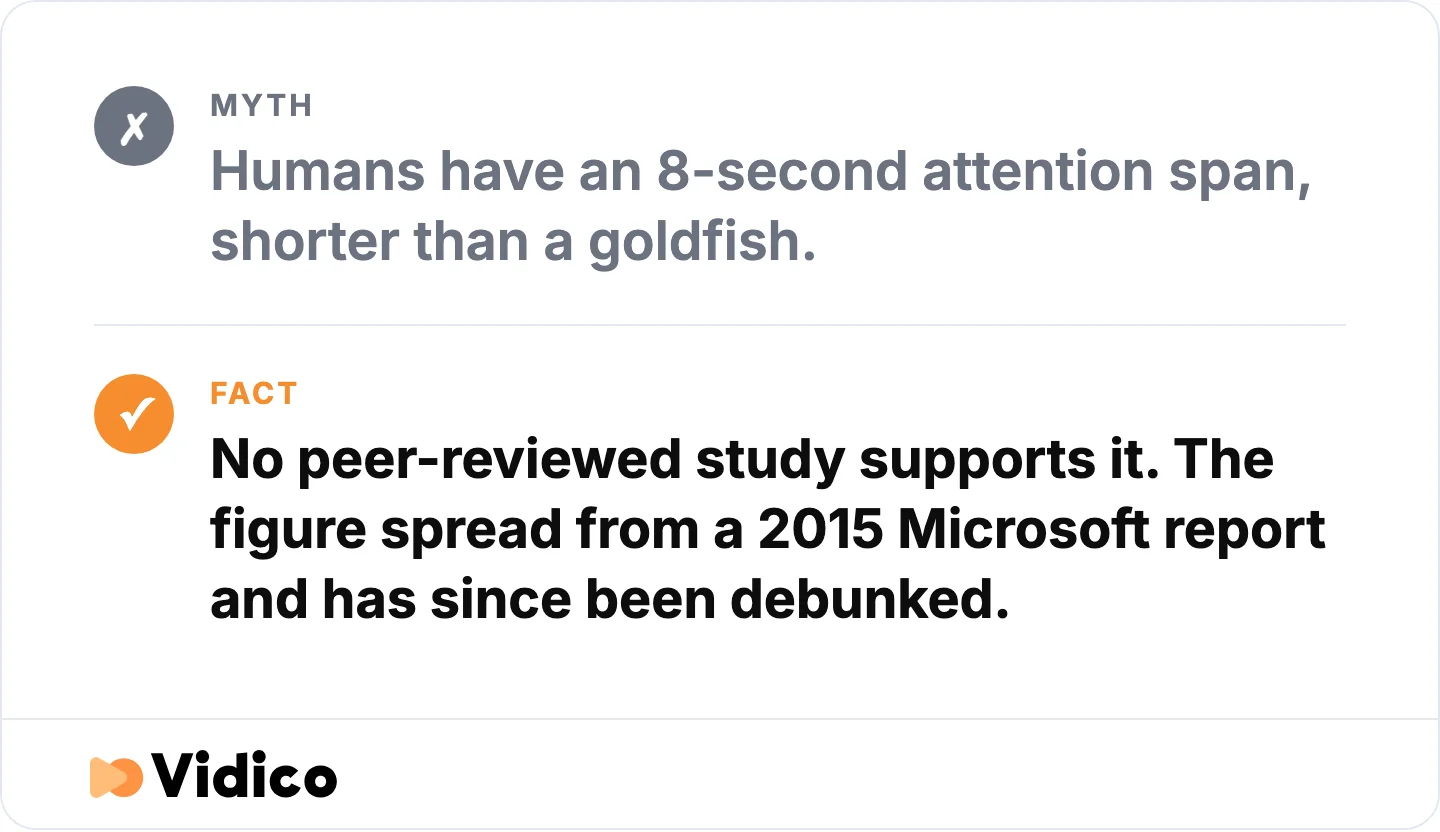
The most repeated attention statistic has no research behind it. Source: King’s College London.
4. UK adults check their phones up to 80 times a day, not the 25 they assume. King’s College London found people badly underestimate their own device use, guessing about 25 checks a day when studies suggest the real figure is up to 80. The problem is a distracting environment, not a broken brain.
Human Attention Span: What the Research Really Shows
Real attention is not one number. Scientists separate short, stimulus-driven attention that lasts seconds from sustained attention that can last hours when you choose the task.
5. Young adults sustain peak focus for about 76 seconds. A peer-reviewed study across the lifespan, published on the National Library of Medicine, measured an “A-span,” the longest a person continuously held an optimal “in the zone” focused state. Young adults averaged 76.24 seconds.
6. Older adults sustain peak focus for about 67 seconds. The same lifespan study found older adults held an A-span of 67.01 seconds, close to but below young adults.
7. Children sustain peak focus for about 30 seconds. The lifespan study measured children at an A-span of 29.61 seconds, far shorter than adults. Attention is developmental, not fixed.
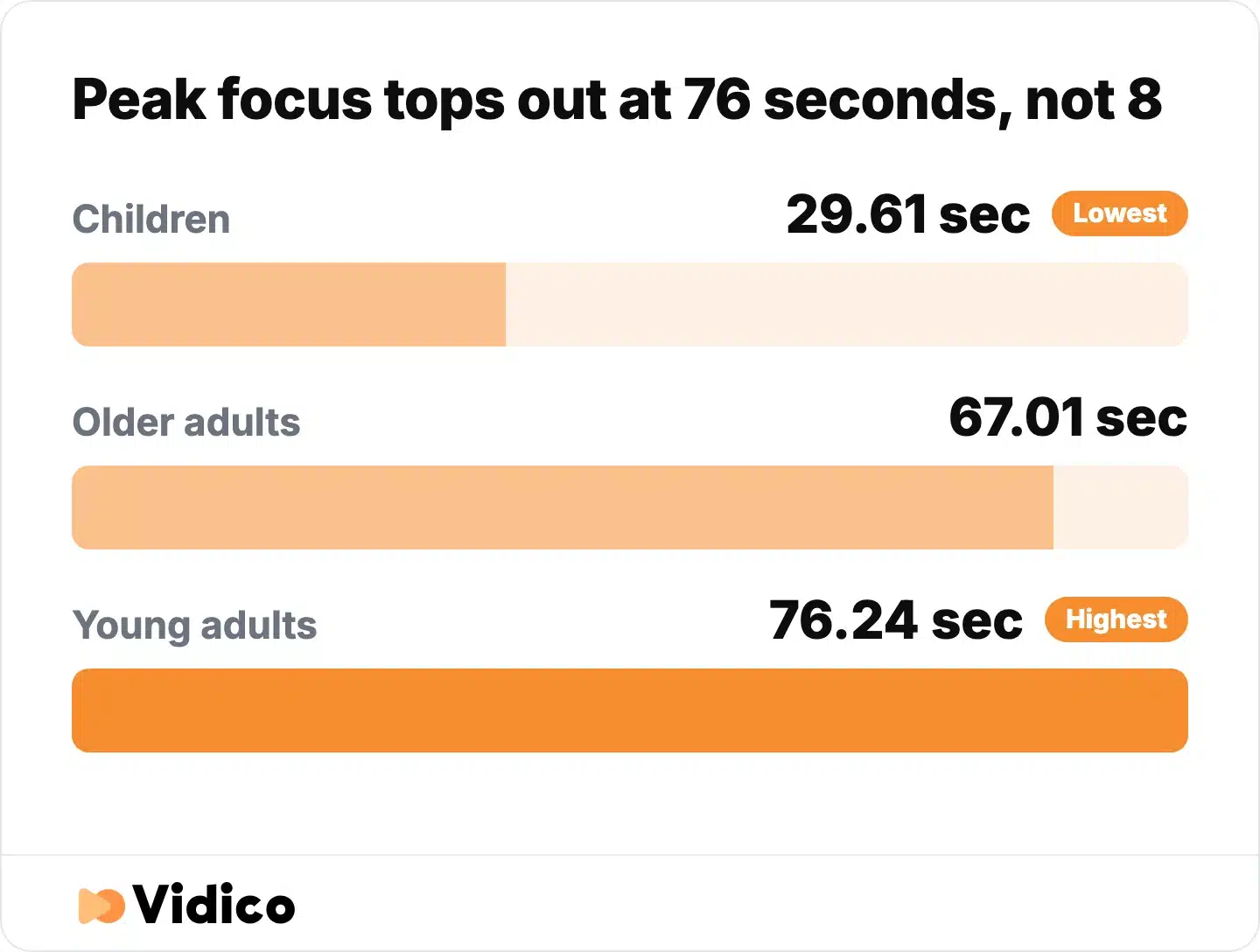
Peak continuous focus measured across the lifespan, in seconds. Source: National Library of Medicine.
8. Children’s focus fades far faster than adults’ during a long task. In the lifespan study, children’s attention dropped 27.41% over the task, while young adults dropped only 2.54%. This is why classroom focus is so different from adult focus.
9. Healthy adults can sustain attention on a chosen task for hours. Research summary notes that healthy teens and adults renew their focus repeatedly and can hold attention on a chosen task for up to about 5 hours, which is how anyone watches a two-hour movie or reads all afternoon.
10. Attention has at least two forms, and they are not the same. Research distinguishes transient attention, the seconds-long response to a new stimulus, from sustained or selective attention, the focus that produces consistent results on a task over time. Mixing the two is how the 8-second myth spread.
How Digital Screens Fragmented Our Focus
The real change over 20 years is not total attention capacity. It is how often we switch. The best measure of that comes from Dr. Gloria Mark, a leading researcher on attention and screens.
11. In 2004, people focused on a single screen for 2.5 minutes on average. In an interview with the American Psychological Association, Gloria Mark reported that early research found an average screen focus of two and a half minutes.
12. By 2012, average screen focus had dropped to 75 seconds. Mark told the American Psychological Association that the same measure fell sharply in under a decade.
13. Today, average screen focus is about 47 seconds, with a median of 40. Gloria Mark found current attention on a screen averages 47 seconds, and half of all measurements were 40 seconds or less. Other teams have replicated the result within a few seconds.
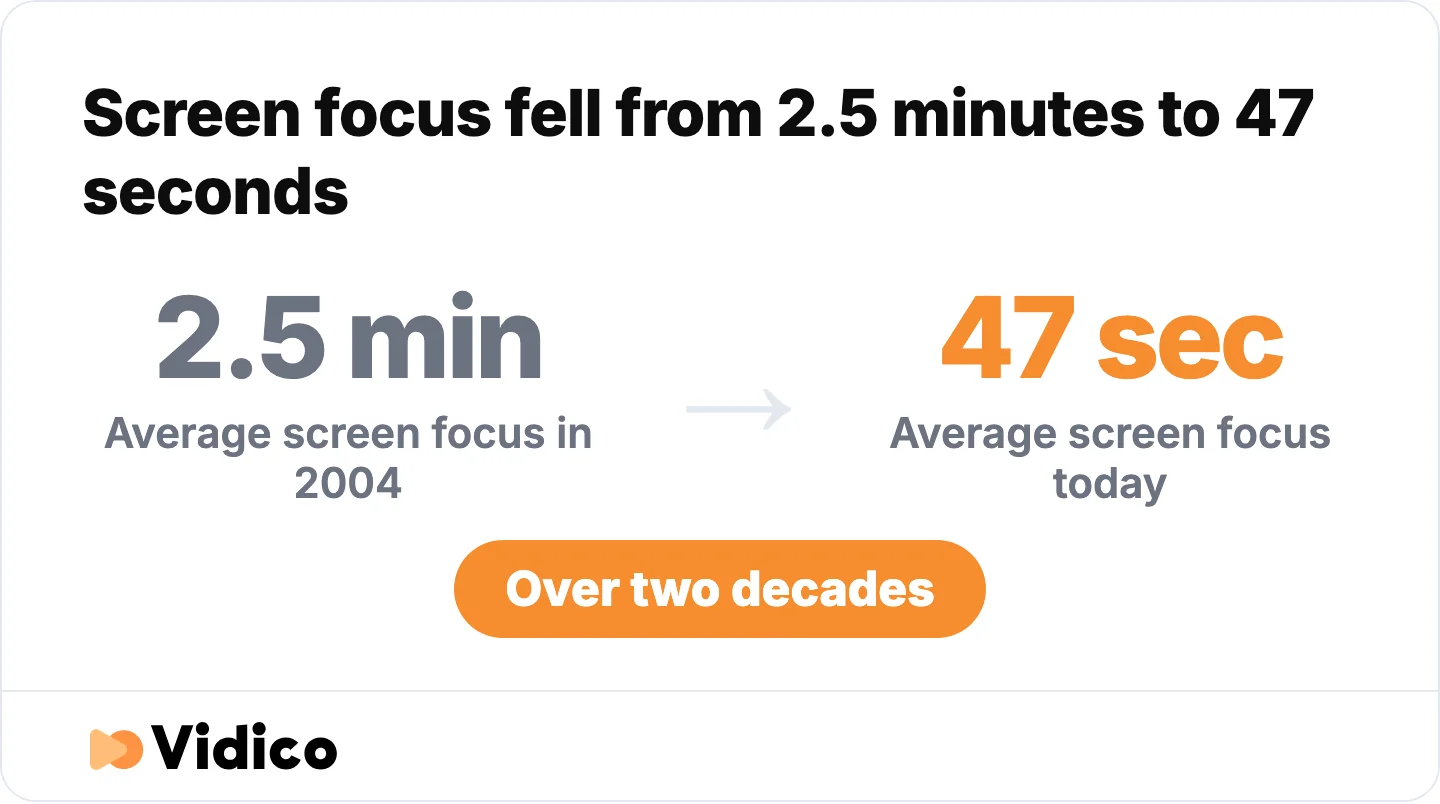
Average time on a single screen before switching, then and now. Source: Gloria Mark, via the American Psychological Association.
14. People check email about 77 times a day. Gloria Mark’s research put daily email checks at an average of 77, a steady stream of self-interruption on top of outside pings.
15. Focus on one task fell from about 2.5 minutes to roughly 40 seconds over two decades. National Geographic reported the same long decline, drawing on Mark’s research. Its “roughly 40 seconds” lines up with the 40-second median Mark measured.
16. Task switching can cut productivity by up to 40%. National Geographic reported that jumping between tasks, rather than doing them one at a time, can reduce productivity by as much as 40%.
17. How often you switch attention is linked to stress. Gloria Mark found a correlation between the frequency of attention switching and measures of stress, including blood pressure. The cost of fragmentation is not only lost time.
Average Attention Span by Age
Attention capacity grows through childhood, peaks in young adulthood, and dips modestly with age. It is developmental, not a flat number that applies to everyone.
| Age group | Typical sustained focus on one task |
|---|---|
| Preschooler (3 to 5) | 3 to 8 minutes |
| Child (around 10) | 20 to 30 minutes |
| Teen to adult | Approaches adult levels by late adolescence |
18. Preschoolers focus for 3 to 8 minutes on a single task. According to ReachLink, a preschooler typically holds attention on one task for three to eight minutes.
19. A 10-year-old can typically sustain 20 to 30 minutes. ReachLink reports that focus climbs steadily with age, reaching 20 to 30 minutes around age 10 and approaching adult levels by late adolescence.
20. Attention capacity peaks in young adulthood, not childhood or old age. The lifespan study on the National Library of Medicine found peak sustained focus in young adults, above both children and older adults, so there is no single human attention span.
Attention Online: Reading, Scrolling, and Watching
Online, people do not read, they scan. They scroll, sample, and move on fast, which is where the “short attention span” feeling really comes from.
21. Users read at most 28% of the words on an average web visit, and 20% is more likely. A study of tens of thousands of page views, summarized by the Nielsen Norman Group, found readers get through only a fraction of a page.
22. Users read half a page’s content only when it is 111 words or fewer. The Nielsen Norman Group found that once a page runs longer than about 111 words, readers take in less than half of it.
23. Videos under 1 minute keep 65% of viewers engaged to the end. Vidyard’s business video benchmark report found short videos hold most of their audience.
24. Videos over 20 minutes keep only 20% of viewers. Vidyard found engagement falls off a cliff as length grows, from 65% under a minute to 20% past 20 minutes.
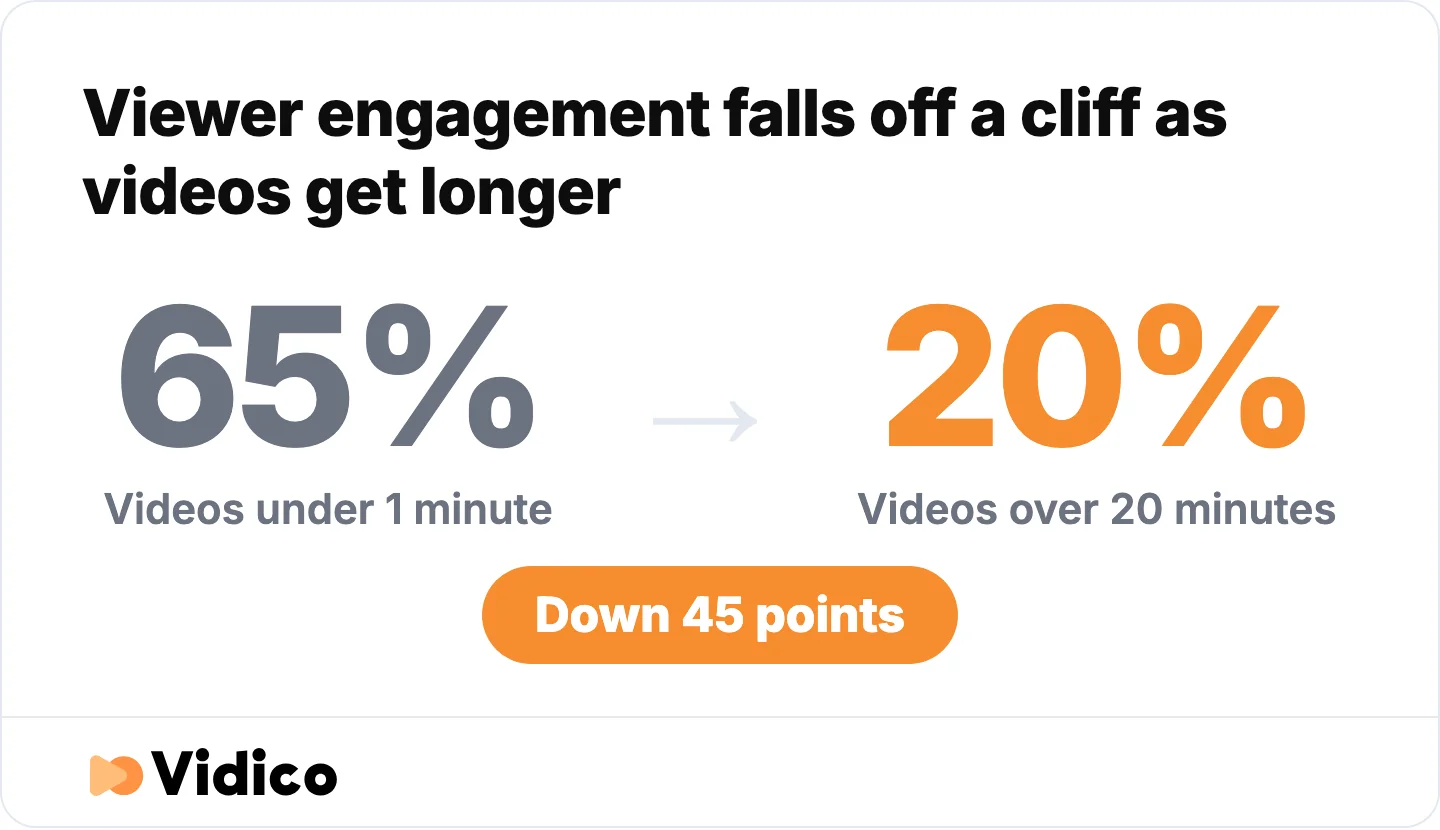
Share of viewers who watch to the end, by video length. Source: Vidyard business video benchmarks.
25. Videos under one minute average just 16 seconds of watch time. HubSpot’s video data shows that even for short clips, most people do not watch to the end. The opening seconds carry the whole load.
What Attention Data Means for Marketers and Video
If you are trying to hold an audience, the takeaway is not “you have 8 seconds.” It is that you have just a couple of attentive seconds to earn the rest. The opening moment decides whether anyone sees the other 30.
26. Mobile web video ads get about 1.6 attentive seconds. Research by Amplified Intelligence, published by Digital Turbine, measured actual eyes-on-screen attention, not just an ad being served.
27. Social video ads get about 2.5 attentive seconds. Digital Turbine’s research found social placements hold slightly more real attention than mobile web, but still only a couple of seconds.
28. In-app rewarded video ads held about 22 seconds of active attention. Digital Turbine’s research found that when the format and context fit, the same viewer will pay attention far longer. Attention depends on where and how you show up.
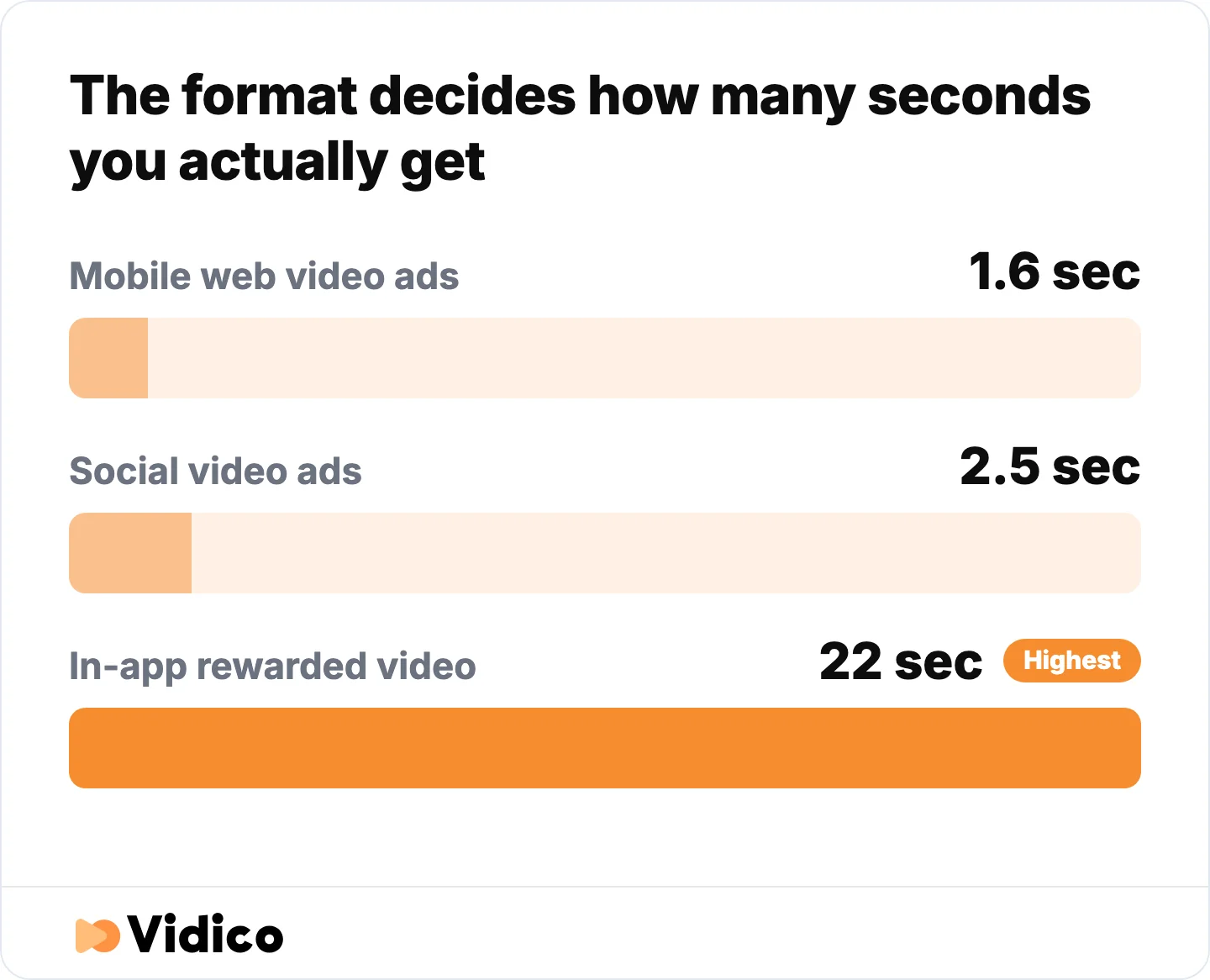
Measured eyes-on-screen attention by format. Source: Amplified Intelligence, published by Digital Turbine.
29. As of 2026, short-form video delivers the highest ROI of any media format, with 48.6% of marketers ranking it in their top three. HubSpot’s marketing data shows short-form is where attention and return now concentrate.
30. Short-form video is the most-used video format, with 29.18% of marketers using it. HubSpot found short clips on TikTok, Reels, and YouTube Shorts now lead all other formats among marketers.
31. 42% of B2B tech marketers say getting attention is harder now, and 35% cite accelerating creative fatigue. Those figures come from our own State of Creative in Tech report, a 2026 survey of more than 230 B2B tech marketing leaders. More competition and sameness, not weaker audiences, are the real pressure.
The lesson from every number above is the same. The winning video is not the shortest one, it is the one that hooks fast and holds. Explainer video production for SaaS is our core work, and it is why we obsess over the first few seconds. When Cascade needed a brand video that held its audience, the result was a 93% view rate across 1.4 million YouTube views. If you want a read on how your current creative holds attention against competitors, our Creative Intelligence Report breaks it down.
What Affects Your Attention Span
Attention is state-dependent. The same person focuses for seconds or for hours, and a handful of factors decide which.
- Interest and task difficulty. The peer-reviewed lifespan research shows attention tracks the task, not a fixed clock. A child who cannot sit still for handwriting will happily build a train track for 45 minutes.
- Sleep and fatigue. A tired brain wanders, and focus is one of the first things to slip when you are short on rest.
- Digital load. Constant notifications and app-switching train the habit of moving on. Gloria Mark’s finding that people check email 77 times a day is a picture of that pressure.
- Environment. Noise, clutter, and a phone within reach all pull focus away before you notice it happening.
How to Improve Your Attention Span
Attention is trainable, and most of the fixes are about your environment, not willpower.
32. 12 minutes of mindfulness, four times a week, measurably improves attention. National Geographic reported on research by Amishi Jha showing that a short, regular mindfulness practice improves attention, memory, and resilience to stress.
Beyond that, the practical moves are simple. Single-task instead of switching. Batch your notifications so pings do not set the pace. Protect your sleep, since a tired brain wanders. And match hard work to your own interest, because attention follows what you care about far more than any clock.
Frequently Asked Questions
What is the average human attention span?
There is no single average. Attention depends on the task and the person. Peer-reviewed research puts continuous peak “in the zone” focus at about 30 seconds for children, 76 seconds for young adults, and 67 seconds for older adults. Average focus on a screen is roughly 47 seconds, though people sustain attention for hours on tasks they choose.
Is the 8-second attention span real?
No. The claim that humans have an 8-second attention span, shorter than a goldfish, is a myth. It spread from a 2015 Microsoft report and has since been debunked. No peer-reviewed study supports an 8-second figure.
How long is Gen Z’s attention span?
There is no credible evidence that Gen Z has a shorter clinical attention span than any other group. Younger users move through social feeds quickly, but they also watch long films, play deep games, and binge full seasons when the content earns it. Attention follows interest, not birth year.
What was the average attention span in 2000?
The popular claim that attention was “12 seconds in 2000” comes from the same debunked myth chain as the 8-second figure and has no credible source. The reliable long-term measure is Gloria Mark’s screen-focus data, which was about 2.5 minutes in 2004.
Is a 20-minute attention span bad?
No. Twenty minutes of sustained focus is normal for a child around age 10 and healthy for adults on a single task. Adults can renew their focus and sustain attention for hours on tasks they choose, so a 20-minute stretch is a sign of typical, not poor, attention.
The Bottom Line
Attention is not collapsing to goldfish levels. The 8-second claim is a myth, and the real data tells a clearer story. We hold continuous peak focus for 30 to 76 seconds depending on age; we average about 47 seconds on a screen, and we can concentrate for hours when we choose the task. What changed is the environment. We switch more, we scroll more, and we have become far more selective about what earns our focus.
For anyone making content, that is the real headline. You are not fighting a shrinking brain; you are competing for a choice. At Vidico, we build reusable video production systems for B2B teams, and across our 1.5 billion-plus views, the pattern holds: the first few seconds decide everything, so they have to be worth watching. If you want to see how attention data maps to video length and drop-off, our video marketing statistics roundup goes deeper on what keeps viewers watching.
For the full picture, our short-form video statistics roundup breaks down engagement by platform and length.
Sources
- National Library of Medicine: Quantifying attention span across the lifespan
- American Psychological Association: Why our attention spans are shrinking
- National Geographic: The average attention span has shrunk
- King’s College London: Are attention spans really collapsing?
- Nielsen Norman Group: How Little Do Users Read?
- Vidyard: Video in Business Benchmark Report
- HubSpot: Video Marketing Statistics
- HubSpot: Marketing Channels
- Digital Turbine: Mobile video ad attention research (Amplified Intelligence)
- ReachLink: Attention span by age