A cybersecurity explainer video is a short animated or live-action video that turns an abstract security idea, threat, or product into something a non-technical buyer can picture, with one clear message. It is the format security brands reach for when a firewall, a zero-trust model, or a phishing attack is too invisible to sell with a feature list.
You are probably here for one of two reasons. You want a video to show your team or a class to explain a security concept, or you are planning to commission one for your own brand. This list serves both. Each pick below links to the actual video so you can watch it, and each one comes with a short breakdown of the single creative choice that makes it work.
At Vidico, we produce B2B explainer videos for SaaS and tech teams like Square and NinjaOne, and we build them as reusable systems so one shoot becomes 40+ assets across channels. We make these videos for a living, so read our pick of our own work below as exactly that.
Key Takeaways
- Lead with the consequence, not the technology. The strongest security videos show what an attack costs a business before they show how the product stops it. The product is the payoff, not the premise.
- Named, real examples beat generic clips. A roundup of actual brand videos you can watch teaches far more than stock motion graphics, which is why this list names every company and links every video.
- Match the style to the audience. Motion graphics suit SOC analysts and dashboards, character animation suits end-user awareness training, and 3D suits hardware and infrastructure. Style is an audience decision.
- Trust is the real product. Security buyers are risk-averse by job description. A video that over-promises or leans on fear without reassurance loses them faster than a dull one.
- Keep it tight. Aim for 60 seconds to two minutes for a website explainer, with 20 to 30 second cuts for paid social. The best security explainers respect a technical buyer’s time and make one idea land, rather than touring every feature.
Content
Top 8 Cybersecurity Explainer Videos
The eight videos below span animation, live action, comedy, and cinematic drama, because there is no single right way to explain security. The numbering is a tour, not a leaderboard. Watch the overview first, then read the breakdowns for the creative lesson behind each.
| # | Video | Company and category | Creative style | The lesson |
|---|---|---|---|---|
| 1 | Domotz brand animation | Network monitoring and security | 2D with 3D effects, robot mascot | Keep a dry infrastructure product warm |
| 2 | Welcome to CrowdStrike | Endpoint protection platform | Motion graphics and platform diagrams | Credibility before cleverness |
| 3 | Who Is Okta? | Identity and access management | Particle animation and live action | Sell the mission, not the feature |
| 4 | Singularity Platform | SentinelOne, autonomous AI security | Dark, sci-fi motion design | Match visual tone to positioning |
| 5 | Supervisin’ Ryan | 1Password, password management | Live-action comedy | Humor beats fear |
| 6 | Zero Trust Exchange | Zscaler, zero-trust networking | Fast typography and icons | Organize a short list in 30 seconds |
| 7 | The Inside Man trailer | KnowBe4, security awareness training | Scripted live-action drama | Turn training into entertainment |
| 8 | Protecting your most valuable assets | Proofpoint, people-centric security | Live action with animated overlays | One idea beats a feature tour |
1. Domotz: network monitoring and security
Domotz is a network monitoring and security platform for IT teams and managed service providers, and the brand animation we made for them is where we would start. The product is the kind of infrastructure tool that usually produces dry, forgettable video. The animation avoids that with a branded robot mascot and a 2D illustration style with 3D effects applied on top, paced so the value points land instead of blurring together. It is proof that a technical, security-adjacent product can stay warm and watchable. Vidico’s case study reports more than 500,000 views across organic and paid channels and says the video was placed on the company homepage.
2. CrowdStrike: Welcome to CrowdStrike
Welcome to CrowdStrike opens with a direct “We stop breaches” statement and builds a red-and-black diagram of the platform. The opening uses branded motion graphics and labeled layers to organize the offer. The lesson is credibility before cleverness. When buyers already feel the pain and want confidence, a calm, direct explainer earns more trust than a clever metaphor. This is the model for a brand whose audience is stressed security leaders, not curious newcomers.
3. Okta: Who Is Okta?
Who Is Okta? opens with an abstract particle form and the mission “Free everyone to safely use any technology,” then moves into live-action scenes of people and workplaces. The opening frames identity around the people using technology before moving into product context. The lesson is to sell the mission, not the feature, which works when buyers already understand the category and need a reason to care about your version of it. At under two minutes, it is a mission film that still reads as an explainer.
4. SentinelOne: Singularity Platform
SentinelOne’s Singularity Platform video uses a cinematic opening built from purple-and-blue particles, glowing structures, and network-like connections against a dark background. These opening images give an abstract security platform a distinct visual language. The lesson is to match the visual tone to the promise. If the product claims to be faster and more autonomous than a human analyst, the video should feel that way, not like a slideshow of bullet points.
5. 1Password: Supervisin’ Ryan
Supervisin’ Ryan with 1Password cuts between several comic live-action scenes, including a car ride and a script-reading setup, before ending on the 1Password brand. It uses a celebrity-led comedy format rather than a visible product-feature checklist. The lesson is that humor can beat fear, especially for a consumer-facing security product where the competition relies on anxiety. The useful pattern is a relatable situation that can carry a short security message without a threat-heavy visual treatment.
6. Zscaler: Zero Trust Exchange
Understanding Zscaler’s Zero Trust Exchange runs for 30 seconds. It introduces four numbered goals, including minimizing the attack surface and stopping data loss, then groups four integrated solutions on screen. Fast typography and simple icons keep the list organized. At 30 seconds, it offers a useful model for a paid-social cut with one organizing message. The lesson is compression. When you have 30 seconds on LinkedIn or YouTube pre-roll, pick the single idea that matters and cut everything that slows it down. This is the shape a longer explainer should collapse into for ads.
7. KnowBe4: The Inside Man
The Inside Man trailer turns security awareness training into a scripted workplace thriller series rather than a corporate video. The opening uses a new employee arriving at an office, phone calls, and an investigation-wall image to establish the thriller format. The lesson is to give training a plot and recurring characters that people can follow. It is the most structurally different pick here, and it shows how far the format can stretch when the job is internal, not sales.
8. Proofpoint: Protecting your most valuable assets
Proofpoint’s Protecting your most valuable assets opens with live-action scenes of people at work and in daily life, then introduces animated security symbols around them. That opening gives its people-centric security positioning a human setting instead of starting with a hardware diagram. The lesson is that one repeated idea beats a feature tour. A single strong frame gives the viewer something to remember and repeat, which a list of capabilities never does. For a people-centric security pitch, the discipline of staying on one message is the point.
What Makes a Cybersecurity Explainer Video Different
Cybersecurity is harder to explain than most software because the problem is invisible and the audience is split. There is no physical product to show and no obvious moment of failure until a breach has already happened. The video has to make an abstract threat feel real before it can make the solution feel necessary.
The audience is rarely one person. A CISO watches for strategic fit, a SOC analyst watches for technical credibility, and procurement watches for budget and compliance signals like SOC 2 and ISO 27001. A good security explainer gives each of them a reason to keep watching without drowning any of them in jargon. That balance is why the format rewards clarity over completeness.
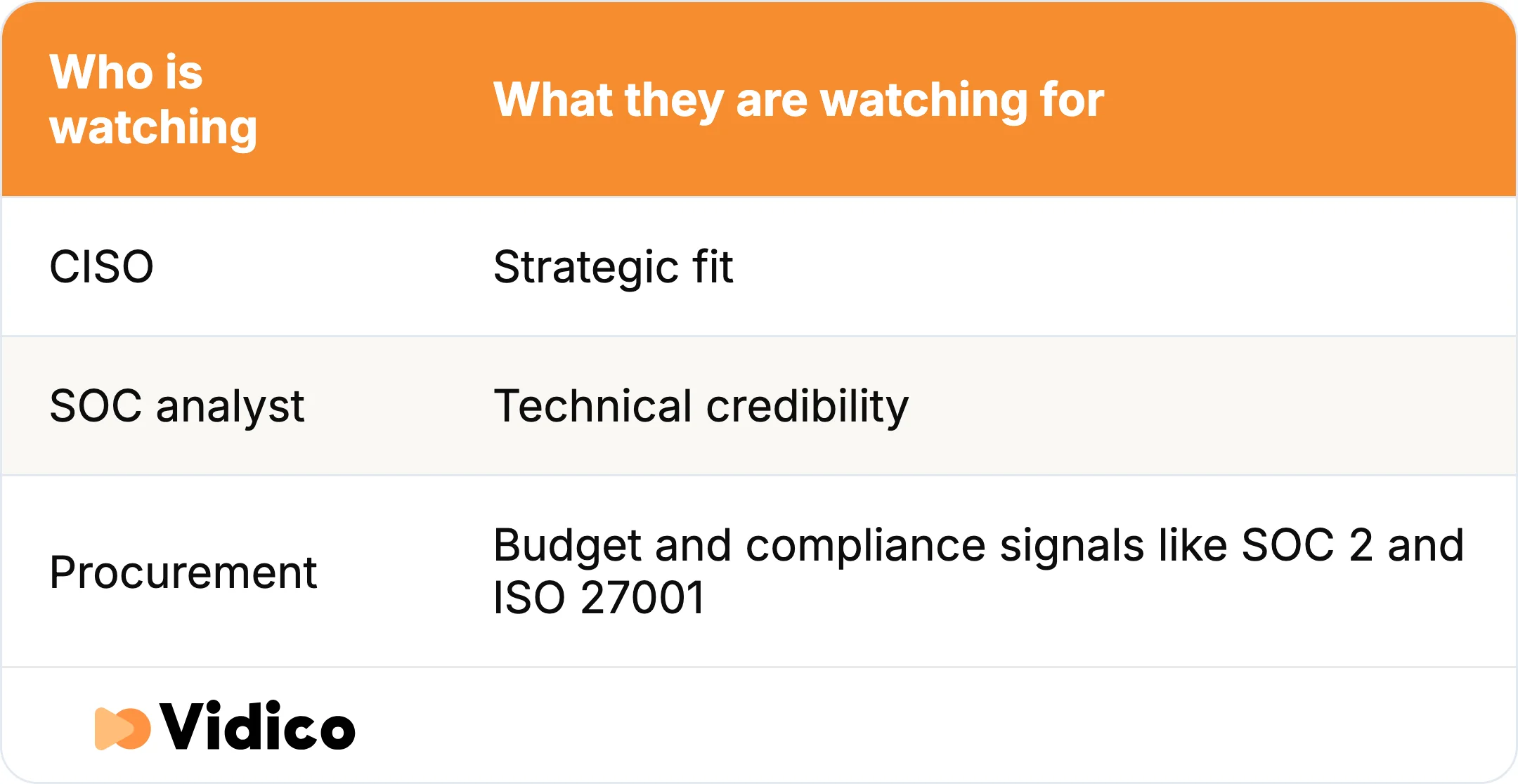
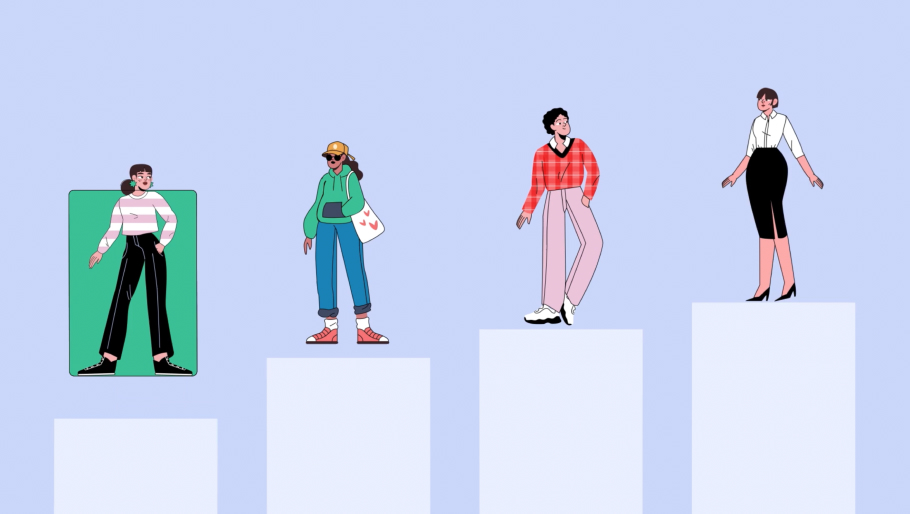
Three people watch the same security video for three different reasons, and the script has to serve all of them.
It also sells into a trust-driven, slow buying cycle. Security buyers are paid to be skeptical, so a video that over-promises or uses fear without offering reassurance backfires. The job is to build confidence, not anxiety. If you are new to the format, our guide to what makes a strong explainer video covers the fundamentals, and our tech explainer video examples show how adjacent categories handle the same problem.
Creative Styles That Work for Security
The right style for a cybersecurity explainer is an audience decision, not an aesthetic one. Each approach fits a different viewer and goal.
- Motion graphics suit technical audiences and anything involving network traffic, threat paths, or dashboards. They make data movement visible, which is why SOC and analyst-facing videos lean on them.
- 2D character animation suits security awareness and end-user tools. A relatable character lowers the stakes for non-technical staff learning to spot phishing. Our overview of 2D animation styles breaks down the options.
- 3D animation suits hardware, appliances, and infrastructure, where showing the physical or architectural layer helps the concept land.
- Metaphor-driven animation turns an abstract defense idea into a concrete image, like a shape that morphs across environments to show the same protection following data everywhere.
- Cinematic live action suits brand and anthem pieces aimed at practitioners, where emotion and identity matter more than mechanics.
Most videos mix two of these. A product explainer might open with cinematic footage, then switch to motion graphics to show the platform in action.
How to Structure a Cybersecurity Explainer
The structure that works for security follows a simple arc: problem, consequence, solution, proof, action. Lead with the threat the buyer recognizes, show what it costs if it lands, introduce the product as the fix, back it with proof, and end with one clear next step.
Keep the whole thing to 60 seconds to two minutes for a website or sales video. A frequent mistake is leading with features before the viewer cares, which turns a story into a spec sheet. The second is piling on so many concepts that none of them stick. One threat, one solution, one proof point, one ask.
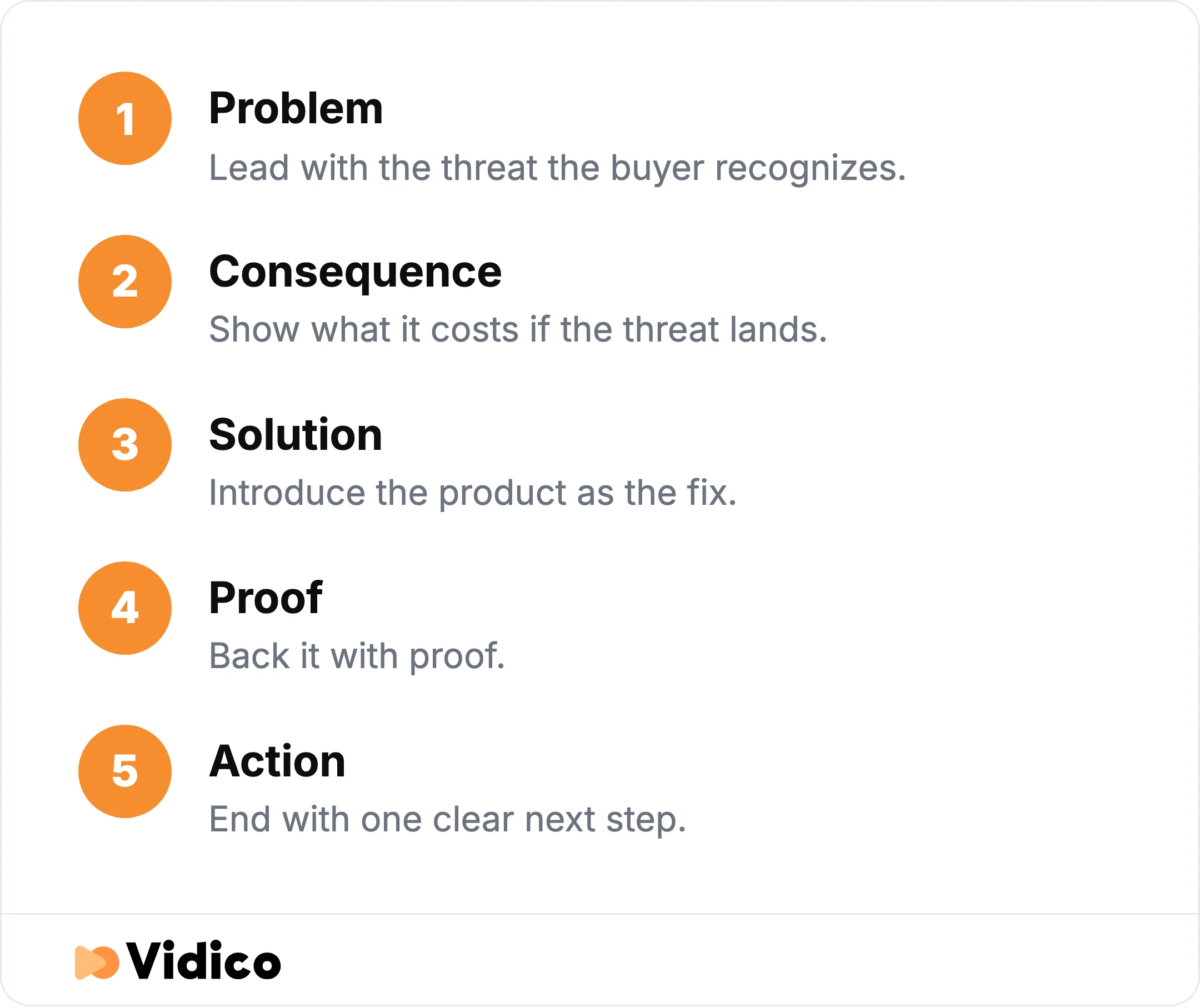
The arc that works for security: show the threat and its cost before the product appears.
If you want a read on how your current security creative performs before you brief a new one, our free Creative Intelligence Report reviews it across 12 areas in 48 hours.
Where Cybersecurity Explainer Videos Get Used
A single cybersecurity explainer earns its budget by working across the funnel, not just on one page. The highest-value placements are consistent across security brands.
- Website and landing pages, where the explainer answers “what is this and why do I care” above the fold.
- Paid social and pre-roll, cut down to 20 to 30 seconds for LinkedIn and YouTube. HubSpot reports short-form video as the top ROI-driving format among marketers, at 49%. Use that broad benchmark as context when planning a short edit, then measure its results for your own campaign.
- Sales and BDR outreach, where a 60-second explainer warms up a cold prospect better than a deck.
- Events like RSA and Infosecurity, where a looping video draws people to a busy booth.
- Partner and MSSP enablement, where channel partners use the video to sell on your behalf.
Planning the cut-downs before the shoot is what makes one video stretch this far. Our B2B video ad examples show how the short versions are built.
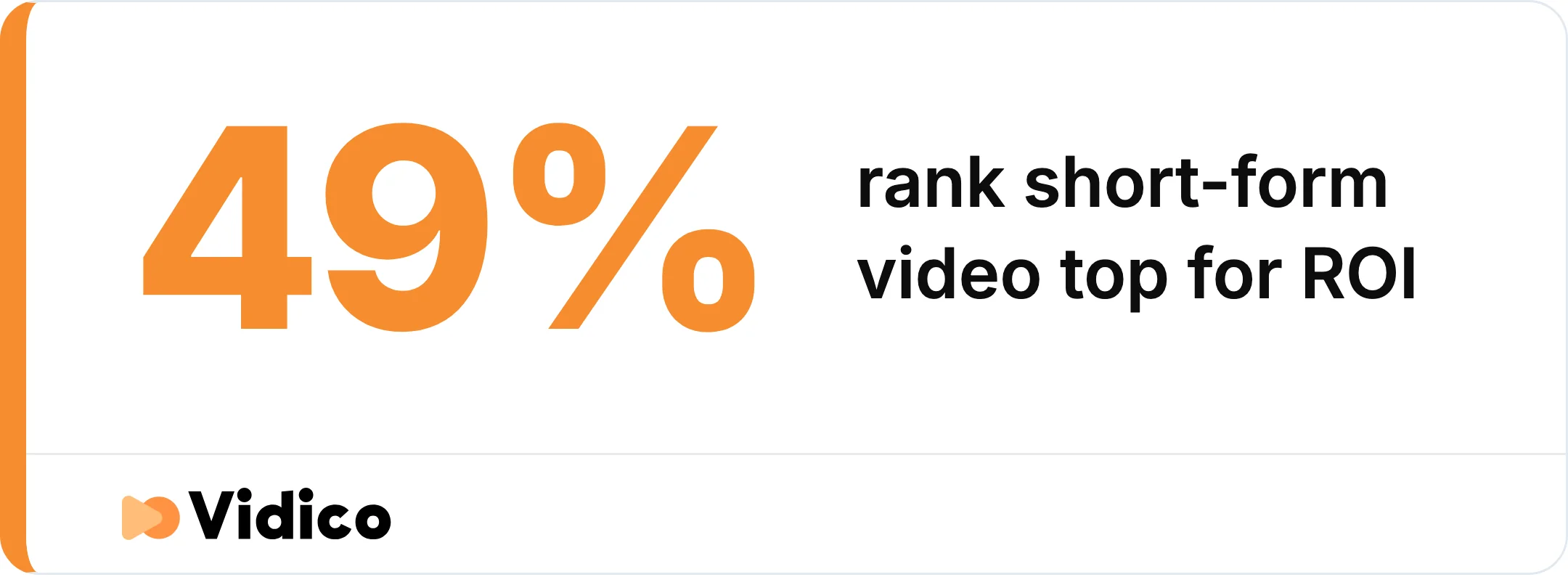
HubSpot reports that 49% of marketers rank short-form video as the top ROI-driving format.
How Much a Cybersecurity Explainer Video Costs
Use these planning estimates from Vidico’s published video production cost guide when scoping a cybersecurity explainer. They are general production ranges, not cybersecurity-specific quotes. As of 2026, an animated explainer runs about $3,000 to $15,000 per finished minute, while a live-action explainer runs about $2,000 to $8,000 per finished minute. A complete, finished corporate or explainer piece typically lands between $4,500 and $20,000.
Custom animation complexity and additional revision rounds can raise the quote. Scope those needs before comparing production estimates. Our full breakdown of video production cost covers how length, animation style, and revisions move the number.
Frequently Asked Questions
What is a cybersecurity explainer video?
A cybersecurity explainer video uses animation, live action, or both to make a security concept, threat, or product clear to a non-technical viewer. It simplifies ideas like phishing, zero trust, or endpoint protection into a visual story, and it is used for marketing, sales, and employee training.
How long should a cybersecurity explainer video be?
For a website or sales explainer, aim for 60 seconds to two minutes. That is long enough to set up a threat and a solution without losing a technical buyer, and short enough to cut down to 20 to 30 seconds for paid social. Training series can run longer because the viewer is already committed.
What animation style works best for cybersecurity?
Motion graphics work best for technical, data-heavy topics like network traffic and threat detection. 2D character animation fits end-user awareness training, and 3D fits hardware and infrastructure. The right choice depends on who is watching and what they need to understand, not on which style looks most impressive.
Should I show my team an existing video or commission my own?
If your goal is to teach a team or class a general concept, an existing video from a trusted source does the job. If your goal is to market or sell your own product, commission one. A branded explainer controls the message, matches your positioning, and can be cut down for ads and sales, which a borrowed video cannot.
What do most cybersecurity videos get wrong?
Common mistakes include leading with product features before the viewer cares, using fear without offering reassurance, and overloading the script with too many concepts. Security buyers are skeptical, so a video that builds confidence around one clear idea beats one that tries to prove everything at once.
The Bottom Line
The best cybersecurity explainer videos all do the same thing: they make an invisible problem feel real, then make the solution feel obvious, without burying a skeptical buyer in jargon. Whether you want a video to show your team or one built to sell your platform, start by picking the single idea that matters most and the style that fits your audience.
Vidico is a B2B explainer video company built for ongoing creative production, and we have shipped 2,000+ campaigns across SaaS, finance, and enterprise. Our strength is making a complex, trust-sensitive product clear and watchable, the same job every security explainer has. We have proven it on IT and network-security work, from the NinjaOne campaigns that generated 66.6 million views and 1.42 million clicks to the Domotz brand animation covered above.
When you are ready to build one, you can book a free strategy session with our team to map the concept, style, and cut-downs for your own security explainer.