The best startup explainer videos hook viewers in the first 10 seconds by leading with a specific problem, showing the product solving it, and ending with one clear call to action. A startup explainer video is a short video, usually 60 to 90 seconds, that introduces a product or service and shows prospects exactly how it works.
At Vidico, we’ve produced over 2,000 campaigns for startups and tech brands. Below are 11 examples we’ve seen and produced, with breakdowns of what makes each one effective.
Key Takeaways
- Hook viewers in the first 10 seconds by opening with a specific, relatable pain point rather than features or a logo reveal
- Startup stage determines video style. Pre-seed startups benefit from whiteboard or basic 2D animation ($5,000 to $10,000), while funded startups can invest in live-action or premium production ($15,000+)
- Professional explainer videos drive measurable results. EverString saw a 27% signup increase, HoneyBook lifted waitlist signups 9% in an A/B test, and Taggg attributed its first 250 users directly to its launch video
- Keep runtime under 90 seconds. Videos under one minute hold 50% viewer engagement, while videos over five minutes drop to 38%
- Every style works if the storytelling matches the product. Whiteboard animation suits new product categories. Live-action works for personality-driven brands. Product demos sell visual interfaces
Content
Top 11 Startup Explainer Videos
1. Vidico x EverString
Style: 2D animated explainer
Best for: SaaS startups with complex products that need to show ROI to enterprise buyers
EverString needed to explain B2B data enrichment to marketing teams that had never heard of the category. The explainer video focused on one specific pain: sales teams wasting time on accounts that will never convert. The animation walked viewers through how EverString identifies high-value prospects and routes them to the right rep.
Why it works: The video framed the product around a frustration every B2B marketer recognizes. Instead of listing database features, it showed the outcome: more pipeline, less wasted effort.
2. Dropbox
Style: Whiteboard animation
Best for: Early-stage SaaS startups explaining a brand-new product category
Dropbox’s original explainer video is the most referenced startup video of all time. Instead of explaining cloud storage (a concept few people understood in 2009), Drew Houston’s team focused on a universal frustration: forgetting your USB drive, emailing yourself files, losing work. Simple stick-figure animation walked through the problem and showed how Dropbox made files available everywhere.
Why it works: The video proved that leading with the problem makes the solution stick. No feature list. No jargon. Just a relatable scenario followed by “here’s how we fix it.” The simplicity of the whiteboard style matched the simplicity of the product’s value prop.
3. Dollar Shave Club
Style: Live-action humor
Best for: D2C startups and subscription services competing against established brands
Michael Dubin turned a $4,500 production budget into the most viral startup video ever made. The 90-second pitch nails the value prop in the opening line and uses deadpan humor to make a commodity product memorable. Every shot does double duty: it entertains while reinforcing why paying less for razors delivered to your door makes more sense than overpaying at the drugstore.
Why it works: The humor is the vehicle, not the point. Underneath the jokes is a tight argument: you’re overpaying for razors, the middleman adds no value, and Dollar Shave Club eliminates both problems for a dollar a month. The video drove more than 12,000 orders in its first 48 hours and has passed 27 million YouTube views.
Want to see how 230+ tech teams approach creative production? Our 2026 State of Creative in Tech report covers budgets, production speed, and measurement benchmarks. Free download.
4. Vidico x HoneyBook
Style: Product explainer with UI footage and motion graphics
Best for: SaaS startups that want to test which message converts before they scale spend
HoneyBook needed to introduce a reimagined version of its client management platform without alienating the customers who already knew the old one. The explainer paired clean product UI with bold typography and an upbeat voiceover, built to re-excite existing users and pull in new signups at the top of the funnel.
Why it works: Instead of guessing which message would land, HoneyBook tested it. Vidico produced multiple variations so the team could A/B test the animated explainer against an internal testimonial video and let the data pick the winner. The lesson: treat your explainer as something to optimize, not a one-shot bet.
Results: 9% lift in waitlist signups in the A/B test against the testimonial video. Signups from the video also adopted new features faster.
5. Slack
Style: Documentary/live-action
Best for: Startups changing how teams work, communicate, or collaborate
“So Yeah, We Tried Slack” uses real teams at a real company (Sandwich Video) describing real workflow problems. No scripted narration, no animated characters, no product feature walkthrough. The team talks about what work was like before Slack (buried in email, losing track of conversations) and what changed after.
Why it works: The documentary format builds trust faster than any polished pitch can. Prospects see themselves in the story. When the team says “I used to miss things. Now I don’t,” that’s more persuasive than any animation of a Slack channel. The video also pioneered a format that dozens of B2B startups have copied since.
6. Grammarly
Style: 2D animated product explainer
Best for: Utility and AI tools whose value is obvious the moment you see them work
Grammarly’s animated explainer shows the product doing its job inside the apps people already use: an email, a doc, a message, with suggestions appearing in real time as someone writes. There is no abstract pitch about smarter writing. The video just shows mistakes getting fixed where the work actually happens.
Why it works: For a tool that lives in the background of everything you type, the fastest way to explain the value is to show it in context. Grammarly skips the category lecture and demonstrates the payoff: cleaner writing, no extra effort. Seeing the product work removes any need to describe it.
How does your startup’s creative compare? Our Creative Intelligence Report is a free competitive analysis across 12 areas of your creative output, delivered in 48 hours. Limited spots.
7. Airbnb
Style: Illustrated animated short film
Best for: Marketplace and platform startups that need people to trust a stranger
Airbnb’s “Wall and Chain” is an animated short built on one true story: a former East German border guard ends up hosting the family of a former West German guard, decades after the Berlin Wall fell. Hand-illustrated animation and a warm palette turn Airbnb’s core promise, trusting a stranger with your home, into something moving instead of risky.
Why it works: A two-sided marketplace lives or dies on trust, and animation makes that case better than any feature walkthrough. Rather than explain how booking works, the film shows the human payoff: a connection between people who would never otherwise have met. It earns the emotion first, then lets the platform speak for itself.
8. Vidico x Taggg
Style: 2D animated SaaS launch explainer
Best for: Pre-seed and seed-stage SaaS startups launching their first product
Taggg needed users fast. The explainer video focused on one clear promise: scheduling group meetings without the back-and-forth. Clean animation, tight 60-second runtime, and one CTA.
Why it works: The video didn’t try to explain every feature. It picked one relatable scenario (trying to find a meeting time for 5+ people) and showed how Taggg eliminates the problem in three steps. Simplicity drove results: the first 250 platform users came directly from the video.
Results: 250 initial platform users attributed directly to the launch video.
See more of our work across SaaS, tech, and enterprise. Browse our portfolio for explainer videos, product demos, brand campaigns, and ad creative.
9. Crazy Egg
Style: Animated data-driven explainer
Best for: Analytics, data, and developer tools that need to explain technical concepts to non-technical decision-makers
Crazy Egg’s explainer video turned heat mapping, a concept most marketers hadn’t encountered, into something immediately intuitive. The animation used visual metaphors (hot and cold zones on a web page) to show what the tool does without any jargon about session recordings or scroll depth.
Why it works: The video converts a technical concept into a visual story. Instead of explaining how the algorithm works, it shows what the marketer sees: “here’s where people click, here’s where they stop scrolling, here’s what you change.” That clarity made heat mapping feel intuitive to marketers who had never heard the term.
10. monday.com
Style: Bright 2D animated explainer
Best for: Flexible, do-anything platforms that are hard to describe in one line
monday.com sells a “work OS,” a product that can be a CRM, a project tracker, or a content calendar depending on who opens it. Its 60-second explainer solves that abstraction problem with bold, color-coded boards and fast, energetic animation that shows the platform organizing real work instead of a logo and a tagline.
Why it works: When a product can do almost anything, buyers struggle to picture it. monday.com makes the abstract concrete by animating actual boards filling with tasks, owners, and statuses. The bright palette and quick pacing carry the energy while the visuals do the explaining.
11. Asana
Style: 2D animated explainer
Best for: Feature-heavy platforms that need to explain a lot without overwhelming the viewer
Asana’s “What is Asana?” explainer takes a product with dozens of features and keeps the video about one idea: getting work organized so teams stop chasing status updates. Clean animation moves through tasks, projects, and goals without ever turning into a feature checklist.
Why it works: Complex products tempt founders to cram every capability into the video. Asana does the opposite. It picks the outcome that matters, less busywork and a clear owner for every task, and lets the animation carry the rest. That restraint is what makes a dense product feel simple.
What Makes a Great Startup Explainer Video
The best startup explainer videos share five traits, regardless of budget or animation style.
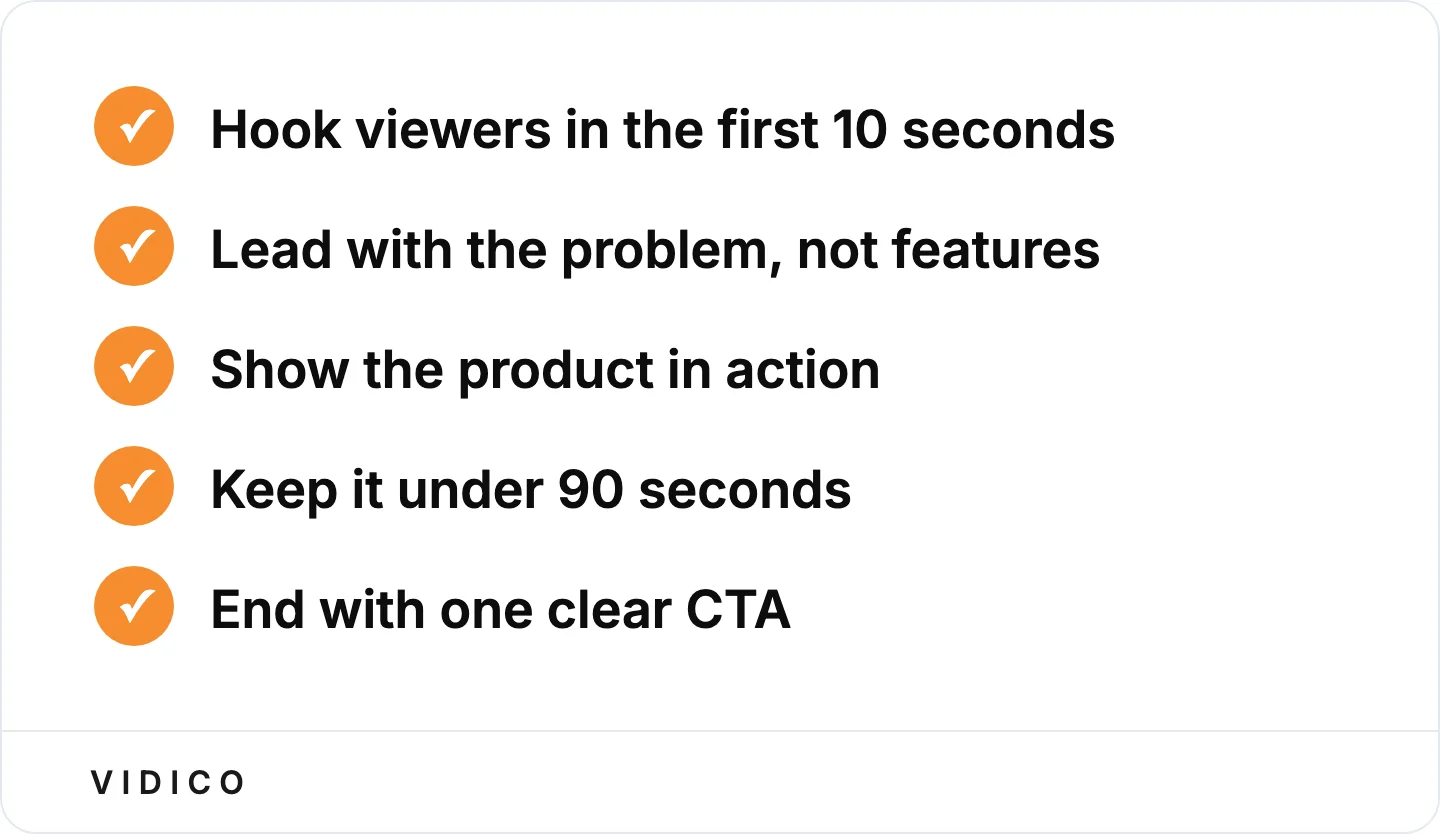
The five traits the strongest startup explainer videos share, regardless of budget or style.
Hook viewers in the first 10 seconds. Viewers decide whether to keep watching almost immediately. Open with the problem, not your logo. Wistia’s engagement research shows that videos under one minute hold 50% engagement, while engagement drops steadily after that. Your first 10 seconds determine whether the other 80 get watched.
Lead with the problem, not features. Dropbox didn’t open with “cloud storage syncs your files.” It opened with “you forgot your USB drive.” Name the pain before you name the product. Every example on this list that drove real conversions (EverString, HoneyBook, Dollar Shave Club) followed this pattern.
Show the product in action. Grammarly’s approach works because it replaces explanation with demonstration. If your product has a visual interface, screen recordings and UI animations do more selling than any voiceover. For non-visual products, use animation to represent the workflow.
Keep it under 90 seconds. Explainer videos work best in a tight window, and the strongest ones run 60 to 90 seconds. Longer than that and you’re competing with your audience’s attention span, not your competitors.
End with one clear CTA. One action. Not “visit our website, follow us on social, and sign up for the newsletter.” Taggg’s video ends with “schedule your first meeting.” Dollar Shave Club ends with “join the club.” The CTA should be as specific as the rest of the video.
For more on structuring a script, see our video script writing guide.
Startup Explainer Video Styles Compared
Choosing the right style depends on your product, audience, and budget.
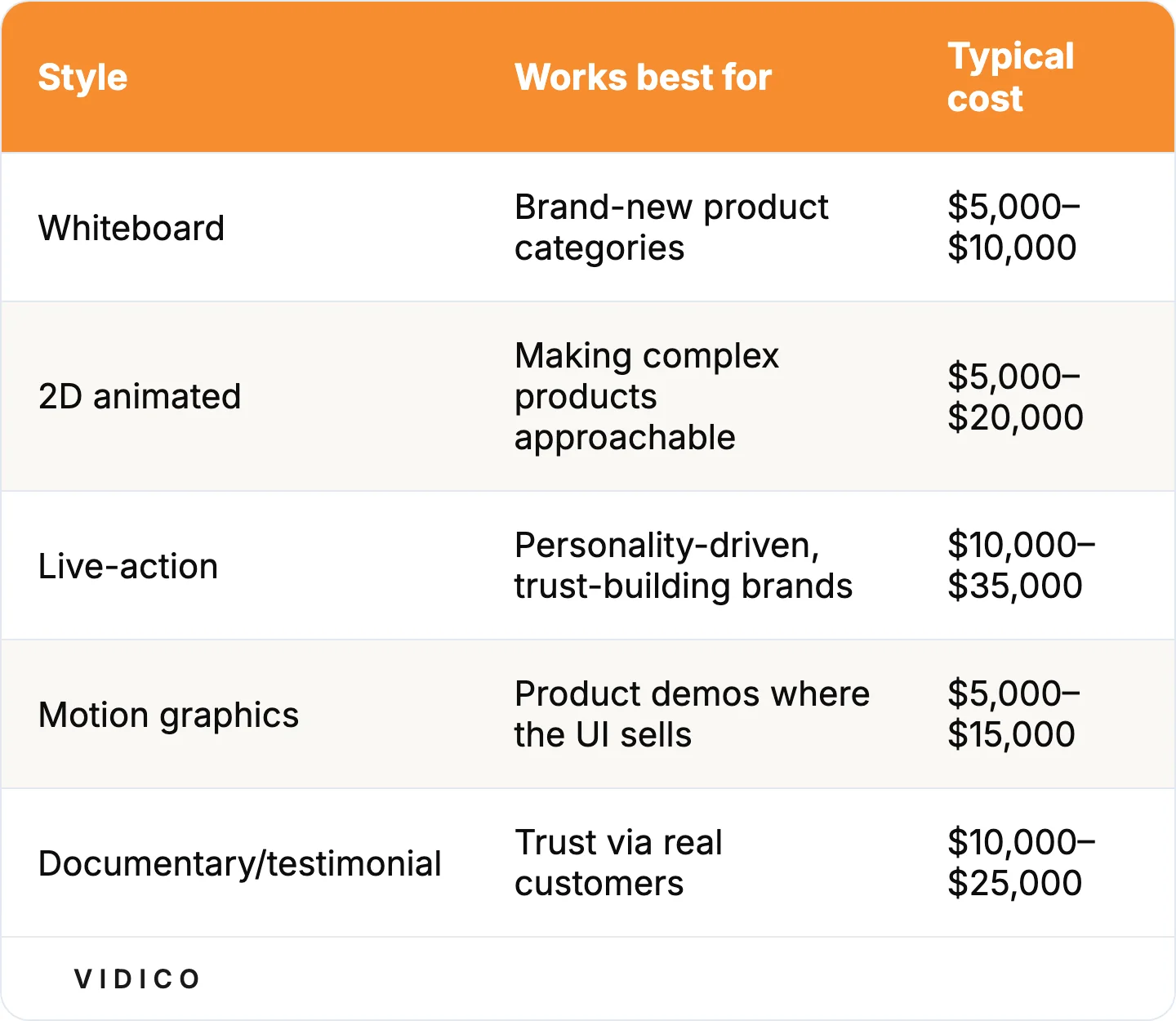
Five common explainer styles, what each fits, and typical 2026 cost ranges.
Whiteboard animation uses simple drawings on a white background, built in real time. It works best for explaining brand-new product categories where the audience doesn’t have a mental model yet. Dropbox used this style to introduce a product category buyers had never seen. Typical cost: $5,000 to $10,000.
2D animated is the most common style for startup explainers. Custom character design, on-brand color palettes, and smooth transitions make complex products feel approachable. EverString, Grammarly, monday.com, and Asana all used 2D animation. Typical cost: $5,000 to $20,000 depending on complexity.
Live-action uses real people, real locations, and real cameras. It works for personality-driven brands (Dollar Shave Club) and trust-building scenarios (Slack’s documentary). Typical cost: $10,000 to $35,000, depending on talent, locations, and crew.
Motion graphics combine typography, shapes, and UI elements in animated sequences. Best for product-focused demos where the interface is the selling point, like HoneyBook. Typical cost: $5,000 to $15,000.
Documentary and testimonial captures real customers or team members on camera. Builds trust faster than any scripted approach but requires willing participants and skilled editing. Typical cost: $10,000 to $25,000.
For a deeper comparison, see our guide on live-action vs. animation and explainer video styles by budget.
How Much Does a Startup Explainer Video Cost in 2026?
Professional startup explainer videos range from $5,000 to $35,000, with many funded startups spending $5,000 to $10,000 for their first video. The cost depends on style, length, and complexity.
DIY tier ($0 to $500). AI tools like Synthesia, Lumen5, and Canva’s video editor have reduced production costs for basic videos significantly. These tools work for MVP demos, internal presentations, and social media clips. They won’t replace a professional explainer for your homepage or investor deck, but they handle the volume plays.
Mid-range ($5,000 to $10,000). This is the sweet spot for most funded startups. You get custom animation or a basic live-action shoot with professional voiceover, sound design, and one to two rounds of revisions. Taggg and most of the animated examples on this list fell in this range.
Premium ($15,000 to $35,000). Full production with custom illustration, original music, professional talent, and extended revision cycles. Live-action shoots with multiple locations and crew fall here. Dollar Shave Club’s original video cost just $4,500, but that was 2012, and production values have risen since.
In Vidico’s 2026 State of Creative report, 42.7% of B2B tech marketers now allocate 21% to 35% of their total marketing budget to creative production. Teams that build reusable production systems produce content in 1 to 3 days versus 4 to 14 days for those starting from scratch each time.
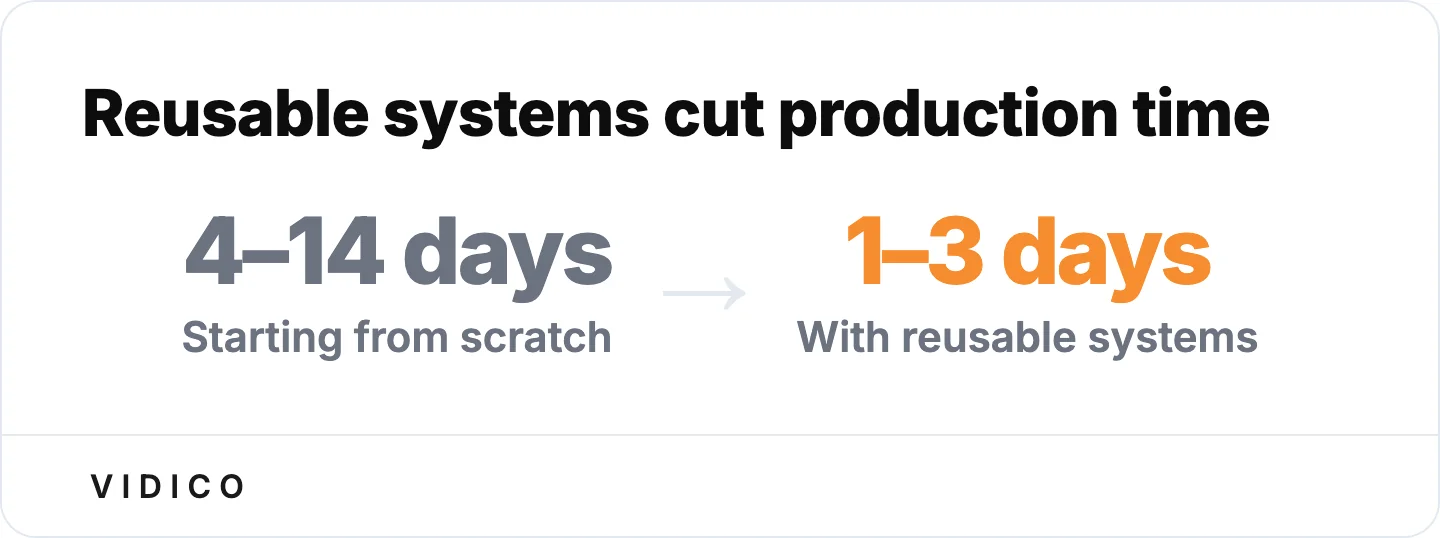
Teams with reusable production systems ship in 1 to 3 days versus 4 to 14 days from scratch. Source: Vidico 2026 State of Creative report.
For a tailored estimate, try the VidiFit Quiz. For broader production cost ranges, see our video production cost guide and animation cost breakdown.
FAQs
How long should a startup explainer video be?
Most startup explainer videos perform best between 60 and 90 seconds. Wistia’s engagement research shows that videos under one minute maintain about 50% engagement, while videos over five minutes drop to around 38%. For funded startups, 60 to 90 seconds gives enough time to present the problem, demonstrate the solution, and land one CTA without losing the audience.
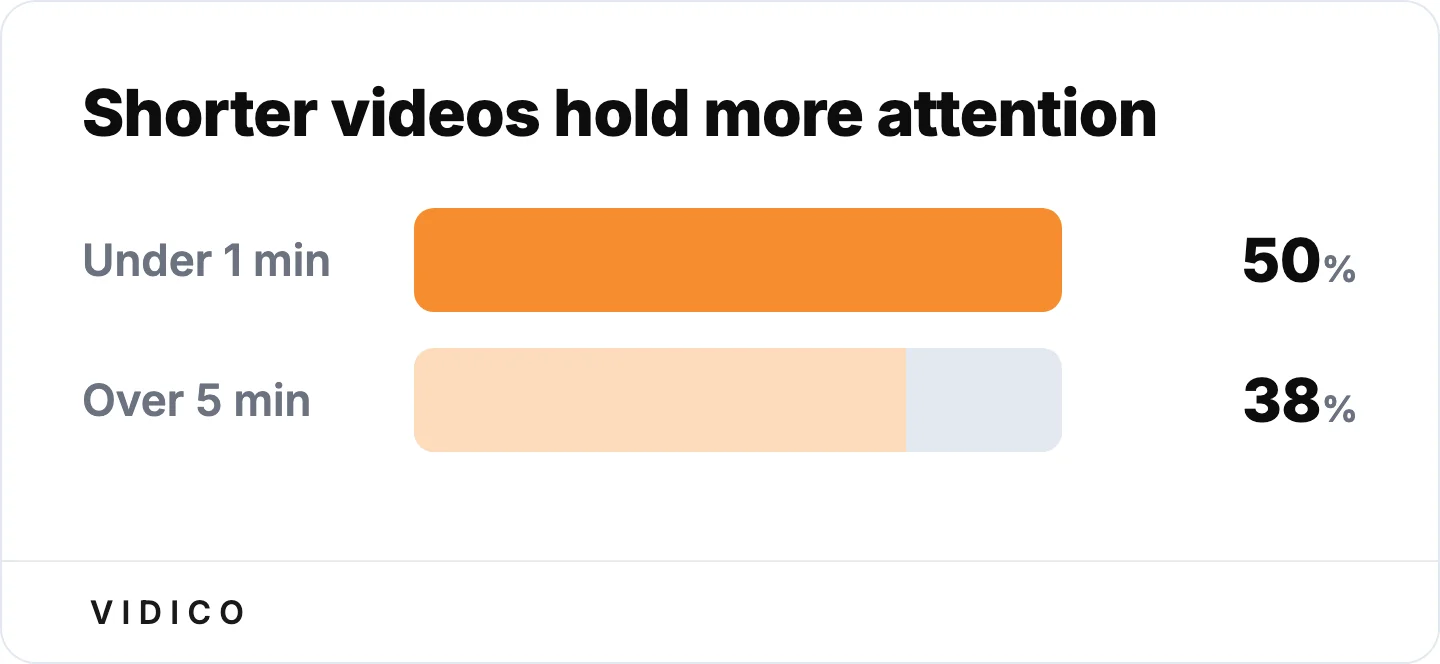
Shorter videos hold more attention: 50% engagement under one minute versus 38% over five minutes. Source: Wistia engagement research.
Are startup explainer videos still effective in 2026?
Yes. Explainer videos remain one of the highest-engagement formats marketers produce. Wistia’s State of Video research finds that 76% of companies now publish at least one video a month, and that educational content, which is what an explainer is, earns higher engagement than product demos or promotional clips. The format works because it compresses a complex value prop into something viewers can absorb in under two minutes.
What is the best AI tool to create explainer videos?
Synthesia, Lumen5, and Canva are among the most popular AI video tools today. Synthesia generates AI presenter videos from text scripts. Lumen5 converts blog posts into animated clips. Canva’s video editor handles simple motion graphics and social content. These tools work well for internal videos, social clips, and quick prototypes. For a homepage explainer, investor pitch, or paid campaign asset, professional production still delivers stronger results because human creative direction, custom animation, and brand-specific design can’t be replicated by template-based tools.
Should an early-stage startup invest in a professional explainer video?
It depends on what the video needs to accomplish. If you’re pitching investors, launching a product, or running paid acquisition, a professional video pays for itself. Taggg attributed its first 250 users directly to a professionally produced explainer. If you’re pre-revenue and testing ideas, a DIY tool or screen recording gets you started without the cost. The inflection point is when your startup video becomes a sales and conversion asset, not just an awareness play.
Conclusion
The best startup explainer videos share a formula: open with the problem, demonstrate the solution, and close with one CTA. The style (animation, live-action, documentary) matters less than the storytelling. Every example on this list proves that specificity beats polish.
Vidico produces explainer videos for startups and SaaS teams, with over 920 brands in our client community and campaigns that have generated 1.5 billion views. Our subscription model means production gets faster every month as we build your reusable template library.
Ready to see what a professional explainer could do for your startup? Book a free strategy session or start with our Creative Intelligence Report for a free competitive analysis of your current creative.