
Product video costs range from $200 for a UGC-style review to $200,000+ for a cinematic product launch commercial. That gap exists because “product video” covers at least seven distinct formats, each with different production requirements, crew needs, and timelines.
Most B2B brands spend between $3,000 and $15,000 per product video. But the real number depends on the type of product video you need, how you produce it, and how many you need per month.
Vidico produces video for B2B brands like Square, NinjaOne, and Amazon on monthly subscription plans. This guide breaks down what each product video type actually costs in 2026, what drives pricing, and how to pick the right production method for your budget and volume.
Key Takeaways
- Ecommerce product showcase videos cost $1,000 to $10,000 depending on complexity. A simple white-background turntable runs $1,000 to $3,000. Multi-angle shoots with lifestyle context push past $7,000.
- SaaS product demos run $1,500 to $15,000. Screen recordings with voiceover sit at the low end. Fully animated UI walkthroughs with custom motion graphics hit the high end.
- UGC-style product reviews are the cheapest format at $200 to $2,000 per video, and they often outperform polished production on social platforms where authenticity drives engagement.
- Subscription production models cut per-video cost over time. The first video is the most expensive. Reusable templates make each one after that faster and cheaper.
- Hidden costs add 15 to 30% to the initial quote. Revision rounds, product update re-shoots, and platform reformatting are the three most common budget surprises.
Content
How Much Does a Product Video Cost?
Most product videos cost between $500 and $50,000. The range is wide because “product video” includes everything from a 15-second Amazon listing clip to a full-production launch commercial.
Here is what each type costs in 2026:
| Product Video Type | Budget | Mid-Range | Premium |
|---|---|---|---|
| Ecommerce product showcase | $1,000 to $3,000 | $3,000 to $7,000 | $7,000 to $10,000+ |
| SaaS product demo | $1,500 to $2,500 | $2,500 to $5,000 | $5,000 to $15,000 |
| Amazon listing video | $500 to $1,500 | $1,500 to $3,500 | $3,500 to $7,000 |
| 3D product animation | $5,000 to $7,000 | $7,000 to $15,000 | $15,000 to $50,000+ |
| UGC-style product review | $200 to $800 | $800 to $2,000 | $2,000 to $5,000 |
| Product launch commercial | $5,000 to $15,000 | $15,000 to $50,000 | $50,000 to $200,000+ |
| Social media product teaser | $500 to $1,500 | $1,500 to $3,000 | $3,000 to $5,000 |
These ranges reflect U.S. market pricing as of mid-2026. Based on rate data from production companies across regions, European production tends to run about 35% less and Asian production roughly 70% lower than U.S. rates.
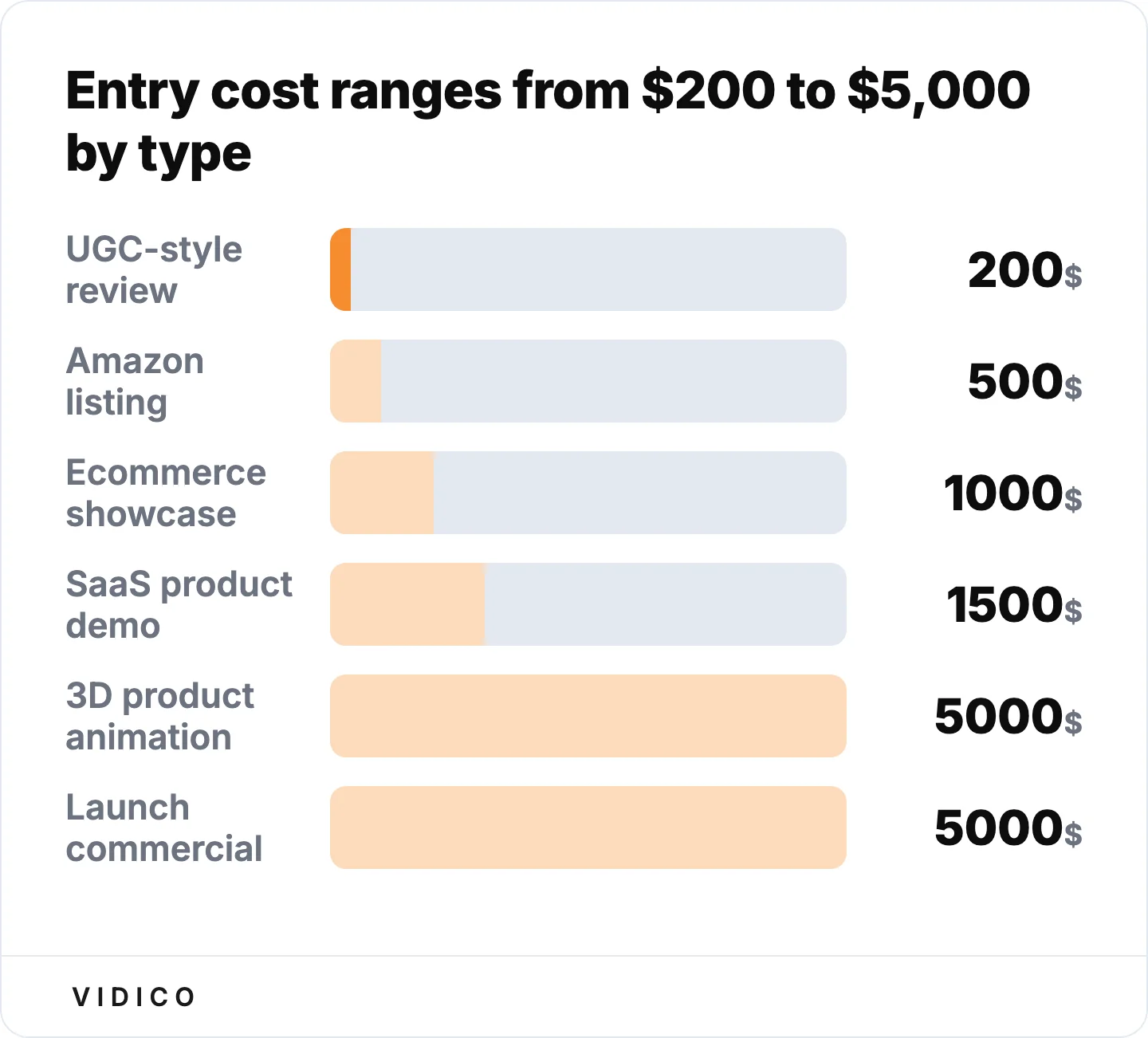
Budget-tier starting prices for each product video type. Source: Vidico 2026 product video pricing.
For a broader view of video production pricing across all categories (corporate, brand, event, educational), see our full video production cost guide.
In Vidico’s State of Creative Marketing in Tech report, 42.7% of B2B tech marketing leaders said they put 21 to 35% of their total marketing budget into creative production. Budget (27.4%) was the single biggest constraint they cited. Getting the cost right matters because most teams are working within tight creative budgets even as demand for video content grows.
Download the full State of Creative in Tech report to see how 230+ B2B tech marketing leaders are allocating creative budgets in 2026.
Product Video Cost by Type
Each product video format has a different cost structure. A 30-second ecommerce product showcase and a 30-second SaaS product demo might have the same runtime, but they require completely different production setups.
Ecommerce Product Showcase ($1,000 to $10,000)
Ecommerce product showcase videos present physical products with clean visuals, multiple angles, and lifestyle context. They are the most common type of product video for DTC and retail brands.
Budget tier ($1,000 to $3,000): Simple turntable or static shots on a white background. One product, one angle, basic transitions. Works for catalog-scale production where you need dozens of product pages covered.
Mid-range ($3,000 to $7,000): Multi-angle shots, 360-degree rotation, close-ups of materials and finishes. May include a model or lifestyle setting. Post-production includes color grading and branded lower thirds.
Premium ($7,000 to $10,000+): Cinematic product shots with professional lighting rigs, custom sets, talent, VFX compositing, and original music. This is the tier for hero product pages and paid media.
Ecommerce brands producing multiple product videos per month often bring per-video costs down to the $1,000 to $2,000 range through batch shooting. Filming 5 to 10 products in a single studio day splits setup and crew costs across all of them.
For more on ecommerce video strategy, see our ecommerce video production guide.
SaaS Product Demo ($1,500 to $15,000)
SaaS product demos show the software in action. The cost depends almost entirely on how you present the interface: screen recording vs. animated UI walkthrough vs. hybrid with a live presenter.
Budget tier ($1,500 to $2,500): Clean screen recording with professional voiceover, branded intro/outro, and basic transitions. This is the baseline for most SaaS product pages.
Mid-range ($2,500 to $5,000): Animated cursor movements, highlighted UI elements, step-by-step flow with callout graphics. More polished than raw screen capture, easier to update when the product changes.
Premium ($5,000 to $15,000): Fully custom UI animations, 2D/3D motion graphics, split-screen demos with real-user footage. Typical for flagship product pages and sales enablement.
Most B2B SaaS companies land in the $2,500 to $5,000 range for a 2 to 3 minute product demo.
See real examples of how SaaS brands structure their demos in our product demo video examples guide.
Amazon Listing Video ($500 to $7,000)
Amazon allows up to four video slots per product listing. These videos are short (15 to 60 seconds), auto-play on mute, and need to communicate value without sound.
Budget tier ($500 to $1,500): Simple product-on-white footage or AI-generated product visualization. Amazon’s own Video Builder tool (still in beta as of 2026) offers a free starting point, but the output is limited to basic templates.
Mid-range ($1,500 to $3,500): Professionally shot product footage with text overlays, feature callouts, and comparison visuals. This is the tier where Amazon sellers typically see the strongest return. Product videos on listings reduce returns and increase conversion by giving buyers a clearer picture of what they are getting.
Premium ($3,500 to $7,000): Lifestyle-shot video with talent demonstrating the product, studio lighting, and branded post-production. Common for premium brands that want their Amazon presence to match their DTC site quality.
For more on video ad formats that work on Amazon and other platforms, see our guide on ecommerce video ads.
3D Product Animation ($5,000 to $50,000+)
3D product animation is the most expensive category per minute. It is used for products that cannot be easily filmed: unreleased hardware, complex machinery, medical devices, or products with internal components buyers need to see.
Budget tier ($5,000 to $7,000): Simple 360-degree product rotation from existing CAD files. Minimal environment, basic materials rendering.
Mid-range ($7,000 to $15,000): Custom-modeled product with realistic materials, environment, and animated feature highlights. 2 to 4 week production timeline.
Premium ($15,000 to $50,000+): Photorealistic rendering, exploded-view animations showing internal components, cinematic camera movements, and custom environments. 4 to 8 week timeline.
The cost driver in 3D animation is modeling time. If your engineering team can provide production-ready CAD or 3D files, you can cut the budget-tier cost by 20 to 30%.
For more on animation pricing across all formats, see our animation cost breakdown.
Free competitive analysis: Wondering how your product videos compare to competitors? Get a Creative Intelligence Report with a side-by-side breakdown of your creative vs. top competitors in your space. 48-hour delivery, limited spots.
If that’s the route you need, our 3D product animation production service scopes and prices this exact deliverable.
UGC-Style Product Review ($200 to $5,000)
User-generated content (UGC) style product reviews are shot by creators on smartphones. They are designed to look organic, not produced. This format consistently outperforms polished production on social platforms where authenticity drives engagement.
Budget tier ($200 to $800): A single creator, one take, minimal editing. Post on a UGC marketplace like Billo or Insense and receive a finished video in 3 to 7 days.
Mid-range ($800 to $2,000): Creator with a larger following, scripted talking points, branded elements, multiple takes with professional editing.
Premium ($2,000 to $5,000): Managed UGC programs with 3 to 5 creators producing multiple variations for A/B testing across channels. Includes creative direction, script development, and performance tracking.
UGC works best for social media ads, TikTok, Instagram Reels, and top-of-funnel paid campaigns. It is not the right format for product pages, sales decks, or any placement where your brand needs to look established and polished.
Product Launch Commercial ($5,000 to $200,000+)
Product launch commercials have the widest cost range of any product video type because scope varies from a 30-second social spot to a multi-location TV campaign.
Budget tier ($5,000 to $15,000): Single-location shoot, small crew (3 to 5 people), one to two days of production. Works for startups launching a first product and SaaS companies announcing a major feature.
Mid-range ($15,000 to $50,000): Multi-day shoot, professional talent, custom set design, branded post-production with motion graphics. This is the tier for product launches at established companies that need to land across paid social, YouTube, and website.
Premium ($50,000 to $200,000+): Multi-location or multi-market shoot, professional talent, VFX, original score, and edits formatted for TV, connected TV, cinema, and digital. Enterprise-level product launches and rebrands.
For product launch video inspiration, see our roundup of top product launch videos.
Social Media Product Teaser ($500 to $5,000)
Social media product teasers are 15 to 30 second clips optimized for TikTok, Instagram, LinkedIn, or Facebook. They are often repurposed from longer product videos, which significantly cuts cost.
Budget tier ($500 to $1,500): Repurposed from existing product footage. New intro hook, platform-specific formatting (9:16 for TikTok/Reels, 1:1 for feed), basic text overlays.
Mid-range ($1,500 to $3,000): Original short-form creative with motion graphics, branded transitions, and platform-native pacing. Shot specifically for social, not repurposed.
Premium ($3,000 to $5,000): Multiple variations (3 to 5 hooks, different formats) for A/B testing across platforms. Includes performance-optimized editing and trend-informed creative direction.
The smartest way to reduce social teaser costs is to plan them into a larger product video shoot. One product shoot can yield 40+ assets when you shoot with repurposing in mind: hero video, social cutdowns, ad variations, GIFs, and email assets.
For social-specific pricing details, see our social media video cost guide.
What Drives Product Video Pricing
Six factors determine what you will pay for a product video. Understanding them helps you scope projects accurately and avoid budget surprises.
1. Product complexity. A SaaS dashboard walkthrough, a physical product showcase, and a 3D-rendered prototype each require fundamentally different production setups. Physical products need studio time, lighting rigs, and potentially talent. Software products need screen capture, UI animation, or motion graphics. The production approach changes the cost structure entirely.
2. Video length and format. A 15-second social teaser and a 3-minute product walkthrough have very different budgets even when they feature the same product. Longer videos require more footage, more editing, and more review cycles. But length alone does not equal cost. A 15-second product animation can cost more than a 3-minute talking-head walkthrough because animation is billed by complexity, not runtime.
3. Production approach. Live-action shoots with crew and talent cost more per day than screen capture or animation. But they also produce more raw footage that can be repurposed. Budget allocation for a typical live-action product video: pre-production (20 to 25%), production (50 to 60%), post-production (20 to 25%).
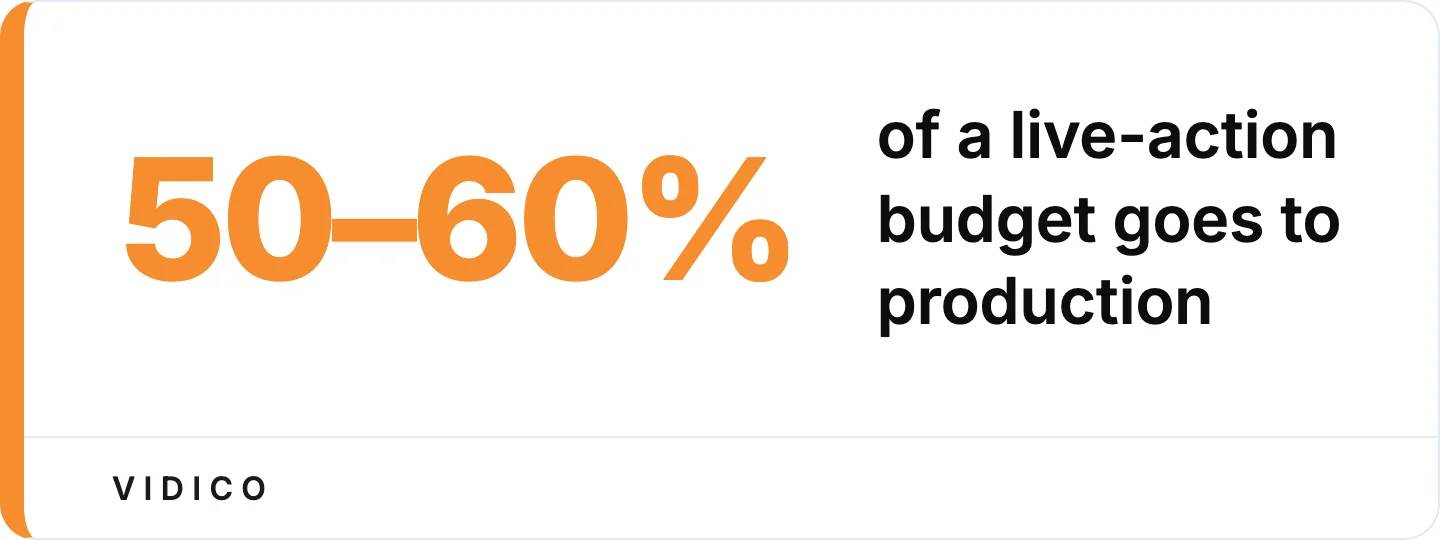
On a typical live-action shoot, pre-production and post-production each take 20-25%. Source: Vidico production budget breakdown.
4. Revision rounds. Most quotes include 1 to 2 rounds of revisions. Additional rounds typically cost $500 to $2,000 each. This is the most common source of budget overruns on product videos. Define what “final” means before production starts.
5. Localization. Adapting a product video for additional markets costs $600 to $2,000 per language per video. This includes subtitle translation, voiceover re-recording, and cultural adaptation. Brands serving global markets should budget for localization from the start.
6. Platform requirements. Amazon, Shopify, TikTok, YouTube, and LinkedIn each have different technical specs (aspect ratios, file sizes, duration limits). Reformatting a single product video for five platforms adds $200 to $500 per platform in post-production time.
Get a custom quote: Not sure which production approach fits your budget? Take the Vidico quiz to see pricing options matched to your video needs and volume.
Product Video Cost by Production Method
How you produce product videos matters as much as what type you produce. The same ecommerce product showcase can cost $500 or $10,000 depending on whether a freelancer, agency, or in-house team creates it.
| Method | Monthly Cost | Per-Video Cost | Best For |
|---|---|---|---|
| DIY (AI tools) | $20 to $200/mo | $5 to $50 | Internal comms, low-stakes content |
| Freelancer | Varies | $500 to $2,000 | One-off projects, simple formats |
| Agency (per-project) | Varies | $3,000 to $15,000 | Campaign-quality, one-time needs |
| Subscription/retainer | $2,500 to $16,500+/mo | Decreases over time | Ongoing monthly production |
| In-house team | $7,000 to $15,000+/mo | Amortized | Full-time, daily video needs |
DIY and AI tools ($20 to $200/month) work for internal presentations, quick social posts, and draft-quality content. Tools like Descript, CapCut, and Canva’s video editor lower the barrier to entry. But they produce template-driven output that falls short for customer-facing product pages and paid media.
Freelancers ($500 to $2,000 per video) are the cheapest option for low-volume production (fewer than 6 videos per month). The tradeoff is management overhead. Coordinating scripts, feedback, and delivery with freelancers can eat into the hourly savings vs. a full-service team.
Agency per-project ($3,000 to $15,000 per video) delivers campaign-quality production with a dedicated team. The downside is cost unpredictability. Each new project starts from scratch with a new quote, new onboarding, and no template carry-over.
Subscription and retainer models ($2,500 to $16,500+/month) make sense when you need 8 or more videos per month. A flat monthly fee covers the full production team. The key advantage is that cost per video decreases over time as reusable templates, brand assets, and production workflows compound. At Vidico, we produce product videos for B2B brands on monthly subscription plans, and our clients see the per-asset cost drop as their template library builds. Across 920+ clients, the average per-asset cost drops 40-60% by the sixth month as template libraries compound.
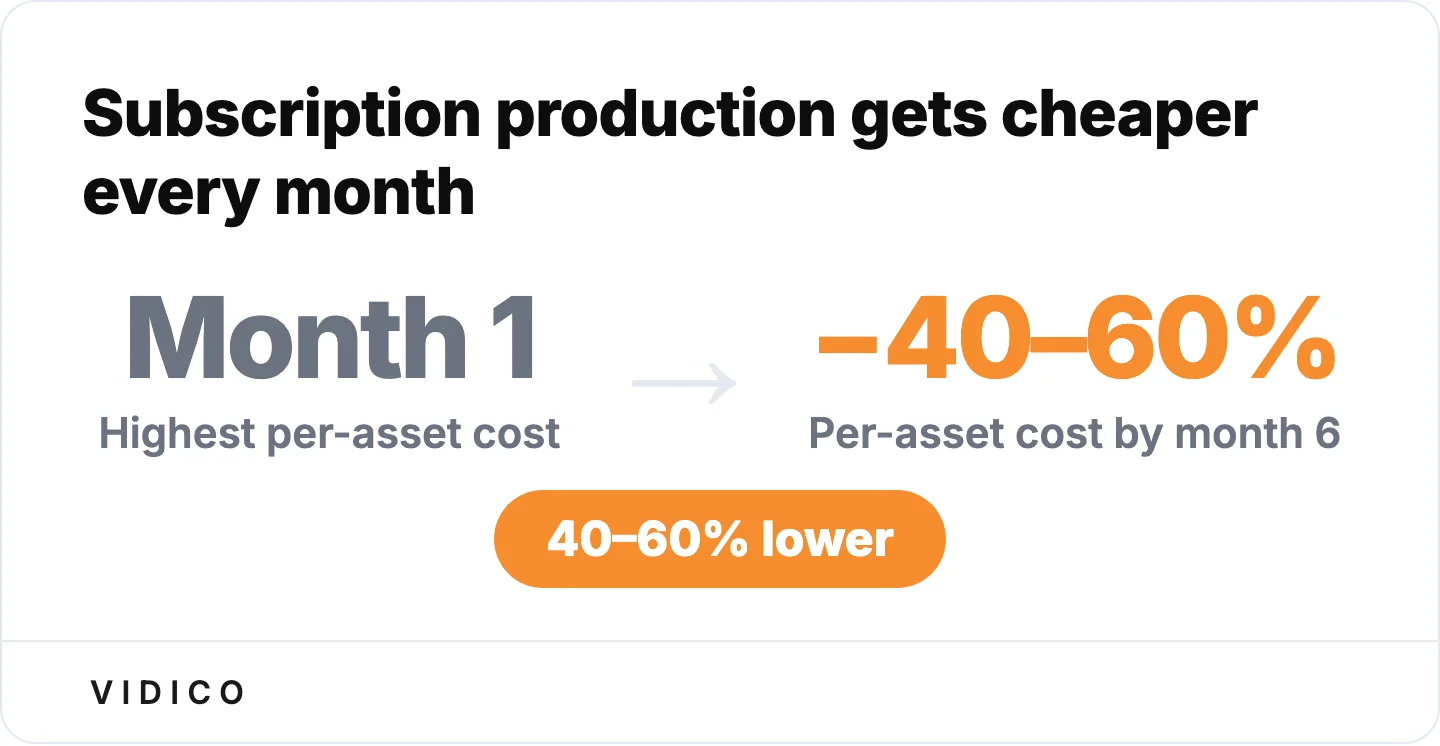
Reusable templates and brand assets compound, so cost per video falls month over month. Source: Vidico, across 920+ clients.
In-house teams ($7,000 to $15,000+/month in salary and equipment) work when your company produces video every day. Below that volume, you are paying a full-time salary for part-time output.
In Vidico’s State of Creative Marketing in Tech report, nearly half of B2B tech marketing teams said they run a hybrid production model (in-house plus external). The hybrid approach lets teams handle quick-turn content internally while outsourcing higher-production work to a dedicated partner.
For a deeper look at outsourcing tradeoffs, see our outsourcing video production guide.
Hidden Costs in Product Video Production
The quoted price is rarely the final price. These are the costs most buyers do not plan for.

Revision rounds, product update re-shoots, and platform reformatting are the most common surprises. Source: Vidico hidden-cost breakdown.
1. Extra revision rounds ($500 to $2,000 each). Most quotes include 1 to 2 rounds. Every round beyond that is billable. “Quick changes” to pacing, subtitles, or color grading can add $50 to $100 per change. Define the number of included revisions in your contract before signing.
2. Product update re-shoots ($2,000 to $5,000 per video). When your product changes, your videos are outdated. SaaS companies with frequent UI updates and hardware brands with annual model refreshes face this cost every product cycle. Animated and screen-capture formats are cheaper to update than live-action because they do not require a reshoot.
3. Localization ($600 to $2,000 per language per video). Subtitles alone run $200 to $500 per language. Voiceover re-recording adds $400 to $1,500. Cultural adaptation (adjusting visuals, references, or humor for different markets) adds more.
4. Music licensing ($50 to $5,000+ per track). Stock music from libraries like Artlist or Epidemic Sound runs $50 to $300 per video. Custom composition starts at $2,000. Well-known tracks cost significantly more and require separate licensing for each platform.
5. Platform reformatting ($200 to $500 per platform). A product video shot in 16:9 for YouTube needs to be reformatted for Amazon (1:1), TikTok (9:16), and LinkedIn (4:5 or 1:1). Each reformat requires re-editing, not just cropping.
6. Freelancer management overhead. The hourly savings of freelancers over agencies can disappear when you factor in the time spent writing briefs, reviewing cuts, coordinating schedules, and managing file delivery. This cost is invisible but real. It is the primary reason teams with 8+ videos per month switch to retainer or subscription models.
For an overview of retainer pricing structures, see our guide on video retainer packages.
Plan your video strategy: Get a free video marketing plan with production recommendations tailored to your product type, volume, and budget.
How to Budget for Product Videos
Building a product video budget starts with three questions: what type of video, how many per month, and what production method.
Step 1: Define the video type. Use the pricing table in the first section of this guide to identify which product video types you need. A SaaS company launching a new feature might need a product demo ($2,500 to $5,000) plus 3 to 5 social teasers ($500 to $1,500 each). An ecommerce brand onboarding 20 new SKUs might need batch product showcases at $1,000 to $2,000 per video.
Step 2: Calculate monthly volume. How many product videos will you need per month or per quarter? Volume determines which production method is most cost-effective. Under 6 per month, freelancers are usually cheapest. At 8 to 20 per month, a retainer or subscription model brings per-video cost below what you would pay per-project.
Step 3: Choose the production method. Match your volume to the production method comparison table above. Factor in quality requirements. UGC and freelancer work is fine for social media. Product pages and sales decks need mid-range or premium production.
Step 4: Add 15 to 30% for hidden costs. Revision rounds, platform reformatting, and product update re-shoots are near-certainties for any ongoing video program. Budget for them upfront.
Step 5: Track ROI per asset. Video viewers convert at 2 to 4 times baseline rates according to video commerce research.
Geographic context based on production company rate data: a 60-second product video averages about $6,630 in the U.S., roughly $4,285 in Europe, and about $1,930 in Asia.
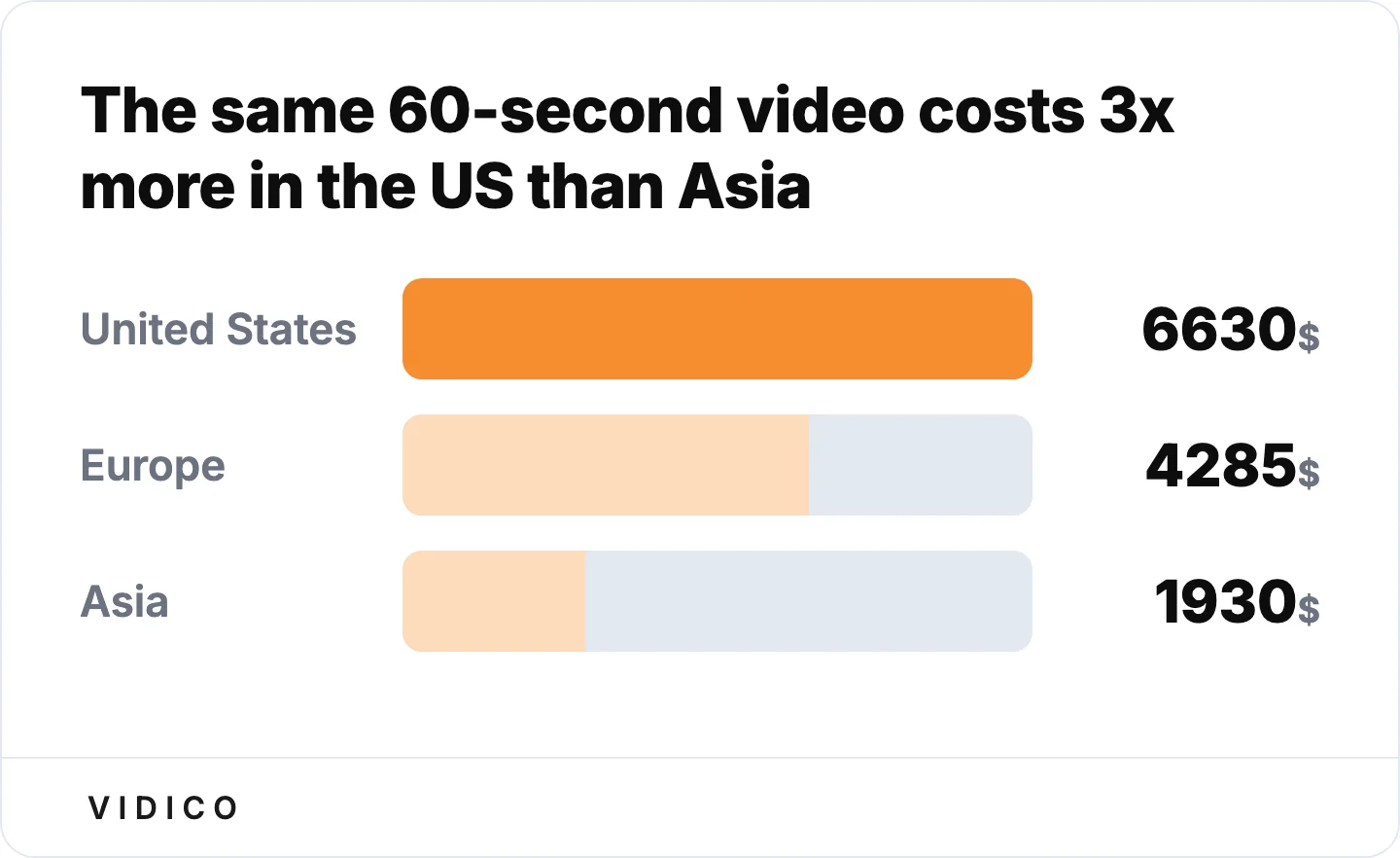
Average cost of a 60-second product video by region, from production company rate data. Source: Vidico.
Teams with reusable template systems produce content 3 to 10 times faster than teams starting from scratch on every project.
For a tool to estimate your specific costs, see the video production cost calculator.
FAQs
How many product videos do I need per month?
The right number depends on your channel mix and product catalog. A SaaS company with one core product might need 3 to 5 videos per month — a product demo, a couple of social teasers, and an ad variation. An ecommerce brand onboarding 20 new SKUs per quarter might need 15 to 20 product showcases per month during launch periods. The volume question matters most for choosing your production method. Under 6 per month, per-project pricing works. Above that threshold, a subscription model typically delivers lower per-video costs because setup, onboarding, and template development are amortized across every video.
Do product videos actually increase conversions?
Yes. Video commerce research shows that shoppers who watch product videos convert at roughly 2 to 4 times the rate of those who do not. The effect is strongest on product pages where buyers are evaluating a purchase decision — seeing the product in use reduces uncertainty and return rates. The format matters too. UGC-style reviews tend to outperform polished production on social platforms where authenticity drives engagement, while professionally produced demos perform better on product pages and in sales enablement where the brand needs to look established.
Final Thoughts
Product video costs depend on three things: type, production method, and volume. A $200 UGC review and a $50,000 product launch commercial serve completely different purposes, and neither is the “right” answer without knowing what you need.
Start with the type table in this guide. Match it to your monthly volume. Choose a production method that fits both. And budget 15 to 30% above the quoted price for the hidden costs that catch most first-time buyers.
At Vidico, we have shipped 2,000+ campaigns across SaaS, ecommerce, and enterprise on monthly subscription plans. Our template systems reduce per-video cost over time, so month three is cheaper than month one.
If you are producing product videos on an ongoing basis, book a free strategy session to see how a subscription model compares to your current per-project costs.