
SaaS marketing in 2026 runs on three shifts: answer engine optimization, AI that executes instead of assists, and growth built on trust and retention rather than paid volume. The spending question has changed with it. Budgets are growing, but they are concentrating into fewer, better-made things.
We surveyed 230+ B2B tech marketing leaders for Vidico’s 2026 State of Creative in Tech report. Three quarters of them told us their creative production budget is going up this year. The same group told us their hardest problem is no longer making content. It is getting attention for the content they already have.
These are the ten trends deciding which SaaS teams compound and which ones just spend.
Key Takeaways
- Creative budgets are growing, not shrinking. 76% of B2B tech marketers say their creative production budget is increasing this year, and 74% say total marketing budget is growing.
- Attention is the constraint, not production. 42% say getting attention is harder now because of competition and sameness. Differentiation has overtaken efficiency as the top priority for 2026.
- Proof is a distribution problem. Only 6.8% say they lack enough proof. The other 93% have proof and cannot activate it, which is a packaging failure rather than a content shortage.
- Reusable systems cut time-to-live from weeks to days. Most teams take 4 to 14 days from concept to live. Teams with reusable creative systems ship in 1 to 3.
- AI governance is the gap nobody has closed. Only 29% of teams have a formalized AI policy, even though AI now sits inside most production workflows.
Content
The 10 SaaS Marketing Trends Shaping 2026
1. AI Moves From Assistant to Autonomous Agent
Agentic workflows are AI systems that run and adjust marketing campaigns end to end, replacing generative tools that only drafted content. The shift is from “help me write this” to “run this campaign and correct it while it runs.”
Adoption is already broad. SaaS Capital’s survey of private SaaS companies found that over 76% of respondents were using at least some AI in their existing products, 69% had deployed AI in day-to-day operations, and nearly 92% planned to increase their use of AI during 2025.
Where AI actually lands inside the workflow is more specific than the adoption numbers suggest. In our 2026 State of Creative in Tech report, B2B tech marketers told us AI does the most work mid-process, on editing and repurposing material that already exists. The brief at the start and the final output at the end stay human. Final copy is the single most protected output from AI in their workflows, and accuracy is the risk they worry about most.
This is also where personalization now happens. AI adjusts email sequences, ad variants, landing page copy, and in-product onboarding against behavioral signals from first-party data rather than static persona segments. That only holds together when the underlying data is clean, which is why teams that invested in data infrastructure first get more out of the same tools.
The governance gap is the part most teams have not addressed. Only 29% of the marketing leaders we surveyed have a formalized AI policy, and nearly half are still building one. Running autonomous agents against customer data without a written policy is the operational risk of this trend, not the technology itself.
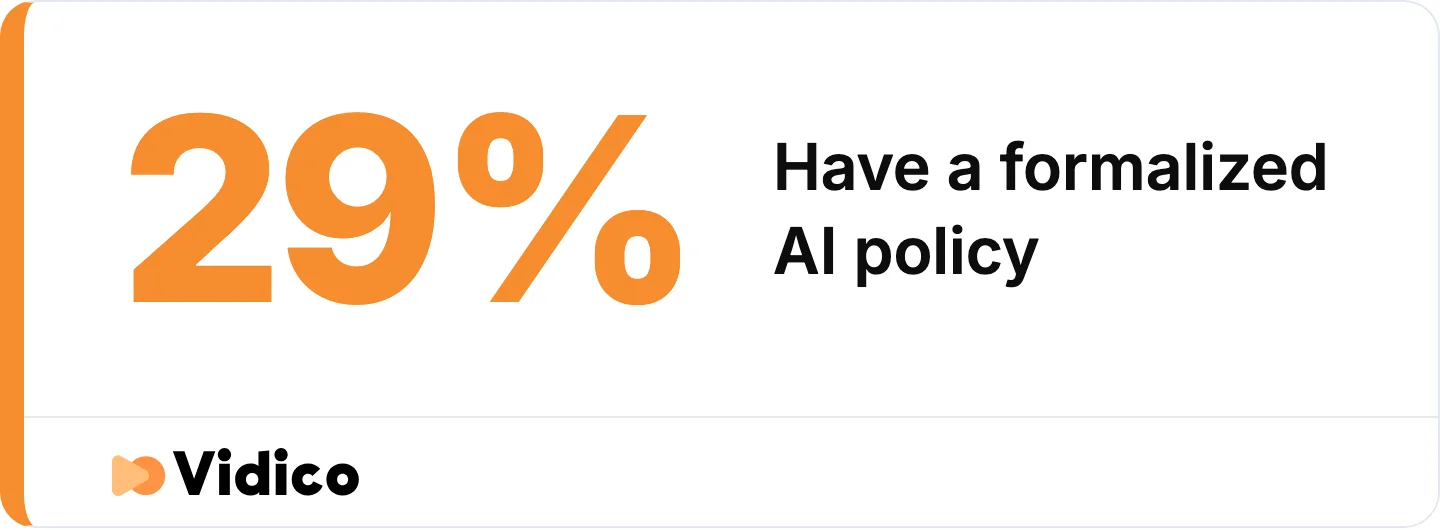
Most teams run AI inside production workflows without a written policy. Source: Vidico’s 2026 State of Creative in Tech survey of 230+ B2B tech marketing leaders.
We take the same position internally. AI speeds our production on localization, repurposing, and variation. Our creative directors own the brief and every final deliverable.
2. Precision Content Replaces High-Volume AI Output
Precision content is the shift from publishing high volumes of generic AI-assisted material to publishing fewer pieces built on original research and named human expertise. Volume stopped working because everyone got volume at the same time.
Vidico’s 2026 State of Creative in Tech survey shows why. 42% of B2B tech marketers say getting attention is harder now, and they attribute it to two things at once: more competition and more sameness. 35% report accelerating creative fatigue, meaning their assets stop performing faster than they used to. Differentiation now edges out efficiency as the top priority for 2026, which reverses the order of the last several years.
The practical response is to publish less and make each piece carry something nobody else has. Original data, a named practitioner’s judgment, a real customer result with numbers attached. These are the elements an AI system cannot synthesize from other people’s pages, which is exactly why they get cited.
Distribution through people rather than logos follows the same logic. Metricool’s analysis of 673,658 LinkedIn posts across 63,108 accounts found personal profiles outperform company pages by 63% on engagement rate, at 2.60% against 1.74%. That is a meaningful edge and worth building around. It is not the order-of-magnitude gap that circulates in marketing posts.
Get the full dataset. Our 2026 State of Creative in Tech report breaks down how 230+ B2B tech marketing leaders are budgeting, testing, and shipping creative this year.
3. SEO Becomes Answer Engine Optimization
Answer engine optimization is the practice of structuring content so AI systems cite it directly, rather than optimizing only to rank a blue link. It covers ChatGPT, Perplexity, Gemini, and Google’s AI Overviews, and it is sometimes called generative engine optimization (GEO).
The click math is what forces the change. Pew Research Center tracked the actual browsing behavior of 900 US adults across 68,879 searches. Users who saw an AI summary clicked a traditional search result in 8% of visits. Users who did not see one clicked in 15% of visits, nearly twice as often. Users clicked a link inside the AI summary itself in just 1% of visits.
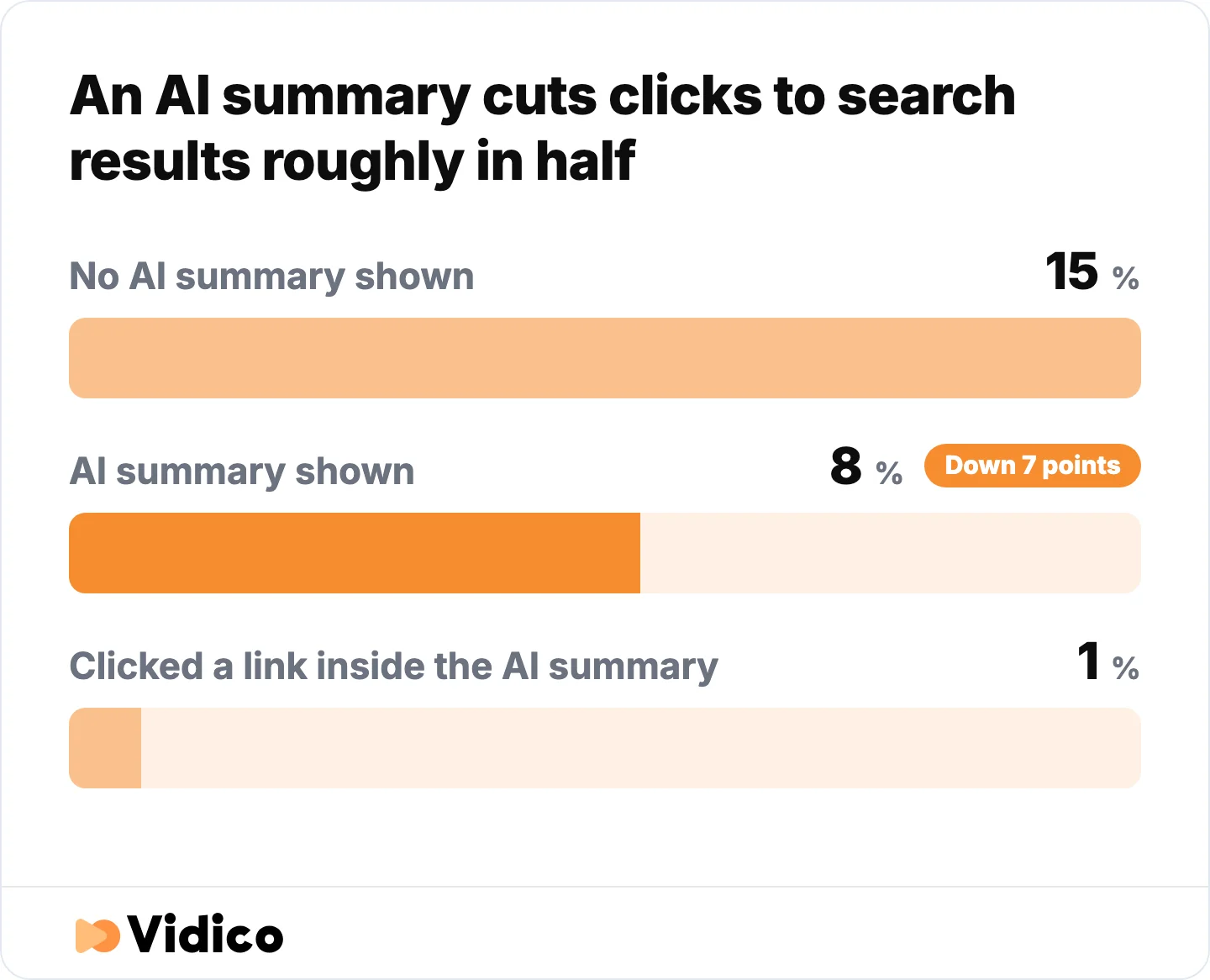
An AI summary nearly halves clicks to traditional results, and almost nobody clicks the links inside it. Source: Pew Research Center, 68,879 searches across 900 US adults.
Read together, those numbers say the citation is the outcome now. Being named inside the answer matters more than being the eleventh link under it.
Structure is what earns the citation. The peer-reviewed GEO study presented at KDD found that content restructured for generative engines can lift visibility in generative responses by up to 40%. What that looks like in practice for a SaaS page:
- Self-contained passages. Each section answers its own question without depending on the paragraph above it.
- Declarative sentences that state a fact plainly enough to be quoted whole.
- One topic per heading, with a clean H2 and H3 hierarchy.
- Structured data, including schema markup, FAQ blocks, and tables.
- Primary source citations an AI system can verify.
The test is simple. Lift any section out of the page, read it cold, and see whether it still makes sense as a standalone answer. If it needs the surrounding page to be intelligible, it will not be cited.
4. Proof Becomes a Distribution Problem, Not a Creation Problem
Most SaaS teams do not have a proof shortage. They have a proof activation problem. In Vidico’s 2026 State of Creative in Tech survey, only 6.8% of B2B tech marketers said they lack enough proof, which means roughly 93% already have customer evidence sitting somewhere and cannot get it in front of buyers effectively.
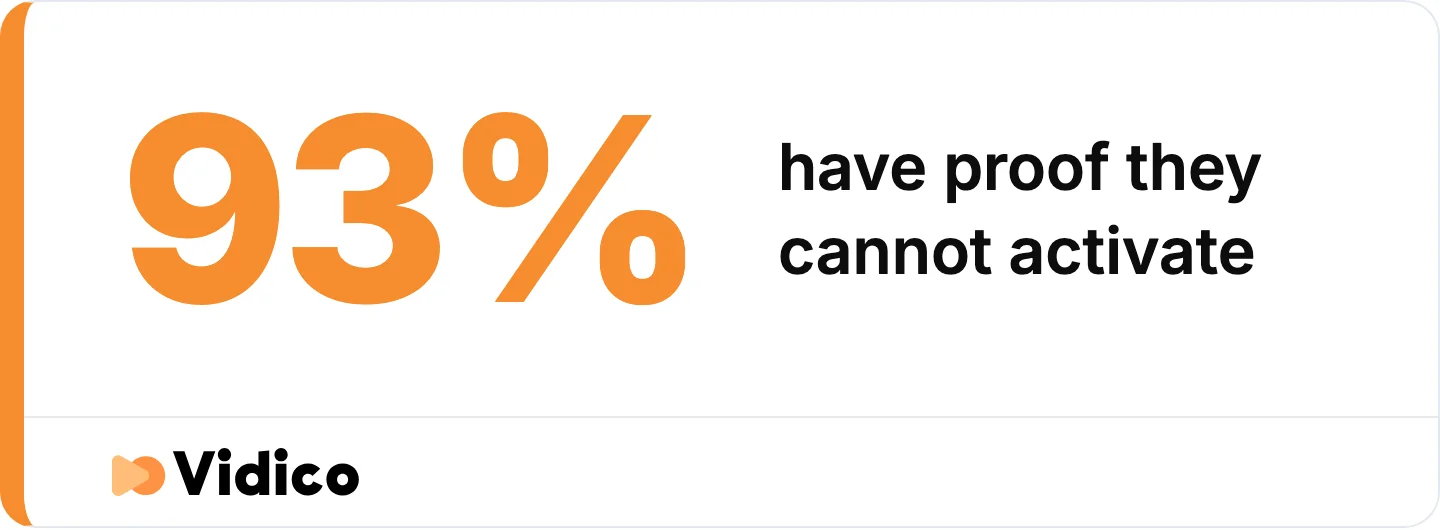
Just 6.8% say they lack enough proof material, meaning roughly 93% have proof they cannot activate. Source: Vidico 2026 State of Creative in Tech report.
The gap shows up in how proof gets managed. 85% of teams have at least a partial proof system. Only 38% have standardized it. The difference between those two numbers is a folder of case studies nobody can find against a library the sales team actually uses.
Proof type matters as much as proof volume. Customer outcomes and results are the most persuasive proof type at 42.7%, ahead of every other category we tested. Feature explanations and company credentials do not move buyers the way a named customer with a number does.
Three things separate teams that activate proof from teams that store it:
- One asset becomes many formats. A customer interview becomes a case study page, a 60-second social cut, a sales deck slide, an ad, and a landing page module.
- Proof lives where the decision happens. On the pricing page and inside the trial, not only in a case studies archive.
- The system is standardized, so a new customer result enters a defined pipeline instead of waiting for someone to have time.
Our A/B tested work with HoneyBook is a small, clean example of the effect. A single video variation produced a 9% lift in waitlist signups against the control.
5. Video Becomes the Proof Format
Video’s role in SaaS marketing has moved from awareness content to the format that carries proof. The question changed from whether to make video to which videos actually influence revenue.
Format preference has settled. In Vidico’s 2026 State of Creative in Tech survey, mid-form video is now the leading content format, though by a slim margin. Paid social video and customer-proof video are tied as the highest-impact formats for 2026, which puts customer evidence and paid distribution at the same level of importance.
The ROI picture from independent surveys points the same direction. HubSpot’s State of Marketing survey of more than 1,500 global marketers found the top three ROI-driving content formats are all video-based: short-form video at 49%, long-form video at 29%, and live-streaming video at 25%.
Adoption is high but not universal. The Content Marketing Institute’s B2B benchmark research, based on 980 B2B marketers, found 76% used video in the previous 12 months.
Spending is flattening rather than climbing, which is the detail most trend posts miss. Wistia’s State of Video report, built on a survey of 900+ marketers plus platform data covering 13 million videos, found 40% expect to spend more this year while 46% are holding budgets flat. The share planning increases has fallen since 2023. Video is not getting a bigger slice automatically. It has to earn it.
That makes production efficiency the deciding variable. Our brand video work with Cascade reached 1.4M+ YouTube views at a 93% view rate.
See what your competitors are shipping. Our Creative Intelligence Report analyzes 12 areas of what your competitors are shipping and lands in 48 hours.
Teams making this shift often start with a SaaS explainer video that turns product complexity into a proof asset buyers can share internally.
6. Creative Production Shifts From Projects to Systems
A creative system is a library of branded templates, reusable motion assets, and defined formats that make each new asset faster to produce than the last. A project model starts from zero every time. This is the single largest efficiency gap in SaaS marketing right now, and almost nobody writes about it.
The speed difference is measurable. In Vidico’s 2026 State of Creative in Tech survey, most teams take 4 to 14 days to go from concept to live. Teams running reusable creative systems ship in 1 to 3 days. That is the difference between reacting to a competitor’s launch in the same news cycle and reacting two weeks later.

Reusable creative systems compress concept-to-live from weeks to days. Source: Vidico’s 2026 State of Creative in Tech survey.
Only 1 in 3 teams has a fully reusable asset system today. The rest are rebuilding.
The bottlenecks are consistent and they are not budget. Production capacity and internal approvals are the top two workflow constraints our respondents named. Nearly half now run a hybrid model, combining an in-house team with external production capacity, which is a structural answer to a capacity problem rather than a cost-cutting move.
Testing cadence depends on the same infrastructure. 65% of teams run structured creative experimentation at least monthly. Sustaining that requires variations to be cheap to produce, which only happens when the underlying assets are templated. Teams testing monthly on a project model burn their budget on production and have nothing left to test with.
This is what we build for teams as a Content Engine, which in plain terms is a branded template library plus the motion and design systems around it. One campaign becomes 40+ assets: ad variations, social cutdowns sized per platform, email banners, landing page loops, and sales enablement clips. The templates make each subsequent month faster instead of starting over.
7. Creative Budgets Grow, But They Concentrate
Creative production budgets are increasing for most B2B tech teams, and they are being spent on fewer, more deliberate things. 76% of the marketing leaders in Vidico’s 2026 State of Creative in Tech survey say their creative production budget is increasing this year, and 74% say total marketing budget is growing.
Creative is also taking a larger share of the total. 42.7% of teams now allocate 21% to 35% of total marketing budget to creative production. Another 35.9% allocate 10% to 20%.
What gets cut when budgets tighten is the more revealing data. Brand campaigns go first at 17.5%, followed closely by creative experimentation at 17.1%. Always-on content volume is the most protected at 9.0%.
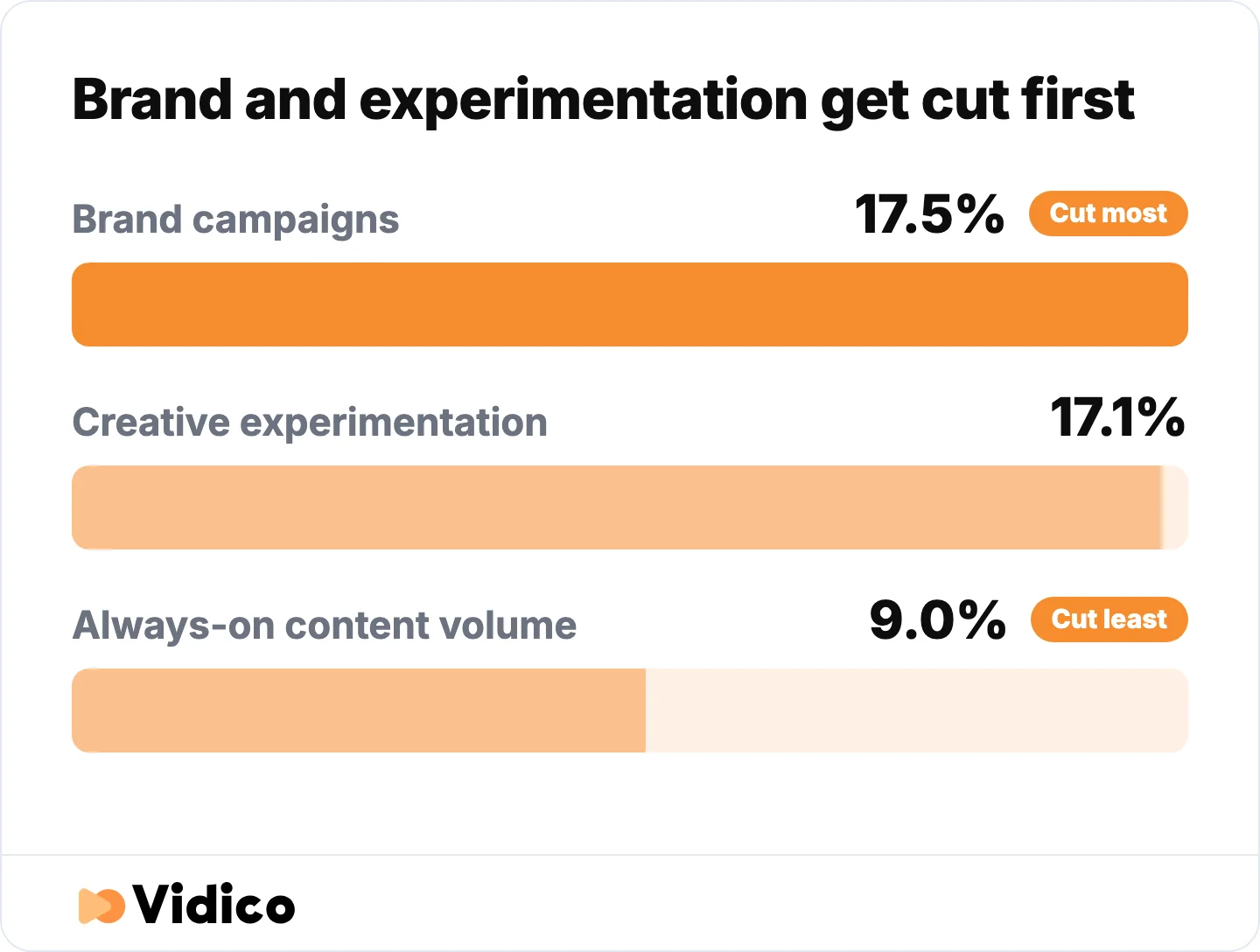
The two line items cut first are the two that compound. Source: Vidico’s 2026 State of Creative in Tech survey.
That order has a consequence worth naming. The two line items cut first are the two that compound: brand builds recognition over years, and experimentation is how a team learns what works. Protecting always-on volume while cutting both is a defensible short-term call that gets more expensive every quarter it continues.
Build the system before the budget cycle. Our Scaling B2B Creative Masterclass covers how SaaS teams structure creative production that survives a budget squeeze.
8. Trust and Security Become Marketing Assets
Security posture is now marketing material for SaaS companies, not a late-stage procurement document. SOC 2 status, data residency, privacy practices, and subprocessor transparency have moved onto pricing pages and into demand generation content because buyers screen on them before they take a call.
The buyer-side difficulty is real and documented. The Cloud Security Alliance’s annual SaaS security survey, fielded in January 2024, found 65% of organizations struggle with tracking and monitoring risks from third-party integrated apps and with rectifying SaaS misconfigurations. The same research found 70% of organizations have moderate to full visibility into their SaaS applications, which leaves a significant minority operating with limited visibility.
For a SaaS vendor, that difficulty is a marketing opening. Buyers are trying to assess risk with incomplete information. The vendor that publishes its security posture plainly, in language a non-security buyer can follow, removes friction that competitors leave in place.
Practical version: put the trust content where the evaluation happens. A trust center linked from the pricing page, plain-language answers to the questions that appear in security reviews, and current compliance status stated openly.
9. Ecosystem-Led Growth and Micro-Communities Replace Paid-Only GTM
Ecosystem-led growth (ELG) is a go-to-market model where partner networks, integrations, and co-marketing generate pipeline, rather than direct paid acquisition carrying it alone. It has moved from a side channel to a primary one.
Vidico’s 2026 State of Creative in Tech survey found partnerships are the top-cited growth channel for 2026, overtaking paid social for the first time. That is a genuine reordering of where B2B tech teams expect their growth to come from.
Investment intent from the partner side matches. Forrester’s research on partner ecosystems found 67% of surveyed organizations plan for their indirect revenue, meaning revenue transacted by partners, to grow above or significantly above the prior year.
Where ecosystem pipeline actually comes from:
- Technology integrations on major platforms, where a listing puts the product in front of an existing install base
- Agency and consultancy partnerships that carry implementation credibility into accounts
- Co-marketing programs that split audience and production cost
- Co-branded demand generation aimed at a shared ICP
Micro-communities run on the same trust mechanism at smaller scale. Niche user groups, private Slack and Discord channels, and industry forums now shape evaluation before a vendor site is ever visited. Credibility inside a tight industry community transfers faster than any ad can buy.
The reason both work is the same. A recommendation from a partner or a peer carries trust that paid placement cannot manufacture.
10. Retention and Expansion Become the Growth Engine
Net revenue retention, not new logo count, is what drives SaaS valuation in 2026. Churn has moved from a customer success metric to a company-level KPI, and marketing now owns part of it.
The acquisition math explains the shift. Harvard Business Review’s analysis, published in 2014, established the widely cited finding that acquiring a new customer costs five to 25 times more than retaining an existing one. That figure is over a decade old, and it still frames the decision.
Current benchmark data gives it a sharper edge. Benchmarkit’s research with Aleph, covering 342 B2B SaaS and AI-native companies on FY2025 actuals, found a blended CAC ratio of $1.30 of sales and marketing spend per $1 of new ARR, down 7% year over year. Acquisition efficiency improved.
Payback periods remain long. Aleph’s analysis of the same dataset puts the median B2B SaaS CAC payback at 16 months, with the top quartile recovering in six months or less and the bottom quartile taking 24 months or more. The 16-month median is an 11% improvement on the prior year’s 18 months.
Two corrections worth making to numbers that circulate widely. Sub-12-month payback is not the median, it is top-quartile performance. And the familiar 3:1 LTV:CAC target originated in David Skok’s SaaS Metrics work as a minimum viability floor, not a goal. Current benchmarks land above it, at 4.1x for horizontal SaaS and 5.6x for vertical SaaS.
What this means for marketing: onboarding content, product education, and in-app video are retention infrastructure, and they compete for budget on equal terms with acquisition campaigns. Teams above roughly $5M ARR that direct a meaningful share of marketing spend toward retention and expansion are protecting the metric that actually sets their valuation.
See the work. Browse our case studies for SaaS campaigns with the results attached.
How to Build a SaaS Marketing Strategy for 2026
These ten trends point at one shift. SaaS marketing is becoming an infrastructure problem rather than a spending problem. Here is the order we would work in:
- Audit your creative infrastructure first. Are you producing project by project, or do you have reusable templates? This decides the cost and speed of everything downstream.
- Structure content for citation, not just ranking. Self-contained passages, declarative sentences, real sources. Write for the answer, not the tenth blue link.
- Fix proof activation before making more proof. You almost certainly have customer results that are not packaged, findable, or placed where buyers decide.
- Publish less and make it original. One piece with data nobody else has beats five that restate the same industry commentary.
- Measure payback and net revenue retention. Traffic and MQL counts do not tell you whether the motion is working. CAC payback and NRR do.
If you’re mapping this out from scratch, our SaaS go-to-market strategy guide breaks down how to sequence creative against each GTM motion.
Frequently Asked Questions
What is the biggest SaaS marketing trend in 2026?
The shift from creative projects to creative systems. Teams with reusable template libraries go from concept to live in 1 to 3 days, against 4 to 14 days for teams producing project by project, according to Vidico’s 2026 State of Creative in Tech survey of 230+ B2B tech marketing leaders. That speed gap compounds across every campaign in a year.
Is SEO still relevant for SaaS companies in 2026?
Yes, but the outcome has changed. Pew Research Center found users click a traditional search result in 8% of visits when an AI summary appears, against 15% when it does not. Ranking still matters because AI systems draw citations from ranking pages. The goal is being cited inside the answer, not only listed beneath it.
How much should a SaaS company spend on marketing?
There is no single benchmark, and allocation shifts as you scale. What current data supports: 42.7% of B2B tech teams put 21% to 35% of total marketing budget into creative production, and the blended CAC ratio sits at $1.30 of sales and marketing spend per $1 of new ARR, per Benchmarkit’s research with Aleph covering 342 companies.
What is answer engine optimization for SaaS?
Answer engine optimization is structuring content so AI systems like ChatGPT, Perplexity, and Google’s AI Overviews cite it directly. In practice it means self-contained passages, declarative sentences, clean heading hierarchy, structured data, and primary source citations. Peer-reviewed research presented at KDD found generative engine optimization can lift visibility in generative responses by up to 40%.
Should SaaS companies prioritize acquisition or retention?
Retention, at most stages past early growth. Net revenue retention drives SaaS valuation more than new logo count, and median CAC payback sits at 16 months per Aleph’s analysis of 342 companies. Harvard Business Review’s 2014 analysis put the cost of acquiring a customer at five to 25 times the cost of retaining one.
How should SaaS teams use AI in marketing?
Mid-process, on work that already exists. The B2B tech marketing leaders in Vidico’s 2026 State of Creative in Tech survey rely on AI most for editing, repurposing, localization, and variation, while keeping the brief and the final output human. Final copy is the most protected output from AI in their workflows, and accuracy is their top risk concern. Only 29% have a formalized AI governance policy, which is the gap most teams should close first.
Is video still worth the investment for SaaS in 2026?
Yes, though budgets are flattening rather than growing automatically. HubSpot’s survey of 1,500+ marketers found the top three ROI-driving formats are all video. Wistia’s research found 40% of marketers expect to spend more on video this year while 46% are holding flat, so video now has to earn its share on measured performance.
Final Thoughts
The 2026 playbook is not about producing more. It is about building assets once and getting many uses out of each one. AI handles the middle of the workflow, video carries the proof, ecosystems carry distribution, and retention protects the number your valuation rests on.
If most of your budget still goes to net-new acquisition through paid channels, you are running a 2023 motion in a 2026 market. The data from 230+ B2B tech marketing leaders points one direction: efficiency through systems, distribution through trust, and growth through keeping the customers you have.
At Vidico, we produce B2B explainer videos and creative systems for SaaS and tech teams, including campaigns for Cascade, HoneyBook, and Square. The teams that pull ahead this year will not chase all ten trends. They will pick two, build the system that supports them, and let it compound.
Want to map yours? Book a strategy session and we will walk through where a creative system would take pressure off your 2026 plan.
Sources
- SaaS Capital: AI Adoption Among Private SaaS Companies
- Metricool: LinkedIn Study
- Pew Research Center: Google Users and AI Summaries
- GEO: Generative Engine Optimization
- HubSpot: State of Marketing
- Content Marketing Institute: B2B Content Marketing Benchmarks
- Wistia: State of Video Report
- Cloud Security Alliance: Annual SaaS Security Survey Report
- Forrester: The State of Partner Ecosystems
- Harvard Business Review: The Value of Keeping the Right Customers
- Benchmarkit: SaaS and AI-Native Performance Metrics
- Aleph: CAC Payback Period in SaaS